Metrics Ventures Market Observation: Chaotic Consolidation Continues

marsbitPublicado em 2025-12-28Última atualização em 2025-12-28

Resumo

Metrics Ventures Market Observation: Continued Chaotic Consolidation As 2025 concludes, the crypto market has experienced a cold year, with crypto assets ranking at the bottom in USD-denominated annual returns, largely due to a Q4 downturn. The past month's market activity has been stagnant, characterized by a lack of vitality, shrinking volumes on both CEXs and the NYSE, and converging volatility. This period of narrow-range trading is nearing its end, with sudden "flash crashes" expected to be a recurring theme, making it a challenging environment for high-frequency traders. The report suggests this is a time for rest and systematic reflection rather than active trading. The recent market spotlight has shifted to precious metals, notably silver, rather than crypto. Silver futures volume on the Shanghai exchange alone has exceeded RMB 75 trillion monthly, with COMEX option open interest multiples of actual inventory, reminiscent of the 2020-2021 crypto frenzy. In contrast, Bitcoin's performance remains weak. The relative strength of gold versus Bitcoin has broken out of its long-term downward trend since the 2020 easing cycle, highlighting a significant capital rotation into metals. Despite the gloom, positive signals include MSTR maintaining its Nasdaq-100 index status, clearer guidance from the Fed Chair, and potential risks in the AI bubble that could benefit crypto in 2026. The current market is viewed as a continuation of the consolidation that began in late 2024, wi...

Author: Metrics Ventures

Metrics Ventures December Market Observation Guide

1/ As 2025 is almost settled, first and foremost, we wish all MVC friends a happy holidays! Looking back, 2025 has been a cold year for crypto investments, with crypto assets ranking at the bottom in terms of annual returns in the dollar market, which is mainly due to the Q4 collapse. At the year's end, we hope everyone can take advantage of the dull market to rest more and recharge for the coming year.

2/ The market over the past month actually hasn't been particularly noteworthy for analysis. The market is in a lifeless, chaotic state, with trading volumes continuously shrinking on both CEXs and the NYSE, volatility sharply converging, and the exchange of chips within the current narrow range approaching its end. What makes high-frequency traders even more uncomfortable is that this contraction shows no sign of a near-term turning point. So-called "painting the door" and "flash crashes" are expected to be the main themes in the near future. This period might be more suitable for resting and organizing thoughts, engaging in more systematic thinking about the market.

Overview and Commentary on Overall Market Conditions and Trends

Compared to the crypto market, the recent protagonist in the capital markets has been precious metals. The Q4行情 (market trend/action) anticipated within the circle did happen, but it was usurped by silver—the monthly trading volume of silver on the Shanghai Silver Exchange alone has now exceeded 7,500 billion RMB, and the open interest in options on COMEX is several times the actual market inventory. This frenzy is reminiscent of the crypto market in 2020-2021, and in contrast, Bitcoin's lethargic state is lamentable. Specifically, since October, the relative price strength of gold versus Bitcoin has also broken through the long-term downward trend channel since the 2020 easing, making this high-level capital rotation even more直观 (intuitive/visually clear).

Chart: Gold to Bitcoin Price Exchange Rate Pair
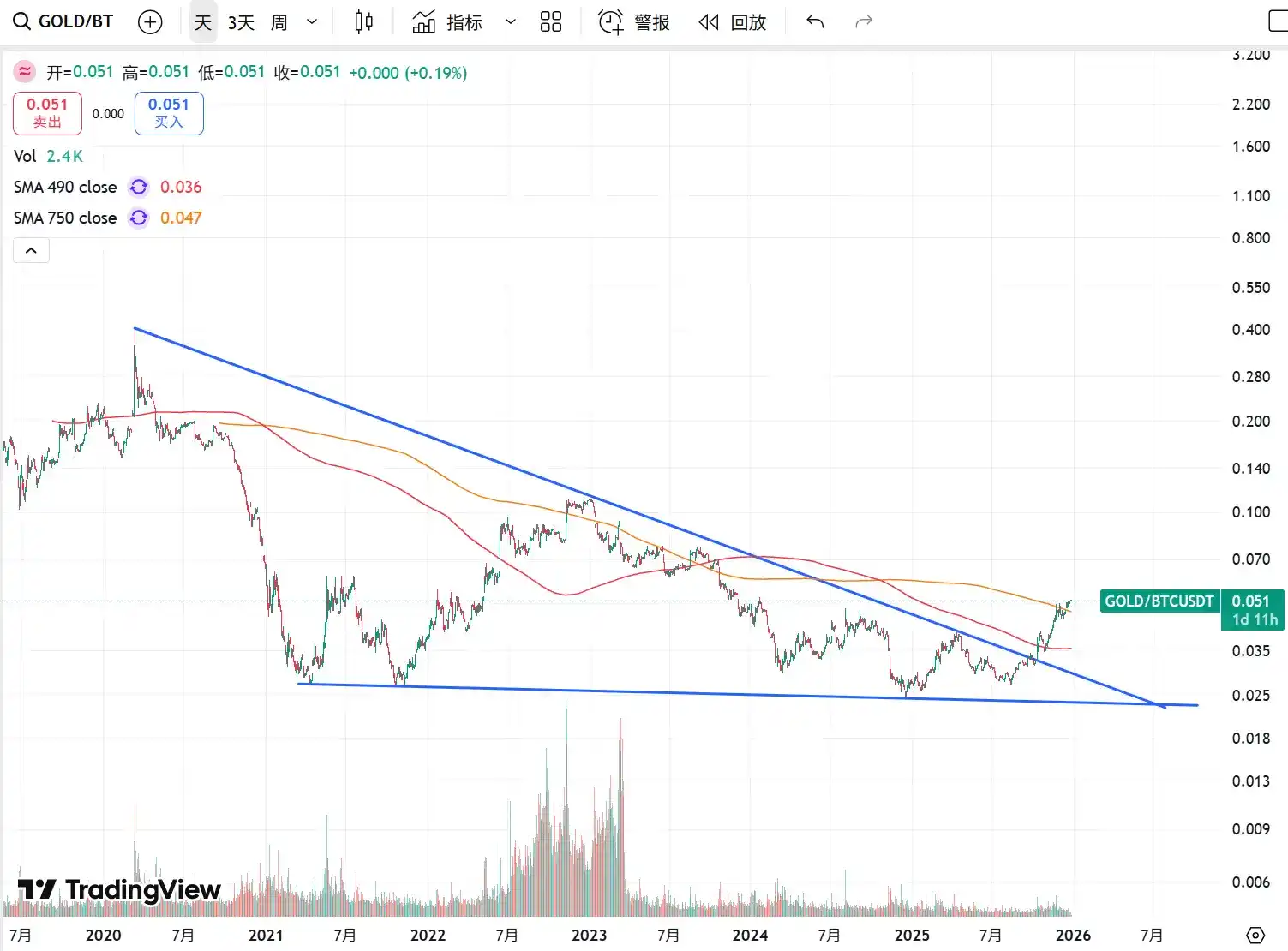
Of course, there are still some positive signals in the market. MSTR retaining its NASDAQ100 index status, the clearer direction indicated by the Fed Chair, and the potential crisis of the AI bubble all provide support for the 2026 market outlook. Standing at the end of 2025, we still believe this is a continuation of the year-long consolidation that began at the end of 2024. In the midst of price fluctuations with wide ranges, there will always be times of ebb and flow. Now is the time to conserve energy and build up strength.

This month's report is relatively brief, which also aligns more with our theme that it's a suitable time for rest. Once again, we wish everyone a happy holidays! See you in 2026!


Perguntas relacionadas

QWhat is the overall sentiment of Metrics Ventures towards the cryptocurrency market at the end of 2025?

AThe overall sentiment is negative and cautious, describing the market as 'cold,' 'lifeless,' and in a state of 'chaotic consolidation' with low volumes and high volatility compression. They advise investors to rest and prepare for the next year.

QAccording to the report, which asset class was the main performer in the capital markets over the past month, contrasting with crypto's performance?

APrecious metals, specifically silver, were the main performers. The report highlights that monthly trading volume for silver on the Shanghai Silver Exchange alone exceeded 7.5 trillion RMB, drawing a comparison to the frenzy of the 2020-2021 crypto market.

QWhat positive signals for the 2026 crypto market does Metrics Ventures mention?

AThe positive signals mentioned are: MSTR retaining its NASDAQ100 index status, greater clarity on the direction of the Federal Reserve Chair, and the potential crisis in the AI bubble, which could provide support for the market in 2026.

QHow does the report characterize the current trading activity and volatility in both crypto and traditional exchanges?

AThe report characterizes trading activity as萎缩 (shrinking) on both CEXs and the NYSE, with volatility加剧收敛 (intensifying compression). It states the market is in a narrow range and that sudden 'flash crashes' or 'painting the door' movements are expected to be the main theme.

QWhat does the chart labeled '黄金与比特币价格汇率对' (Gold-to-Bitcoin Price Exchange Rate Pair) illustrate according to the text?

AThe chart illustrates that the relative price strength of gold versus Bitcoin has broken through its long-term downward trend that began with the 2020 easing policies, making the rotation of capital into higher-priced assets more直观 (intuitive or visually clear).

Leituras Relacionadas

OpenAI Goes Left, DeepSeek Goes Right

On April 24, 2026, DeepSeek released V4, a Chinese large language model offering a free "million-token context window," enabling it to process vast amounts of data like entire books or years of corporate documents in one go. In contrast, OpenAI’s GPT-5.5, released around the same time, is more powerful but significantly more expensive, charging up to $180 per million output tokens. DeepSeek’s strategy represents a shift from a pure AI research firm to a heavy-infrastructure player, building data centers in Inner Mongolia’s Ulanqab to bypass U.S. chip export restrictions. This move, supported by Huawei’s Ascend chips and China’s cheap green electricity, highlights a fundamental divergence in AI development models: U.S. firms focus on high-cost, high-margin services, while Chinese players like DeepSeek prioritize accessibility and affordability. Facing intense talent poaching from tech giants, DeepSeek is seeking a $44 billion valuation funding round to retain researchers and scale infrastructure. Meanwhile, Chinese manufacturers are compressing AI models to run on smartphones, making AI accessible offline and across the Global South. Through open-source models and localized solutions, Chinese AI is empowering non-English speakers and low-income users, driving a form of "digital equality." While Silicon Valley builds walled gardens, DeepSeek and others are turning AI into a public utility—like tap water—flowing freely to those previously left behind.

marsbitHá 13m

OpenAI Goes Left, DeepSeek Goes Right

marsbitHá 13m

$292 Million KelpDAO Cross-Chain Bridge Hack: Who Should Foot the Bill?

On April 18, 2026, an attacker stole 116,500 rsETH (worth ~$292M) from KelpDAO’s cross-chain bridge in 46 minutes—the largest DeFi exploit of 2026. The stolen assets were deposited into Aave V3 as collateral, causing $177–200M in bad debt and triggering a cascade of losses across nine DeFi protocols. Aave’s TVL dropped by ~$6B overnight. This legal analysis argues that KelpDAO and LayerZero Labs share concurrent liability, with fault apportioned 60%/40%. KelpDAO negligently configured its bridge with a 1-of-1 decentralized verifier network (DVN)—a single point of failure—despite LayerZero’s explicit recommendation of a 2-of-3 setup. LayerZero, which operated the compromised DVN, failed to secure its RPC infrastructure against a known poisoning attack vector. Both protocols’ terms of service cap liability at $200 (KelpDAO) or $50 (LayerZero), but these limits are likely unenforceable due to unconscionability, gross negligence exceptions, and potential securities law invalidation (if rsETH is deemed a security under the Howey test). Aave’s governance also faces fiduciary duty claims for raising rsETH’s loan-to-value ratio to 93%—far above competitors’ 72–75%—without adequately assessing bridge risks, amplifying the systemic fallout. Practical recovery targets include LayerZero Labs (a registered Canadian entity), KelpDAO’s founders, auditors, and identifiable Aave governance delegates. The incident underscores escalating legal risks for DeFi protocols, infrastructure providers, and governance participants.

marsbitHá 1h

$292 Million KelpDAO Cross-Chain Bridge Hack: Who Should Foot the Bill?

marsbitHá 1h

Insider Trading in War: 5 People Involved, the Highest Earner Was Arrested

On April 24, the U.S. Department of Justice arrested U.S. Army Special Forces Staff Sergeant Gannon Ken Van Dyke for insider trading related to the capture of Venezuelan President Nicolás Maduro on January 3. Van Dyke allegedly profited over $400,000 by placing bets on a prediction market, Polymarket, using insider knowledge of the covert operation. According to the indictment, Van Dyke registered an account (0x31a5) on December 26 and made a series of bets predicting Maduro’s capture and U.S. military involvement in Venezuela. He withdrew most of his funds on the day of the operation and attempted to obscure his tracks by transferring assets through crypto and brokerage accounts. This case marks the first time the DOJ has prosecuted insider trading on Polymarket. PolyBeats had previously identified five suspicious accounts, including Van Dyke’s—the highest earner—in January. The other accounts, with profits ranging from $34,000 to $145,000, remain under unofficial scrutiny but have not been charged. Their lower profits, indirect access to information, and unclear legal boundaries may complicate prosecution. Polymarket has since strengthened its market integrity rules, explicitly prohibiting trading based on confidential or insider information. Van Dyke’s arrest, nearly four months after his trades, signals increased regulatory attention and the persistent traceability of blockchain-based transactions.

marsbitHá 1h

Insider Trading in War: 5 People Involved, the Highest Earner Was Arrested

marsbitHá 1h

Trading

Spot
Futuros
活动图片




