Mastercard and Ripple Complete Historic Transaction, New Use Case for XRP?

bitcoinistPublicado em 2026-05-08Última atualização em 2026-05-08

Resumo

Mastercard, Ripple, Ondo Finance, and J.P. Morgan's Kinexys have successfully completed the first near real-time, cross-border, cross-bank redemption of tokenized US Treasuries. The pilot transaction, executed in under five seconds, used the XRP Ledger as the settlement blockchain to connect public blockchain infrastructure directly to traditional global banking rails for the first time. Ripple redeemed a tokenized treasury fund (OUSG) on the XRPL, triggering a fiat payout via Mastercard's Multi-Token Network. J.P. Morgan's Kinexys then processed the payment to Ripple's bank account in Singapore. This integration demonstrates a single, uninterrupted flow between on-chain and off-chain systems, addressing a key gap in the rapidly growing tokenized real-world assets (RWA) market. The development highlights a significant step towards a 24/7 financial system and positions the XRP Ledger as a potential settlement infrastructure for institutional cross-border transactions.

Ondo Finance, Kinexys by J.P. Morgan, Mastercard, and Ripple have jointly completed the first near real-time cross-border, cross-bank redemption of tokenized US Treasuries — with the XRP Ledger serving as the settlement blockchain at the center of a transaction that connected public blockchain infrastructure directly to global banking rails for the first time.

The pilot, announced on May 6, executed in under five seconds — a stark contrast to the one-to-three business day timeframe that cross-border correspondent banking typically requires. It also occurred outside traditional banking hours, underscoring what the participating firms described as a step toward a financial system capable of operating 24 hours a day, seven days a week.
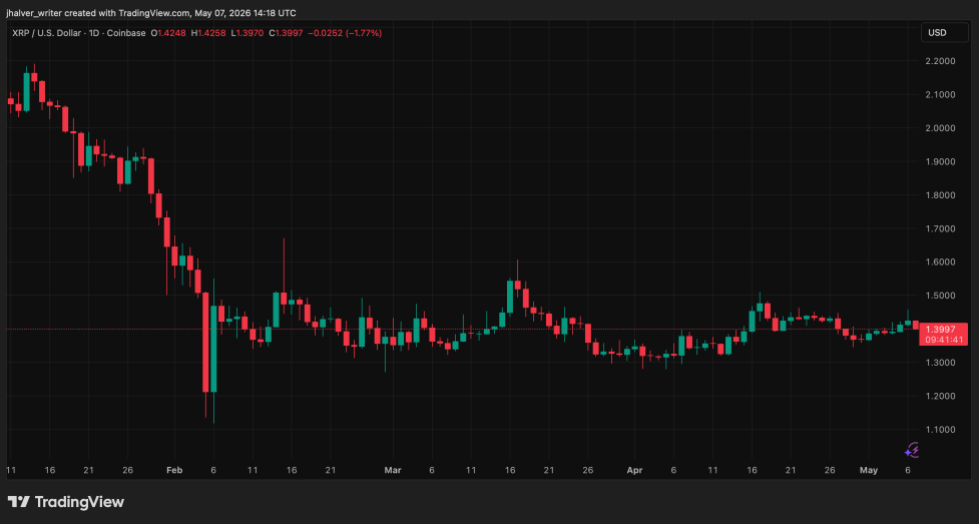
XRP's price trends sideways on the daily chart. Source: XRPUSD on Tradingview

Ripple Gains Relevance with Mastercard Partnership

The mechanics of the pilot reveal how each institution contributed a distinct piece of the settlement architecture. Ripple redeemed a portion of its holdings in OUSG — Ondo Finance’s Short-Term US Government Treasuries fund, a tokenized product available to accredited investors and qualified purchasers — directly on the XRP Ledger. Ondo processed the redemption and triggered a fiat payout instruction through Mastercard’s Multi-Token Network (MTN), a platform designed to enable interoperability between on-chain assets and traditional money movement systems.

From there, Mastercard’s MTN routed the instruction to Kinexys by J.P. Morgan — JPMorgan’s blockchain infrastructure platform, which has now processed more than $3 trillion in cumulative transactions, per figures cited in the announcement.

Kinexys debited Ondo’s Blockchain Deposit Account and delivered US dollar proceeds to Ripple’s bank account in Singapore through its correspondent banking network. One leg of the transaction settled on a public blockchain. The other settled on institutional banking rails. Both happened within the same uninterrupted flow.

What It Signals For The Broader Market

The transaction arrives against a backdrop of rapid growth in tokenized real-world assets. Tokenized US Treasuries crossed the $10 billion mark for the first time on February 11, 2026, according to TheStreet Crypto, and stood at approximately $12.88 billion by early April — a 225% increase over 15 months. The broader tokenized RWA market surged 256.7% from $5.42 billion at the start of 2025 to $19.3 billion by the end of Q1 2026. Despite that growth, redemption infrastructure has lagged, still dependent on wire transfers, manual processes, and fixed banking windows. This pilot addresses that gap directly.

Markus Infanger, SVP of RippleX, noted in the official release that the XRP Ledger enables real-time asset movement and that, when paired with global banking infrastructure, the pilot demonstrates how institutions can execute cross-border transactions as a single integrated flow — rather than a sequence of siloed instructions across separate systems.

The DTCC separately announced earlier this week that it plans to launch its own tokenization service later in 2026 — a signal that the institutional race to build out this infrastructure is accelerating across the industry simultaneously.

This development marks a pivotal moment for the nascent sector and, specifically, for the XRP Ledger’s positioning within institutional finance. Whether the XRPL’s role as settlement infrastructure in this pilot translates into a sustained and expanded use case will depend on how many further cross-border tokenized asset transactions adopt the same architecture — and how quickly the broader regulatory and banking framework catches up to what the technology can already do.

Cover image from Grok, XRPUSD chart on Tradingview

Perguntas relacionadas

QWhat was the significance of the pilot transaction involving Mastercard and Ripple announced on May 6?

AIt was the first near real-time cross-border, cross-bank redemption of tokenized US Treasuries. The transaction connected public blockchain infrastructure (the XRP Ledger) directly to global banking rails for the first time, settling in under five seconds and outside traditional banking hours.

QWhich institutions were involved in the pilot, and what was the specific role of the XRP Ledger?

AOndo Finance, Kinexys by J.P. Morgan, Mastercard, and Ripple were involved. The XRP Ledger served as the settlement blockchain where Ripple redeemed its tokenized US Treasury holdings (OUSG), enabling the on-chain leg of the integrated transaction.

QWhat problem does this pilot transaction aim to address in the tokenized real-world asset (RWA) market?

AIt addresses the gap in redemption infrastructure, which has lagged behind market growth. Traditional redemptions rely on slow wire transfers, manual processes, and fixed banking windows. This pilot demonstrates a near-instant, 24/7 integrated flow for cross-border redemptions.

QAccording to the article, what key statistic highlights the growth of the tokenized RWA market?

AThe broader tokenized RWA market surged 256.7% from $5.42 billion at the start of 2025 to $19.3 billion by the end of Q1 2026. Specifically, tokenized US Treasuries grew to approximately $12.88 billion by early April 2026, a 225% increase over 15 months.

QWhat broader industry trend does the DTCC's separate announcement about launching a tokenization service signal?

AIt signals that the institutional race to build out tokenization and related settlement infrastructure is accelerating across the financial industry simultaneously, highlighting the growing importance and adoption of this technology.

Leituras Relacionadas

Apple Also Has to Pay Rent Now

Apple Pays Rent Too: The Two-Way Flow of "Traffic Tax" and "AI Capability Rent" Between Tech Giants For over two decades, Google has paid Apple an estimated $20 billion annually to remain the default search engine on Safari, a "traffic tax" for a critical user entry point. However, in 2026, the direction of this cash flow partially reversed. Apple agreed to pay Google roughly $1 billion per year to license its Gemini AI models, as Apple's own models reportedly struggled with complex tasks. This creates a unique dynamic: Apple acts as the "landlord" in the established search ecosystem, collecting rent from Google for access. Simultaneously, in the emerging AI arena, Apple becomes the "tenant," paying Google for access to cutting-edge AI capabilities it cannot currently match internally. While Apple claims its new models are "distilled" from Gemini outputs and contain "not a drop" of Google's original code, core dependencies remain. Its knowledge base is refined using Gemini's outputs, and its most powerful cloud model runs on Google's infrastructure. Apple has structured the deal as non-exclusive, allowing it to theoretically switch AI suppliers—a hedge against over-reliance. The future hinges on whether advanced AI models become a commodity (cheap and abundant) or remain a concentrated, scarce resource (expensive and controlled by few). Apple is betting on the former, leveraging its massive device ecosystem to be a powerful, choosy customer. If the latter proves true, its bargaining power could erode. This power dynamic is extending to developers. Apple, Google, and WeChat are all pushing for apps to expose their core functions as standardized "actions" or "intents" that their respective AI assistants (Siri, Gemini, WeChat AI) can directly call. The new scarce resource is no longer just app store visibility, but "being selected by the AI." The currency of "rent" has changed from a 30% revenue share to ceding control over how users interact with an app's functions.

marsbitHá 43m

Apple Also Has to Pay Rent Now

marsbitHá 43m

Missed the SpaceX IPO? WEEX's "First Trade Protection" Lets You Experience US Stock Trading Risk-Free.

With the excitement around SpaceX's recent public listing reigniting interest in the US stock market, Chinese investors face significant challenges accessing compliant and convenient trading channels following regulatory actions against major online brokers. This article explores the available options, highlighting their risks and limitations. Traditional paths for US stock investments remain problematic. Qualified Domestic Institutional Investor (QDII) and Listed Open-Ended Fund (LOF) products, while compliant, suffer from high fees, significant purchase premiums, and a very limited selection of assets. Small, unregulated offshore brokers pose substantial risks, including potential insolvency. While secure, VIP accounts at banks in Hong Kong or Singapore require high minimum deposits (often 1-2 million RMB) and in-person visits, placing them out of reach for most retail investors. The article positions cryptocurrency exchanges, specifically their TradFi (traditional finance on-chain) offerings, as a compelling alternative. Platforms like WEEX are noted for providing access to a wide range of US stocks and ETFs, including SpaceX (SPCXON), through tokenized assets. This method offers advantages such as a single account for both crypto and traditional assets, USDT-based settlement avoiding fiat complexities, flexible leverage, and robust risk management. To attract users, WEEX is promoting a "First Trade Guarantee" campaign. Running from June 15 to July 8 (UTC+8), it features a $30,000 prize pool. Users who trade $500 worth of US stock contracts can qualify for a guarantee on their first eligible trade: 100% loss coverage up to $30 or a 20% bonus on profits up to $30. The campaign is presented as a low-risk opportunity for both crypto natives and traditional investors to experience US stock trading.

marsbitHá 44m

Missed the SpaceX IPO? WEEX's "First Trade Protection" Lets You Experience US Stock Trading Risk-Free.

marsbitHá 44m

How Difficult is Chip Making? A Division Error Costs 475 Million Dollars

How Hard Is It to Make a Chip? A Division Error Cost $475 Million Chip expert Shi Kan, a researcher at the Chinese Academy of Sciences and a popular tech creator, explains the immense challenges of chip development. Chips are foundational to modern technology, but their creation is extraordinarily difficult. The journey from sand to a functional chip involves complex design and manufacturing, but a critical bottleneck is verification—ensuring the design works flawlessly before costly production. A single, undetected bug can have catastrophic consequences, as illustrated by the infamous 1994 Intel Pentium FDIV bug. A flaw in the floating-point division unit forced a recall costing $475 million. Unlike software, chips cannot be easily patched after manufacture, making "first-time success" paramount. However, industry surveys show only 24% of chip projects achieve this; over three-quarters require at least one costly re-spin due to design flaws. Verification has thus become the dominant phase, consuming up to 70% of the design cycle. The core challenge is a "verification impossible triangle" between high performance, good debuggability, and low cost. Exhaustively verifying a modern CPU core could take 15,000 years with software simulation, or 30 years with advanced hardware emulation—timeframes utterly impractical for development. Despite being essential, verification is often seen as unglamorous "dirty work," receiving less academic attention than fields like AI. Shi and his team are tackling this by developing an agile verification research framework called ENCORE, based on FPGA technology, to improve verification efficiency and debug capability. Beyond research, Shi engages in public science communication through long-form video content, aiming to demystify chip technology, AI, and computer science. He argues for the value of pursuing "hard and long-term" endeavors, whether in the meticulous world of chip verification or in creating substantive educational content, believing such sustained effort is likely the right path forward.

marsbitHá 54m

How Difficult is Chip Making? A Division Error Costs 475 Million Dollars

marsbitHá 54m

Trading

Spot
Futuros

Artigos em Destaque

O que é XRP 2.0

XRP 2.0: Uma Nova Fronteira no Landscape das Criptomoedas Introdução ao XRP 2.0 No reino em constante evolução das criptomoedas, novos projetos surgem continuamente, lutando por atenção e adoção. Uma dessas iniciativas promissoras é o XRP 2.0, um novo projeto de criptomoeda concebido para aproveitar a tecnologia de blockchain avançada e as metodologias de criptografia robustas. Embora o nome tenha paralelos com o XRP da Ripple, é crucial notar que o XRP 2.0 opera de forma independente, focando em melhorar a segurança das transações, a privacidade e a escalabilidade. À medida que o panorama financeiro digital abraça cada vez mais soluções descentralizadas, o XRP 2.0 visa contribuir de forma significativa para a web3 e a expansão global dos projetos de criptomoedas. O que é o XRP 2.0? No seu núcleo, o XRP 2.0 é um projeto de criptomoeda que visa criar um ecossistema de moeda digital seguro e descentralizado. Sua tecnologia fundamental integra princípios de blockchain sofisticados com técnicas de criptografia de ponta. O objetivo abrangente do XRP 2.0 é estabelecer-se como uma plataforma confiável e eficiente que possibilita a execução rápida de transações, priorizando a proteção de privacidade aprimorada para os seus usuários. O projeto é promovido como uma solução para muitas limitações enfrentadas pelas criptomoedas existentes, propondo um sistema que pode lidar com um volume maior de transações com velocidade e privacidade melhoradas. Esta versatilidade posiciona o XRP 2.0 como um concorrente significativo em um mercado repleto de várias moedas digitais. Quem é o Criador do XRP 2.0? A identidade do criador por trás do XRP 2.0 foi identificada como 'Wilbur.' No entanto, detalhes abrangentes sobre Wilbur ou a sua entidade associada permanecem elusivos. O anonimato de muitos criadores de criptomoedas não é um fenômeno incomum na indústria, muitas vezes concebido para manter um grau de privacidade e segurança. Quem são os Investidores do XRP 2.0? Até agora, informações específicas relacionadas às fundações ou organizações de investimento que apoiam o XRP 2.0 não estão disponíveis publicamente. No setor das criptomoedas, o apoio de investidores reputados pode influenciar significativamente a credibilidade e o sucesso de um projeto, no entanto, a transparência em relação aos apoiantes financeiros do XRP 2.0 não foi estabelecida. Como Funciona o XRP 2.0? O XRP 2.0 destaca-se por empregar uma combinação de tecnologia blockchain e algoritmos de criptografia avançados que asseguram transações seguras e descentralizadas. Sua estrutura inovadora inclui características únicas projetadas para fomentar o envolvimento dos usuários e ampliar as funcionalidades além das transações convencionais de criptomoedas. Entre essas características, o XRP 2.0 incorpora capacidades potenciadas por IA, como funcionalidades de texto-para-imagem e texto-para-fala. Estas adições são projetadas para melhorar a experiência interativa dos usuários, promovendo uma maior aplicabilidade em vários setores. Ao unir avanços tecnológicos com um design centrado no utilizador, o XRP 2.0 pretende captar a atenção de uma diversa gama de indivíduos e empresas que procuram integrar soluções de criptomoedas em suas estruturas operacionais. Cronologia do XRP 2.0 Compreender o XRP 2.0 requer examinar os marcos que definiram sua jornada até agora: 23 de Julho de 2023: O XRP 2.0 é apresentado como um novo projeto de criptomoeda, visando revolucionar as capacidades de transação seguras e descentralizadas no domínio do blockchain. 8 de Setembro de 2023: O lançamento de outro projeto, XRP20, ocorre, marcando o surgimento de um token ERC-20 na blockchain Ethereum que permanece não relacionado ao XRP 2.0. 13 de Novembro de 2023: O XRP Ledger passa por uma atualização significativa com o lançamento da versão 2.0.0 do software do servidor rippled. É importante notar que este desenvolvimento está desconectado do projeto de criptomoeda XRP 2.0. Pontos-chave sobre o XRP 2.0 Para destilar a essência do XRP 2.0, vários fatores críticos emergem: Características Únicas: A inclusão de características como texto-para-imagem e texto-para-fala potenciadas por IA diversifica ainda mais as aplicações potenciais do XRP 2.0. Tecnologia Blockchain: A estrutura utiliza mecanismos de blockchain avançados e protocolos de criptografia, assegurando um ambiente seguro e descentralizado para transações. Escalabilidade e Privacidade: O XRP 2.0 prioriza proteção de privacidade aprimorada nos processos de transação e a escalabilidade necessária para acomodar uma base de utilizadores crescente. Sem Afiliação com a Ripple: Importante, apesar do seu nome, o XRP 2.0 não tem qualquer lealdade ou colaboração com o XRP da Ripple, distinguindo sua estrutura operacional e objetivos dentro do ecossistema das criptomoedas. Conclusão O XRP 2.0 representa uma empreitada ambiciosa no domínio das criptomoedas, visando oferecer uma combinação de segurança, privacidade e eficiência em transações digitais. Ao integrar tecnologias sofisticadas e características amigáveis ao utilizador, o projeto propõe-se a ampliar os horizontes do que as criptomoedas podem alcançar na economia digital atual. Embora o anonimato do seu criador e a falta de investidores divulgados possam levantar questões para alguns, o foco do XRP 2.0 em funcionalidades avançadas e descentralização aumenta seu apelo num mercado de criptomoedas cada vez mais congestionado. À medida que o panorama das criptomoedas continua a evoluir, o XRP 2.0 pode ainda emergir como um jogador crucial na expansão de soluções de blockchain seguras e escaláveis.

99 Visualizações TotaisPublicado em {updateTime}Atualizado em 2024.12.03

O que é XRP 2.0

Como comprar XRP

Bem-vindo à HTX.com!Tornámos a compra de XRP (XRP) simples e conveniente.Segue o nosso guia passo a passo para iniciar a tua jornada no mundo das criptos.Passo 1: cria a tua conta HTXUtiliza o teu e-mail ou número de telefone para te inscreveres numa conta gratuita na HTX.Desfruta de um processo de inscrição sem complicações e desbloqueia todas as funcionalidades.Obter a minha contaPasso 2: vai para Comprar Cripto e escolhe o teu método de pagamentoCartão de crédito/débito: usa o teu visa ou mastercard para comprar XRP (XRP) instantaneamente.Saldo: usa os fundos da tua conta HTX para transacionar sem problemas.Terceiros: adicionamos métodos de pagamento populares, como Google Pay e Apple Pay, para aumentar a conveniência.P2P: transaciona diretamente com outros utilizadores na HTX.Mercado de balcão (OTC): oferecemos serviços personalizados e taxas de câmbio competitivas para os traders.Passo 3: armazena teu XRP (XRP)Depois de comprar o teu XRP (XRP), armazena-o na tua conta HTX.Alternativamente, podes enviá-lo para outro lugar através de transferência blockchain ou usá-lo para transacionar outras criptomoedas.Passo 4: transaciona XRP (XRP)Transaciona facilmente XRP (XRP) no mercado à vista da HTX.Acede simplesmente à tua conta, seleciona o teu par de trading, executa as tuas transações e monitoriza em tempo real.Oferecemos uma experiência de fácil utilização tanto para principiantes como para traders experientes.

1.7k Visualizações TotaisPublicado em {updateTime}Atualizado em 2026.06.02

Como comprar XRP

Discussões

Bem-vindo à Comunidade HTX. Aqui, pode manter-se informado sobre os mais recentes desenvolvimentos da plataforma e obter acesso a análises profissionais de mercado. As opiniões dos utilizadores sobre o preço de XRP (XRP) são apresentadas abaixo.

活动图片