Manufacturing's Share Drops Below 25%: Is Hangzhou Unconcerned?

marsbitPublicado em 2026-08-19Última atualização em 2026-08-19

Resumo

Hangzhou is entering a critical phase of industrial restructuring. While its manufacturing-to-GDP ratio has fallen below 25%, the city is not alarmed. Instead, it is strategically navigating a dual focus: advancing advanced manufacturing and expanding its service sector, particularly producer services. Recently, the city celebrated the IPO of a humanoid robotics company, seen as a milestone in moving beyond its e-commerce era. Simultaneously, it set an ambitious target for its service sector: to exceed 2 trillion yuan in value by 2030, with producer services making up over 60%. Data shows a clear trend: the service sector's share of GDP has risen to 75.3%, while manufacturing's share has declined to around 20.1%. This shift revives the debate on whether a strong service sector weakens a city's manufacturing "foundation." Hangzhou's approach challenges the notion of a fixed manufacturing "red line" near 25%. The city argues that the quality and integration of industries matter more than simple ratios. Its strategy is "using software to drive hardware," leveraging its core strengths in digital economy and producer services—like R&D, software, and supply chain management—to empower and add value to manufacturing. This is embodied by its emerging "AI era" companies, whose innovation in Hangzhou feeds into national industrial chains. The city believes that for a hub like Hangzhou, the key is not merely boosting visible manufacturing output, but strengthening the "invisible" co...

Hangzhou is entering a critical period of a new round of industrial adjustment.

On August 19, Unitree Robotics will list on the SSE Sci-Tech Innovation Board, becoming the "first humanoid robot stock" on the A-share market. The first of the "Six Little Dragons" to achieve an IPO is considered another milestone for Hangzhou in moving beyond the "e-commerce era."

Just a few days earlier, Hangzhou further deepened its commitment to its "traditional strength" in the services sector—setting a clear goal at a high-profile city-wide services industry conference: by 2030, the added value of the services industry will exceed 2 trillion yuan, with producer services accounting for over 60%.

On one side is manufacturing, on the other is services, bringing to light the long-discussed issue of Hangzhou's perceived "imbalance" in manufacturing.

In recent years, Hangzhou has continuously ramped up its emphasis on manufacturing, proposing to "rebuild a Hangzhou industry." However, from the data, the proportion of added value from large-scale industries in Hangzhou has been declining, accounting for only 20.1% of GDP last year.

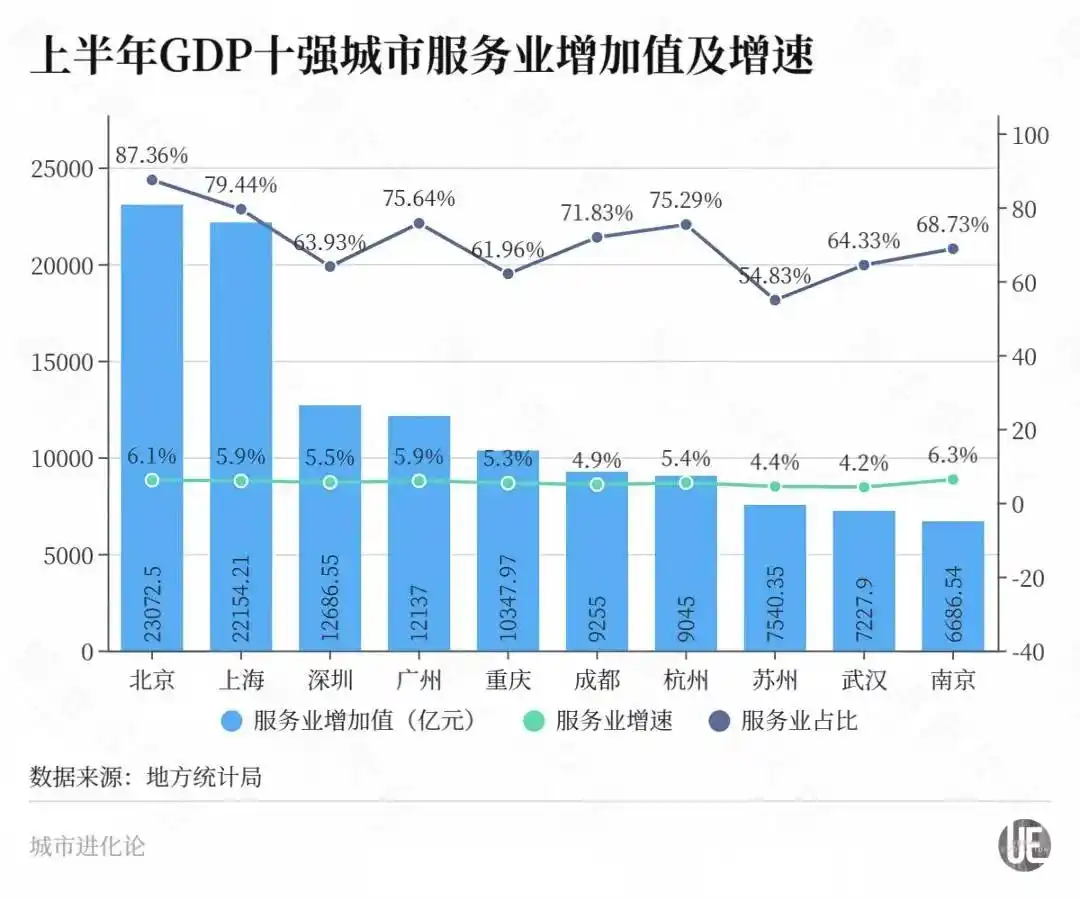
The other side of the coin is the continuous growth of the services sector. In the first half of this year, the added value of Hangzhou's services industry reached 904.5 billion yuan, a year-on-year increase of 5.4%, the highest growth rate in two years; the services sector's share of GDP exceeded 75% for the first time, reaching 75.3%, second only to Beijing, Shanghai, and Guangzhou.

This "rise and fall" has brought an old question back to the surface: as the services sector climbs higher, will the "foundation" of manufacturing become thinner? Under the requirement to maintain a reasonable proportion of manufacturing, what kind of reference can Hangzhou provide for cities hoping to bet on the next "little dragon"?

"25%"

25% was once considered a "red line" for the proportion of manufacturing in a city's economy.

The most representative example is Shanghai, which, in the "Shanghai Three-Year Action Plan for Promoting High-Quality Development of the Manufacturing Industry (2023-2025)" issued in 2023, explicitly drew a red line: by 2025, the proportion of industrial added value in Shanghai's regional GDP should reach over 25%. This was also the first time in seven years that Shanghai re-emphasized this goal.

Authoritative validation comes from a report by a World Bank research team: for megacities like Shanghai, the proportion of manufacturing should be between 25% and 30%. Consistent with this, many cities have also drawn their own "red lines." For example, Shenzhen, a major industrial city, although its manufacturing share is still significantly above 30%, still proactively set a red line for the city, mandating that the proportion of industrial land should not be less than 30%.

Although Hangzhou did not explicitly state such a red line at the time, under the national overall requirement to keep manufacturing's share "basically stable," Hangzhou also made similar arrangements in its 14th Five-Year Plan outline, proposing to deeply implement the "New Manufacturing Plan" and advance the "New Factory Plan."

However, this did not prevent the continuous rise in the services sector share in many cities. Several years later today, the manufacturing "red lines" in more and more cities are showing signs of loosening.

Looking at data from the first half of this year, as most cities have not released specific manufacturing data, if we only refer to the proportion of services sector added value in GDP, among the trillion-yuan GDP cities, there are four where this indicator exceeds 75%. Particularly Shanghai, where this indicator reached 79.4%, an increase of 4.2 percentage points compared to 2023, second only to Beijing.
Hangzhou is one of them.

A set of data repeatedly cited by local media is that in 2023, after Hangzhou's services sector added value share exceeded 70%, it continued to rise, increasing by 5 percentage points in three years, and further broke through 75% in the first half of this year, with the gap with Guangzhou narrowing to 0.3 percentage points.

In fact, Hangzhou has not relaxed its emphasis on manufacturing. In the past few years, under the goal of building a "global advanced manufacturing base," Hangzhou has, on one hand, reshaped its industrial geography, creating the East Hangzhou Intelligent Manufacturing Corridor to synergize with the West Hangzhou Science and Technology Innovation Corridor, forming a "two corridors" linkage. On the other hand, it has restructured its industrial framework, building the "296X" advanced manufacturing clusters, aiming to break the "significant deficiencies" in manufacturing in terms of total volume, growth rate, investment, industrial level, and enterprise attraction capacity.

But at the same time, the services sector remains a key development direction for Hangzhou. Just from a policy perspective, starting in 2022, Hangzhou has held high-level conferences on the high-quality development of the modern services industry for three consecutive years, hoping to further promote the upgrading of the services industry.

At this year's services industry conference, Hangzhou Municipal Party Committee Secretary Liu Fei further pointed out that the services industry is the "driving force industry" for Hangzhou to promote economic and social development, concerning industrial development, economic circulation, and people's livelihood and employment. It is necessary to "take promoting the expansion, quality improvement, and efficiency enhancement of the services industry as a major task, continuously achieve new results, and continue to lead the nation."

"Dual 70%"

Why does Hangzhou continue to push for an increase in the services sector share while under the requirement to stabilize the industrial proportion? One reason is that Hangzhou experienced the debate between manufacturing and services very early on.

One consensus is that the year 2000 was the starting point for Hangzhou's new-era promotion of the "industry revitalizing the city" strategy. Subsequently, Hangzhou's total industrial output value grew at a pace of crossing a 100-billion-yuan threshold almost every year, reaching 800 billion yuan by 2007.

The 2008 financial crisis became a turning point in Hangzhou's development. For many years thereafter, Hangzhou's GDP growth rate once fell to the bottom among sub-provincial cities. Issues such as a lack of land resources and high production factor prices made it difficult for manufacturing to maintain its inherent development model. Also in 2008, Hangzhou officially proposed the "services first" development strategy, achieving a landmark "tertiary-secondary-primary" industrial structure transformation the following year, marking a new starting point for Hangzhou's development of the services industry.

The lever for the shift towards services was precisely what later became Hangzhou's pride: the electronic information industry. As Liu Ting, former Deputy Director of the Zhejiang Provincial Development and Reform Commission, pointed out, from the "industry revitalizing the city" strategy to the information economy as the "No. 1 Project," Hangzhou's economy underwent a strategic leap from industrial-led to information-led, from industrial economy-dominated to information economy-dominated. This became the major background for Hangzhou's leading development in the new economy.

And now, more than a decade of accumulation in the services sector has, in turn, become the key to Hangzhou's advancement in manufacturing.

Last year, the emergence of Hangzhou's "Six Little Dragons" was seen as a milestone marking Hangzhou's transition from the "e-commerce era" to the "AI era." But if we look closely at the "Six Little Dragons," peeling back the shell of "hardcore manufacturing," it is precisely the core of Hangzhou's services industry, represented by the digital economy, that provides support.

Among them, Game Science and DeepSeek, which gained attention earlier, are backed by Hangzhou's advantage in software and information services—in 2025, the revenue of just large-scale information services exceeded 1.3 trillion yuan. Even Unitree Robotics, which focuses more on hardware development, has in the past year "conquered" many cities across the country, integrating into the industrial chains of major manufacturing cities like Chongqing. However, as a research and development center, Hangzhou's focus remains on its advantages in the digital economy, technological innovation, and the integration of the digital and real economies.

As pointed out in an article published on the official WeChat account of the Hangzhou Investment Promotion Bureau, this essentially injects Hangzhou's innovation genes into the national industrial and innovation chains. Such a city "truly deserves the term 'national strategic force.'" To achieve this goal, Hangzhou's services must not be just the "human touch" of consumer services; more importantly, they must be producer services that act as an "accelerator" for manufacturing.

Looking closely at the composition of "Hangzhou Services," the keyword also falls on "producer services"—a set of data repeatedly cited by local media in Hangzhou is that as early as 2024, the share of producer services in Hangzhou's services sector added value reached 63.2%, surpassing Shanghai and second only to Beijing.

In Hangzhou's 5.3% services sector growth last year, revenue from information transmission, software, and information technology services maintained double-digit growth for 11 consecutive months, with a full-year growth of 13.4%.

Comparing with the internationally commonly used "dual 70%" indicator for observing urban economic development levels, Hangzhou's services sector share has already "crossed the line." The next step is to fill the gap in producer services.

"Imbalance"?

In this sense, for Hangzhou, a more fundamental question is whether it actually needs to maintain an unchanged proportion of manufacturing.

Last year, at a Hangzhou conference on producer services, Huang Qifan, former Mayor of Chongqing, raised an "Apple question":

Apple doesn't build factories, has no production lines, and doesn't engage in manufacturing, so why does it take the vast majority of the product's profit? The reason is that it firmly controls every link of producer services, including research and development, logistics and distribution, market access, inspection and testing, digital empowerment, financial clearing, sales, and after-sales service. These are the foundation of the industrial chain and the bestowers of its core value.

In other words, to increase added value, manufacturing must extend into links such as R&D design, industrial software, supply chain management, brand services, and financial services. It is precisely these producer services that ultimately determine the profit and industrial added value of manufacturing, determining the gold content of modern manufacturing.

Going further, industry insiders have summarized the development path of Hangzhou's "Six Little Dragons" as a "soft driving hard" development model with Hangzhou characteristics. Compared to the longboards of Beijing, Shanghai, and Shenzhen in computing infrastructure and talent density, Hangzhou's artificial intelligence industry, based on the advantages of the digital economy and the services sector, has the potential to carve out a distinctive path of promoting innovation through application and gathering resources through ecology.

It is difficult to fully reflect the quality of a region's manufacturing development simply by looking at the increase or decrease in numbers.

Liu Ting once recalled in an interview that a few years ago, Hangzhou's economic growth rate was once at the bottom within the province. The local government became anxious, wondering whether to invite back heavy and chemical industries to boost the manufacturing proportion. After debate, a sober judgment emerged: the root of Hangzhou's problem was not insufficient industry, but insufficiently strong producer services. Sacrificing invisible competitiveness for visible numbers was not worthwhile.

One reason is that, unlike the "visible" manufacturing, the manufacturing growth driven by producer services is relatively "invisible." Many places have already realized this issue. According to media reports, in order to make this part of manufacturing data visible, Jiangsu changed its assessment method for manufacturing, no longer isolating and assessing the secondary industry share, but instead looking at the combined proportion of manufacturing and producer services in GDP. "The former is the 'skeleton,' the latter is the 'muscle'; looking at either one alone will be distorted."

From a national perspective, policies are also changing.

In the outline of the 15th Five-Year Plan, the phrasing of keeping manufacturing's share "basically stable" was replaced with a "reasonable proportion." Xiao Rongmei, Deputy Director of the Policy and Economics Research Institute of the China Academy of Information and Communications Technology, and others once wrote in an article that this means "after fully considering various internal and external risk impacts and balancing development stages and industrial structure issues, allowing the proportion of manufacturing to fluctuate within a certain reasonable range," "not only pursuing the scale expansion of manufacturing, but more importantly striving to achieve a systematic improvement in quality."

Under the new round of adjustment, how should we re-examine the judgment of Hangzhou's services sector "imbalance"? Where exactly is the "reasonable proportion" for Hangzhou's manufacturing? Hangzhou has already made its judgment. According to the "Hangzhou Three-Year Action Plan for Accelerating Manufacturing Development (2025-2027)," by 2027, the total added value of large-scale industries will reach 530 billion yuan, with an average annual growth of over 6%, and the proportion of industrial added value in GDP will be over 22%.

This article is from the WeChat public account "City Evolution Theory," author: Yang Qifei

Criptomoedas em alta

Perguntas relacionadas

QWhy is the service industry considered the 'main driving force industry' for Hangzhou's economic and social development?

AThe service industry is considered the 'main driving force industry' for Hangzhou's economic and social development because it is crucial for industrial development, economic circulation, and people's livelihoods and employment. Hangzhou aims to continuously promote the expansion and quality improvement of the service industry to maintain its leading position nationally.

QWhat is the significance of the '25%' manufacturing share threshold mentioned for major cities?

AThe '25%' manufacturing share threshold is a benchmark often discussed for major cities. A World Bank research team report suggests that for megacities like Shanghai, the manufacturing share should be between 25% and 30%. Many cities, including Shanghai and Shenzhen, have used or referenced this threshold in their planning to ensure a stable industrial foundation. However, the article notes that this threshold is becoming more flexible in many cities.

QHow does Hangzhou's development of 'producer services' relate to its manufacturing sector?

AHangzhou's development of 'producer services' is closely tied to and supports its manufacturing sector. Producer services act as an 'accelerator' for manufacturing. The high value-added segments of manufacturing, such as R&D, industrial software, and supply chain management, are embedded within producer services. Hangzhou's strength in the digital economy and information services provides the core support for its advanced manufacturing clusters, enabling a 'soft drives hard' development model.

QWhat was the strategic shift in Hangzhou's industrial policy around 2008, and what triggered it?

AAround 2008, Hangzhou shifted its strategy from 'industrial revitalization' to prioritizing the service industry ('service industry first'). This strategic shift was triggered by the 2008 financial crisis, which exposed challenges for Hangzhou's traditional manufacturing model, including a lack of land resources and high production factor costs. This marked the beginning of Hangzhou's transition towards an economy led by information and services.

QAccording to the article, how has the national policy perspective on the manufacturing share in GDP changed recently?

AThe national policy perspective on the manufacturing share in GDP has shifted from emphasizing the need to keep its share 'basically stable' to maintaining a 'reasonable share' or 'reasonable proportion.' This change, noted in the context of the 15th Five-Year Plan, indicates a more flexible approach. It recognizes that the manufacturing share can fluctuate within a reasonable range based on various factors, with a greater focus on achieving systematic quality improvement rather than just scale expansion.

Leituras Relacionadas

The Philadelphia Semiconductor Index Tumbles Nearly 5% in a Single Night, Optical and Memory Sectors 'Collapse' Together: Surging U.S. Bond Yields Shake AI Belief

On the evening of August 18th, the US stock market saw a sharp sell-off concentrated in the AI hardware sector, with the Philadelphia Semiconductor Index plummeting nearly 5%. Leading AI infrastructure and components companies in fields like optical communication and memory chips experienced some of the steepest declines, such as Fabrinet (-19.38%) and Kioxia ADR (-13%). The sell-off was not broad-based but rather targeted the long-duration, high-momentum stocks previously driven by AI narrative optimism. This market shift is primarily attributed to a significant surge in long-term US Treasury yields, with the 30-year yield hitting its highest level since 2007. Rising yields increase discount rates, disproportionately impacting the valuations of growth stocks whose profits are projected far into the future—a category that includes most AI hardware plays. Additional pressure came from climbing oil prices due to Middle East tensions, which fueled inflation concerns. The article identifies three structural reasons for the severity of the drop in these specific subsectors: excessive prior gains and crowded positioning, high sensitivity to the sustainability of AI capital expenditure narratives, and inherent high volatility within the supply chain. Importantly, the sell-off appears to be a valuation and positioning reset rather than a fundamental repudiation of AI, evidenced by the relatively modest decline in a bellwether like Nvidia (-2.34%). Looking ahead, the direction hinges on three key indicators: whether the 30-year Treasury yield stabilizes, the trajectory of oil prices and geopolitical risks, and the market's pricing of new AI-related corporate debt. For related Asian and A-share markets, short-term negative sentiment spillover is expected, but medium-term drivers like domestic cloud capex may provide divergence. The episode signifies a market transition from pricing AI's "story" to rigorously evaluating its returns against a backdrop of higher financing costs.

marsbitHá 38m

The Philadelphia Semiconductor Index Tumbles Nearly 5% in a Single Night, Optical and Memory Sectors 'Collapse' Together: Surging U.S. Bond Yields Shake AI Belief

marsbitHá 38m

Ten Years, Wang Xingxing's Comeback: Unitree Valued at 400 Billion

Over a decade ago, Wang Xingxing, a 29-year-old with a passion for robotics but little funding, demonstrated his struggling robot dog to investors in Hangzhou. In 2019, with his company Unitree nearly out of cash, he captured the attention of Sequoia Capital China's managing director Li Yannan. Despite initial skepticism about the niche market for robot dogs, Wang's vision and deep technical conviction led Sequoia to make an initial seed investment. This marked a turning point. Following Sequoia's lead, a wave of prominent investors including Meituan, Tencent, Alibaba, and various venture capital and state-backed funds joined subsequent funding rounds. Wang's relentless focus and Unitree's technological advancements propelled the company to become a global leader in humanoid robotics. On August 19th, 2027, Unitree Robotics debuted on Shanghai's STAR Market as the first listed humanoid robotics company in China. Its shares skyrocketed over 500% at opening, reaching a market valuation of approximately 400 billion yuan. Wang Xingxing became one of the wealthiest individuals of his generation on the exchange, while Sequoia China, having invested across multiple rounds, remained a major shareholder. The story is celebrated as a classic outlier's triumph—a founder without elite credentials achieving success through pure belief and perseverance. Unitree's IPO is seen as a major milestone for China's embodied AI industry, providing a valuation benchmark and accelerating the sector's maturation. As Wang once stated, he aims to be "a small boat riding the mighty torrent of technology." His journey symbolizes the beginning of a new narrative for Chinese robotics on the global stage.

marsbitHá 38m

Ten Years, Wang Xingxing's Comeback: Unitree Valued at 400 Billion

marsbitHá 38m

SEC Suddenly Proposes "Regulation Crypto": U.S. Token Fundraising May Become Legal Again

On August 18, the U.S. Securities and Exchange Commission (SEC) proposed a landmark set of permanent rules, "Regulation Crypto Assets," specifically designed for crypto asset investment contracts. The 402-page proposal introduces two registration exemption paths and a groundbreaking safe harbor mechanism, representing the SEC's first dedicated crypto-specific regulatory framework. Two exemption tiers are proposed: a "Startup Exemption" allowing a one-time raise of up to $5 million within four years with basic disclosure requirements, and a "Financing Exemption" permitting raises of up to $75 million every 12 months with stricter obligations, including financial statements and ongoing reporting. Both paths require "principles-based narrative disclosure," a flexible approach distinct from traditional IPO forms. The most transformative element is the investment contract safe harbor. It provides a legal path for tokens to "graduate" from being classified as securities. If an issuer completes or permanently ceases its "essential managerial efforts" as promised in the investment contract and meets specific conditions, it can file with the SEC to have the token exit the securities framework. This creates a novel legal lifecycle where a token can begin as a regulated security for fundraising and later become a non-security asset as the network decentralizes. This move is seen as the SEC pragmatically filling a legislative vacuum, as the stalled CLARITY Act in Congress faces significant delays. The proposal aims to offer a compliant pathway for token offerings within the U.S., countering the trend of projects moving overseas. While currently a proposal open for a 60-day public comment period, it signals a major potential shift from an enforcement-heavy approach toward establishing clearer rules for the crypto industry.

marsbitHá 1h

SEC Suddenly Proposes "Regulation Crypto": U.S. Token Fundraising May Become Legal Again

marsbitHá 1h

Late Qing County Magistrates' 'Official Debt' and the Crypto World's 'Exchange Listings': The Cross-Temporal Truth of Financializing Power

This article draws parallels between financialization of power in late Qing Dynasty China and the modern cryptocurrency industry. It opens with a staggering contemporary corruption case involving billions, illustrating how official positions control massive cash flows, akin to toll booths. The core analysis focuses on Du Fengzhi, a late Qing county magistrate. His 22-year journey from passing the provincial exam to finally obtaining a post highlights how bureaucratic "qualification" (like a VC investment) doesn't guarantee immediate benefit. Crucially, upon receiving his appointment, Du had to borrow heavily—"official debt"—to cover travel and networking costs to actually assume his position. Lenders, seeing his future post as a revenue-generating asset, offered loans with exorbitant effective interest rates (e.g., borrowing 4000 taels but receiving only 2000), effectively discounting and financializing his future power. Once in office, Du faced immense pressure from both public tax quotas and his crippling private debt. His diaries reveal aggressive, sometimes extreme, tax collection methods (sealing ancestral temples, pressuring local gentry) to meet these demands. The article argues this created a system where public duty and private financial survival became indistinguishable, with corruption evolving from operational necessity to normalized practice. The piece consistently analogizes this to crypto: VC funding as mere "qualification," the costly "listing" process on exchanges, the role of market makers and KOLs as intermediaries akin to local gentry, and the relentless pressure on funded projects to deliver returns—often leading to perpetual pivots, artificial metrics, and ultimately, the extraction of value from retail liquidity. Both systems, it concludes, are driven by the financialization of future potential, trapping individuals in cycles of debt and obligation with limited alternatives for upward mobility.

marsbitHá 1h

Late Qing County Magistrates' 'Official Debt' and the Crypto World's 'Exchange Listings': The Cross-Temporal Truth of Financializing Power

marsbitHá 1h

Trading

Spot

Artigos em Destaque

O que é $S$

Compreender o SPERO: Uma Visão Abrangente Introdução ao SPERO À medida que o panorama da inovação continua a evoluir, o surgimento de tecnologias web3 e projetos de criptomoeda desempenha um papel fundamental na formação do futuro digital. Um projeto que tem atraído atenção neste campo dinâmico é o SPERO, denotado como SPERO,$$s$. Este artigo tem como objetivo reunir e apresentar informações detalhadas sobre o SPERO, para ajudar entusiastas e investidores a compreender as suas bases, objetivos e inovações nos domínios web3 e cripto. O que é o SPERO,$$s$? O SPERO,$$s$ é um projeto único dentro do espaço cripto que procura aproveitar os princípios da descentralização e da tecnologia blockchain para criar um ecossistema que promove o envolvimento, a utilidade e a inclusão financeira. O projeto é concebido para facilitar interações peer-to-peer de novas maneiras, proporcionando aos utilizadores soluções e serviços financeiros inovadores. No seu núcleo, o SPERO,$$s$ visa capacitar indivíduos ao fornecer ferramentas e plataformas que melhoram a experiência do utilizador no espaço das criptomoedas. Isso inclui a possibilidade de métodos de transação mais flexíveis, a promoção de iniciativas impulsionadas pela comunidade e a criação de caminhos para oportunidades financeiras através de aplicações descentralizadas (dApps). A visão subjacente do SPERO,$$s$ gira em torno da inclusão, visando fechar lacunas dentro das finanças tradicionais enquanto aproveita os benefícios da tecnologia blockchain. Quem é o Criador do SPERO,$$s$? A identidade do criador do SPERO,$$s$ permanece algo obscura, uma vez que existem recursos publicamente disponíveis limitados que fornecem informações detalhadas sobre o(s) seu(s) fundador(es). Esta falta de transparência pode resultar do compromisso do projeto com a descentralização—uma ética que muitos projetos web3 partilham, priorizando contribuições coletivas em vez de reconhecimento individual. Ao centrar as discussões em torno da comunidade e dos seus objetivos coletivos, o SPERO,$$s$ incorpora a essência do empoderamento sem destacar indivíduos específicos. Assim, compreender a ética e a missão do SPERO é mais importante do que identificar um criador singular. Quem são os Investidores do SPERO,$$s$? O SPERO,$$s$ é apoiado por uma diversidade de investidores que vão desde capitalistas de risco a investidores-anjo dedicados a promover a inovação no setor cripto. O foco desses investidores geralmente alinha-se com a missão do SPERO—priorizando projetos que prometem avanço tecnológico social, inclusão financeira e governança descentralizada. Essas fundações de investidores estão tipicamente interessadas em projetos que não apenas oferecem produtos inovadores, mas que também contribuem positivamente para a comunidade blockchain e os seus ecossistemas. O apoio desses investidores reforça o SPERO,$$s$ como um concorrente notável no domínio em rápida evolução dos projetos cripto. Como Funciona o SPERO,$$s$? O SPERO,$$s$ emprega uma estrutura multifacetada que o distingue de projetos de criptomoeda convencionais. Aqui estão algumas das características-chave que sublinham a sua singularidade e inovação: Governança Descentralizada: O SPERO,$$s$ integra modelos de governança descentralizada, capacitando os utilizadores a participar ativamente nos processos de tomada de decisão sobre o futuro do projeto. Esta abordagem promove um sentido de propriedade e responsabilidade entre os membros da comunidade. Utilidade do Token: O SPERO,$$s$ utiliza o seu próprio token de criptomoeda, concebido para servir várias funções dentro do ecossistema. Esses tokens permitem transações, recompensas e a facilitação de serviços oferecidos na plataforma, melhorando o envolvimento e a utilidade gerais. Arquitetura em Camadas: A arquitetura técnica do SPERO,$$s$ suporta modularidade e escalabilidade, permitindo a integração contínua de funcionalidades e aplicações adicionais à medida que o projeto evolui. Esta adaptabilidade é fundamental para manter a relevância no panorama cripto em constante mudança. Envolvimento da Comunidade: O projeto enfatiza iniciativas impulsionadas pela comunidade, empregando mecanismos que incentivam a colaboração e o feedback. Ao nutrir uma comunidade forte, o SPERO,$$s$ pode melhor atender às necessidades dos utilizadores e adaptar-se às tendências do mercado. Foco na Inclusão: Ao oferecer taxas de transação baixas e interfaces amigáveis, o SPERO,$$s$ visa atrair uma base de utilizadores diversificada, incluindo indivíduos que anteriormente podem não ter participado no espaço cripto. Este compromisso com a inclusão alinha-se com a sua missão abrangente de empoderamento através da acessibilidade. Cronologia do SPERO,$$s$ Compreender a história de um projeto fornece insights cruciais sobre a sua trajetória de desenvolvimento e marcos. Abaixo está uma cronologia sugerida que mapeia eventos significativos na evolução do SPERO,$$s$: Fase de Conceituação e Ideação: As ideias iniciais que formam a base do SPERO,$$s$ foram concebidas, alinhando-se de perto com os princípios de descentralização e foco na comunidade dentro da indústria blockchain. Lançamento do Whitepaper do Projeto: Após a fase conceitual, um whitepaper abrangente detalhando a visão, os objetivos e a infraestrutura tecnológica do SPERO,$$s$ foi lançado para atrair o interesse e o feedback da comunidade. Construção da Comunidade e Primeiros Envolvimentos: Esforços ativos de divulgação foram feitos para construir uma comunidade de primeiros adotantes e investidores potenciais, facilitando discussões em torno dos objetivos do projeto e angariando apoio. Evento de Geração de Tokens: O SPERO,$$s$ realizou um evento de geração de tokens (TGE) para distribuir os seus tokens nativos a apoiantes iniciais e estabelecer liquidez inicial dentro do ecossistema. Lançamento da dApp Inicial: A primeira aplicação descentralizada (dApp) associada ao SPERO,$$s$ foi lançada, permitindo que os utilizadores interagissem com as funcionalidades principais da plataforma. Desenvolvimento Contínuo e Parcerias: Atualizações e melhorias contínuas nas ofertas do projeto, incluindo parcerias estratégicas com outros players no espaço blockchain, moldaram o SPERO,$$s$ em um jogador competitivo e em evolução no mercado cripto. Conclusão O SPERO,$$s$ é um testemunho do potencial do web3 e das criptomoedas para revolucionar os sistemas financeiros e capacitar indivíduos. Com um compromisso com a governança descentralizada, o envolvimento da comunidade e funcionalidades inovadoras, abre caminho para um panorama financeiro mais inclusivo. Como em qualquer investimento no espaço cripto em rápida evolução, potenciais investidores e utilizadores são incentivados a pesquisar minuciosamente e a envolver-se de forma ponderada com os desenvolvimentos em curso dentro do SPERO,$$s$. O projeto demonstra o espírito inovador da indústria cripto, convidando a uma exploração mais aprofundada das suas inúmeras possibilidades. Embora a jornada do SPERO,$$s$ ainda esteja a desenrolar-se, os seus princípios fundamentais podem, de facto, influenciar o futuro de como interagimos com a tecnologia, as finanças e uns com os outros em ecossistemas digitais interconectados.

387 Visualizações TotaisPublicado em {updateTime}Atualizado em 2024.12.17

O que é $S$

O que é AGENT S

Agent S: O Futuro da Interação Autónoma no Web3 Introdução No panorama em constante evolução do Web3 e das criptomoedas, as inovações estão constantemente a redefinir a forma como os indivíduos interagem com plataformas digitais. Um projeto pioneiro, o Agent S, promete revolucionar a interação humano-computador através do seu framework aberto e agente. Ao abrir caminho para interações autónomas, o Agent S visa simplificar tarefas complexas, oferecendo aplicações transformadoras em inteligência artificial (IA). Esta exploração detalhada irá aprofundar-se nas complexidades do projeto, nas suas características únicas e nas implicações para o domínio das criptomoedas. O que é o Agent S? O Agent S é um framework aberto e agente, especificamente concebido para abordar três desafios fundamentais na automação de tarefas computacionais: Aquisição de Conhecimento Específico de Domínio: O framework aprende inteligentemente a partir de várias fontes de conhecimento externas e experiências internas. Esta abordagem dupla capacita-o a construir um rico repositório de conhecimento específico de domínio, melhorando o seu desempenho na execução de tarefas. Planeamento ao Longo de Longos Horizontes de Tarefas: O Agent S emprega planeamento hierárquico aumentado por experiência, uma abordagem estratégica que facilita a decomposição e execução eficientes de tarefas intrincadas. Esta característica melhora significativamente a sua capacidade de gerir múltiplas subtarefas de forma eficiente e eficaz. Gestão de Interfaces Dinâmicas e Não Uniformes: O projeto introduz a Interface Agente-Computador (ACI), uma solução inovadora que melhora a interação entre agentes e utilizadores. Utilizando Modelos de Linguagem Multimodais de Grande Escala (MLLMs), o Agent S pode navegar e manipular diversas interfaces gráficas de utilizador de forma fluida. Através destas características pioneiras, o Agent S fornece um framework robusto que aborda as complexidades envolvidas na automação da interação humana com máquinas, preparando o terreno para uma infinidade de aplicações em IA e além. Quem é o Criador do Agent S? Embora o conceito de Agent S seja fundamentalmente inovador, informações específicas sobre o seu criador permanecem elusivas. O criador é atualmente desconhecido, o que destaca ou o estágio nascente do projeto ou a escolha estratégica de manter os membros fundadores em anonimato. Independentemente da anonimidade, o foco permanece nas capacidades e no potencial do framework. Quem são os Investidores do Agent S? Como o Agent S é relativamente novo no ecossistema criptográfico, informações detalhadas sobre os seus investidores e financiadores não estão explicitamente documentadas. A falta de informações disponíveis publicamente sobre as fundações de investimento ou organizações que apoiam o projeto levanta questões sobre a sua estrutura de financiamento e roteiro de desenvolvimento. Compreender o apoio é crucial para avaliar a sustentabilidade do projeto e o seu impacto potencial no mercado. Como Funciona o Agent S? No núcleo do Agent S reside uma tecnologia de ponta que lhe permite funcionar eficazmente em diversos ambientes. O seu modelo operacional é construído em torno de várias características-chave: Interação Humano-Computador Semelhante: O framework oferece planeamento avançado em IA, esforçando-se para tornar as interações com computadores mais intuitivas. Ao imitar o comportamento humano na execução de tarefas, promete elevar as experiências dos utilizadores. Memória Narrativa: Utilizada para aproveitar experiências de alto nível, o Agent S utiliza memória narrativa para acompanhar os históricos de tarefas, melhorando assim os seus processos de tomada de decisão. Memória Episódica: Esta característica fornece aos utilizadores orientações passo a passo, permitindo que o framework ofereça suporte contextual à medida que as tarefas se desenrolam. Suporte para OpenACI: Com a capacidade de funcionar localmente, o Agent S permite que os utilizadores mantenham o controlo sobre as suas interações e fluxos de trabalho, alinhando-se com a ética descentralizada do Web3. Fácil Integração com APIs Externas: A sua versatilidade e compatibilidade com várias plataformas de IA garantem que o Agent S possa integrar-se perfeitamente em ecossistemas tecnológicos existentes, tornando-o uma escolha apelativa para desenvolvedores e organizações. Estas funcionalidades contribuem coletivamente para a posição única do Agent S no espaço cripto, à medida que automatiza tarefas complexas e em múltiplos passos com mínima intervenção humana. À medida que o projeto evolui, as suas potenciais aplicações no Web3 podem redefinir a forma como as interações digitais se desenrolam. Cronologia do Agent S O desenvolvimento e os marcos do Agent S podem ser encapsulados numa cronologia que destaca os seus eventos significativos: 27 de Setembro de 2024: O conceito de Agent S foi lançado num artigo de pesquisa abrangente intitulado “Um Framework Agente Aberto que Usa Computadores como um Humano”, mostrando a base para o projeto. 10 de Outubro de 2024: O artigo de pesquisa foi disponibilizado publicamente no arXiv, oferecendo uma exploração aprofundada do framework e da sua avaliação de desempenho com base no benchmark OSWorld. 12 de Outubro de 2024: Uma apresentação em vídeo foi lançada, proporcionando uma visão visual das capacidades e características do Agent S, envolvendo ainda mais potenciais utilizadores e investidores. Estes marcos na cronologia não apenas ilustram o progresso do Agent S, mas também indicam o seu compromisso com a transparência e o envolvimento da comunidade. Pontos-Chave Sobre o Agent S À medida que o framework Agent S continua a evoluir, várias características-chave destacam-se, sublinhando a sua natureza inovadora e potencial: Framework Inovador: Concebido para proporcionar um uso intuitivo de computadores semelhante à interação humana, o Agent S traz uma abordagem nova à automação de tarefas. Interação Autónoma: A capacidade de interagir autonomamente com computadores através de GUI significa um avanço em direção a soluções computacionais mais inteligentes e eficientes. Automação de Tarefas Complexas: Com a sua metodologia robusta, pode automatizar tarefas complexas e em múltiplos passos, tornando os processos mais rápidos e menos propensos a erros. Melhoria Contínua: Os mecanismos de aprendizagem permitem que o Agent S melhore a partir de experiências passadas, aprimorando continuamente o seu desempenho e eficácia. Versatilidade: A sua adaptabilidade em diferentes ambientes operacionais, como OSWorld e WindowsAgentArena, garante que pode servir uma ampla gama de aplicações. À medida que o Agent S se posiciona no panorama do Web3 e das criptomoedas, o seu potencial para melhorar as capacidades de interação e automatizar processos significa um avanço significativo nas tecnologias de IA. Através do seu framework inovador, o Agent S exemplifica o futuro das interações digitais, prometendo uma experiência mais fluida e eficiente para os utilizadores em diversas indústrias. Conclusão O Agent S representa um ousado avanço na união da IA e do Web3, com a capacidade de redefinir a forma como interagimos com a tecnologia. Embora ainda esteja nas suas fases iniciais, as possibilidades para a sua aplicação são vastas e cativantes. Através do seu framework abrangente que aborda desafios críticos, o Agent S visa trazer interações autónomas para o primeiro plano da experiência digital. À medida que avançamos mais profundamente nos domínios das criptomoedas e da descentralização, projetos como o Agent S desempenharão, sem dúvida, um papel crucial na formação do futuro da tecnologia e da colaboração humano-computador.

986 Visualizações TotaisPublicado em {updateTime}Atualizado em 2025.01.14

O que é AGENT S

Como comprar S

Bem-vindo à HTX.com!Tornámos a compra de Sonic (S) simples e conveniente.Segue o nosso guia passo a passo para iniciar a tua jornada no mundo das criptos.Passo 1: cria a tua conta HTXUtiliza o teu e-mail ou número de telefone para te inscreveres numa conta gratuita na HTX.Desfruta de um processo de inscrição sem complicações e desbloqueia todas as funcionalidades.Obter a minha contaPasso 2: vai para Comprar Cripto e escolhe o teu método de pagamentoCartão de crédito/débito: usa o teu visa ou mastercard para comprar Sonic (S) instantaneamente.Saldo: usa os fundos da tua conta HTX para transacionar sem problemas.Terceiros: adicionamos métodos de pagamento populares, como Google Pay e Apple Pay, para aumentar a conveniência.P2P: transaciona diretamente com outros utilizadores na HTX.Mercado de balcão (OTC): oferecemos serviços personalizados e taxas de câmbio competitivas para os traders.Passo 3: armazena teu Sonic (S)Depois de comprar o teu Sonic (S), armazena-o na tua conta HTX.Alternativamente, podes enviá-lo para outro lugar através de transferência blockchain ou usá-lo para transacionar outras criptomoedas.Passo 4: transaciona Sonic (S)Transaciona facilmente Sonic (S) no mercado à vista da HTX.Acede simplesmente à tua conta, seleciona o teu par de trading, executa as tuas transações e monitoriza em tempo real.Oferecemos uma experiência de fácil utilização tanto para principiantes como para traders experientes.

1.8k Visualizações TotaisPublicado em {updateTime}Atualizado em 2026.06.02

Como comprar S

Discussões

Bem-vindo à Comunidade HTX. Aqui, pode manter-se informado sobre os mais recentes desenvolvimentos da plataforma e obter acesso a análises profissionais de mercado. As opiniões dos utilizadores sobre o preço de S (S) são apresentadas abaixo.

活动图片