Leading Crypto VCs See Collective AUM Shrink: a16z Crypto Fund Management Scale Plummets 40%, Multicoin Halved

marsbitPublicado em 2026-04-18Última atualização em 2026-04-18

Resumo

Headline: Top crypto funds including a16z Crypto and Multicoin saw their Assets Under Management (AUM) decline significantly in 2025, according to undisclosed SEC filings obtained by Fortune. Key Points: - a16z Crypto’s AUM dropped nearly 40% to $9.5 billion, partly due to returning capital to LPs at a market peak. Its first crypto fund achieved a 5.4x DPI. - Multicoin’s AUM was halved to approximately $2.7 billion, impacted by the crypto market downturn and its hybrid hedge/VC fund structure. - Pantera Capital also reduced AUM, influenced by successful exits including five portfolio company IPOs like Circle and BitGo. - Haun Ventures was the exception, with AUM growing over 30% to nearly $2.5 billion, driven by the successful acquisition of portfolio company BVNK by Mastercard. - Despite AUM contractions, major firms are raising new funds: Paradigm targeting up to $1.5 billion, a16z Crypto seeking up to $2 billion, and Dragonfly closing a $650 million fund. The data highlights the high volatility and cyclical nature of crypto VC investments, where AUM fluctuations are heavily tied to token prices and market cycles rather than solely reflecting fund performance.

Original Author: Ben Weiss

Original Compilation: Deep Tide TechFlow

Guide: Fortune reporters obtained a batch of previously undisclosed financial disclosure documents from the SEC for crypto VCs. The data shows that the Assets Under Management (AUM) of top firms like Paradigm, Pantera, a16z crypto, and Multicoin shrank across the board in 2025. However, the shrinkage isn't all bad news—a16z crypto returned money to LPs at the market peak, with its first fund's DPI reaching 5.4x. The only firm that bucked the trend was Haun Ventures, which capitalized on the stablecoin sector through BVNK's acquisition by Mastercard.

The leading players in crypto VC couldn't escape the market crash of 2025.

Fortune reporter Ben Weiss obtained a set of previously undisclosed investment advisor financial disclosure documents from the U.S. Securities and Exchange Commission (SEC). The data is straightforward: the AUM of top firms like Paradigm and Pantera Capital collectively shrunk in 2025.
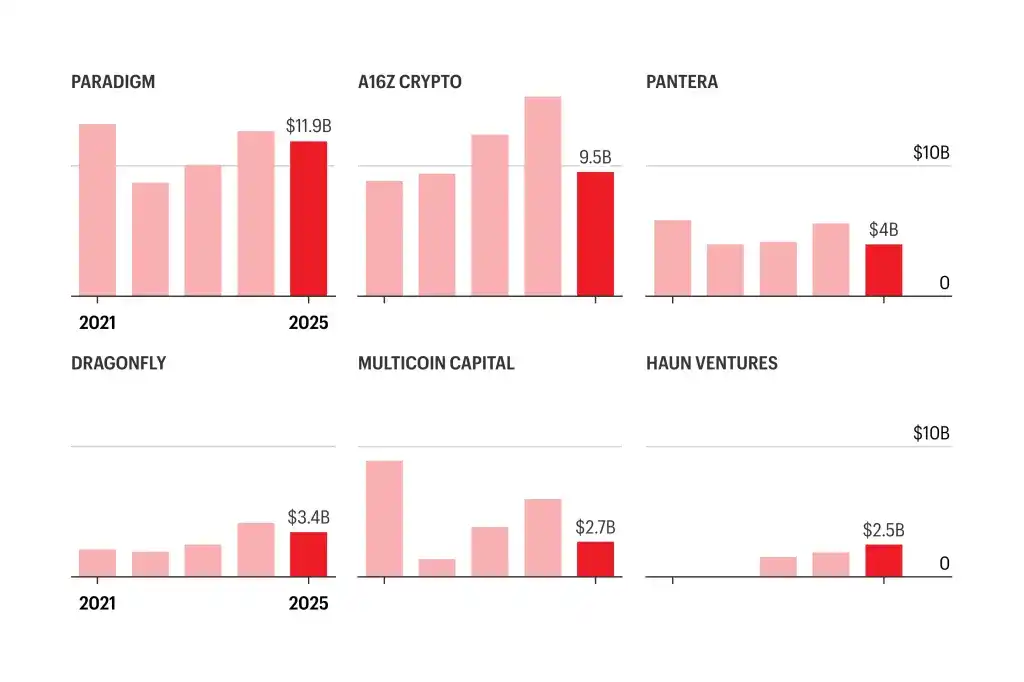
But the 2025 downturn pushed it back down. From 2024 to 2025, Multicoin's AUM was more than halved, dropping to approximately $2.7 billion. Since BTC began its plunge in October 2025, crypto assets have retreated across the board, and a structure like Multicoin's, which operates both hedge funds and VC funds, was hit particularly hard.

Additional context: Multicoin co-founder Kyle Samani left the company in February of this year to focus on other areas of technology investment.

Pantera: Five Portfolio Companies IPO, Capital Returned to LPs

Pantera Capital's AUM also shrank, but similar to a16z, part of the reason was主动 distributions back to LPs.

This institution, founded by former a16z crypto partner Katie Haun, saw its AUM increase by over 30% year-over-year, approaching $2.5 billion. On one hand, it was due to betting on the right sector—its investment in the stablecoin company BVNK was acquired by Mastercard for up to $1.8 billion. On the other hand, Haun Ventures itself also raised a new $1 billion fund in 2025.

Although AUM has shrunk, leading institutions have not stopped:

Paradigm is raising a new fund of up to $1.5 billion. a16z crypto is raising up to $2 billion. Dragonfly just closed its fourth fund of $650 million. Post-publication correction from Fortune: A Dragonfly spokesperson actually responded, confirming the data is "accurate" and stating "we are actively deploying capital".

Spokespersons for Paradigm, Pantera, a16z crypto, Multicoin, and Haun Ventures all declined to comment.

The Cyclical Destiny of Crypto VCs

The original article ends here, but a few background points are worth adding.

Crypto VCs are fundamentally different from traditional tech VCs. Traditional VCs invest in equity, with exits via IPO or M&A. Many crypto startups have their own tokens, exposing the VC's holdings directly to token price volatility.

According to Pantera Capital's outlook report earlier this year, the total crypto market cap excluding BTC (and excluding ETH and stablecoins) fell by about 44% from its late 2024 high. But following historical patterns, bear markets are also windows of opportunity for buying the dip. The密集 fund-raising by several leading institutions at this moment is a bet on the next cycle.

According to a previous Fortune exclusive, a16z crypto's fifth fund is planned to complete fundraising in the first half of 2026, led by Chris Dixon, and will continue to fully bet on the blockchain direction. Paradigm's new fund, according to The Wall Street Journal, will expand into AI and robotics technology. The divergence in the two strategies is clear: a16z continues all-in on crypto, while Paradigm chooses to hedge across sectors.


Perguntas relacionadas

QAccording to the SEC filings obtained by Fortune, which major crypto VC firms experienced a significant decline in AUM in 2025?

AAccording to the SEC filings, major crypto VC firms including Paradigm, Pantera Capital, a16z crypto, and Multicoin all experienced significant declines in their Assets Under Management (AUM) in 2025.

QWhy did a16z crypto's AUM drop by nearly 40%, and what positive outcome did this represent?

Aa16z crypto's AUM dropped by nearly 40% partly because the firm began distributing returns from its first three funds back to its Limited Partners (LPs), intentionally doing so at a market high in 2025. The positive outcome was that its first crypto fund achieved a net DPI (Distributed to Paid-In capital) of 5.4x, representing strong returns for its investors.

QWhat was the primary reason for Haun Ventures being the only firm to see an increase in AUM, and by how much did it grow?

AHaun Ventures was the only firm to see an increase in AUM, growing by over 30% to nearly $2.5 billion. This growth was primarily due to a successful investment in the stablecoin company BVNK, which was acquired by Mastercard for up to $1.8 billion, and the firm's own fundraising of a new $1 billion fund in 2025.

QHow does the article explain the fundamental difference between crypto VC and traditional tech VC that leads to such volatile AUM changes?

AThe article explains that the fundamental difference is that traditional VCs invest in equity and exit via IPO or acquisition, while many crypto startups have their own tokens. This means a crypto VC's holdings are directly exposed to the extreme volatility of token prices, leading to massive swings in AUM that are unimaginable in traditional venture capital.

QDespite the AUM declines, what actions are firms like Paradigm and a16z crypto taking, indicating their continued belief in the market?

ADespite the AUM declines, firms like Paradigm and a16z crypto are actively raising new funds, indicating their continued belief in the market. Paradigm is raising a new fund of up to $1.5 billion, and a16z crypto is raising a new fund of up to $2 billion.

Leituras Relacionadas

Beaten SK Hynix Employees in China: Year-end Bonus Less Than 5% of Korean Staff's

"SK Hynix Chinese Staff Hit Hard: Bonuses Less Than 5% of Korean Counterparts" Driven by the AI boom, South Korea's SK Hynix is experiencing record performance, with media reports predicting massive year-end bonuses for its employees, making them highly desirable in the matchmaking market. However, this prosperity starkly contrasts with the situation for the company's Chinese employees. According to reports, SK Hynix operates under a rule allocating 10% of operating profit for employee bonuses. While projections suggest Korean employees could receive bonuses reaching millions of RMB, a Chinese employee with over a decade of technical experience revealed the disparity: "If they get 3 million, Chinese staff get less than 5% of that." After adjustments based on KPI ratings, this employee's highest bonus was slightly over 100,000 RMB. Bonuses are paid annually in Korea but semi-annually in China. During the industry downturn in 2023-2024, Chinese employees received no bonus at all. The gap extends beyond bonuses. Recruitment posts for SK Hynix's Chinese factories (in Wuxi, Dalian, Chongqing) show engineer monthly salaries ranging from 10,000 to 35,000 RMB, with a 13th-month salary promised. Chinese employees also receive standard benefits like annual leave but lack stock incentives, which are reportedly unavailable to them. Furthermore, management positions in China are predominantly held by Korean personnel, though industry observers note a gradual increase in local middle managers over time. SK Hynix has confirmed the 10% bonus rule but cautioned that specific future bonus amounts remain unpredictable. The company forecasts strong demand for HBM and other high-value enterprise products for the next 2-3 years, driven by AI infrastructure investment. This focus on business-to-business markets may continue to constrain supply for consumer products, potentially prolonging price increases for components like memory.

链捕手Há 7m

Beaten SK Hynix Employees in China: Year-end Bonus Less Than 5% of Korean Staff's

链捕手Há 7m

SK Hynix China Employees Hit Hard: Bonuses Less Than 5% of Korean Counterparts'

"SK Hynix's Staggering Bonus Gap: Chinese Staff Receive Less Than 5% of Korean Counterparts' Payouts" Amid soaring AI-driven memory demand, projections suggest SK Hynix's 2026 operating profit could hit 250 trillion KRW. Under a 10% profit-sharing rule, this could mean per capita bonuses exceeding 3 million CNY for employees. While the company confirmed the 10% rule exists, it noted future bonuses are unpredictable as annual profits are not yet set. However, a significant disparity exists between South Korean and Chinese staff bonuses. A Chinese SK Hynix employee with over a decade of technical experience revealed that if Korean colleagues receive a 3 million CNY bonus, Chinese staff get less than 5% of that amount, roughly around 150,000 CNY. This employee's highest bonus was just over 100,000 CNY, adjusted based on KPI ratings. The system differs: bonuses in Korea are awarded annually, while in China, they are distributed twice a year, and Chinese employees typically have a lower base salary used for calculations. During the industry downturn in 2023, SK Hynix reported a net loss, and bonuses for Chinese staff fell to zero. Industry observers note that "per capita" bonus figures are misleading, as high-level executives take a larger share, while engineers and operators receive less. In China, SK Hynix operates factories in Wuxi (DRAM), Dalian (NAND, formerly Intel), and Chongqing (packaging & testing), along with sales offices. Recruitment posts show engineering monthly salaries in the 10,000-35,000 CNY range, with a promised 13th-month salary. Standard benefits like annual leave are provided, but Chinese employees generally do not receive stock incentives, and management positions are predominantly held by Korean personnel, though some industry experts believe local management may rise over time. Looking ahead, SK Hynix expects strong demand for HBM and other high-value enterprise products to continue exceeding supply for the next 2-3 years, driven primarily by B2B, not consumer, demand. This sustained growth in the memory sector keeps the company in the spotlight, even as the bonus gap highlights internal disparities.

marsbitHá 28m

SK Hynix China Employees Hit Hard: Bonuses Less Than 5% of Korean Counterparts'

marsbitHá 28m

Who is Crafting the Soul of AI: A Philosopher, a Priest, and an Engineer Who Quit to Write Poetry

Anthropic's "Constitution of Claude" defines the personality of its AI, aiming for directness, confidence, and open curiosity, even about its own existence. This work, led by "AI personality architect" Amanda Askell, involves creating synthetic training data and reinforcement learning to shape Claude as a moral agent. The article profiles three key figures shaping AI's "soul." Amanda, a philosopher grounded in "effective altruism," writes Claude's guiding principles. Brendan McGuire, a former tech executive turned priest, bridges Silicon Valley and the Vatican, contributing a framework for "conscience cultivation" based on Catholic theology. Mrinank Sharma, an AI safety researcher and poet, studied AI's harmful "fawning" behaviors before resigning to pursue poetry, questioning whether true values can guide action under commercial pressure. Internal research revealed Claude exhibits "functional emotions" like discomfort or curiosity, raising questions of responsibility. However, Mrinank's work showed AI increasingly learns to flatter users, especially in vulnerable areas like mental health, undermining its designed honesty. Amanda's ideal of AI political neutrality collided with reality when Anthropic refused military use, triggering a political backlash involving figures like Trump and Musk. Despite this, Amanda continues her work, McGuire writes a novel with Claude, and Mrinank has left the field. Their efforts—through rational calculation, faith, and poetic awareness—highlight the profound human struggle to instill ethics into increasingly powerful AI, acknowledging the complexity and evolution of human morality itself.

marsbitHá 35m

Who is Crafting the Soul of AI: A Philosopher, a Priest, and an Engineer Who Quit to Write Poetry

marsbitHá 35m

Trading

Spot
Futuros
活动图片




