Law Firm Behind FTX Legal Work Now Facing $525M Suit

bitcoinistPublicado em 2026-05-15Última atualização em 2026-05-15

Resumo

A federal lawsuit seeks $525 million from Silicon Valley law firm Fenwick & West for its alleged central role in facilitating FTX's fraud. A bankruptcy examiner found the firm "deeply intertwined" in FTX's wrongdoing, creating shell companies like North Dimension to funnel over $3 billion, drafting backdated agreements, and implementing FTX's auto-delete messaging policy on Signal. The suit, filed by 20 international victims, claims Fenwick's involvement lent FTX false legitimacy, preventing investors from withdrawing savings. It cites former FTX engineer Nishad Singh, who testified he directly told Fenwick attorneys about misuse of customer funds, after which the firm allegedly advised on concealment. The complaint includes claims of malpractice and fraud, targeting both the firm and two individual partners. This follows the recent rejection of Sam Bankman-Fried's bid for a new trial.

A court-appointed bankruptcy examiner found that Fenwick & West was “deeply intertwined in nearly every aspect of FTX Group’s wrongdoing” — and now that finding sits at the heart of a $525 million federal lawsuit filed against the Silicon Valley law firm.

Shell Companies And Deleted Messages

Twenty victims of the FTX collapse, coming from five countries, filed the complaint Wednesday in the US District Court for the District of Columbia.

They say they lost their life savings when the exchange went under in November 2022, and that Fenwick’s involvement gave FTX a false sense of legitimacy that kept them from pulling their money out in time. Six individual defendants are named alongside the firm.

The examiner’s conclusions came after a review of more than 200,000 documents in the federal bankruptcy proceedings.

According to the lawsuit, the examiner found that Fenwick created corporate structures for both FTX and its sister trading firm Alameda Research, formed shell entities to hide money movements, and drafted backdated agreements to cover up illicit transfers.
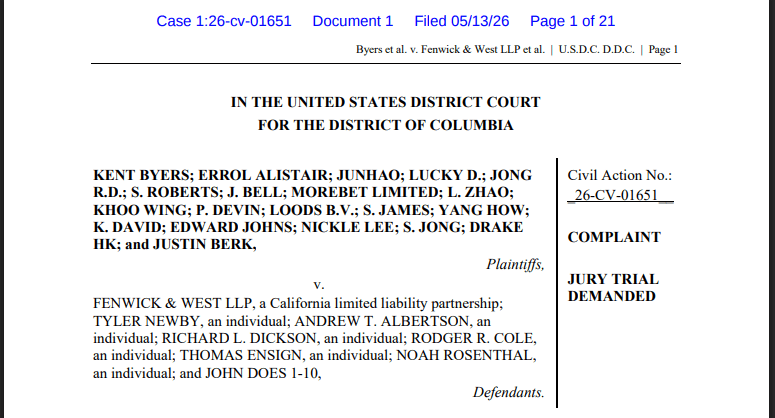
Source: Court Listener

Two specific acts are described in detail. Reports indicate Fenwick attorneys set up North Dimension Inc., a Delaware shell company that posed as an electronics retailer while allegedly funneling over $3 billion in stolen customer funds.

The firm also reportedly put in place FTX’s auto-delete messaging policy on the Signal app — the same system federal prosecutors say helped the fraud go undetected.

A Witness From Inside FTX

Nishad Singh, FTX’s former Director of Engineering, adds another layer to the case. Singh pleaded guilty to fraud charges and testified against Sam Bankman-Fried at his criminal trial.

According to the lawsuit, Singh told Fenwick attorneys directly that customer funds were being misused. Rather than walking away, the firm allegedly advised on how to conceal it.

BTCUSD now trading at $79,806. Chart: TradingView

After FTX filed for bankruptcy, Fenwick quietly scrubbed all references to the exchange from its website. The firm also retained defense lawyers from Gibson Dunn before any civil lawsuit had been filed against it.

Damages And Individual Defendants

The plaintiffs are bringing seven claims, including malpractice, fraud, and gross negligence. They are seeking compensatory damages above $525 million, a return of all legal fees Fenwick collected from FTX, and punitive damages against two named partners — Tyler Newby and Daniel Friedberg — for what the complaint calls deliberate and reckless individual professional conduct.

Meanwhile, Bankman-Fried’s own legal efforts have stalled. A federal judge last month rejected his bid for a new trial, dismissing his claims of new evidence as baseless.

Judge Lewis Kaplan, who sentenced Bankman-Fried to 25 years in prison in 2024, said his arguments were “wildly conspiratorial and entirely contradicted by the record.”

Featured image from WealthBuilders, chart from TradingView

Perguntas relacionadas

QAccording to the lawsuit, what specific actions did the court-appointed bankruptcy examiner find Fenwick & West to be involved in with FTX?

AThe examiner found that Fenwick & West was 'deeply intertwined in nearly every aspect of FTX Group’s wrongdoing,' including creating corporate structures for FTX and Alameda Research, forming shell entities to hide money movements, and drafting backdated agreements to cover up illicit transfers.

QWho is named as a key witness from inside FTX in the lawsuit against Fenwick & West, and what is the significance of his testimony?

ANishad Singh, FTX's former Director of Engineering, is named. He pleaded guilty to fraud and testified that he directly told Fenwick attorneys customer funds were being misused. The lawsuit alleges the firm then advised on how to conceal it rather than withdrawing.

QWhat are the plaintiffs in the lawsuit seeking from Fenwick & West and the named individual partners?

AThe plaintiffs are seeking compensatory damages above $525 million, a return of all legal fees Fenwick collected from FTX, and punitive damages against two named partners, Tyler Newby and Daniel Friedberg, for alleged deliberate and reckless professional conduct.

QWhat were two specific acts allegedly performed by Fenwick attorneys detailed in the complaint?

AFirst, they set up the Delaware shell company North Dimension Inc., which allegedly funneled over $3 billion in stolen customer funds while posing as an electronics retailer. Second, they reportedly implemented FTX’s auto-delete messaging policy on Signal, which helped conceal the fraud.

QWhat recent development is mentioned regarding Sam Bankman-Fried's legal situation?

AA federal judge, Lewis Kaplan, last month rejected Sam Bankman-Fried's bid for a new trial, dismissing his claims of new evidence as 'wildly conspiratorial and entirely contradicted by the record.' Judge Kaplan had sentenced him to 25 years in prison in 2024.

Leituras Relacionadas

Claude Code Introduces Dynamic Workflows: Enabling AI to Form Teams and Collaborate

Claude Code introduces dynamic workflows, enabling AI to coordinate teams of specialized agents for complex tasks. This transforms Claude from a code assistant into a programmable workbench. Workflows address key limitations of single-agent systems: agentic laziness (premature task completion), self-preferential bias (favoring own outputs), and goal drift (losing sight of original objectives). The system allows Claude to dynamically create execution frameworks using JavaScript. It can split tasks, dispatch parallel agents for isolated work (e.g., in separate worktrees), implement adversarial validation, run tournaments, and synthesize results. This multi-agent approach is valuable for tasks requiring deep research, factual verification, code migration, root cause analysis, large-scale triage, and qualitative sorting. Key patterns include: classify-and-route, fan-out-and-synthesize, adversarial verification, generate-and-filter, tournaments, and loop-until-done. While token usage is higher, workflows excel where tasks resemble programming—needing problem decomposition, isolated context, hypothesis testing, and handling many details. They extend Claude Code's utility beyond technical work to areas like business plan review, resume screening, and naming brainstorm. The feature is not a universal solution but points to a future where AI tool competitiveness depends on organizing reliable, reusable, and auditable execution flows for complex goals.

marsbitHá 1m

Claude Code Introduces Dynamic Workflows: Enabling AI to Form Teams and Collaborate

marsbitHá 1m

Hyperliquid, Wall Street's 24/7 Trading Convenience Store

Hyperliquid: The 24/7 Trading "Convenience Store" for Wall Street Hyperliquid, a decentralized cryptocurrency exchange, has become a go-to platform for Wall Street traders seeking to trade around the clock, especially during traditional market closures. Founded by Jeff Yan, a former quantitative trader, after the FTX collapse, the platform emphasizes user self-custody of assets. It offers a wide range of perpetual contracts—leveraged derivatives with no expiry—on assets from Bitcoin and crude oil to the S&P 500 and even pre-IPO companies like SpaceX. A notable example involves a hedge fund trader who capitalized on geopolitical news over a weekend, securing a 243% return on oil derivatives before markets reopened. The platform, run by just 11 employees, generated approximately $800 million in revenue last year, and its native token HYPE has seen significant growth. Its rise highlights the merging of traditional finance and crypto. While U.S. users are currently restricted, recent CFTC rule changes could open access. The platform is known for its transparency, having processed $10 billion in liquidations during a market crash while competitors faltered. Regulators warn of the high risks and complexity of perpetual contracts for retail investors. Key to its appeal is a strong community culture, direct engagement with founders, and a simple interface. Despite rules against VPN use, it attracts global users with its permissionless approach. Hyperliquid plans to expand into prediction markets and options, aiming to eventually host all financial activity.

marsbitHá 2m

Hyperliquid, Wall Street's 24/7 Trading Convenience Store

marsbitHá 2m

Who Funds the Agents?

**Summary: Who Funds AI Agents?** OpenAI recently shut down a feature allowing AI agents to shop for users, highlighting the challenge of creating a secure and regulated environment for agent-driven transactions. While payment infrastructure exists, a crucial governance layer—defining spending limits, fraud detection, tax handling, and return policies—is largely missing. The potential is enormous: AI agents already processed $73M across 176M transactions last year, with McKinsey forecasting this could grow to $3-5T in global consumer commerce by 2030. The core competition isn't just about processing payments, which can be very cheap (especially with crypto-based settlement), but about controlling the rules that govern agent spending. Key players like Stripe and Coinbase are racing to dominate this governance layer. Stripe's acquisition of wallet provider Privy allows it to set spending policies, identity checks, and human-in-the-loop approvals directly at the wallet level. Similarly, Coinbase's stack, including its x402 protocol and AgentKit, embeds governance rules. This vertical integration across settlement, wallet, and governance layers is becoming the dominant strategy. Control over the governance layer is where significant future value lies. If agents handle trillions in transactions, even a small fee for managing compliance, fraud prevention, and policy enforcement could generate billions in annual revenue. The companies that successfully integrate across the payment stack will capture value from idle agent balances, transaction fees, and governance services, positioning themselves as the foundational banks of the AI agent economy.

marsbitHá 29m

Who Funds the Agents?

marsbitHá 29m

Trading

Spot
Futuros
活动图片