In a research report dated July 21, J.P. Morgan estimated that the South Korean KOSPI index has fallen approximately 28% from its peak on June 22, with leveraged ETF and hedge fund positions contracting significantly. However, the firm maintained its overweight stance on the Korean market, keeping its 12-month KOSPI baseline target at 12500 points.
The primary reasoning behind this assessment is not a simple bet on a rebound but interpreting this sharp decline in the Korean stock market as a leverage-driven sell-off and concentrated position adjustment. According to J.P. Morgan's metrics, the assets of Korea-linked leveraged ETFs have dropped from around $50 billion at the end of June to about $26 billion currently, achieving roughly 75% of the unwinding. Equity hedge fund deleveraging progress also exceeds 50%. Foreign capital outflows this year surpassed $110 billion, with about 90% stemming from the two major memory chip stocks, Samsung Electronics and SK Hynix.
However, reduced positioning does not equate to a calmed market. Volatility in the Korean stock market remains elevated, with the VKOSPI-to-VIX ratio nearing 5x, compared to a normal level around 1x. Tight swap capacity, stricter regulation on single-stock leveraged products, and whether AI demand can continue to support the memory and industrial sectors remain key conditions for determining if this adjustment phase is truly nearing its end.
The Decline is Deep, But Selling Pressure Resembles a Positioning Squeeze
The drop in the Korean stock market has been sufficiently severe. The KOSPI hit a record closing high of 9114.55 points on June 22 and had fallen over 20% from that peak by early July. Calculating from around 6516 points around July 21, the decline from the peak is approximately 28.5%.
The premise for J.P. Morgan maintaining its 12500-point target is that this decline is not due to a sudden collapse in fundamentals but rather the forced unwinding of previously overly crowded trades. The Korean market had rallied rapidly earlier, driven by expectations surrounding AI, the memory upturn cycle, and corporate governance reforms, with some funds amplifying their exposure through leveraged ETFs, swaps, and long-short fund positions. As volatility increased, unwinding and redemptions exacerbated the decline.
The price momentum factor's four-week drawdown approaching -26% points to the same issue: stocks that saw stronger gains and more crowded positioning previously are facing greater pressure.
Nevertheless, volatility itself has not normalized. The VKOSPI-to-VIX ratio near 5x indicates local Korean market volatility remains far higher than in the US market. Positioning pressure is decreasing, but price swings may still amplify in the short term.
Leveraged ETFs Drop from $50 Billion to $26 Billion
The most conspicuous unwinding occurred in leveraged ETFs.
J.P. Morgan estimates that the asset size of Korea-linked leveraged ETFs shrank from about $50 billion at the end of June to $26 billion currently, with unwinding progress around 75%, nearing the more acceptable size they view as around $18 billion.
This number should not be simplistically interpreted as massive investor redemptions. Cumulative fund inflows during the same period remained positive; the decline in size primarily resulted from the underlying market drop. In other words, net subscriptions haven't completely disappeared, but price declines have led to a passive contraction of leveraged exposure.
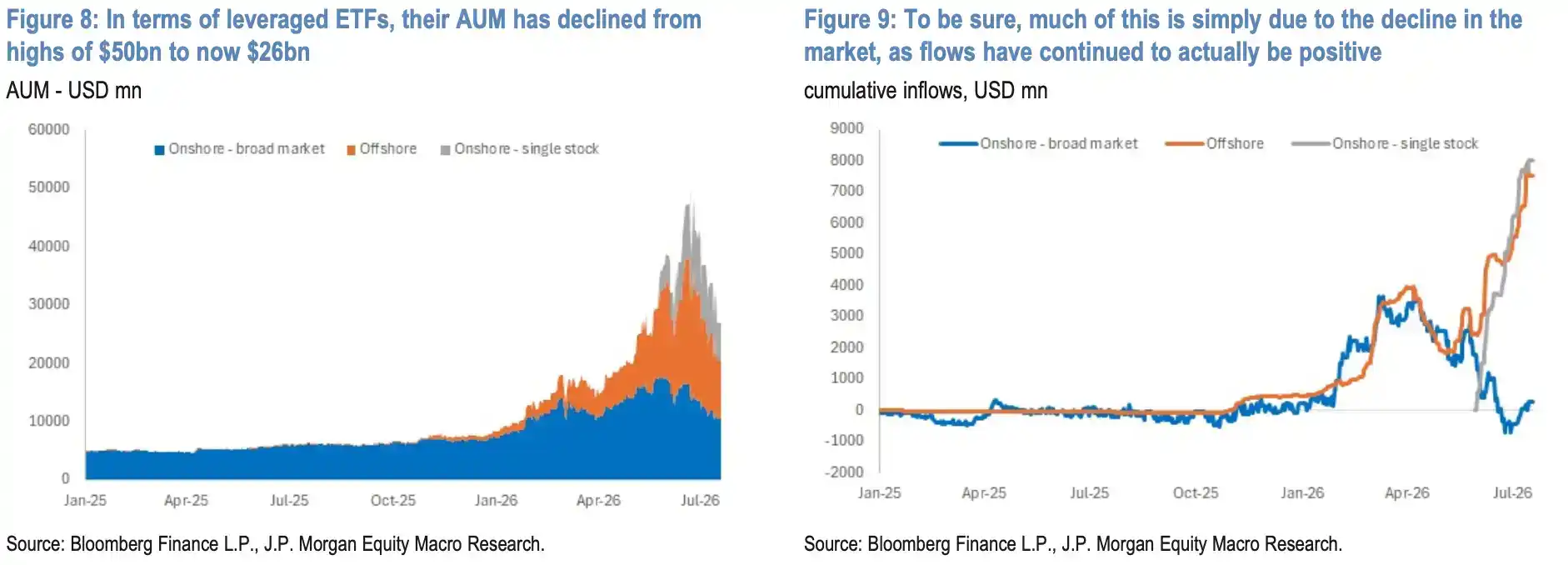
Leveraged ETF AUM fell from ~$50bn to $26bn, but cumulative fund flows remain positive.
This is also why J.P. Morgan believes deleveraging has made substantial progress. If leveraged product sizes remained high, each market decline could trigger further passive selling. With the size halved, the same price volatility will have a diminished amplifying effect on subsequent selling pressure.
Viewed cross-sectionally, Korean retail margin debt itself is not extreme. Metrics cited in the report show that Korean margin balance is about $21 billion, accounting for 0.5% of total stock market capitalization. Leveraged ETFs around $26 billion account for 0.7%. In comparison, US margin balance accounts for about 1.9% of market cap, leveraged ETFs about 0.3%. China A-share margin balance accounts for about 2.8%, with leveraged ETFs close to 0%.
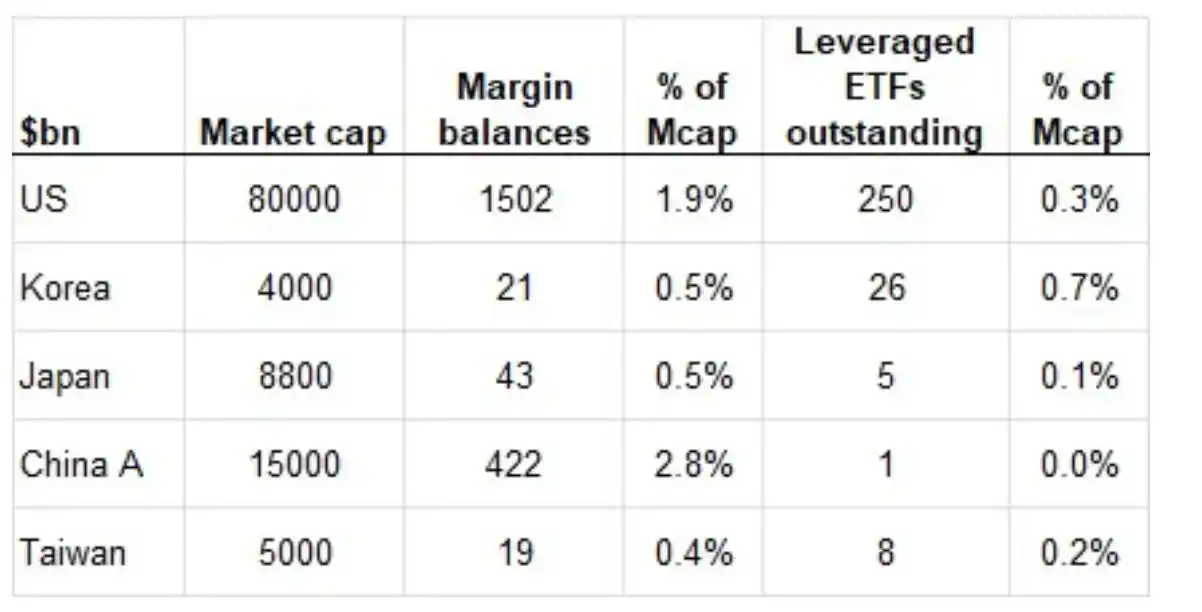
Korean margin balance $21bn is 0.5% of market cap, leveraged ETFs $26bn is 0.7%.
This comparison indicates that the problem in the Korean market is not abnormally high margin debt but rather the relatively prominent presence of leveraged ETFs within the market. Retail investors remain a significant buyer in the Korean stock market, with several leveraged products still ranking high in overseas stock purchases since June. Sentiment hasn't completely cooled; it's just that the decline and regulatory expectations have first suppressed leverage size.
Hedge Fund Selling Pressure Also Eased, But Not Back to Normal
The second unwinding clue comes from hedge funds.
J.P. Morgan's Prime book data shows that equity hedge fund deleveraging progress has exceeded 50%, with the long-short ratio falling from a peak above 5.5x to below 4x. This indicates that funds that increased exposure during Korea's rapid rally over the past year have cut a significant portion of their positions.
The index decline of about 28% shows price adjustment, while the falling long-short ratio indicates the "forced selling" fuel is also diminishing. If the long-short ratio continues to fall, subsequent chain-reaction selling pressure caused by overcrowded positions would be lower than at the end of June.
However, below 4x is not complete normality. There remains a gap from normal deleveraging levels, and issues like tight swap capacity and abnormal volatility haven't fully dissipated. In a market with high concentration like Korea, once financing channels narrow, pullbacks in popular stocks—especially core holdings previously supported by the AI and memory chains—can be amplified.
"75% unwound" cannot be directly equated with bottom confirmation. The market can retreat from its most crowded state, but as long as volatility remains high and financing tight, remaining positions could still amplify declines on certain trading days.
Foreign Selling Pressure Concentrated on Two Memory Chip Stocks
The structure of foreign fund flows is more critical than the total amount.
According to J.P. Morgan's July 21 report, foreign net outflows from the Korean stock market this year exceed $110 billion, with about 90% coming from Samsung Electronics and SK Hynix. In earlier public reports from late June, a similar figure was around $95 billion; subsequent numbers may have been updated with market declines and foreign selling.
This concentrated outflow differs from a comprehensive withdrawal from Korea. The weight of the two major memory stocks in the MSCI EM Index has dropped from 9.5% and 8.3% at the end of June to 7.5% and 5.7% respectively. Following this weight reduction, the pressure for funds constrained by mandate scope, benchmark weight, or concentration limits to continue forced selling should ease somewhat.
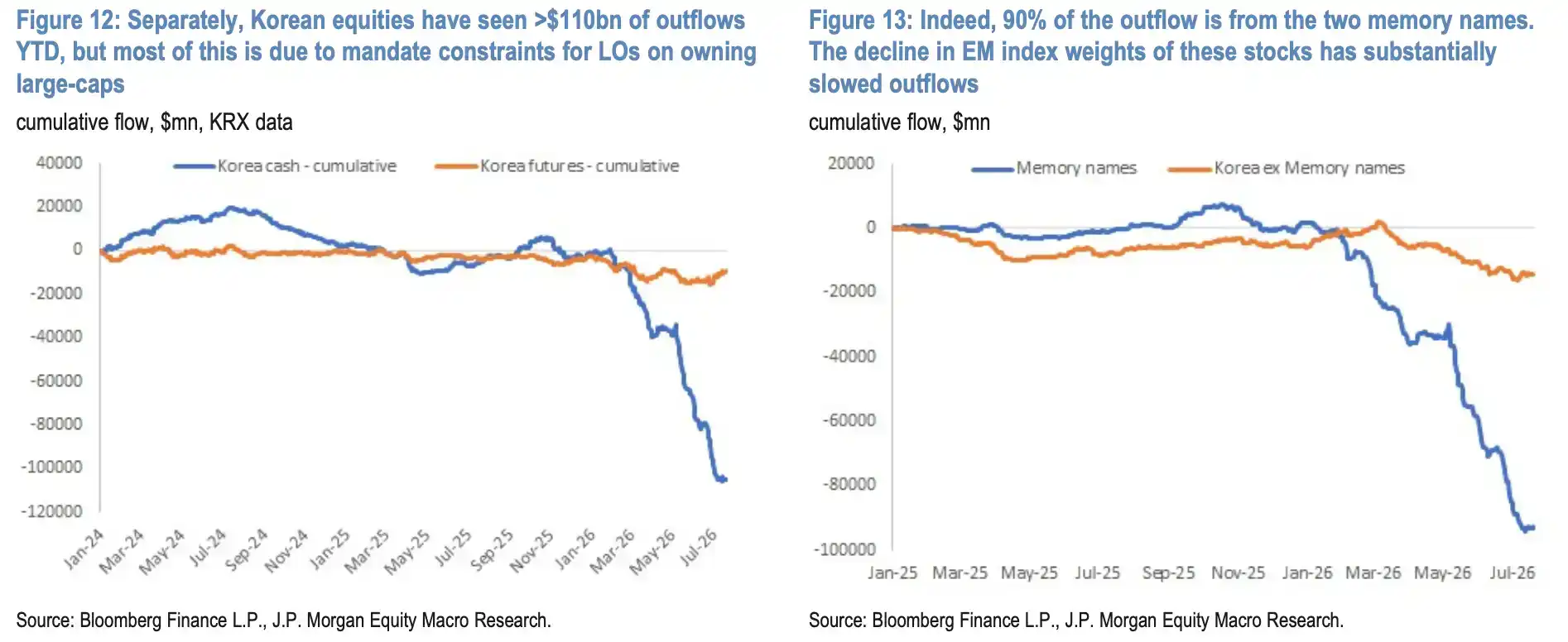
Foreign outflows YTD exceed $110bn, with ~90% from the two major memory stocks.
This is also one of the key reasons J.P. Morgan maintains its overweight on Korea. If foreign capital were selling Korean assets across the board, the problem would lean more towards a systemic loss of confidence. If selling pressure is primarily focused on two overweight memory stocks, market pressure dynamics differ as weights decline and positioning constraints ease.
The risk also concentrates here. The core support for the Korean market remains tied to AI capital expenditure, data center construction, and high-end memory demand. Once the market begins questioning the sustainability of AI compute investment or anticipates technologies that reduce demand for high-end memory, Samsung Electronics and SK Hynix could still amplify foreign fund flows and index volatility.
Single-Stock Leveraged Products Tightened, Leverage Unlikely to Quickly Return
Korean regulators have begun cooling high-leverage trading.
The Financial Services Commission of Korea confirmed in a July 16 announcement the suspension of new listings for single-stock leveraged, inverse, and covered call products. The minimum deposit requirement will increase from 10 million won to 30 million won, expected to take effect on August 5. Starting August 19, initial margin will be calculated using cash only. From November, the minimum trading unit for listed single-stock leveraged products in Korea is proposed to increase from 1 share to 20 shares.
These measures are not targeting all leveraged ETFs but focus on single-stock leveraged products. The impact isn't an immediate boost to the index but restricts the re-expansion of leveraged products. Even if retail sentiment remains strong, the space for funds to quickly amplify exposure again through small transactions and non-cash margin will shrink.
This explains why J.P. Morgan, while bullish on Korea, still emphasizes regulatory effects. If regulation only temporarily suppresses, leveraged funds might re-accumulate through other products or markets. If new rules persist, the volatility amplification mechanism in the Korean stock market will weaken.
AI Earnings Revisions Continue, Risk Also Lies in AI
Another reason for J.P. Morgan's maintained optimism is that Korean earnings expectations are still being revised upward.
The report shows that South Korea's market 2026 EPS has been revised up by 143.4% over the past six months, with the tech sector up 215.5% and the industrial sector up 91.0%. Despite significant price retracements, analysts' revisions to future earnings remain strong, especially concentrated in AI-related tech and industrial chains.
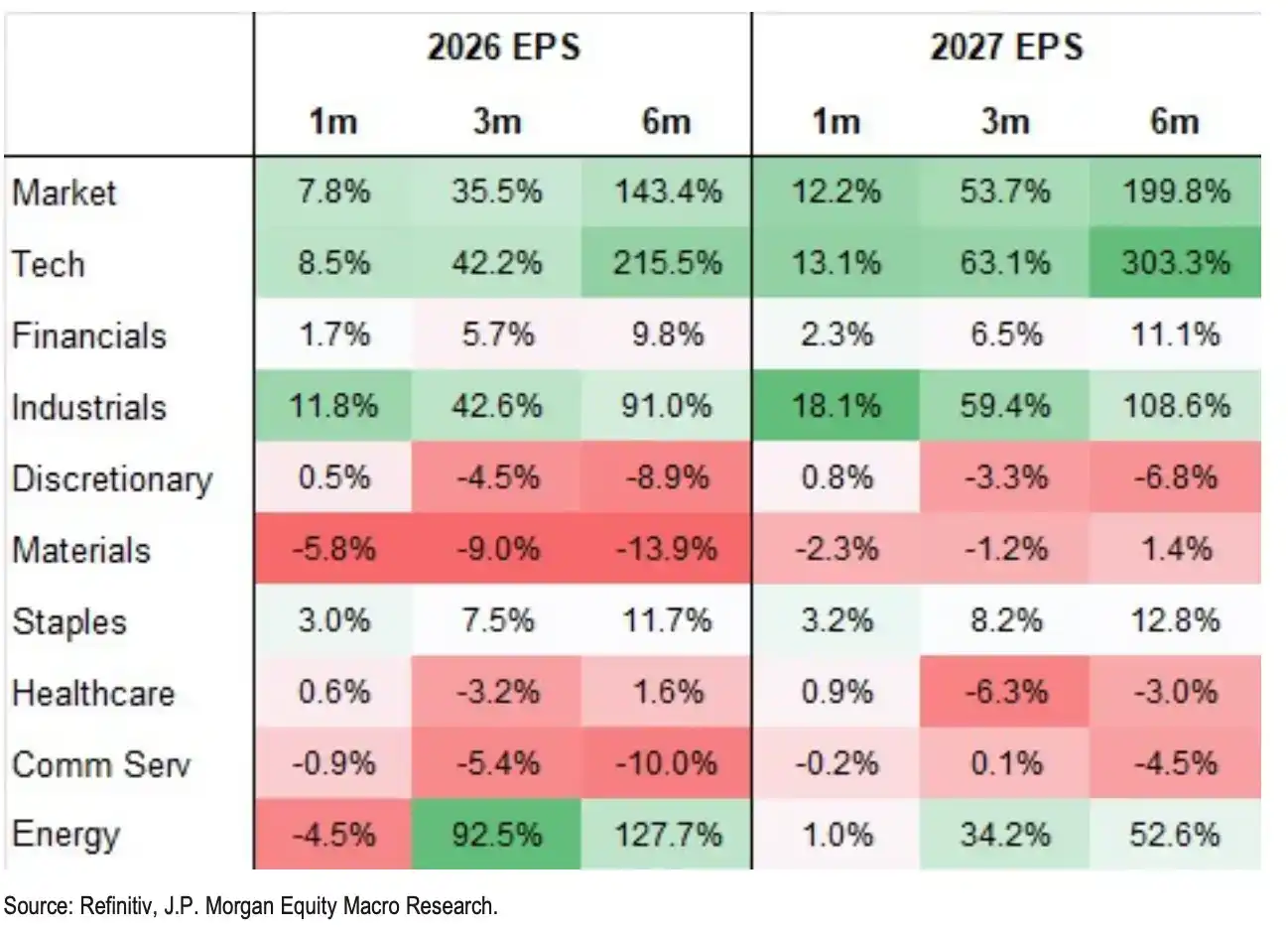
Korea market 2026 EPS revised up 143.4% over six months, tech sector up 215.5%, industrial sector up 91.0%.
Factors supporting these upward revisions include hyperscale compute investment, data center construction, security and resilience spending, and medium-to-long-term expectations for Korean corporate governance reforms. For the Korean market, memory, servers, industrial equipment, and related supply chains remain the most direct beneficiaries.
The risk comes from the same direction. The fundamental pivot for this Korean market rally is highly dependent on the AI cycle. If AI capital expenditure slows, or new technologies reduce demand for high-end memory and related hardware, earnings revisions may be revisited. The relative weakness in materials, consumer sectors, etc., also indicates the Korean market's improvement is not synchronized across all industries.
J.P. Morgan's 12500-point target is based on a combination of conditions: continued progress in leverage unwinding, AI demand not being disproven, and easing concentrated foreign selling pressure. What can be said now is that the most crowded positions in the Korean market have clearly loosened. What cannot yet be said is that volatility has normalized, foreign capital has turned to sustained inflows, or the AI chain's earnings upgrades are fully locked in.