Jensen Huang: Vera Rubin Full Mass Production, AI Agent a Key Focus, Challenging Intel to Target the Next-Generation AI PC Gateway

marsbitPublicado em 2026-06-01Última atualização em 2026-06-01

Resumo

NVIDIA CEO Jensen Huang delivered the keynote speech at GTC Taipei 2026, announcing several major product launches and strategic directions. The company's Vera Rubin architecture is now in full-scale production, with OpenAI, Anthropic, and SpaceX among the first customers. NVIDIA highlighted AI Agent as a key future focus, introducing the Vera CPU designed for AI agents and the Vera BlueField-4 STX for secure, chip-level AI storage processing. A significant move involves challenging Intel in the PC market. NVIDIA, in collaboration with MediaTek, is developing the RTX SPARK PC chip (manufactured by TSMC) for Windows systems, set to launch this fall for laptops and desktops. This signals NVIDIA's push into the next-generation AI PC arena, aiming to provide a vertically integrated core computing platform for the entire Windows ecosystem, similar to Apple's approach. Other announcements include the new Nemotron 3 Ultra AI model and the NVIDIA DSX platform, described as a complete "playbook" for building AI factories, allowing performance simulation and validation before physical deployment. In automotive, the DRIVE Hyperion platform was positioned as a global robotaxi platform, with major Chinese automakers like BYD, Geely, Zeekr, Xiaomi, and Pony.ai already adopting or developing autonomous driving solutions based on it. The Alpamayo 2 super open inference model for robotaxis was also introduced. For robotics, NVIDIA unveiled the Isaac GR00T humanoid robot reference platform...

Author: Wall Street Insights

On June 1st, NVIDIA founder and CEO Jensen Huang delivered the NVIDIA GTC Taipei 2026 keynote speech in Taipei, China.

During this speech, Huang focused on releasing multiple new products and platforms including the Vera Rubin architecture, the Vera CPU for AI Agents, the AI model Nemotron 3 Ultra, and the AI factory platform DSX.

Simultaneously, NVIDIA further signaled its push into the next-generation AI PC market, targeting the entire Windows ecosystem.

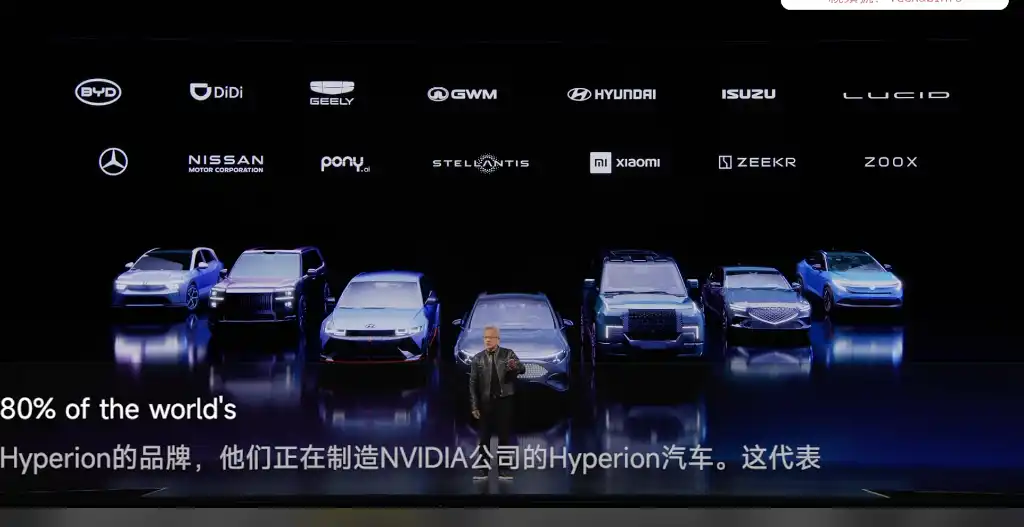
NVIDIA revealed at the event that mainstream Chinese automakers and autonomous driving companies including BYD, Geely, ZEEKR, Xiaomi, and Pony.ai have adopted or are developing autonomous driving based on the NVIDIA Hyperion platform.

NVIDIA's U.S. stock pre-market price rose 2.7%.

Vera Rubin Now in Full Mass Production

Jensen Huang stated that the Vera Rubin architecture has now fully entered mass production, with OpenAI, Anthropic, and SpaceX becoming the first customers for NVIDIA's Vera chips.
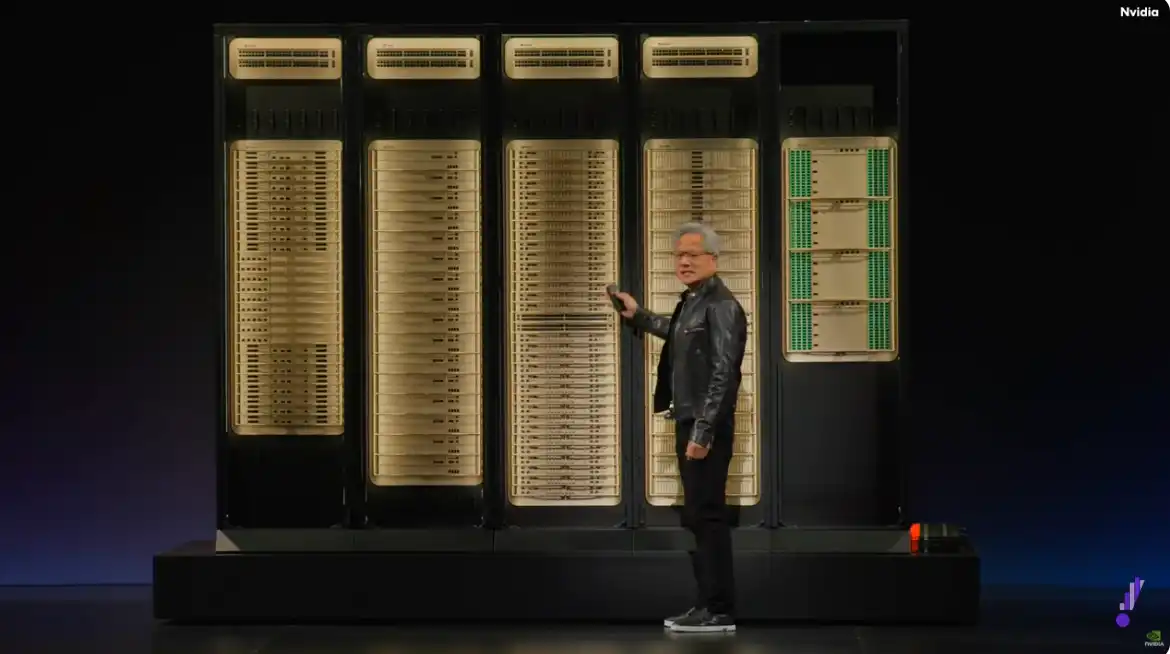
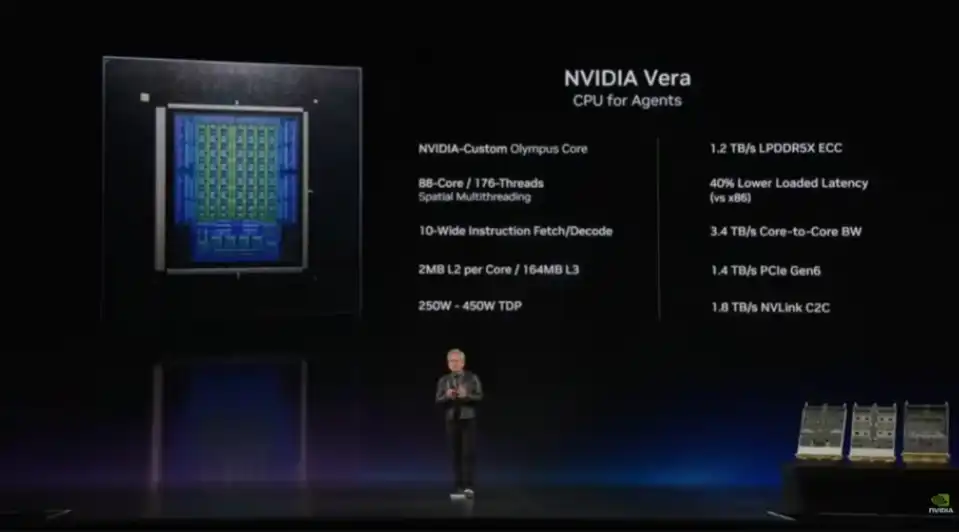
AI Agents will become a key focus for future efforts, and NVIDIA will launch the Vera CPU for AI agents.

Huang also emphasized that NVIDIA Vera BlueField-4 STX delivers chip-level secure, agentic AI storage processing capabilities.
Targeting the Next-Generation AI PC Gateway

Notably, NVIDIA unveiled a new processor for Windows-based personal computers, challenging Intel.

NVIDIA will collaborate with MediaTek to develop the RTX SPARK personal computer chip, which will be manufactured by TSMC. Huang revealed that NVIDIA's personal computer chip will launch this fall, suitable for laptops and desktops.

Jensen Huang stated that NVIDIA will launch a new generation of personal computer (PC) chips alongside each generation of its AI processors.

Previously, NVIDIA's official social media account issued a three-word teaser—"A new era of PC"—signaling its aim for the next-generation AI PC gateway.

Analysis suggests NVIDIA intends to integrate CPU, GPU, and AI units into a single SoC, directly supplying a complete core computing platform to OEMs like Dell and Lenovo, fundamentally altering its position in the value chain. This follows the vertical integration path of Apple Silicon, but targets the entire Windows ecosystem.

NVIDIA: Will Collaborate with Unitree Tech and Other Global Humanoid Robot Makers to Develop Robots

NVIDIA plans to collaborate not only with China's Unitree Tech but also with humanoid robot manufacturers in the United States, Europe, and South Korea on research robot projects.

Launches New AI Model + AI Factory "Action Guide"

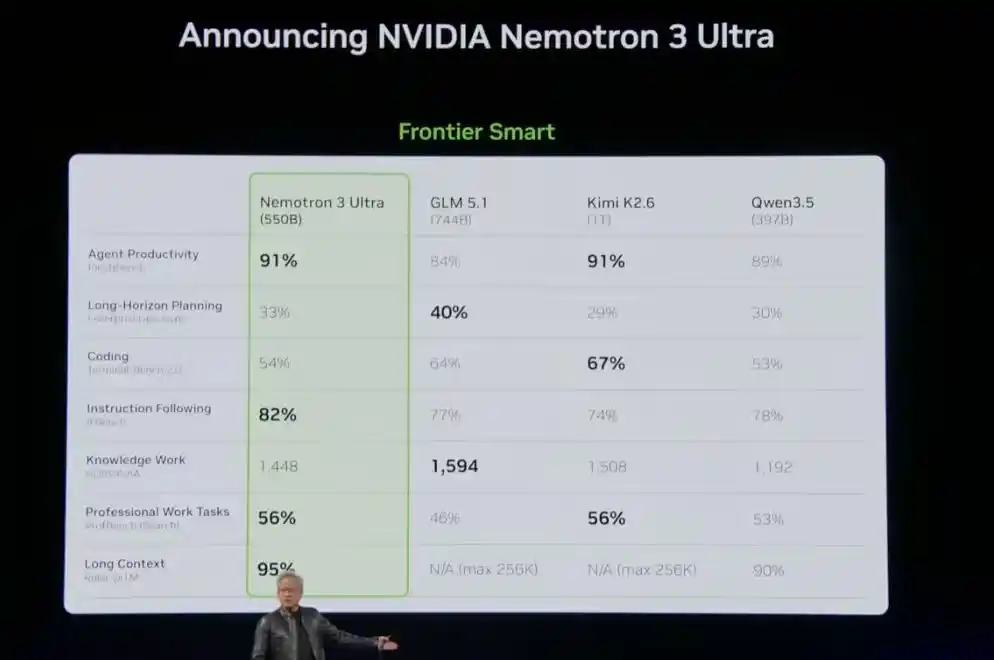
Furthermore, NVIDIA announced the launch of a new AI model, Nemotron 3 Ultra.
NVIDIA announced the launch of the NVIDIA DSX platform, providing infrastructure builders with a complete action guide for creating AI factories. Jensen Huang stated:

With the DSX platform, you can simulate the entire factory without spending a dime, validate performance before installing a single rack, and operate with the reliability required for production-grade AI.

Autonomous Driving Platform Hyperion Ecosystem Emerges

NVIDIA DRIVE Hyperion becomes the global autonomous robotaxi platform.

NVIDIA revealed at the event that mainstream Chinese automakers and autonomous driving companies including BYD, Geely, ZEEKR, Xiaomi, and Pony.ai have adopted or are developing autonomous driving based on the NVIDIA Hyperion platform.

NVIDIA also launched the Alpamayo 2 super open inference model for autonomous taxis.
Building the Development Ecosystem for the Robotics Era

In the field of humanoid robots, NVIDIA is attempting to play the role of an "infrastructure provider."

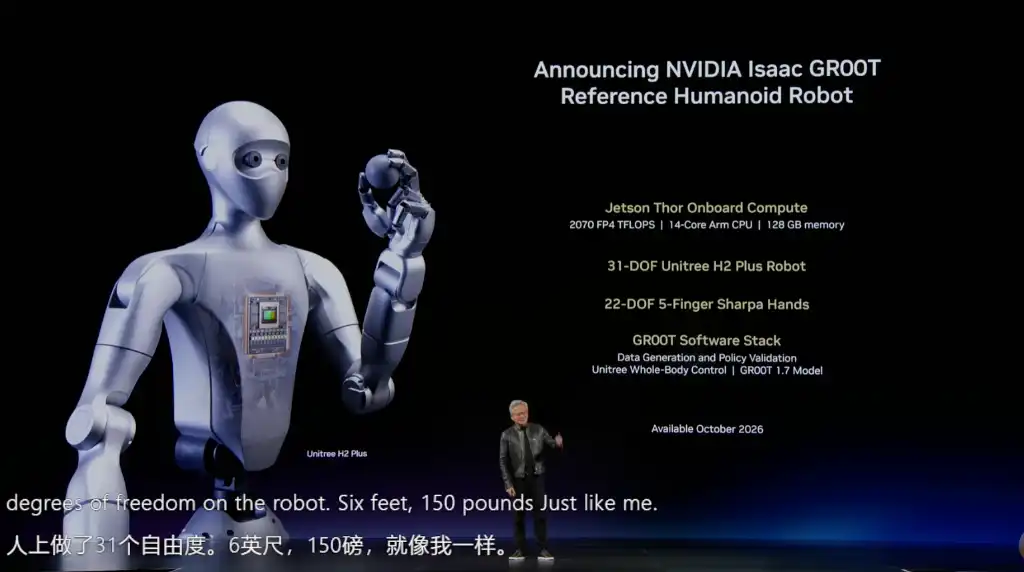
At this launch event, NVIDIA introduced the NVIDIA Isaac GR00T humanoid robot reference platform for academic research, while also releasing a large-scale open-source toolkit of agents and skills for Physical AI.

At the event, NVIDIA selected Unitree Tech's H2 Plus as the reference model, introducing the Isaac GR00T reference humanoid robot platform. This platform integrates Jetson Thor computing chips, the GR00T software stack, as well as dexterous hand and full-body control systems, providing robot manufacturers with a hardware-to-software one-stop development framework.
Perguntas relacionadas

QWhat major new products or platforms did Jensen Huang announce during his GTC Taipei 2026 keynote?

AJensen Huang announced several major new products and platforms, including the Vera Rubin architecture, the Vera CPU for AI Agents, the Nemotron 3 Ultra AI model, the DSX platform for building AI factories, and new processors for Windows PCs developed in partnership with MediaTek (RTX SPARK chips).

QWhat is the significance of NVIDIA's partnership with MediaTek on the RTX SPARK PC chips?

AThe partnership with MediaTek to develop RTX SPARK PC chips signifies NVIDIA's major push into the next-generation AI PC market, directly challenging Intel. These SoC (System on Chip) designs integrate CPU, GPU, and AI units, aiming to provide a complete core computing platform to OEMs like Dell and Lenovo. This represents a fundamental shift in NVIDIA's position in the value chain.

QWhich major companies were mentioned as the first customers for the new Vera Rubin architecture chips?

AOpenAI, Anthropic, and SpaceX were named as the first customers for NVIDIA's Vera Rubin architecture chips.

QIn which key application areas besides AI PCs did NVIDIA highlight its ecosystem growth during the keynote?

ANVIDIA highlighted significant ecosystem growth in two key areas: Autonomous Driving, with companies like BYD, Geely, ZEEKR, Xiaomi, and Pony.ai adopting the NVIDIA Hyperion platform, and Robotics, with announced collaborations with global humanoid robot makers including China's Unitree Robotics.

QHow does NVIDIA's Isaac GR00T platform aim to support development in the robotics field?

ANVIDIA's Isaac GR00T is a reference humanoid robot platform designed to be a development ecosystem provider. It integrates the Jetson Thor compute chip, the GR00T software stack, and dexterous hand and whole-body control systems. It provides robot manufacturers with a comprehensive hardware-to-software development framework, with Unitree's H2 Plus robot serving as a reference model.

Leituras Relacionadas

U.S. Government Bans Foreign Nationals from Using Fable 5, Anthropic Issues Rebuttal

U.S. Government Bans Foreign Access to Fable 5, Anthropic Issues Rebuttal On June 12th, the U.S. government ordered AI company Anthropic to immediately suspend all foreign access—including foreign nationals within the U.S. and Anthropic's own foreign employees—to its newly released Fable 5 and Mythos 5 AI models, citing national security concerns. This forced Anthropic to temporarily disable access to both models for all users globally, as it cannot technically differentiate user nationality at scale. The models, released just three days prior, represent Anthropic's highest public capability tier. Fable 5 is the first publicly available model from the advanced "Mythos" family, while Mythos 5 is a less-restricted version for approved cybersecurity and critical infrastructure partners. The government's directive was reportedly triggered by claims from another company that it could "jailbreak" Mythos 5, raising alarm within the Trump administration. Anthropic, in a detailed public statement, strongly challenged this rationale. The company argues the demonstrated "jailbreak" is a narrow, non-generalized technique that merely involves identifying minor, known software vulnerabilities—a capability common to other publicly available models like OpenAI's GPT-5.5 and routinely used by cybersecurity defenders. Anthropic stated it has complied with the order but disagrees with the government's standard, warning that applying it industry-wide would halt all new frontier model deployments. The company criticized the lack of a transparent, fact-based legal process and expressed confidence the situation stems from a misunderstanding. It is working to restore access and will release more technical details within 24 hours. Other Anthropic models remain unaffected.

链捕手Há 18m

U.S. Government Bans Foreign Nationals from Using Fable 5, Anthropic Issues Rebuttal

链捕手Há 18m

The Revelation from the Raydium Theft Incident: New DeFi Vulnerabilities Lurking in Forgotten Old Contracts

**Raydium Exploit Reveals DeFi's Hidden Risk: Forgotten "Zombie" Contracts** A recent attack on Raydium's deprecated V3 AMM pools resulted in a loss of approximately $1.34 million. The hacker exploited pools that were no longer supported by Raydium's current UI or SDK but remained fully functional and accessible on-chain. This incident highlights a critical, often overlooked category of risk in DeFi: inactive or legacy smart contracts that projects fail to properly decommission. Since March 2025, there have been at least 8 publicly reported attacks targeting such abandoned contracts, with total losses around $10.8 million. Including older pools and deprecated features, the count rises to 10 incidents with roughly $22.5 million in losses. These "zombie contracts" represent a lifecycle management failure rather than a code vulnerability, yet they are typically misclassified under general "code bug" categories in security reports, masking the true scale of the problem. The root cause is that projects often merely document a contract as "deprecated" without taking essential technical steps to secure it: withdrawing remaining assets, disabling external call functions, and implementing ongoing monitoring. These forgotten, under-monitored components become prime targets for attackers. To address this, the industry needs to recognize "zombie contracts" as a distinct risk category and establish standardized decommissioning protocols. Essential steps should include: 1) a formal retirement announcement, 2) removal of all front-end integrations, 3) withdrawal of locked assets, 4) disabling key contract functions, 5) ongoing security monitoring, 6) clear user communication, and 7) a post-mortem analysis. The value of a DeFi project lies not only in its current TVL but also in the security of its historical codebase, which has now become a new attack surface.

Foresight NewsHá 2h

The Revelation from the Raydium Theft Incident: New DeFi Vulnerabilities Lurking in Forgotten Old Contracts

Foresight NewsHá 2h

Robots Begin to 'Consume Data': The Hidden Production Chain from Indian Data Factories to Billion-Dollar Humanoid Robots

Robots have started to 'consume data,' driving the formation of a new industrial supply chain focused on producing training data for embodied AI. Unlike large language models, which are trained on vast internet text corpora, embodied AI models face a 'data desert' in the physical world. This has created a massive demand for first-person perspective video data (Ego Data), captured by workers wearing cameras in places like Indian garment factories. Companies like Neocambrian AI are establishing 'data factories' where workers perform standardized tasks (e.g., sorting clothes, kitchen organization) to generate thousands of hours of video. Research, such as NVIDIA's EgoScale, demonstrates that scaling this human demonstration data predictably improves robot performance, particularly for dexterous manipulation. This has validated a training path combining large-scale human data for pre-training with smaller amounts of robot-specific data for fine-tuning. The value of different data types varies significantly, forming a 'data pyramid.' The base consists of low-cost, large-scale internet and Ego Data. Higher layers include more expensive motion-capture data (e.g., from data gloves), simulation/synthetic data, and the most costly and scarce layer: real robot teleoperation data. This demand has spawned a layered ecosystem of data suppliers: low-cost data factories, motion capture and alignment specialists, robot-native teleoperation service providers, simulation data companies, and platforms aiming for data standardization. Robot companies themselves are adopting a 'layered procurement' strategy: outsourcing generic Ego Data while building in-house capabilities for robot-specific adaptation data and the critical deployment/failure data generated in real-world applications. The industry is shifting focus from hardware and basic mobility to the data pipelines required for general-purpose capability. While parallels exist to data labeling companies like Scale AI in the LLM boom, the physical complexity of robot data—involving action success ambiguity and sim-to-real gaps—requires more integrated solutions for data collection, annotation, and a continuous feedback loop. The race is on to build the data engines that will teach robots to operate reliably in the unstructured real world.

marsbitHá 4h

Robots Begin to 'Consume Data': The Hidden Production Chain from Indian Data Factories to Billion-Dollar Humanoid Robots

marsbitHá 4h

Trading

Spot
Futuros
活动图片