Is the 'Token Subsidy War' Among AI Giants Almost Over?

marsbitPublicado em 2026-06-21Última atualização em 2026-06-21

Resumo

The article discusses the ongoing "token subsidy war" among AI giants like OpenAI and Anthropic, questioning whether it's nearing its end. It reveals that current AI subscription prices are heavily subsidized, with some plans offering tokens at up to 70 times the actual cost to attract and retain heavy users, especially developers and enterprises. This strategy mirrors past internet-era subsidy battles, but with a key difference: AI tokens lack "lock-in" effects. Unlike ride-hailing or food delivery apps, users can easily switch between AI providers as APIs become standardized, making it difficult for companies to raise prices post-subsidy. The piece highlights a structural asymmetry in the competition. Giants like Google, with massive advertising revenue, can afford to subsidize tokens indefinitely, akin to using "tokens as a weapon." In contrast, venture-backed companies like OpenAI and Anthropic face pressure to become profitable, especially as they approach IPO. The article cites Google Ventures founder Bill Maris, who suggests Google could slash token prices by 80%, putting immense pressure on competitors. Two potential endgames are presented: the "internet service" model (subsidize, monopolize, then raise prices) and the "utility" model (tokens become a standardized, low-margin commodity like electricity). Given the low switching costs, the latter seems more likely. The competition may not have a single winner but could instead accelerate AI's evolution into a foundat...

Tokens are expensive, and the cost is painful.

This is not only the sentiment of those currently obsessed with Vibe Coding, but even Silicon Valley giants who previously fervently advocated for Tokenmaxxing have started imposing token limits on their own employees.

However, a counterintuitive point is that students currently using AI subscriptions are actually using tokens that have already been subsidized by the major AI companies. The highest subsidy might even be a staggering 70 times the subscription fee!

What's more concerning is that both OpenAI and Anthropic, the two leading AI companies, have entered the final sprint towards their IPOs. After these companies go public,

will they follow the pattern of the internet era's "subsidy wars," where the remaining companies begin raising customer prices, causing token prices to return to rationality?

The good news is, this might not happen. Recently, Bill Maris, the founder of Google Ventures, raised a question on the All-in podcast:

If Google decided to slash token prices by another 80%, how would OpenAI and Anthropic respond?

Coincidentally, not long ago, the startup team Agnes AI, in a livestream with GeekPark, explained in detail the possible advent of the "Token Free Era."

So, will the price of tokens increase or decrease in the future? And what does this mean for those already addicted to AI?

01 The Token Subsidy War is Fierce

Why is it said that current token prices are not actually expensive?

Because, at least in terms of AI subscriptions, the current prices offered by various AI companies are already "rock-bottom prices" after subsidies.

Recently, SemiAnalysis conducted a detailed evaluation comparing the actual token consumption value against subscription fees in the subscription models of OpenAI and Anthropic.

SemiAnalysis did something simple yet effective—actually using AI to complete various tasks under different subscription plans on various AI platforms, then using the public API pricing to calculate back how much those tasks' tokens were worth. The results are as follows:
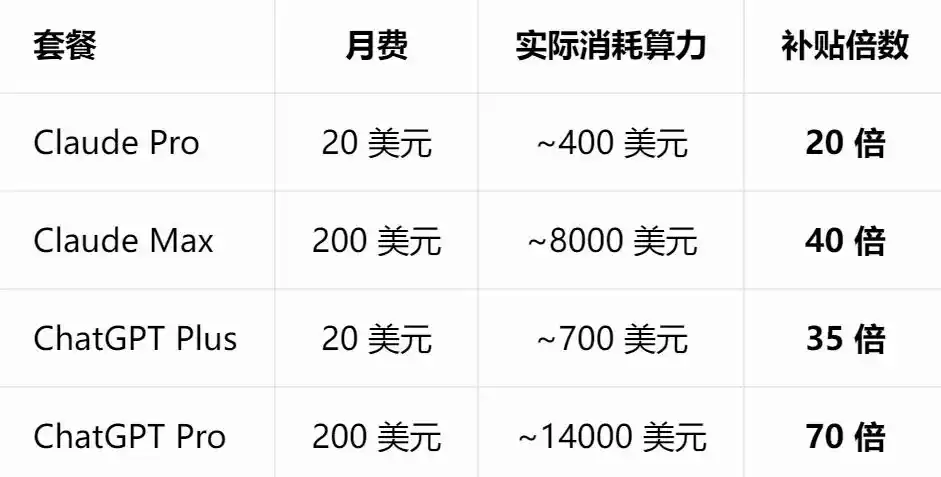
Note a pattern: the more expensive the plan, the higher the subsidy multiple. This itself indicates that these high-end plans are not meant for profit—they are a form of "reverse pricing," using the most aggressive losses to retain the heaviest users. Because heavy users are developers, enterprise decision-makers. Once they are locked into a platform, they bring along entire teams and product lines.

With losses this severe, why continue? The standard answer is: burn money first to gain scale, then raise prices to recoup after achieving scale. Mobile internet played this game—DiDi and Uber subsidized hundreds of billions of RMB in ride fares, and fares increased after subsidies ended; Meituan subsidized countless food deliveries, and delivery fees increased after subsidies ended. This logic hinges on one key premise: a lock-in effect was established during the subsidy period.

DiDi could raise prices because drivers couldn't leave the order flow on the platform, and passengers couldn't leave the drivers on the platform. Meituan could raise prices because merchants couldn't leave its traffic and delivery network. When subsidies ended, users were already "locked" into the ecosystem, making switching costs extremely high.

But the AI war differs fundamentally from the internet—Tokens have almost no lock-in effect.

If Claude raises prices, developers can migrate API calls to GPT or Gemini within a day—interfaces from different companies are becoming increasingly standardized, with many development frameworks even having built-in multi-model switching functions. It's even simpler for regular users: just change a URL. AI isn't like ride-hailing with its local driver network, or food delivery with its logistics system, or social media with its friend networks. A token is a token; no matter who produces it, it's the same thing.

This means that once subsidies stop, users can be lost instantly. Subsidies aren't "building moats"; they're more like "maintaining a heartbeat"—as soon as someone offers a lower price, users run.

And this hasn't even accounted for a new variable that's making everyone's bills spiral out of control: AI Agents.

When you chat with ChatGPT, a single conversation might consume a few thousand tokens. But when you have an AI Agent perform a complex task—writing a piece of code and debugging it automatically, analyzing a dozens-page document and generating a report—a single round can consume 5 to 30 times the tokens of a normal conversation. Developers have tested that on a $100 Claude Max plan, a single Agent programming session can burn through nearly $100 worth of tokens. Uber's CTO recently revealed that the company burned through its entire 2026 AI budget in just four months.

The question is, can such a Token Subsidy War continue? Who might be the ones left standing after the chaotic battle?

Bill Maris believes the answer is obviously the traditional giants.

02 Token as a Weapon

To understand the true brutality of this subsidy war, one must first see a structural asymmetry—the sources of ammunition for each combatant are completely different.

Google's annual ad revenue exceeds $300 billion. This isn't money from investors, not money raised and burned, but an automatic money-printing machine running daily. Billions of people worldwide open its search engine, watch YouTube, and use Gmail every day, and ad revenue flows into its account automatically. It doesn't need roadshows, doesn't need to please analysts, doesn't need to explain to anyone why it's spending this money.

Google using ad profits to subsidize AI tokens is like someone with an oil well fighting a gas station price war—his oil comes from his own land, while his opponents' oil is bought with bank loans.

OpenAI and Anthropic are those buying oil with loans.

OpenAI has raised over $180 billion cumulatively, with its latest valuation exceeding $850 billion. Anthropic has raised over $130 billion. This money comes from venture capital and strategic investors—they aren't giving money as charity; they expect these companies to go public, expect to get rich returns upon exit.

And after going public, the real trouble begins. Going public means financial statements are public to the world. Every quarter, Wall Street analysts will scrutinize revenue, profit, customer acquisition cost, and marginal cost. When they calculate that you actually lose $70 for every $1 of subscription fee you receive—even the most glorious growth story won't support the stock price.

Bill Maris spelled out this logic bluntly on the podcast. His exact words were: "If I were Google, and decided to arbitrarily cut token prices by 80%, what would happen to OpenAI and Anthropic's business models?"

The host pressed, asking how likely that was. Maris didn't hesitate: "100%. Capital as a weapon, tokens as a weapon."

This isn't analyst speculation. Bill Maris is the founder and CEO of Google Ventures, also a Google VP for Special Projects, having incubated Waymo and Google X. Everyone present understood: this isn't a hypothesis; this is him having seen firsthand how Google fights wars.

He painted a simple scenario: Google announces an 80% price cut for the Gemini API. What would enterprise customers do? If the product quality is similar—in many benchmark tests Gemini is already on par with Claude and GPT—but the price is four-fifths cheaper, would you continue using the expensive one?

Maris gave his own answer: "If you're a company, and you can pay 80% less at Google and Gemini for basically the same product, why wouldn't you? And then the pressure on those companies becomes very severe."

And OpenAI and Anthropic have almost no symmetrical means of retaliation. They cannot follow suit with price cuts—they have no money-printing machine; every dollar is investor money. They also cannot maintain a premium based on a technical gap—the gap between large models is shrinking rapidly; you might lead by three months today, and be caught up in three months. This isn't like the generational technological gap between the iPhone and Nokia. The moat between AI models is more like a sand dike; the tide rises and washes over it.

In Bill's narrative, Google has a big advantage, but in the AI world, can Google really monopolize? Meta can open-source a free model at any time, China has DeepSeek and ByteDance, Amazon is pushing its own model. When you drive token prices down to cabbage prices, the competitors don't disappear—they are also cutting prices.

The AI war might have no winner.

03 The "Infinite Game" of Tokens?

Even those unfamiliar with history might make the following judgment about the ultimate outcome of the current AI war:

The first is the "Internet Service" script—the DiDi story, the Amazon story: subsidize first, then monopolize, then raise prices to harvest. In this script, today's price war is just the prologue; one or two winners will eventually dominate most of the market and gain pricing power. If this is the case, the huge losses today are a worthwhile investment—just like Amazon lost money for two decades before finally becoming the dual titan of e-commerce and cloud computing.

The second is the "Utilities" script. Tokens become a standardized basic resource, like electricity, bandwidth, cloud storage. No one can maintain pricing power long-term because product differentiation is too small, switching costs too low. Competition drives prices infinitely towards the cost line, with profit margins approaching zero. Ultimately, governments might step in for regulation—just as they did with electricity and telecom a hundred years ago.

The dividing line between the two scripts depends on one word:

Lock-in.

DiDi could raise prices because passengers are locked into the driver network, and drivers are locked into the order flow. Amazon could raise prices because merchants are locked into its logistics and traffic ecosystem.

The lock-in effect is the cornerstone of the "lose first, earn later" model.

But AI tokens—as argued repeatedly above—have almost no lock-in. APIs are standardized, switching costs are practically zero. The core condition for the first script doesn't exist for the product that is tokens.

If the second script, the utilities/infrastructure endgame, is closer to reality, then what we are witnessing is not a war that will eventually have a winner, but an attrition race with no end.

Meituan founder Wang Xing once described this competitive state. His insight was: some competitions have no concept of "winning." The goal of participants isn't to defeat opponents, but to ensure they remain at the table. Because as long as you are still at the table, you can continue raising funds, hiring, iterating. Leaving the table is the only way to lose.

Re-examining today's AI landscape with this framework, many seemingly contradictory things suddenly become clear.

OpenAI's latest valuation exceeding $800 billion isn't because training models requires that much money. It needs that much money to continue fighting the price war. Raising funds isn't to win; it's to "qualify to keep fighting."

Google preparing to cut token prices by 80% isn't to eliminate OpenAI and Anthropic. It's to ensure it remains a core player in the AI era—just as it once ensured it wouldn't be left off the table in the mobile era by giving away Android for free.

And Anthropic raising the API pricing of its latest flagship model Fable 5 to double that of its predecessor—$10 per million tokens for input, $50 per million for output—seemingly "raising prices," is actually proactively filtering for enterprise customers willing to pay for high-end capabilities, because deep down it knows: the consumer-side subsidy war cannot be won against Google.

Every round of price war expands the scale of AI usage. Expanding scale means more data, more scenarios, more developers flooding into the ecosystem. This, in turn, makes all participants' models stronger. Combatants use the war itself to attract resources to upgrade themselves—this isn't a zero-sum, life-and-death battle, but a process where everyone becomes stronger through competition, but also one where no one is likely to make huge profits.

Doesn't this sound like what the electricity industry eventually became?

140 years ago, Edison and Westinghouse both thought they were fighting for a winner-takes-all market. They staked their entire fortunes, betting that "whoever defines the standard for electricity owns electricity." But the fate of electricity teaches us a simple truth:

When a technology is important enough, general enough, standardized enough, it no longer belongs to any single company. It belongs to the infrastructure.

On the surface, the AI competition seems to be Google vs. OpenAI vs. Anthropic, a contest of model capabilities, a comparison of fundraising scale. But zooming out, the real role of this competition is: it is accelerating the push of AI towards a level of infrastructure that no single company can monopolize.

When Bill Maris says "100% will happen," he might not just be predicting that Google will cut prices. He might be unconsciously predicting a larger trend—in the AI world, tokens ultimately won't belong to anyone. Just like no one "owns" electricity today.

For OpenAI and Anthropic, this means something unsettling: even with technological leadership, even after raising astronomical sums, the future of "making big money from AI" they are chasing might never have existed. They aren't facing a temporary price war, but a structural fate—the thing they are striving to build is, in essence, likely the next generation's water, electricity, and highways.

For users, to some extent, this might be good news. Because as long as the Token Subsidy War continues, people can still enjoy the "good deal" of $20 cost for $400 worth of computing power.

This article is from WeChat Official Account "GeekPark" (ID: geekpark), Author: Yu Hangyuan (Astronaut Ape)


Criptomoedas em alta

Perguntas relacionadas

QAccording to the article, what is the key difference between the 'internet service' subsidy model and the current AI token subsidy battle?

AThe key difference is the presence of a 'lock-in' effect. In the 'internet service' model (e.g., Didi, Meituan), heavy subsidies built moats like driver/order networks or merchant/delivery ecosystems, creating high switching costs for users. This allowed companies to raise prices later. However, AI tokens have almost no lock-in effect. APIs are standardized, and users (developers or individuals) can switch between models like GPT, Claude, or Gemini with minimal cost and effort, meaning subsidies do not build lasting user loyalty.

QWhy does Bill Maris believe Google has a significant advantage in the token price war, and what is his prediction?

ABill Maris believes Google has a significant advantage because its massive advertising revenue (over $300 billion annually) acts as a self-sustaining 'money printing press.' This allows Google to subsidize AI tokens using its own profits, unlike OpenAI or Anthropic, which rely on investor capital. He predicts with 100% certainty that Google could use 'capital as a weapon, tokens as a weapon' by slashing token prices by 80%, putting immense pressure on the business models of its cash-burning competitors.

QWhat are the two possible endgame scenarios ('scripts') for the AI token competition described in the article?

AThe two possible endgame scenarios are: 1. The 'Internet Service' script: Similar to Didi or Amazon, where initial subsidies lead to market monopoly/dominance, followed by price increases to recoup losses. 2. The 'Utilities' script: Where tokens become a standardized, commoditized resource like electricity or bandwidth. With minimal product differentiation and near-zero switching costs, competition drives prices down to the cost line, resulting in slim profits and potentially government regulation.

QHow does the article explain the concept of an 'infinite game' in the context of the AI competition, and what is the primary goal for companies within it?

AThe article explains the AI competition as an 'infinite game' where the goal is not to 'win' by defeating opponents, but to ensure one's company 'stays at the table.' As long as a company remains a player, it can continue to raise funds, hire talent, and iterate its technology. The primary objective is to avoid being the one forced to leave the competition entirely. This perspective reframes massive fundraising (like OpenAI's) not as capital to win, but as the 'qualification to keep playing.'

QWhat is the article's final conclusion about the long-term nature of AI tokens and the business prospects for leading AI companies like OpenAI and Anthropic?

AThe article's final conclusion is that AI tokens are destined to become a public infrastructure, similar to electricity or roads—a standardized, essential resource that no single company can own or monopolize. This implies a 'structural fate' for companies like OpenAI and Anthropic: the highly profitable future they are chasing by selling AI capabilities may not exist. Instead, they face a prolonged period of competition that drives prices toward cost, benefiting users with subsidized access but offering limited prospects for massive profits from the token itself.

Leituras Relacionadas

Base Under Pressure

**Title: The Pressure Mounts for Base** Base, the Ethereum Layer 2 scaling solution backed by Coinbase, is facing significant pressure and public scrutiny from its leadership following the launch of Robinhood Chain. Base co-founder Jesse Pollak recently acknowledged strategic missteps, admitting that the chain's past focus on social and creator tokens (e.g., through Farcaster, Zora) failed to deliver sustainable adoption. He has refocused on core infrastructure, handing leadership of the Base App back to Coinbase's Cobie. While Base remains a top L2 contender alongside OP Mainnet and Arbitrum, and boasts the highest TVL (nearly $12B), its weaknesses are being highlighted by the new competitor. Key criticisms include its slow progress on decentralization. Base has faced issues with its single sequencer causing block production halts, and L2BEAT is reportedly considering downgrading its decentralization rating from Stage 1 to Stage 0. This contrasts sharply with the rapid initial success of Robinhood Chain, whose DEX quickly entered the top five by volume. The leadership styles of the parent companies are also being compared: Robinhood's CEO actively engages with new projects, while a recent incident where Coinbase's Brian Armstrong briefly changed his profile picture—sparking and then crashing a related meme token—drew community ire and mockery. Pollak stated Base is working with Coinbase on tokenized stocks backed 1:1 by real equity, differentiating it from Robinhood's derivatives model. However, the article argues that Base's most urgent task is to address its long-standing technical and trust issues. With more traditional finance players likely to emulate Robinhood's path, Base must use this competitive pressure to solidify its position as long-term financial infrastructure.

Foresight NewsHá 7m

Base Under Pressure

Foresight NewsHá 7m

White House Concession Removes Ethical Hurdle, Clarity Act Races Against Final Window Before Recess?

On July 21st, industry sources reported that the Trump administration has agreed to include an ethics provision in the "Clarity Act" (Digital Asset Market Clarity Act of 2025). This concession addresses the long-standing conflict-of-interest concerns regarding government officials and the crypto industry, potentially removing the final major obstacle to the bill's progress. Additionally, Patrick Witt, the executive director of the White House's Digital Asset Advisory Committee, confirmed he will remain in his role to help finalize the bill, alleviating previous concerns about his potential departure. The Clarity Act aims to establish a unified federal regulatory framework for the U.S. digital asset market. Its core objective is to resolve regulatory ambiguity by defining different types of digital assets (digital commodities, investment contract assets, and permitted payment stablecoins) and clarifying the respective oversight roles of the SEC and CFTC. This would end the long-running jurisdictional dispute between the two agencies and provide clearer compliance paths for the industry. With the ethics issue moving toward resolution, the most urgent challenge now is time. The U.S. Congress is set to begin its August recess in mid-August, leaving only a few working weeks to finalize the text and advance the bill through the Senate. Industry advocates, like the Blockchain Association's Kristin Smith, stress that this is a critical moment. If negotiations conclude successfully in the coming weeks, the Clarity Act could pass a key hurdle before the recess; otherwise, it may face significant delays. If enacted, the Clarity Act could mark a historic turning point in crypto regulation. By providing a clearer and more predictable legal framework, it aims to reduce uncertainty for businesses, developers, and traditional financial institutions looking to enter the digital asset space, potentially setting a global benchmark for market structure regulation.

Odaily星球日报Há 13m

White House Concession Removes Ethical Hurdle, Clarity Act Races Against Final Window Before Recess?

Odaily星球日报Há 13m

AI Era, Industrial Revolution, and Future Civilization Interview — Zhang Dingwen: The Future Does Not Belong to Chasers

"AI Era, Industrial Revolution and Future Civilization: An Interview with Zhang Dingwen – The Future Does Not Belong to Those Who Chase" In this interview, entrepreneur Zhang Dingwen reflects on his entrepreneurial journey and philosophy, moving beyond discussions of financing or success to emphasize understanding the "era" itself. He argues that true entrepreneurs should not chase short-term trends ("winds"), but position themselves in the direction of long-term technological and societal evolution. Zhang shares key lessons from his early days, including the realization that user value does not automatically translate to commercial value. For him, the core of entrepreneurship is not building a company but constantly upgrading one's own "cognition" – the ability to interpret information, ask the right questions, and understand the underlying "causes" behind business outcomes, not just the effects. His thinking has evolved from a focus on creating good products to a strategic focus on building "entrances" – platforms that naturally connect users to digital services. He sees smart wearables, like watches, not merely as hardware but as potential future gateways combining technological, financial, social, and even fashion attributes to create sustained user relationships and ecosystems. Ultimately, Zhang's vision transcends individual products or companies. He discusses business competition in three stages: product, platform, and finally, "civilization" – where the greatest companies influence how society operates by defining new rules and ways of life. He believes the mission of a truly great enterprise is to solve problems of its time, build enduring trust, and contribute lasting value, leaving behind not just wealth but a positive impact on how the world works. The future, he concludes, belongs not to the fastest, but to those with the correct long-term direction and a commitment to continuous learning and evolution.

marsbitHá 24m

AI Era, Industrial Revolution, and Future Civilization Interview — Zhang Dingwen: The Future Does Not Belong to Chasers

marsbitHá 24m

Cryptocurrency & Stock Market Barometer丨Strategy Cash Reserves Increase to $3.23 Billion, Halting BTC Purchases; Vanguard and Other Asset Managers Increase Holdings in Strategy Stock (July 21)

Market Overview & Warnings: The article warns of high volatility in South Korean stocks and continued dependence on U.S. stocks on geopolitics. Chinese A-shares remain under pressure. It advises against using leverage in current equity markets. For crypto-linked stocks, most have limited growth except Robinhood, with caution advised. U.S. Stock Market: Bearish bets on U.S. stocks, particularly targeting AI-related companies, have reached record highs since 2010, signaling deep skepticism about the sustainability of the AI-driven rally. Tech and chip stocks led a market decline, with the Philadelphia Semiconductor Index potentially entering a bear market. Increased expectations for Federal Reserve interest rate hikes and geopolitical tensions contributed to the negative sentiment. Bitcoin Treasury Company Updates: * Strategy: Increased its cash reserves to $3.23 billion and paused Bitcoin purchases. Several major asset managers, including Vanguard Group and Capital Group, increased their holdings of Strategy (MSTR) stock. * Global corporate Bitcoin buying slowed significantly to just $1.33 million last week. * Other notable activity: Strive purchased 21 BTC; ORANGE JUICE raised $40 million for Bitcoin acquisitions; Bitcoin Japan Corp. raised $60 million, allocating $4.08 million for its first BTC purchase. Other Crypto Treasury Holdings: * Ethereum: BitMine increased its ETH holdings to 5.78 million, nearing its 5% of supply goal. Its total crypto assets, cash, and securities are valued at $11.5 billion. * Solana: No significant corporate treasury activity reported. * Altcoins: HypeStrat made no adjustments to its treasury; its mNAV ratio fell to a long-term low. (Note: This summary is for informational purposes only and does not constitute investment advice.)

marsbitHá 25m

Cryptocurrency & Stock Market Barometer丨Strategy Cash Reserves Increase to $3.23 Billion, Halting BTC Purchases; Vanguard and Other Asset Managers Increase Holdings in Strategy Stock (July 21)

marsbitHá 25m

Trading

Spot

Artigos em Destaque

Como comprar WAR

Bem-vindo à HTX.com!Tornámos a compra de WAR (WAR) simples e conveniente.Segue o nosso guia passo a passo para iniciar a tua jornada no mundo das criptos.Passo 1: cria a tua conta HTXUtiliza o teu e-mail ou número de telefone para te inscreveres numa conta gratuita na HTX.Desfruta de um processo de inscrição sem complicações e desbloqueia todas as funcionalidades.Obter a minha contaPasso 2: vai para Comprar Cripto e escolhe o teu método de pagamentoCartão de crédito/débito: usa o teu visa ou mastercard para comprar WAR (WAR) instantaneamente.Saldo: usa os fundos da tua conta HTX para transacionar sem problemas.Terceiros: adicionamos métodos de pagamento populares, como Google Pay e Apple Pay, para aumentar a conveniência.P2P: transaciona diretamente com outros utilizadores na HTX.Mercado de balcão (OTC): oferecemos serviços personalizados e taxas de câmbio competitivas para os traders.Passo 3: armazena teu WAR (WAR)Depois de comprar o teu WAR (WAR), armazena-o na tua conta HTX.Alternativamente, podes enviá-lo para outro lugar através de transferência blockchain ou usá-lo para transacionar outras criptomoedas.Passo 4: transaciona WAR (WAR)Transaciona facilmente WAR (WAR) no mercado à vista da HTX.Acede simplesmente à tua conta, seleciona o teu par de trading, executa as tuas transações e monitoriza em tempo real.Oferecemos uma experiência de fácil utilização tanto para principiantes como para traders experientes.

164 Visualizações TotaisPublicado em {updateTime}Atualizado em 2026.06.02

Como comprar WAR

Discussões

Bem-vindo à Comunidade HTX. Aqui, pode manter-se informado sobre os mais recentes desenvolvimentos da plataforma e obter acesso a análises profissionais de mercado. As opiniões dos utilizadores sobre o preço de WAR (WAR) são apresentadas abaixo.

活动图片