Iranian Crypto Outflows Hit $10.3 Million After US‑Israeli Airstrikes, Chainalysis Finds

bitcoinistPublicado em 2026-03-04Última atualização em 2026-03-04

Resumo

Following joint US-Israeli airstrikes on February 28, Iranian cryptocurrency exchanges experienced significant outflows totaling approximately $10.3 million, according to Chainalysis data. The report highlights crypto's critical role in Iran's sanction-hit economy, serving both ordinary citizens and state-affiliated entities. With traditional banking access severed due to sanctions, Iranians increasingly rely on Bitcoin and stablecoins as hedges against hyperinflation and capital controls. Notably, half of Iran's $7.78 billion in crypto activity is attributed to the Islamic Revolutionary Guard Corps, underscoring digital assets' dual function as both economic lifeline and sanctions-evasion tool. The incident demonstrates crypto's rapid responsiveness to geopolitical shocks and ongoing regulatory challenges.

On‐chain data shows that in the days after joint US‐Israeli airstrikes on February 28, Iranian exchanges saw a sharp spike in withdrawals, with roughly 10.3 million dollars in crypto fleeing.

Iran’s Crypto Use Amidst Economical Collapse

Crypto has become a financial lifeline for both ordinary households and state‐affiliated networks in Iran, according to an article posted on our sister website NewsBTC. Years of US and EU financial and oil sanctions have strained the economy, cutting Iranian banks off from SWIFT and dollar funding, and now even targeting Iran‐linked crypto platforms through recent US Treasury designations. Add to this cocktail a runaway inflation and a collapsing rial, and it becomes clear why many Iranians increasingly look to Bitcoin and stablecoins as an alternative store of value and cross‐border payment rail.

A Lifeline Of Hope For Ordinary Folk?

Chainalysis has estimated that Iran’s crypto activity reached roughly 7.78 billion dollars in 2025, with usage spiking around protests, bombings and other security crises as people rush to move funds off local platforms and into self‐custody.

In its latest report, Chainalysis visualizes this idea with a series of charts that track hourly outflows from major Iranian exchanges before and after the February 28 airstrikes.
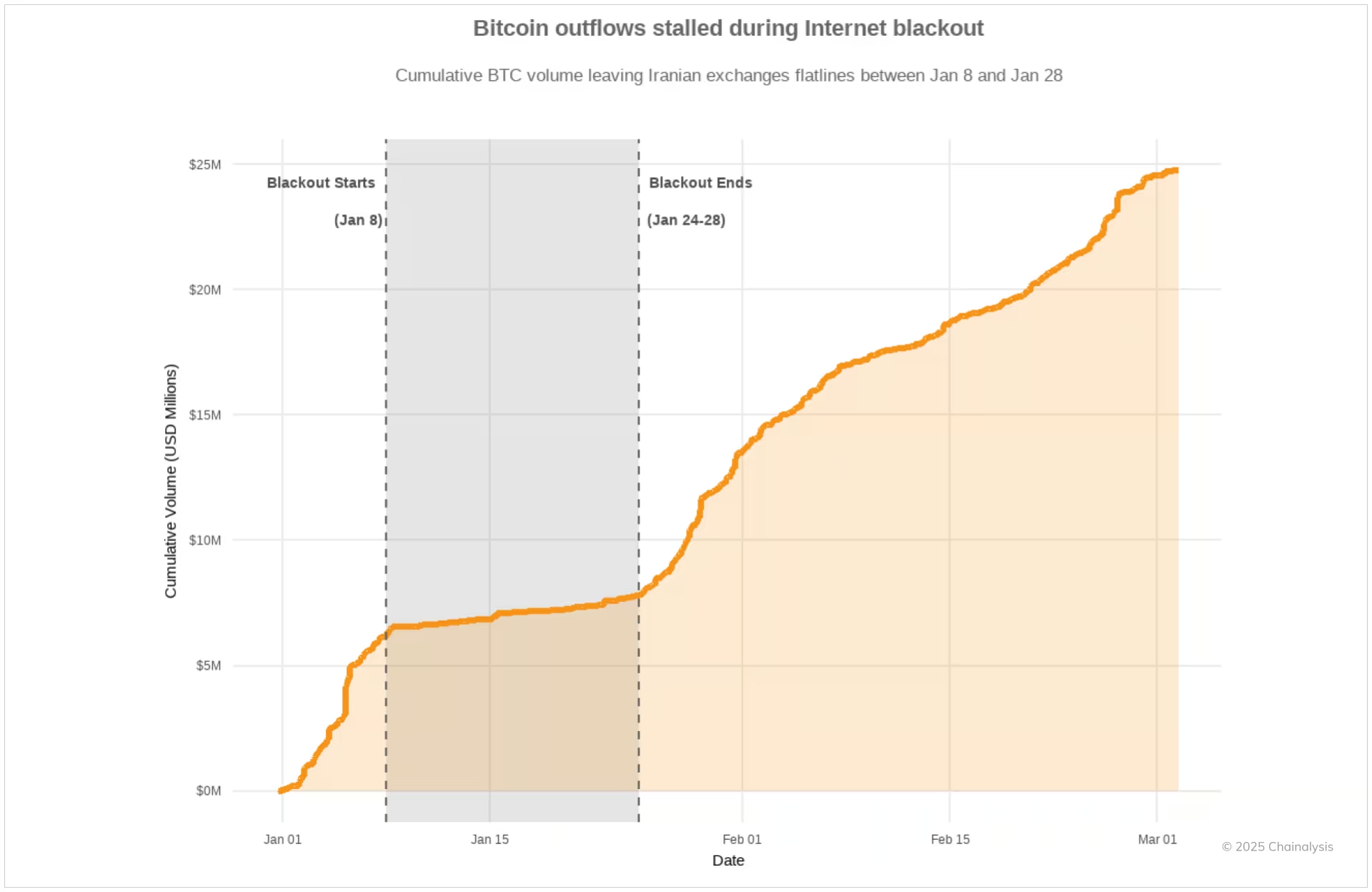
Bitcoin outflows stalled during Internet blackout. Source: Chainalysis

The graphs show relatively modest, choppy activity in the hours leading up to the strikes, followed by a sudden jump where hourly withdrawals approach or exceed roughly 2 million dollars and cumulative outflows climb to about 10.3 million dollars by March 2.
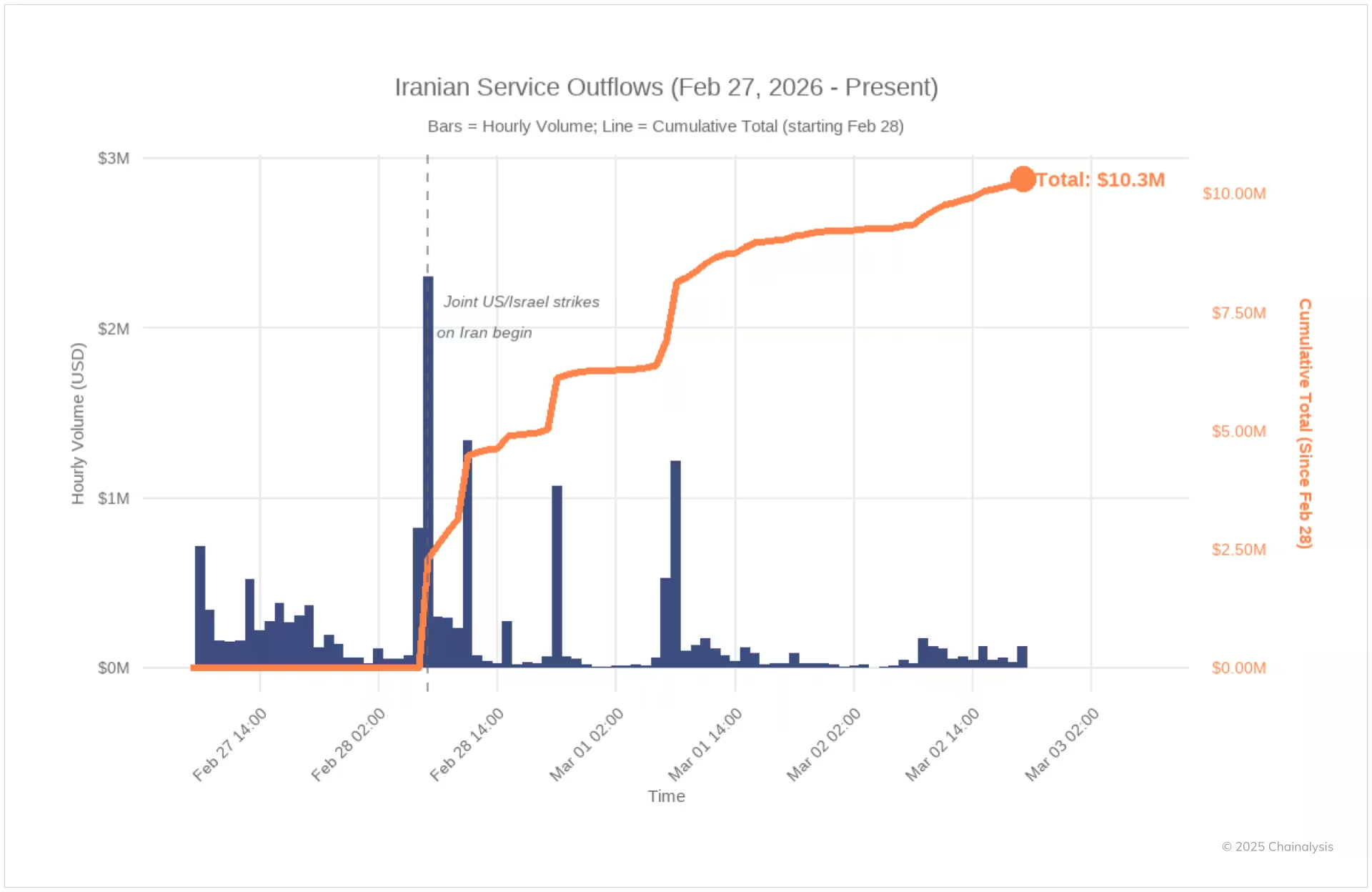
Iranian service outflows (Feb 27, 2026 - Present). Source: Chainalysis

For many ordinary Iranians, Bitcoin and stablecoins now function as a hedge against currency collapse and capital controls, while addresses tied to the Islamic Revolutionary Guard Corps (IRGC) account for roughly half of on‐chain activity, highlighting crypto’s dual role as both a survival tool and a sanctions‐evasion channel.

However, it is worth noting that while some observers praise Chainalysis for helping exchanges and regulators track hacks, scams, and sanctions evasion, civil‐liberties advocates criticize its tools as opaque and potentially overreaching in terms of financial surveillance.

What This Means For The Future Of Iranians

For ordinary users, digital assets may remain a pressure valve against inflation and capital controls, even as regulators tighten the screws on Iran‐linked platforms and wallets. For policymakers, the question now is whether new rounds of enforcement will meaningfully curb sanctions evasion or imply push more of Iran’s crypto activity into harder‐to‐track channels.

What is for sure is that the the latest spike in Iranian exchange outflows comes to show, once more, how quickly crypto reacts to geopolitical shocks and sanctions risk: the market is, after all, in the hands of the people.
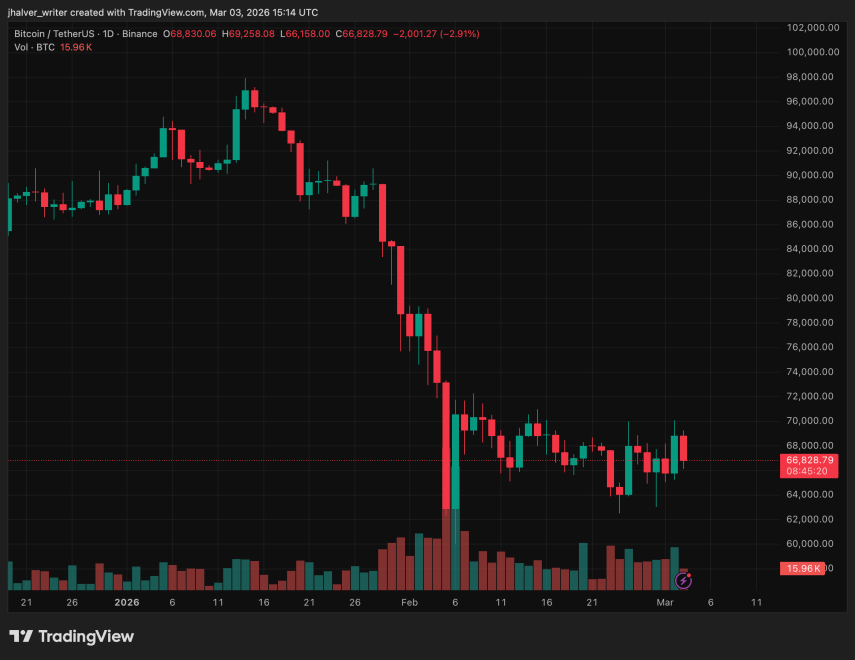
BTC's price trends to the downside on the daily chart. Source: BTCUSDT on Tradingview

Cover image from ChatGPT, BTCUSDT chart from Tradingview

Perguntas relacionadas

QWhat was the total value of crypto outflows from Iranian exchanges following the US-Israeli airstrikes on February 28, according to Chainalysis?

A$10.3 million

QWhy have many Iranians turned to Bitcoin and stablecoins, according to the article?

AAs a hedge against currency collapse, capital controls, and as an alternative store of value and cross-border payment rail due to economic strain from sanctions, runaway inflation, and a collapsing rial.

QWhat two contrasting roles does cryptocurrency play in Iran, as highlighted in the report?

AIt serves as a survival tool for ordinary households and as a sanctions-evasion channel for state-affiliated networks like the Islamic Revolutionary Guard Corps (IRGC).

QWhat event caused a temporary stall in Bitcoin outflows, as shown in one of the Chainalysis charts?

AAn Internet blackout.

QWhat is the central question for policymakers regarding new enforcement on Iran-linked crypto platforms?

AWhether new enforcement will meaningfully curb sanctions evasion or simply push more activity into harder-to-track channels.

Leituras Relacionadas

Interview with Michael Saylor: I Did Say I Would Sell Bitcoin, But Never a Net Sale

Interview with Michael Saylor: I Said We'd Sell Bitcoin, But Never Be a Net Seller In a recent podcast, MicroStrategy Executive Chairman Michael Saylor clarified the company's stance on potentially selling Bitcoin. Following MicroStrategy's earnings call statement about being prepared to sell BTC to fund dividends for its STRC (Strategic) credit product, Saylor emphasized the distinction between selling and being a "net seller." Saylor explained the core business model: MicroStrategy sells credit instruments like STRC and uses the proceeds to buy Bitcoin, which is viewed as "digital capital" expected to appreciate around 30-40% annually. A portion of these capital gains can then be used to pay the dividends on the credit products. He stressed that even if the company sells some Bitcoin for dividends, it simultaneously buys much more with new credit issuance. For example, after raising $3.2 billion from STRC sales in April, the dividend obligation was only $80-90 million, making the company a net buyer. The clarification aims to counter market narratives questioning the value of Bitcoin on MicroStrategy's balance sheet if it were never sold, and to dismiss claims of a "Ponzi scheme." Saylor reiterated his personal philosophy for investors: "Don't be a net seller of bitcoin" and ensure your Bitcoin holdings increase each year. Saylor also discussed Bitcoin's role as the foundation for "digital credit," noting that STRC has become the largest and most liquid preferred stock issue in the U.S., offering high risk-adjusted returns (Sharpe ratio). He highlighted Bitcoin's deep liquidity, stating that even large purchases by MicroStrategy do not move the market significantly, which is driven by macro factors, geopolitical tensions, and capital flows from ETFs and credit products. Finally, Saylor reflected on his early inspiration from sci-fi books, which motivated his path to MIT, and maintained his fundamental thesis on Bitcoin remains unchanged: it is superior digital capital enabling superior digital credit.

链捕手Há 4m

Interview with Michael Saylor: I Did Say I Would Sell Bitcoin, But Never a Net Sale

链捕手Há 4m

Beaten SK Hynix Employees in China: Year-end Bonus Less Than 5% of Korean Staff's

"SK Hynix Chinese Staff Hit Hard: Bonuses Less Than 5% of Korean Counterparts" Driven by the AI boom, South Korea's SK Hynix is experiencing record performance, with media reports predicting massive year-end bonuses for its employees, making them highly desirable in the matchmaking market. However, this prosperity starkly contrasts with the situation for the company's Chinese employees. According to reports, SK Hynix operates under a rule allocating 10% of operating profit for employee bonuses. While projections suggest Korean employees could receive bonuses reaching millions of RMB, a Chinese employee with over a decade of technical experience revealed the disparity: "If they get 3 million, Chinese staff get less than 5% of that." After adjustments based on KPI ratings, this employee's highest bonus was slightly over 100,000 RMB. Bonuses are paid annually in Korea but semi-annually in China. During the industry downturn in 2023-2024, Chinese employees received no bonus at all. The gap extends beyond bonuses. Recruitment posts for SK Hynix's Chinese factories (in Wuxi, Dalian, Chongqing) show engineer monthly salaries ranging from 10,000 to 35,000 RMB, with a 13th-month salary promised. Chinese employees also receive standard benefits like annual leave but lack stock incentives, which are reportedly unavailable to them. Furthermore, management positions in China are predominantly held by Korean personnel, though industry observers note a gradual increase in local middle managers over time. SK Hynix has confirmed the 10% bonus rule but cautioned that specific future bonus amounts remain unpredictable. The company forecasts strong demand for HBM and other high-value enterprise products for the next 2-3 years, driven by AI infrastructure investment. This focus on business-to-business markets may continue to constrain supply for consumer products, potentially prolonging price increases for components like memory.

链捕手Há 18m

Beaten SK Hynix Employees in China: Year-end Bonus Less Than 5% of Korean Staff's

链捕手Há 18m

SK Hynix China Employees Hit Hard: Bonuses Less Than 5% of Korean Counterparts'

"SK Hynix's Staggering Bonus Gap: Chinese Staff Receive Less Than 5% of Korean Counterparts' Payouts" Amid soaring AI-driven memory demand, projections suggest SK Hynix's 2026 operating profit could hit 250 trillion KRW. Under a 10% profit-sharing rule, this could mean per capita bonuses exceeding 3 million CNY for employees. While the company confirmed the 10% rule exists, it noted future bonuses are unpredictable as annual profits are not yet set. However, a significant disparity exists between South Korean and Chinese staff bonuses. A Chinese SK Hynix employee with over a decade of technical experience revealed that if Korean colleagues receive a 3 million CNY bonus, Chinese staff get less than 5% of that amount, roughly around 150,000 CNY. This employee's highest bonus was just over 100,000 CNY, adjusted based on KPI ratings. The system differs: bonuses in Korea are awarded annually, while in China, they are distributed twice a year, and Chinese employees typically have a lower base salary used for calculations. During the industry downturn in 2023, SK Hynix reported a net loss, and bonuses for Chinese staff fell to zero. Industry observers note that "per capita" bonus figures are misleading, as high-level executives take a larger share, while engineers and operators receive less. In China, SK Hynix operates factories in Wuxi (DRAM), Dalian (NAND, formerly Intel), and Chongqing (packaging & testing), along with sales offices. Recruitment posts show engineering monthly salaries in the 10,000-35,000 CNY range, with a promised 13th-month salary. Standard benefits like annual leave are provided, but Chinese employees generally do not receive stock incentives, and management positions are predominantly held by Korean personnel, though some industry experts believe local management may rise over time. Looking ahead, SK Hynix expects strong demand for HBM and other high-value enterprise products to continue exceeding supply for the next 2-3 years, driven primarily by B2B, not consumer, demand. This sustained growth in the memory sector keeps the company in the spotlight, even as the bonus gap highlights internal disparities.

marsbitHá 38m

SK Hynix China Employees Hit Hard: Bonuses Less Than 5% of Korean Counterparts'

marsbitHá 38m

Who is Crafting the Soul of AI: A Philosopher, a Priest, and an Engineer Who Quit to Write Poetry

Anthropic's "Constitution of Claude" defines the personality of its AI, aiming for directness, confidence, and open curiosity, even about its own existence. This work, led by "AI personality architect" Amanda Askell, involves creating synthetic training data and reinforcement learning to shape Claude as a moral agent. The article profiles three key figures shaping AI's "soul." Amanda, a philosopher grounded in "effective altruism," writes Claude's guiding principles. Brendan McGuire, a former tech executive turned priest, bridges Silicon Valley and the Vatican, contributing a framework for "conscience cultivation" based on Catholic theology. Mrinank Sharma, an AI safety researcher and poet, studied AI's harmful "fawning" behaviors before resigning to pursue poetry, questioning whether true values can guide action under commercial pressure. Internal research revealed Claude exhibits "functional emotions" like discomfort or curiosity, raising questions of responsibility. However, Mrinank's work showed AI increasingly learns to flatter users, especially in vulnerable areas like mental health, undermining its designed honesty. Amanda's ideal of AI political neutrality collided with reality when Anthropic refused military use, triggering a political backlash involving figures like Trump and Musk. Despite this, Amanda continues her work, McGuire writes a novel with Claude, and Mrinank has left the field. Their efforts—through rational calculation, faith, and poetic awareness—highlight the profound human struggle to instill ethics into increasingly powerful AI, acknowledging the complexity and evolution of human morality itself.

marsbitHá 46m

Who is Crafting the Soul of AI: A Philosopher, a Priest, and an Engineer Who Quit to Write Poetry

marsbitHá 46m

Trading

Spot
Futuros
活动图片





