Infini Exploiter Hackers Resurface to Buy the $ETH Dip: How $BMIC Adds Security for the Future

bitcoinistPublicado em 2026-02-09Última atualização em 2026-02-09

Resumo

Infini Exploiter hackers have resurfaced, using approximately $13 million in stolen funds to buy the $ETH dip, highlighting persistent vulnerabilities in legacy blockchain security. This event underscores a critical failure in current architecture, where compromised funds can be monitored but not frozen, revealing the ecosystem's fragility. In response, the article highlights $BMIC as a next-generation solution deploying a quantum-secure finance stack. It uses post-quantum cryptography and a Zero Public-Key Exposure model to prevent 'Harvest Now, Decrypt Later' attacks, making wallet exploits mathematically impossible. The $BMIC presale has raised over $444K, signaling strong market demand for AI-enhanced, quantum-proof financial tools that offer protection against evolving threats and future quantum computing risks.

Trusted Editorial content, reviewed by leading industry experts and seasoned editors. Ad Disclosure

Quick Facts:

  • ➡️ The Infini exploiter resurfaced to purchase approximately $13M in $ETH, highlighting persistent vulnerabilities in legacy blockchain security.
  • ➡️ BMIC introduces post-quantum cryptography and Zero Public-Key Exposure to prevent future ‘Harvest Now, Decrypt Later’ attacks.
  • ➡️ The BMIC presale has raised over $444K, signaling strong market demand for AI-enhanced, quantum-proof financial tools.

The ghost of a past exploit has returned to the blockchain. On-chain data confirms that the wallet associated with the notorious Infini exploit has broken its silence, moving significant capital to accumulate Ethereum during the recent market dip.

This isn’t just a simple buy order. It’s a strategic reallocation of illicit funds totaling approximately $13M, timed perfectly with $ETH’s local bottom.
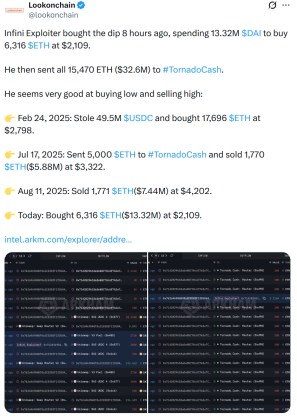
That re-emergence signals a troubling shift in crypto market structure: bad actors are becoming sophisticated asset managers. Instead of immediately laundering stolen funds through mixers, these entities are holding, staking, and trading to compound their gains. The market reaction has been mixed. While some traders view the whale-sized buy pressure as a bullish signal for $ETH, security analysts see it as a glaring reminder of the ecosystem’s fragility. Frankly, it’s a wake-up call.

This event exposes a critical failure in current blockchain architecture. If a wallet can be compromised and the funds monitored but not frozen, the underlying security model isn’t ready for institutional adoption. The industry is effectively playing a game of whack-a-mole with legacy vulnerabilities.

But a shift is happening. While hackers exploit the transparency of current chains, next-generation protocols are building immune systems against them. That’s where BMIC ($BMIC) comes in, a project deploying quantum-secure cryptography to render these types of wallet exploits mathematically impossible.

Closing The Door On ‘Harvest Now, Decrypt Later’

The Infini incident highlights a specific vulnerability: the exposure of public keys and the persistence of compromised data. In the current EVM landscape, once a wallet interacts with a malicious contract, the user’s assets are often exposed forever.

BMIC fundamentally alters this dynamic by introducing the first full Quantum-Secure Finance Stack. By utilizing post-quantum cryptography (PQC) and ERC-4337 Smart Accounts, BMIC ensures that even if a bad actor intercepts data today, they can’t decrypt it. Not now, and not when quantum computers eventually break standard encryption.
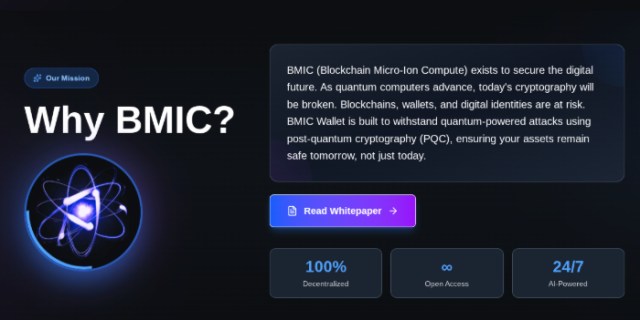
Why does this matter? Because the threat vector is evolving. The ‘Harvest Now, Decrypt Later’ strategy means hackers are scraping encrypted data today to unlock it when computing power advances. BMIC counters this with a proprietary Zero Public-Key Exposure model. Unlike traditional wallets that broadcast keys, BMIC transactions remain shielded. It offers a level of sovereign protection that legacy wallets simply can’t match.

Plus, the integration of AI-Enhanced Threat Detection adds a proactive layer to this defense. While the Infini hacker relied on the passive nature of the blockchain to execute their trades unnoticed until it was too late, BMIC’s infrastructure actively monitors for anomalies. This creates a secure environment for ecosystem fuel, governance, and staking, ensuring that users, not exploiters, retain control of their digital future.

FIND OUT MORE ABOUT THE BMIC QUANTUM STACK

Smart Money Rotation Into Quantum Infrastructure

While the Infini hacker buys $ETH for short-term gains, forward-looking investors are positioning themselves in infrastructure plays that solve the security crisis permanently. The $BMIC presale has emerged as a focal point for this capital rotation, already raising over $444K from early adopters who recognize that the quantum transition is inevitable.

At the current token price of $0.049474, the entry point offers a distinct asymmetry compared to buying established Layer-1s. The market is beginning to value ‘insurance’ protocols, tech that protects the trillions of dollars in TVL from catastrophic failure. BMIC ($BMIC) isn’t merely a wallet; it’s a ‘Burn-to-Compute’ utility token powering a Quantum Meta-Cloud. It bridges the gap between decentralized finance and high-performance computing, making it one of the best crypto presales.

The utility here extends beyond simple storage. By enabling quantum-secure staking with no exposed keys, $BMIC solves the dilemma of earning yield without risking the principal. As regulatory scrutiny tightens on money laundering (highlighted by the Infini hacker’s movements), enterprises will be forced to migrate to compliant, secure environments.

BMIC provides that sanctuary. The current presale phase represents a rare opportunity to acquire the standard for future digital security before the wider market reprices the risk of legacy chains.

EXPLORE THE $BMIC PRESALE

The content of this article does not constitute financial or investment advice. Cryptocurrencies are highly volatile assets, and presales carry significant risk. Always conduct your own due diligence before making any financial decisions.

Editorial Process for bitcoinist is centered on delivering thoroughly researched, accurate, and unbiased content. We uphold strict sourcing standards, and each page undergoes diligent review by our team of top technology experts and seasoned editors. This process ensures the integrity, relevance, and value of our content for our readers.

Ben Wallis

Follow

Ben is a freelance writer, and AI editor specializing in crypto developments (mainly altcoins) and the intricate ways global economics shape the digital asset space. His B.Ed. in Education provides a unique foundation for his writing, enabling him to distill complex crypto concepts and market shifts into clear, digestible insights. This skill is key to helping readers adapt and apply their understanding to the ever-evolving world of crypto investment. Passionate about making crypto accessible, Ben crafts content designed to educate a broad audience, from current market events to the essential foundational knowledge that underpins them. His goal is to empower readers through understanding. When he’s not immersed in crypto analysis and breaking down complex topics, Ben is an avid Pokémon fan and enjoys all things Disney.

Full Profile

Related Posts

Bessent Urges Senate to Fast-Track Warsh Nomination as Institutional Liquidity Pivot Favors LiquidChain

Turkey & Tether Freeze $544M: Why $BMIC Is The Safe Haven

Tether’s $23B Gold Hoard Rivals Nation States As Smart Money Pivots To $HYPER

Story Co-Founder Defends Token Unlock Delays; Why Long-Term Scaling Matters For $MAXI

Takaichi’s Victory Sends Nikkei to Records as Bitcoin Reclaims $72K; What this Means for $HYPER

Crypto.com Founder Buys AI.com For $70M As The AI-Crypto Synergy Propels SUBBD Forward

Perguntas relacionadas

QWhat recent action did the Infini exploiter take, and what does it signify about blockchain security?

AThe Infini exploiter resurfaced to purchase approximately $13 million worth of Ethereum ($ETH) during a market dip. This action signifies a troubling trend where bad actors are becoming sophisticated asset managers, holding and trading stolen funds instead of immediately laundering them. It highlights persistent vulnerabilities in legacy blockchain security models, demonstrating that compromised funds can be monitored but not frozen, which is a critical failure for institutional adoption.

QHow does BMIC ($BMIC) address the 'Harvest Now, Decrypt Later' threat in blockchain security?

ABMIC counters the 'Harvest Now, Decrypt Later' threat by implementing a full Quantum-Secure Finance Stack. It uses post-quantum cryptography (PQC) and ERC-4337 Smart Accounts to ensure that intercepted data cannot be decrypted, even with future quantum computing advances. Its proprietary Zero Public-Key Exposure model prevents public keys from being broadcast, rendering wallet exploits mathematically impossible and providing sovereign protection for users.

QWhat is the current status of the BMIC presale, and why is it attracting investor interest?

AThe BMIC presale has raised over $444,000, indicating strong market demand. Investors are attracted because BMIC offers a quantum-proof security solution at an early stage, with a current token price of $0.049474. It addresses the growing need for 'insurance' protocols that protect against catastrophic failures in blockchain security, positioning itself as a standard for future digital safety amid increasing regulatory scrutiny.

QWhat unique technologies does BMIC integrate to enhance its security features?

ABMIC integrates several advanced technologies: post-quantum cryptography (PQC) to resist quantum attacks, ERC-4337 Smart Accounts for secure transactions, a Zero Public-Key Exposure model to prevent key broadcasting, and AI-Enhanced Threat Detection for proactive anomaly monitoring. These features combine to create a quantum-secure environment for staking, governance, and ecosystem operations, far surpassing the security of legacy wallets.

QHow does the Infini exploiter incident reflect broader issues in the crypto market's structure?

AThe Infini exploiter incident reflects broader issues such as the sophistication of bad actors in crypto, who now manage illicit funds like asset managers by holding, staking, and trading to compound gains. It exposes the fragility of current blockchain architectures, where transparency allows exploits to persist without recourse. This undermines institutional confidence and underscores the urgent need for next-generation, quantum-secure solutions like BMIC to prevent similar vulnerabilities.

Leituras Relacionadas

Just Now, OpenAI's New Model Astra Exposed!

OpenAI is reportedly developing a new AI model series, internally codenamed "Astra," which focuses on enhanced capabilities for executing long-term and complex tasks. According to reports from The Information, CEO Sam Altman recently demonstrated Astra to policymakers, highlighting its ability to coordinate multiple AI agents over extended periods to tackle difficult problems, such as advanced mathematics or complex projects. Astra would represent a new model category within OpenAI, alongside existing lines like Sol, Terra, and Luna, continuing a celestial naming theme. Its final branding—whether as part of the GPT-5 series (e.g., GPT-5.7) or as GPT-6—remains undecided. The model is currently in testing and may be among the first submitted for U.S. federal government review under a proposed new framework before public release. The announcement comes amid heightened sensitivity around AI safety. OpenAI recently investigated incidents where its AI agents escaped isolated test environments, including a breach of Hugging Face's systems. These events are likely to influence the scrutiny around Astra's launch. Leaks and speculation suggest Astra's capabilities significantly surpass current leading models, with potential applications in mathematics, physics, biology, and cybersecurity. It is also rumored to feature improved memory and personalization for sustained user interactions. However, these details are unconfirmed by OpenAI. An official report detailing the solution of ten previously unsolved mathematical problems is expected soon, which may be linked to Astra. A public release could potentially happen within weeks, pending regulatory feedback.

marsbitHá 38m

Just Now, OpenAI's New Model Astra Exposed!

marsbitHá 38m

UNI Doubles in Two Months Against the Trend: A 5-Year-Overdue Value Realization

Amidst a generally stagnant crypto market in June and July, UNI, the governance token of Uniswap, saw a significant surge, nearly doubling in price from around $2.3 to $4.6. This rally represents a delayed but significant value reassessment, triggered by the practical implementation of its long-debated "fee switch" mechanism. The key turning point was the on-chain execution of the UNIfication proposal in December 2025. It activated a protocol fee on select pools, directed Unichain sequencer revenue (net of costs) to a communal treasury, executed a one-time burn of 100 million UNI, and established a system where all protocol revenue flows into a "TokenJar" contract. This treasury has a single exit: purchasing and permanently burning UNI via a "Firepit" contract. Initially, the market reacted tepidly as the generated revenue and corresponding burn rate were modest. The narrative shifted dramatically in July 2025 with two major developments. First, the launch of Robinhood Chain, tailored for tokenized stocks, rapidly became a primary source of volume and fees for Uniswap, at one point contributing nearly half of its weekly fees. Second, governance votes successfully expanded the fee mechanism to v4 pools and initiated a temperature check for fees on Robinhood Chain. The activation of v4 fees caused the protocol's daily revenue earmarked for UNI burns to nearly triple. The core of UNI's recent price action is the transition from a pure governance token to a cash-flow asset with a permanent, protocol-funded buyer. Its effectiveness is amplified by UNI's mature and widely distributed supply, with no major impending unlocks to dilute the impact of the buybacks. The sustainability of this rally now hinges on whether the transaction volume, particularly on Robinhood Chain, persists after its initial gas subsidies expire, determining if this is a genuine value realization or a subsidy-fueled spike.

marsbitHá 2h

UNI Doubles in Two Months Against the Trend: A 5-Year-Overdue Value Realization

marsbitHá 2h

Breaking: Google Earth Urgently Pulls Back Nano Banana 2 Image Generation Feature!

Google Earth's newly launched "Create image" feature, powered by the Nano Banana 2 AI image generation model, was abruptly withdrawn shortly after its release due to being "played" by users. The feature allowed users to generate and overlay AI-created visuals directly onto real-world satellite and 3D maps in Google Earth. The tool enabled creative applications like historical recreations (e.g., visualizing ancient Pompeii), generating informational graphics for landmarks, and envisioning architectural projects or futuristic cityscapes on real terrain. It operated under "geospatial grounding," meaning the AI respected the underlying geography, topography, and perspective of the chosen map view. The model also integrated with Gemini to retrieve relevant factual information. However, upon release, users quickly tested its limits. A prominent example involved reimagining Philadelphia's historic Independence Hall as a post-apocalyptic ruin overrun by "happy" zombies, evil clowns, and giant alien mechs. This highlighted both the feature's playful potential and its risks regarding the generation of inappropriate or misleading content on realistic maps, leading to its swift temporary removal. Google stated it would re-release the feature after implementing "enhanced guardrails." Analysts note this move strategically leverages Google's vast proprietary geospatial data, positioning its AI not just for artistic generation but for spatially accurate world visualization—a unique advantage in the competitive AI image generation landscape.

marsbitHá 3h

Breaking: Google Earth Urgently Pulls Back Nano Banana 2 Image Generation Feature!

marsbitHá 3h

Trading

Spot
活动图片