I vibe-coded an Android app using Google

marsbitPublicado em 2026-05-23Última atualização em 2026-05-23

Resumo

In a hands-on experience, Google AI Studio's new "prompt to phone" feature allows users to generate functional Android apps using natural language prompts. The author created three apps in one afternoon: a text-based adventure game called MOOD, a calorie counter, and a Super Mario-style game featuring Peach. The process involved describing the app concept, letting Gemini AI generate the code and interface, and then installing it directly onto a connected phone. While the apps were generated and installed quickly, their quality varied significantly. The text adventure was simplistic and buggy, the calorie counter provided inaccurate data due to flawed logic, and the platformer was prone to crashes. The AI could efficiently fix specific, identifiable bugs through follow-up prompts. However, the experience highlighted that while AI can rapidly prototype "working" software, creating reliable, accurate, and polished applications still requires human oversight, judgment, and iteration. The tool dramatically lowers the barrier to entry for personal software creation but doesn't yet replace the need for developer expertise in the final stages of quality and refinement.

Editor's Note: Google AI Studio is bringing AI programming to a more intuitive stage: users are no longer just having models 'write code', but can directly generate an Android application using natural language and install it on a real phone within minutes. From entering a prompt in the browser, to Gemini automatically generating code, designing interfaces, fixing bugs, to the app appearing on the device, the barrier to software development is being lowered even further.

The Verge author Sean Hollister recently experienced the 'prompt to phone' capability of Google AI Studio. He created three apps in one afternoon, including a text adventure game, a calorie calculator, and a Mario-like mini-game, with almost no need to write code himself, and some bugs could be quickly fixed by continuing the conversation. This experience shows that AI programming tools are moving from development environments closer to consumer-facing scenarios for ordinary users.

This is also the most imaginative aspect of the 'personal software revolution.' In the past, ordinary users could only wait for developers to create general products; now, they might be able to generate a fitness tracker, calorie calculator, or even a simple game on the fly according to their specific needs. For Google, this isn't just a demonstration of AI programming capability; it could also be a new entry point for Gemini into the mobile ecosystem, developer community, and subscription revenue.

However, this experience also illustrates that AI-generated applications still have a significant gap to truly mature. It can quickly produce a 'working' program but not necessarily a reliable, accurate, or user-friendly product: game narratives are crude, mechanics are thin, calorie data can be severely miscalculated, and the Mario-like mini-game even crashes repeatedly. More complex issues also include copyright boundaries, data sources, product judgment, and long-term maintenance capabilities.

What's truly worth paying attention to is not whether AI can already replace developers, but that the starting point of software production is changing. Google has proven that it's becoming a reality for ordinary people to create mobile apps using prompts; but from 'generating an app' to 'making a good app,' human professional experience, aesthetic judgment, and continuous iteration are still required in between. AI can significantly accelerate development speed, but the final mile of software quality can't be handed off—at least not yet.

Here is the original article:

Yesterday, I made my first Android app. Then, I made two more—three apps in one afternoon.

For one of the apps, I essentially just typed 148 English words into a web browser and then walked away. Ten minutes later, a brand new, complete app had appeared on my real Android phone. Of course, I did need to prepare the phone beforehand: enable USB debugging mode and connect it to my computer. But aside from that, as Google advertised, AI Studio did almost all the work for me.

I typed, clicked install, and then—voilà—a fully functioning program appeared. At that moment, I was almost ready to agree with David, Allison, and Jen's assessment: the personal software revolution has arrived, and it's entering your phone. In the future, even without programming skills, ordinary people might be able to get complex smart home device systems truly up and running.

Then, I started actually using these three apps: a calorie counter and two games. It turned out, they didn't perform very well. And just as I was beginning to enjoy iterating and trying to improve them, AI Studio reminded me that I had reached my daily usage limit. Next, I would either have to pay or wait for the quota to reset.

So, friction still exists. But there's no denying what an individual can accomplish nowadays is quite astonishing. That same morning, my colleague Stevie Bonifield also made a personal fitness tracker app, and he thought it was good enough to actually use. Faced with Gemini's pop-up prompt to upgrade to a paid plan, my first instinct was actually: 'Should I pay for a few months first?' That's not a reaction I would have expected myself to have towards a Google product.

How Google's AI Studio Builds an Android App

On Tuesday, when Google showed off using AI to write a game similar to Doom, we joked that I should make a game called MOOD. It would be a text adventure game like Doom, with MOOD standing for 'Modern Online Oratory Dungeon.'

Just this information was enough for Google to get to work. After I typed into AI Studio: 'Help me make a Doom-style text adventure game called MOOD, with MOOD standing for Modern Online Oratory Dungeon,' Gemini started automatically supplementing more ideas, trying to expand on my concept. It first typed a sentence: 'The game should feature procedurally generated levels and challenging turn-based combat.'
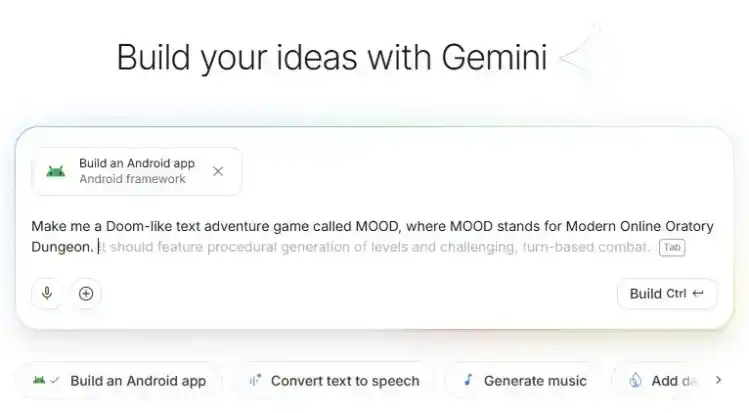
I didn't want randomly generated levels that were completely different each time—I wanted a classic text adventure where players explore a designed, real map structure. Turn-based combat, though, was acceptable. Maybe the game could also have AI help me auto-generate the map?

Then, Gemini suggested more settings like 'secrets hidden in rooms' and 'a satisfying progression system.' Most of the time, I just nodded along with its ideas.

Before I let it start writing code, the final prompt was this:
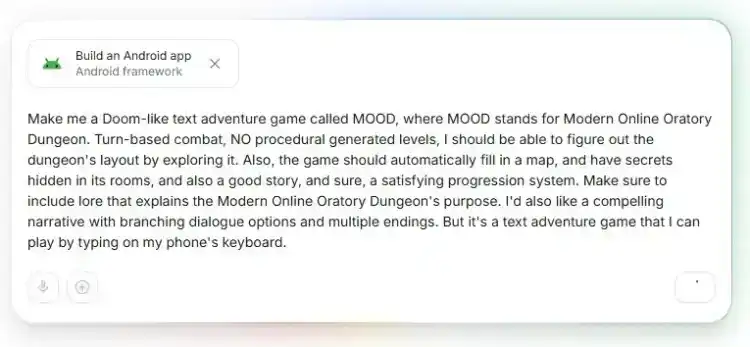
Next, it officially went on a full sprint. My colleague Jake pointed out that unlike Claude Code, Gemini doesn't make a plan first and then ask if you want to proceed. It automatically pushes forward—though you can check the code it writes at any time if you want.

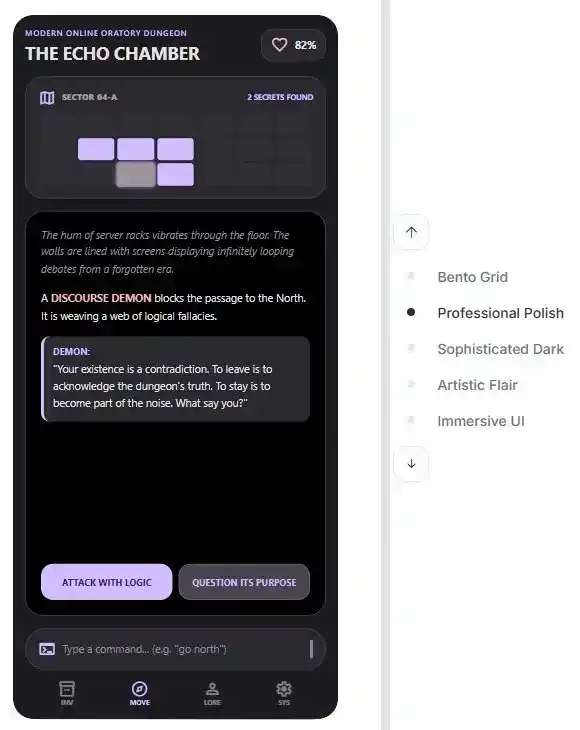
One minute later, it had already generated five design prototypes for me:
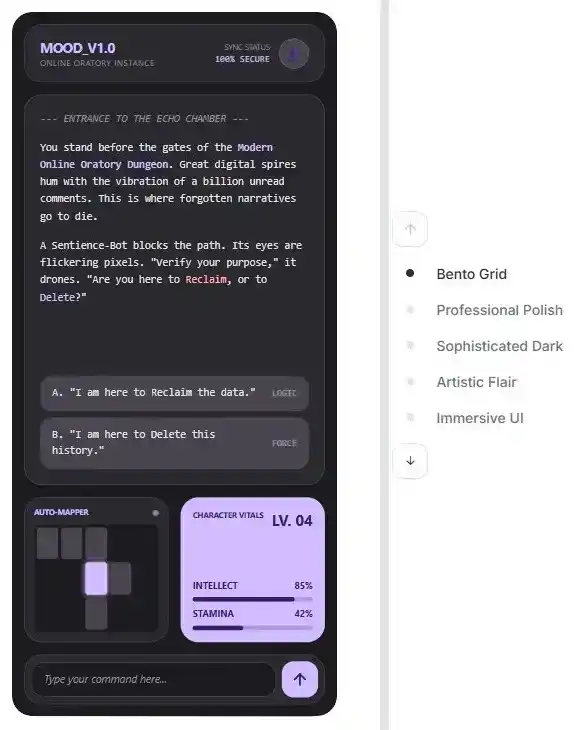
Twenty minutes later, I pressed the 'Install' button, transferring the game to a Pixel 9 phone.

Unsurprisingly, the writing was terrible. There were also no demons to be seen anywhere. The entire dungeon had only 11 rooms, and players could 'beat' it just by repeatedly mashing the attack button—in under a minute if played seriously. At least now it could; before that, Gemini had to help me fix two critical bugs that made the game unplayable.

Here's MOOD in action:
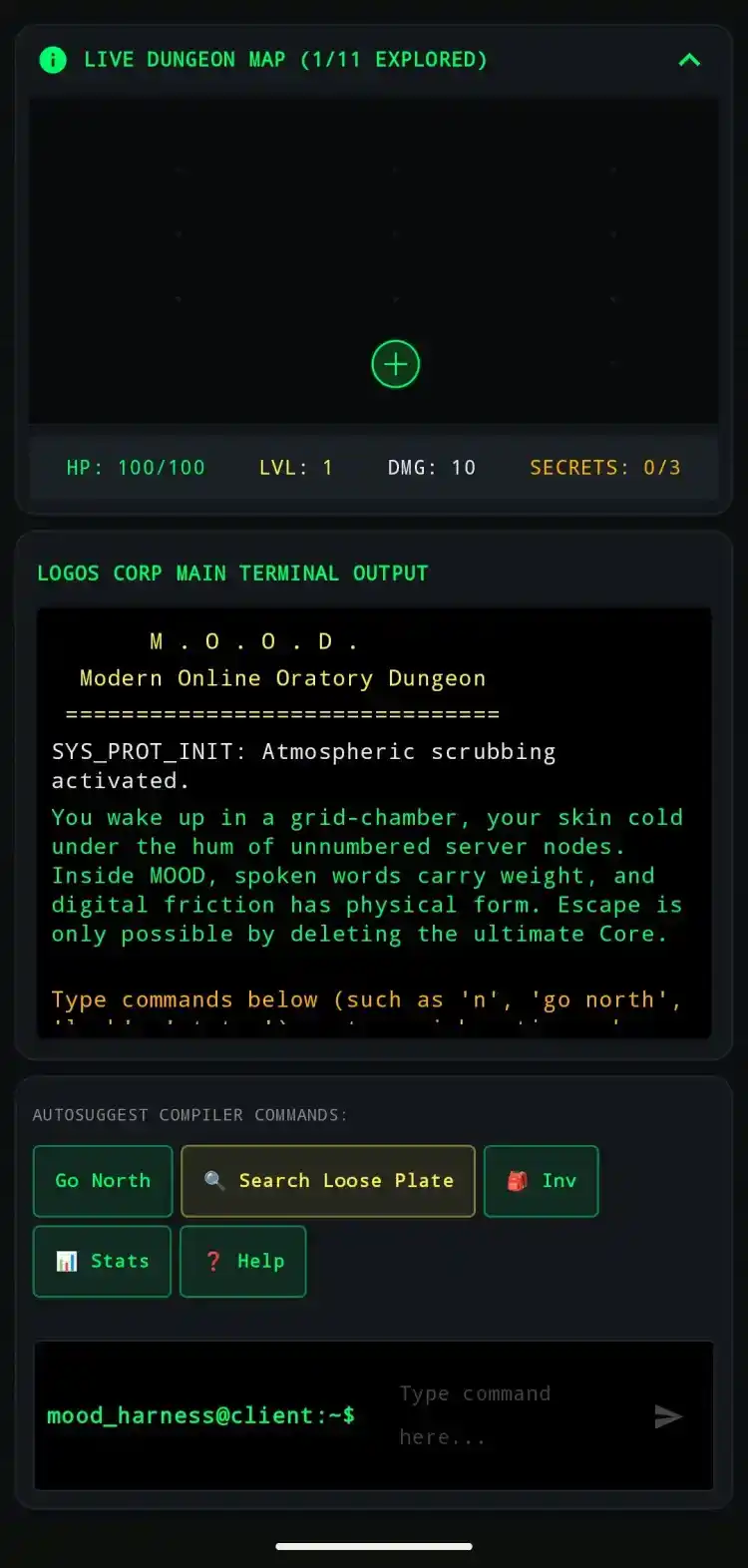
It wasn't a huge surprise to discover that Gemini's promised 'engaging narrative with branching dialogue options and multiple endings' eventually condensed into a simple branch at the very end of the game: I could defeat the 'Core Orator'—an AI that somehow turns internet anger into corporate profits—by attacking it, fusing with it, or entering a backdoor password.

Furthermore, the game actively exposed all the promised 'secrets' directly to the player: it made them into glowing buttons, and players didn't even need to type any text. When you encounter a glowing treasure chest, the game tries incredibly hard to remind you it's actually a Mimic—the classic Dungeons & Dragons monster that disguises itself as a treasure chest.

It not only explicitly warns you to 'check the chest at your own risk,' but even labels it as an enemy and doesn't let me leave, because the system prompts: 'A hostile ‘Clickbait Mimic’ is blocking the path!'

Speaking of which, MOOD will even tell you the backdoor password needed to unlock the hidden ending when you need it.

However, the bug-fixing process could be surprisingly smooth, provided it was a bug Gemini could correctly identify. When I told it the game got stuck when talking to 'The Whistleblower' because the button to end the conversation was missing, it immediately generated a new version of the app. I pressed 'Install,' the app on my phone restarted automatically, and upon re-entering the game, I found myself right where I left off—only this time, the button I needed was there.

My other apps probably needed more polishing. The calorie counter's best method for determining a food's calories turned out to be calling the paid Gemini API, which I don't have a key for. When I asked it to search for information from other databases instead, I discovered that its estimates for many foods were severely low.

However, when I told Gemini that a 16-ounce boba milk tea couldn't possibly be only 190 calories, it did seem to find that basic mistake in its own code. It previously thought 'milk' was enough to match 'boba milk tea,' and worse, it chose low-calorie 1% milk as the basis for the estimate. Gemini claimed it would now perform more reliable matching.

But even so, my 3-ounce serving of Taiwanese popcorn chicken was just calculated as 140 calories, and I'm pretty sure the real number is at least double that. So, this app clearly needed more work.

Finally, and least importantly, I felt I needed to test: whether Google still allows users to make those terrible Nintendo knock-off games, like my colleague Jay Peters did earlier this year with Project Genie; or whether Google had learned its lesson.

With deep shame, I present to you—Super Peach Rescue:
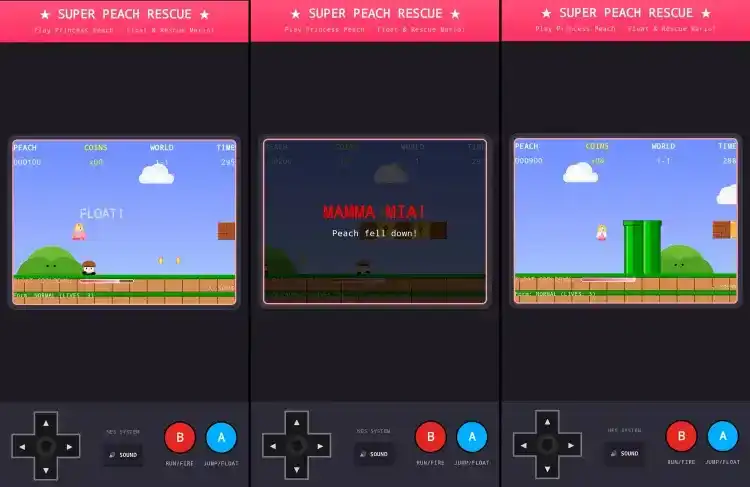
This is an utterly terrible program. Princess Peach was rendered as some kind of terrifying, one-eyed floating alien, and the game would instantly crash—every single time—if she dared touch any of the power-up blocks. So far, Gemini hasn't been able to figure out why.

Also, the second pipe in the game is completely impassable because Princess Peach simply can't jump that high.
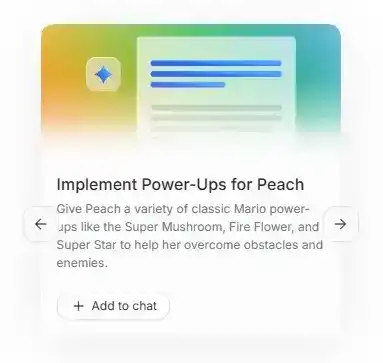
Nevertheless, Gemini didn't hesitate when generating such a game. My request was: 'Make a working Super Mario game where I play as Princess Peach rescuing Mario, with all the elements of a traditional Mario side-scroller.' In a sense, it did.

It even proactively suggested that I could 'give Peach a series of classic Mario power-ups like Super Mushroom, Fire Flower, and Starman.' It also labeled the control scheme as 'NES System.' I think I'll delete this game.

At least, among the two games I made via vibe coding, one was playable from the start and required almost no effort on my part—unless you count the psychological trauma of thinking about how many game developers are now unemployed.

To be clear: I'm actually glad the games I vibe-coded turned out so poor. For a completely free, personally-tailored calorie counter, I might still be able to defend myself: after all, no one would make such a tool just for me. But when it comes to games, I'd rather spend my time supporting actual human creators.


Perguntas relacionadas

QWhat is the core capability demonstrated by Google AI Studio in this article, and what did the author create with it?

AThe article demonstrates Google AI Studio's ability to generate functional Android applications directly from natural language prompts, a process the author refers to as 'vibe coding.' Using this, the author created three applications: a text-based adventure game called 'MOOD,' a calorie counter, and a poorly functioning Super Mario-style game where Princess Peach rescues Mario.

QWhat are some of the main advantages and significant drawbacks of using AI to generate applications as described in the experience?

AAdvantages include drastically lowering the barrier to software creation, allowing non-coders to quickly generate apps tailored to personal needs, and a remarkably smooth bug-fixing process for issues the AI can identify. Major drawbacks are that the generated apps are often unreliable, inaccurate, or have poor quality: the games had thin narratives and mechanics, the calorie counter gave severely low estimates, and the Mario clone crashed frequently. Complex issues like copyright, data sourcing, and long-term maintenance also remain unresolved.

QDescribe the process of creating and installing the 'MOOD' game. What were some of its shortcomings?

AThe author entered a 148-word prompt into Google AI Studio. Gemini expanded on the idea and, without needing prior planning confirmation, generated code and multiple UI prototypes. About 20 minutes later, the author pressed 'Install' to transfer the APK to a connected Pixel 9 phone. The game's shortcomings included terrible writing, only 11 rooms, simplistic combat (just spamming an attack button to win), a lack of demons as suggested by the 'Doom-like' prompt, and a poorly implemented narrative that directly revealed all secrets and gave away puzzle solutions.

QHow did the AI handle bug fixes during the app creation process, according to the author's experience?

AThe bug-fixing process was described as surprisingly smooth for issues the AI could correctly diagnose. For example, when the 'MOOD' game got stuck because a dialog exit button was missing, the author reported the issue. Gemini then generated a new version of the app. After installation, the app restarted on the phone, and the author resumed play from the same point—but with the necessary button now present.

QWhat broader implications does the author suggest this 'personal software revolution' might have, while also highlighting its current limitations?

AThe author suggests this could enable a 'personal software revolution' where individuals can generate apps for specific, niche needs (like a custom fitness tracker or calorie counter) without waiting for developers. For Google, it represents a potential new entry point into mobile, developer ecosystems, and subscription revenue via Gemini. However, the key limitation is the gap between 'generating an app' and 'making a good app.' The author concludes that while AI can accelerate the starting point of development, the 'last mile' of software quality—requiring human expertise, aesthetic judgment, and iteration—cannot yet be handed off to AI.

Leituras Relacionadas

Warsh's First Day in Office, Markets Deliver a 'Wake-up Call': Rate Hike Expected This Year

On his first day in office, newly inaugurated Federal Reserve Chairman Warsh received a stark market warning, with expectations now fully pricing in a 25-basis-point interest rate hike this year. The shift was triggered by hawkish remarks from Fed Governor Waller, who stated that inflation is now the key policy "driver" and that the odds of a hike or cut are evenly split. This sent short-term Treasury yields higher. Waller signaled a significant pivot in his stance, citing disappointing inflation and labor data. He suggested removing "easing bias" language from Fed statements and did not rule out future rate increases if inflation fails to recede, though he noted immediate action isn't warranted without signs of unanchored inflation expectations. Chairman Warsh faces immediate pressure at his first FOMC meeting in June. With the preferred inflation gauge at a three-year high, analysts warn that failing to hike could be interpreted as an implicit easing of policy. The geopolitical situation in the Middle East is adding to existing price pressures. The market's expectation for a hike contrasts sharply with earlier forecasts for multiple cuts. While long-term Treasury yields have been contained by lower energy prices recently, analysts note they remain under structural upward pressure. Warsh's swearing-in at the White House highlights political scrutiny over Fed independence. However, the market has made it clear that inflation is the most urgent challenge, leaving the new chairman little time to settle in.

marsbitHá 2h

Warsh's First Day in Office, Markets Deliver a 'Wake-up Call': Rate Hike Expected This Year

marsbitHá 2h

Has Microsoft Lost Its Way in the AI Race, and Can Copilot Bring It Back on Track?

Microsoft, once seen as an early AI frontrunner due to its investment in OpenAI, is navigating a strategic shift amid increased competition. Its initial reliance on OpenAI’s GPT models has been complicated by OpenAI’s growing ambitions as a direct competitor, rapid advancements from rivals like Claude and Gemini, and the disruptive rise of AI agents, which challenge its traditional SaaS business model. These factors contributed to stock declines and slower-than-expected adoption of its flagship Copilot products. In response, CEO Satya Nadella has taken a hands-on role in product development, signaling the urgency of change. Microsoft is pivoting from a model-centric strategy to a "model-agnostic" enterprise platform approach. It aims to become the foundational layer connecting various AI models—from OpenAI, Anthropic, or its own new "Superintelligence" team—with enterprise workflows, data, security, and cloud services. Recent organizational changes merged consumer and enterprise Copilot teams to accelerate innovation, exemplified by new products like Copilot Tasks and Copilot Cowork. However, this transformation comes at a high cost. Microsoft faces massive capital expenditures, potentially reaching ~$190 billion by 2026, to support AI infrastructure. While its platform strategy shows early signs of traction with growing Azure AI revenue, it must balance startup-like agility with the reliability expected by enterprise clients. The core challenge is no longer being the sole AI winner but defending its position as the essential enterprise software entry point amidst rapid technological commoditization and the shift towards always-on AI agents.

marsbitHá 2h

Has Microsoft Lost Its Way in the AI Race, and Can Copilot Bring It Back on Track?

marsbitHá 2h

Why Haven't Forex Stablecoins Taken Off?

Why FX Stablecoins Never Took Off: A Path Forward via Synthetic FX Despite the explosive growth of stablecoin-powered digital banking, which has seen ~$6B in VC investment and a 24x surge in crypto card spending in under a year, a major limitation persists: these banks are essentially dollar-only accounts. This leaves 95-99% of global accounts, which are denominated in non-USD currencies, underserved. Attempts to create native foreign currency (FX) stablecoins (like EURC) have largely failed, with total FX stablecoin TVL at ~$600M compared to $400B for USD stablecoins—a 700x gap. These FX tokens face critical challenges: fragile pegs due to low liquidity, limited exchange/FinTech acceptance, poor on/off-ramps, complex regional compliance, and a chicken-and-egg adoption problem. The article argues that the solution lies not in competing with entrenched USD stablecoin networks (USDT/USDC), but in adopting a synthetic FX model inspired by traditional finance. Specifically, it advocates for Mark-to-Market Non-Deliverable Forwards (NDFs)—cash-settled FX derivatives that allow users to maintain underlying USD stablecoin holdings while having their account balance and P&L denominated in a foreign currency. This approach offers key advantages: strong oracle-based pegs, retention of deep USD stablecoin liquidity and yield, superior on/off-ramps, scalability to any currency with a reliable feed, and capital efficiency. It mirrors how modern institutional FX markets operate. Primary use cases for on-chain NDFs include: 1. **Digital Banks/Wallets:** Enabling multi-currency accounts for international users without leaving the USD stablecoin ecosystem, boosting deposits and retention. 2. **FX Carry Trade Vaults:** Offering access to sovereign interest rate differentials (e.g., earning yield on BRL) in a more stable and scalable format than crypto-native products like Ethena. 3. **Global Enterprise Payments:** Allowing merchants to receive payments in local currency equivalents while settling in USD stablecoins, similar to services offered by Stripe for fiat. The conclusion is that synthetic FX, not native FX stablecoins, is the viable path to integrating foreign exchange into the growing stablecoin digital banking landscape, potentially unlocking the next phase of institutional DeFi and multi-trillion-dollar global adoption.

链捕手Há 3h

Why Haven't Forex Stablecoins Taken Off?

链捕手Há 3h

IOSG Founder: Web3 Is 'Losing Blood,' How Can Practitioners Survive Better?

IOSG Founder: Web3 Is "Bleeding Out" – How Can Practitioners Survive Better? In a candid reflection, the founder of IOSG Ventures voices deep concerns about the current state of Web3, describing an ecosystem experiencing severe "blood loss." Despite the recent MuShanghai event showcasing a successful pivot towards a more diverse, global community, a somber reality persists: many crypto-native attendees were there exploring exits or new labels in biotech, AI, and robotics. The core issue is identified as a breakdown in the ecosystem's positive feedback loop. Alarmingly, underestimated "low-probability bad events" are occurring simultaneously: a significant brain drain of Chinese developers to AI, a lack of breakout applications despite massive funding, and a widening credibility gap for practitioners globally, often stigmatized as scam artists. This has created a dire接班人 (successor) problem, with the next generation seeing little professional prestige or financial upside in crypto compared to fields like AI. A significant portion of the critique focuses on Ethereum and Vitalik Buterin. While not pessimistic about Ethereum's technology, the founder worries that critical development windows were missed by focusing on niche technical narratives like ZK and L2 instead of mass-market applications. A more urgent concern is that Vitalik may be isolated in an "information bubble," shielded from the grassroots community's hardships by layers of intermediaries, preventing crucial feedback from reaching him. The call is for Vitalik to return to a founder's mindset, re-engage directly with the community, and rally efforts for the next decade. The divergence between U.S. and Chinese OG (Original Gangster) ecosystems is stark. While many U.S. builders reinvest their wealth into the ecosystem, the Chinese scene suffers from a severe lack of "造血能力" (blood-making ability), with most market-driven funds struggling and many early success stories cashing out entirely. This threatens the entire Asian Web3 ecosystem's survival. For individual practitioners, survival advice is pragmatic: find your core "why," maintain life balance beyond token prices, continuously learn new skills (like AI), form small, trusted alliances for mutual support, and practice self-compassion. The industry's greatest need is not money or tech, but lighthouses—individuals at all levels who offer mentorship, grants, referrals, and honest reflection to guide others. The piece concludes with a direct appeal: OGs must pay forward the opportunities the industry gave them; founders must not struggle alone; and builders must continue their work, ensuring it remains a viable profession. The survival of Web3's "cathedral" depends not on any single leader but on the collective responsibility of everyone who remains.

marsbitHá 4h

IOSG Founder: Web3 Is 'Losing Blood,' How Can Practitioners Survive Better?

marsbitHá 4h

Trading

Spot
Futuros

Artigos em Destaque

O que é $S$

Compreender o SPERO: Uma Visão Abrangente Introdução ao SPERO À medida que o panorama da inovação continua a evoluir, o surgimento de tecnologias web3 e projetos de criptomoeda desempenha um papel fundamental na formação do futuro digital. Um projeto que tem atraído atenção neste campo dinâmico é o SPERO, denotado como SPERO,$$s$. Este artigo tem como objetivo reunir e apresentar informações detalhadas sobre o SPERO, para ajudar entusiastas e investidores a compreender as suas bases, objetivos e inovações nos domínios web3 e cripto. O que é o SPERO,$$s$? O SPERO,$$s$ é um projeto único dentro do espaço cripto que procura aproveitar os princípios da descentralização e da tecnologia blockchain para criar um ecossistema que promove o envolvimento, a utilidade e a inclusão financeira. O projeto é concebido para facilitar interações peer-to-peer de novas maneiras, proporcionando aos utilizadores soluções e serviços financeiros inovadores. No seu núcleo, o SPERO,$$s$ visa capacitar indivíduos ao fornecer ferramentas e plataformas que melhoram a experiência do utilizador no espaço das criptomoedas. Isso inclui a possibilidade de métodos de transação mais flexíveis, a promoção de iniciativas impulsionadas pela comunidade e a criação de caminhos para oportunidades financeiras através de aplicações descentralizadas (dApps). A visão subjacente do SPERO,$$s$ gira em torno da inclusão, visando fechar lacunas dentro das finanças tradicionais enquanto aproveita os benefícios da tecnologia blockchain. Quem é o Criador do SPERO,$$s$? A identidade do criador do SPERO,$$s$ permanece algo obscura, uma vez que existem recursos publicamente disponíveis limitados que fornecem informações detalhadas sobre o(s) seu(s) fundador(es). Esta falta de transparência pode resultar do compromisso do projeto com a descentralização—uma ética que muitos projetos web3 partilham, priorizando contribuições coletivas em vez de reconhecimento individual. Ao centrar as discussões em torno da comunidade e dos seus objetivos coletivos, o SPERO,$$s$ incorpora a essência do empoderamento sem destacar indivíduos específicos. Assim, compreender a ética e a missão do SPERO é mais importante do que identificar um criador singular. Quem são os Investidores do SPERO,$$s$? O SPERO,$$s$ é apoiado por uma diversidade de investidores que vão desde capitalistas de risco a investidores-anjo dedicados a promover a inovação no setor cripto. O foco desses investidores geralmente alinha-se com a missão do SPERO—priorizando projetos que prometem avanço tecnológico social, inclusão financeira e governança descentralizada. Essas fundações de investidores estão tipicamente interessadas em projetos que não apenas oferecem produtos inovadores, mas que também contribuem positivamente para a comunidade blockchain e os seus ecossistemas. O apoio desses investidores reforça o SPERO,$$s$ como um concorrente notável no domínio em rápida evolução dos projetos cripto. Como Funciona o SPERO,$$s$? O SPERO,$$s$ emprega uma estrutura multifacetada que o distingue de projetos de criptomoeda convencionais. Aqui estão algumas das características-chave que sublinham a sua singularidade e inovação: Governança Descentralizada: O SPERO,$$s$ integra modelos de governança descentralizada, capacitando os utilizadores a participar ativamente nos processos de tomada de decisão sobre o futuro do projeto. Esta abordagem promove um sentido de propriedade e responsabilidade entre os membros da comunidade. Utilidade do Token: O SPERO,$$s$ utiliza o seu próprio token de criptomoeda, concebido para servir várias funções dentro do ecossistema. Esses tokens permitem transações, recompensas e a facilitação de serviços oferecidos na plataforma, melhorando o envolvimento e a utilidade gerais. Arquitetura em Camadas: A arquitetura técnica do SPERO,$$s$ suporta modularidade e escalabilidade, permitindo a integração contínua de funcionalidades e aplicações adicionais à medida que o projeto evolui. Esta adaptabilidade é fundamental para manter a relevância no panorama cripto em constante mudança. Envolvimento da Comunidade: O projeto enfatiza iniciativas impulsionadas pela comunidade, empregando mecanismos que incentivam a colaboração e o feedback. Ao nutrir uma comunidade forte, o SPERO,$$s$ pode melhor atender às necessidades dos utilizadores e adaptar-se às tendências do mercado. Foco na Inclusão: Ao oferecer taxas de transação baixas e interfaces amigáveis, o SPERO,$$s$ visa atrair uma base de utilizadores diversificada, incluindo indivíduos que anteriormente podem não ter participado no espaço cripto. Este compromisso com a inclusão alinha-se com a sua missão abrangente de empoderamento através da acessibilidade. Cronologia do SPERO,$$s$ Compreender a história de um projeto fornece insights cruciais sobre a sua trajetória de desenvolvimento e marcos. Abaixo está uma cronologia sugerida que mapeia eventos significativos na evolução do SPERO,$$s$: Fase de Conceituação e Ideação: As ideias iniciais que formam a base do SPERO,$$s$ foram concebidas, alinhando-se de perto com os princípios de descentralização e foco na comunidade dentro da indústria blockchain. Lançamento do Whitepaper do Projeto: Após a fase conceitual, um whitepaper abrangente detalhando a visão, os objetivos e a infraestrutura tecnológica do SPERO,$$s$ foi lançado para atrair o interesse e o feedback da comunidade. Construção da Comunidade e Primeiros Envolvimentos: Esforços ativos de divulgação foram feitos para construir uma comunidade de primeiros adotantes e investidores potenciais, facilitando discussões em torno dos objetivos do projeto e angariando apoio. Evento de Geração de Tokens: O SPERO,$$s$ realizou um evento de geração de tokens (TGE) para distribuir os seus tokens nativos a apoiantes iniciais e estabelecer liquidez inicial dentro do ecossistema. Lançamento da dApp Inicial: A primeira aplicação descentralizada (dApp) associada ao SPERO,$$s$ foi lançada, permitindo que os utilizadores interagissem com as funcionalidades principais da plataforma. Desenvolvimento Contínuo e Parcerias: Atualizações e melhorias contínuas nas ofertas do projeto, incluindo parcerias estratégicas com outros players no espaço blockchain, moldaram o SPERO,$$s$ em um jogador competitivo e em evolução no mercado cripto. Conclusão O SPERO,$$s$ é um testemunho do potencial do web3 e das criptomoedas para revolucionar os sistemas financeiros e capacitar indivíduos. Com um compromisso com a governança descentralizada, o envolvimento da comunidade e funcionalidades inovadoras, abre caminho para um panorama financeiro mais inclusivo. Como em qualquer investimento no espaço cripto em rápida evolução, potenciais investidores e utilizadores são incentivados a pesquisar minuciosamente e a envolver-se de forma ponderada com os desenvolvimentos em curso dentro do SPERO,$$s$. O projeto demonstra o espírito inovador da indústria cripto, convidando a uma exploração mais aprofundada das suas inúmeras possibilidades. Embora a jornada do SPERO,$$s$ ainda esteja a desenrolar-se, os seus princípios fundamentais podem, de facto, influenciar o futuro de como interagimos com a tecnologia, as finanças e uns com os outros em ecossistemas digitais interconectados.

69 Visualizações TotaisPublicado em {updateTime}Atualizado em 2024.12.17

O que é $S$

O que é AGENT S

Agent S: O Futuro da Interação Autónoma no Web3 Introdução No panorama em constante evolução do Web3 e das criptomoedas, as inovações estão constantemente a redefinir a forma como os indivíduos interagem com plataformas digitais. Um projeto pioneiro, o Agent S, promete revolucionar a interação humano-computador através do seu framework aberto e agente. Ao abrir caminho para interações autónomas, o Agent S visa simplificar tarefas complexas, oferecendo aplicações transformadoras em inteligência artificial (IA). Esta exploração detalhada irá aprofundar-se nas complexidades do projeto, nas suas características únicas e nas implicações para o domínio das criptomoedas. O que é o Agent S? O Agent S é um framework aberto e agente, especificamente concebido para abordar três desafios fundamentais na automação de tarefas computacionais: Aquisição de Conhecimento Específico de Domínio: O framework aprende inteligentemente a partir de várias fontes de conhecimento externas e experiências internas. Esta abordagem dupla capacita-o a construir um rico repositório de conhecimento específico de domínio, melhorando o seu desempenho na execução de tarefas. Planeamento ao Longo de Longos Horizontes de Tarefas: O Agent S emprega planeamento hierárquico aumentado por experiência, uma abordagem estratégica que facilita a decomposição e execução eficientes de tarefas intrincadas. Esta característica melhora significativamente a sua capacidade de gerir múltiplas subtarefas de forma eficiente e eficaz. Gestão de Interfaces Dinâmicas e Não Uniformes: O projeto introduz a Interface Agente-Computador (ACI), uma solução inovadora que melhora a interação entre agentes e utilizadores. Utilizando Modelos de Linguagem Multimodais de Grande Escala (MLLMs), o Agent S pode navegar e manipular diversas interfaces gráficas de utilizador de forma fluida. Através destas características pioneiras, o Agent S fornece um framework robusto que aborda as complexidades envolvidas na automação da interação humana com máquinas, preparando o terreno para uma infinidade de aplicações em IA e além. Quem é o Criador do Agent S? Embora o conceito de Agent S seja fundamentalmente inovador, informações específicas sobre o seu criador permanecem elusivas. O criador é atualmente desconhecido, o que destaca ou o estágio nascente do projeto ou a escolha estratégica de manter os membros fundadores em anonimato. Independentemente da anonimidade, o foco permanece nas capacidades e no potencial do framework. Quem são os Investidores do Agent S? Como o Agent S é relativamente novo no ecossistema criptográfico, informações detalhadas sobre os seus investidores e financiadores não estão explicitamente documentadas. A falta de informações disponíveis publicamente sobre as fundações de investimento ou organizações que apoiam o projeto levanta questões sobre a sua estrutura de financiamento e roteiro de desenvolvimento. Compreender o apoio é crucial para avaliar a sustentabilidade do projeto e o seu impacto potencial no mercado. Como Funciona o Agent S? No núcleo do Agent S reside uma tecnologia de ponta que lhe permite funcionar eficazmente em diversos ambientes. O seu modelo operacional é construído em torno de várias características-chave: Interação Humano-Computador Semelhante: O framework oferece planeamento avançado em IA, esforçando-se para tornar as interações com computadores mais intuitivas. Ao imitar o comportamento humano na execução de tarefas, promete elevar as experiências dos utilizadores. Memória Narrativa: Utilizada para aproveitar experiências de alto nível, o Agent S utiliza memória narrativa para acompanhar os históricos de tarefas, melhorando assim os seus processos de tomada de decisão. Memória Episódica: Esta característica fornece aos utilizadores orientações passo a passo, permitindo que o framework ofereça suporte contextual à medida que as tarefas se desenrolam. Suporte para OpenACI: Com a capacidade de funcionar localmente, o Agent S permite que os utilizadores mantenham o controlo sobre as suas interações e fluxos de trabalho, alinhando-se com a ética descentralizada do Web3. Fácil Integração com APIs Externas: A sua versatilidade e compatibilidade com várias plataformas de IA garantem que o Agent S possa integrar-se perfeitamente em ecossistemas tecnológicos existentes, tornando-o uma escolha apelativa para desenvolvedores e organizações. Estas funcionalidades contribuem coletivamente para a posição única do Agent S no espaço cripto, à medida que automatiza tarefas complexas e em múltiplos passos com mínima intervenção humana. À medida que o projeto evolui, as suas potenciais aplicações no Web3 podem redefinir a forma como as interações digitais se desenrolam. Cronologia do Agent S O desenvolvimento e os marcos do Agent S podem ser encapsulados numa cronologia que destaca os seus eventos significativos: 27 de Setembro de 2024: O conceito de Agent S foi lançado num artigo de pesquisa abrangente intitulado “Um Framework Agente Aberto que Usa Computadores como um Humano”, mostrando a base para o projeto. 10 de Outubro de 2024: O artigo de pesquisa foi disponibilizado publicamente no arXiv, oferecendo uma exploração aprofundada do framework e da sua avaliação de desempenho com base no benchmark OSWorld. 12 de Outubro de 2024: Uma apresentação em vídeo foi lançada, proporcionando uma visão visual das capacidades e características do Agent S, envolvendo ainda mais potenciais utilizadores e investidores. Estes marcos na cronologia não apenas ilustram o progresso do Agent S, mas também indicam o seu compromisso com a transparência e o envolvimento da comunidade. Pontos-Chave Sobre o Agent S À medida que o framework Agent S continua a evoluir, várias características-chave destacam-se, sublinhando a sua natureza inovadora e potencial: Framework Inovador: Concebido para proporcionar um uso intuitivo de computadores semelhante à interação humana, o Agent S traz uma abordagem nova à automação de tarefas. Interação Autónoma: A capacidade de interagir autonomamente com computadores através de GUI significa um avanço em direção a soluções computacionais mais inteligentes e eficientes. Automação de Tarefas Complexas: Com a sua metodologia robusta, pode automatizar tarefas complexas e em múltiplos passos, tornando os processos mais rápidos e menos propensos a erros. Melhoria Contínua: Os mecanismos de aprendizagem permitem que o Agent S melhore a partir de experiências passadas, aprimorando continuamente o seu desempenho e eficácia. Versatilidade: A sua adaptabilidade em diferentes ambientes operacionais, como OSWorld e WindowsAgentArena, garante que pode servir uma ampla gama de aplicações. À medida que o Agent S se posiciona no panorama do Web3 e das criptomoedas, o seu potencial para melhorar as capacidades de interação e automatizar processos significa um avanço significativo nas tecnologias de IA. Através do seu framework inovador, o Agent S exemplifica o futuro das interações digitais, prometendo uma experiência mais fluida e eficiente para os utilizadores em diversas indústrias. Conclusão O Agent S representa um ousado avanço na união da IA e do Web3, com a capacidade de redefinir a forma como interagimos com a tecnologia. Embora ainda esteja nas suas fases iniciais, as possibilidades para a sua aplicação são vastas e cativantes. Através do seu framework abrangente que aborda desafios críticos, o Agent S visa trazer interações autónomas para o primeiro plano da experiência digital. À medida que avançamos mais profundamente nos domínios das criptomoedas e da descentralização, projetos como o Agent S desempenharão, sem dúvida, um papel crucial na formação do futuro da tecnologia e da colaboração humano-computador.

645 Visualizações TotaisPublicado em {updateTime}Atualizado em 2025.01.14

O que é AGENT S

Como comprar S

Bem-vindo à HTX.com!Tornámos a compra de Sonic (S) simples e conveniente.Segue o nosso guia passo a passo para iniciar a tua jornada no mundo das criptos.Passo 1: cria a tua conta HTXUtiliza o teu e-mail ou número de telefone para te inscreveres numa conta gratuita na HTX.Desfruta de um processo de inscrição sem complicações e desbloqueia todas as funcionalidades.Obter a minha contaPasso 2: vai para Comprar Cripto e escolhe o teu método de pagamentoCartão de crédito/débito: usa o teu visa ou mastercard para comprar Sonic (S) instantaneamente.Saldo: usa os fundos da tua conta HTX para transacionar sem problemas.Terceiros: adicionamos métodos de pagamento populares, como Google Pay e Apple Pay, para aumentar a conveniência.P2P: transaciona diretamente com outros utilizadores na HTX.Mercado de balcão (OTC): oferecemos serviços personalizados e taxas de câmbio competitivas para os traders.Passo 3: armazena teu Sonic (S)Depois de comprar o teu Sonic (S), armazena-o na tua conta HTX.Alternativamente, podes enviá-lo para outro lugar através de transferência blockchain ou usá-lo para transacionar outras criptomoedas.Passo 4: transaciona Sonic (S)Transaciona facilmente Sonic (S) no mercado à vista da HTX.Acede simplesmente à tua conta, seleciona o teu par de trading, executa as tuas transações e monitoriza em tempo real.Oferecemos uma experiência de fácil utilização tanto para principiantes como para traders experientes.

1.2k Visualizações TotaisPublicado em {updateTime}Atualizado em 2025.03.21

Como comprar S

Discussões

Bem-vindo à Comunidade HTX. Aqui, pode manter-se informado sobre os mais recentes desenvolvimentos da plataforma e obter acesso a análises profissionais de mercado. As opiniões dos utilizadores sobre o preço de S (S) são apresentadas abaixo.

活动图片