XRP price prediction: Are sidelined traders refusing to chase shallow bounces?

ambcryptoPublicado em 2026-07-12Última atualização em 2026-07-12

Resumo

XRP's network activity has hit unusually low levels, with daily active addresses and network growth at significant lows for 2026 and since late 2024, respectively. This suggests sidelined traders are waiting for a substantial price move rather than chasing shallow bounces. Spot volume trends confirm muted buying pressure, with the spot Cumulative Volume Delta (CVD) in neutral territory and in decline since March. While XRP is flowing out of exchanges into accumulation, these outflows are less pronounced than in 2025. Despite a major price correction, bearish sentiment remains strong, as evidenced by sustained negative aggregate funding rates throughout 2026. This extreme bearish consensus could paradoxically signal a potential medium-term bullish reversal, similar to a pattern observed before a significant rally in April 2025. However, a major shift in spot volume is necessary for any sustained price recovery.

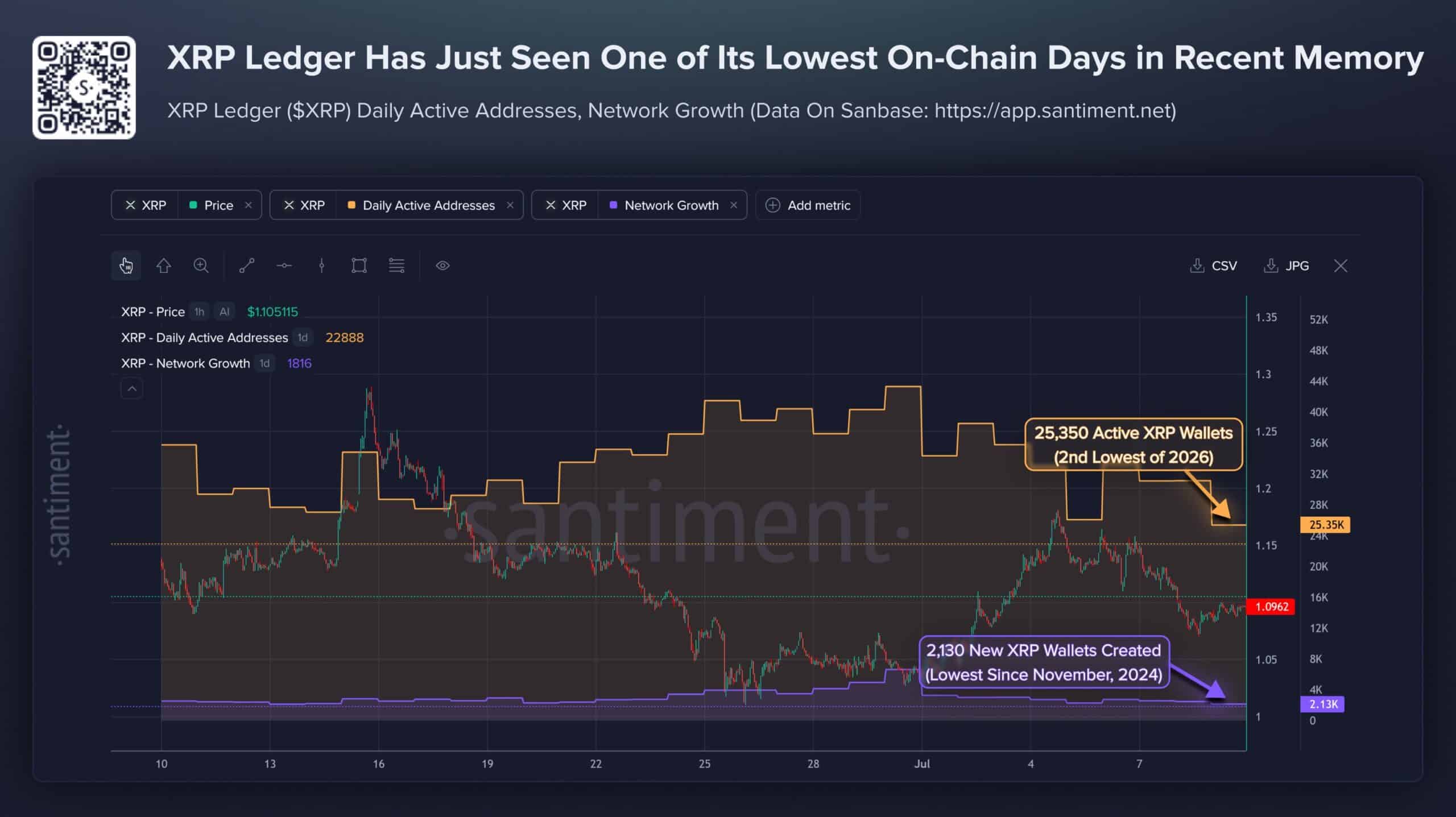
According to Santiment, XRP Ledger activity has fallen to unusually low levels lately. On the 9th and 10th of July, the network saw only 25,350 and 24,887 daily active addresses.
Source: Santiment

These figures were the second-lowest in 2026, Santiment wrote. Moreover, the daily network growth was also at a low figure of 2,130 – The lowest since November 2024.

Traders and investors seemed to be waiting on the wings to buy a real move instead of chasing a shallow price bounce, such as the ones that came in mid-June and early April.

The spot volume trends backed this idea up. The spot CVD for the past 90 days on CryptoQuant was in neutral territory. This metric tracks the aggressive, or taker, participation in the market.

The spot CVD trends have been in decline. Though it was not yet taker sell-dominant, it hinted at reduced buying since March. There was a brief flurry of taker buy activity in May, but it quickly evaporated. At the time, XRP’s price reacted by bouncing towards $1.55, before slumping to $1.10.
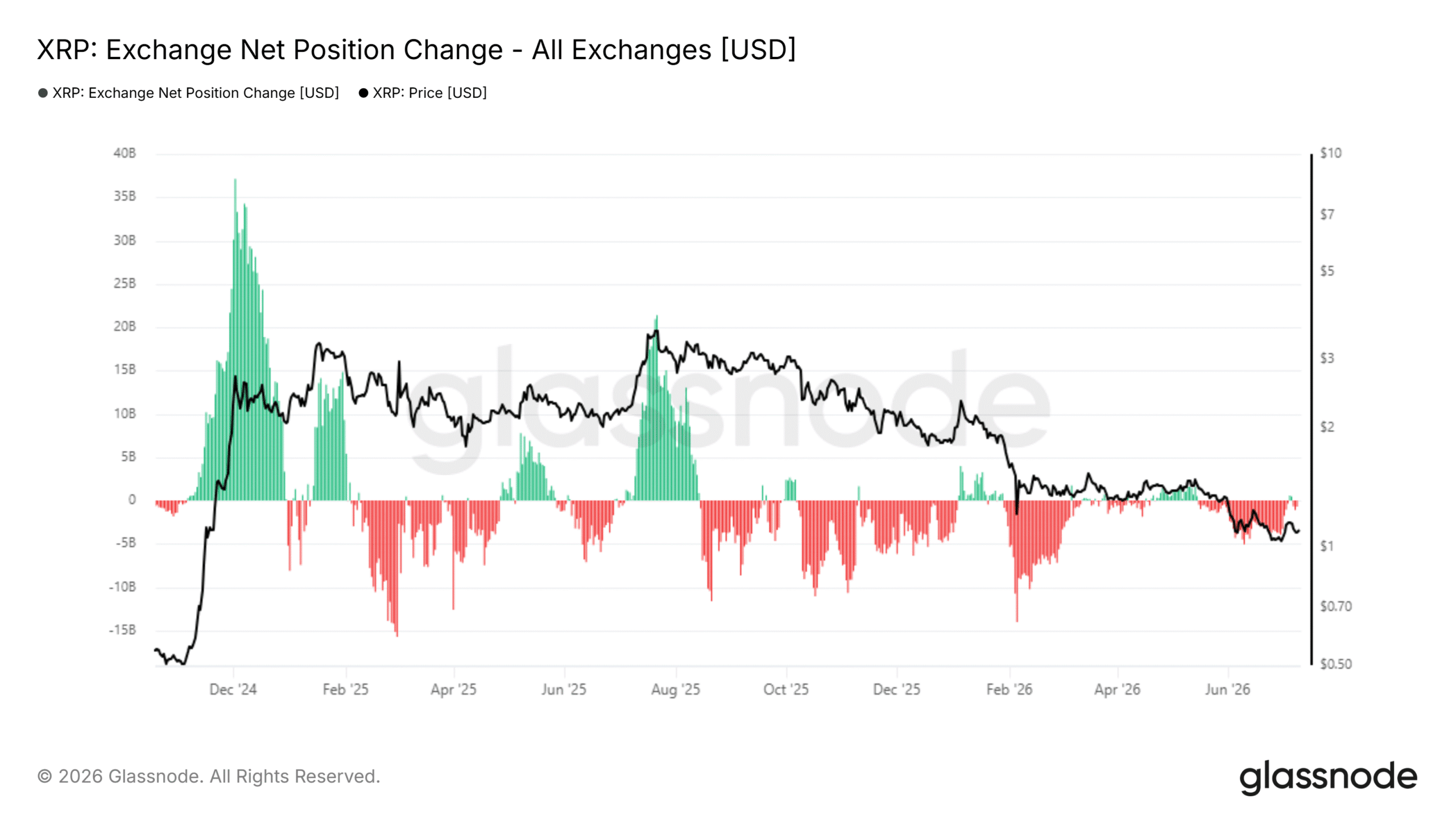
Source: Glassnode

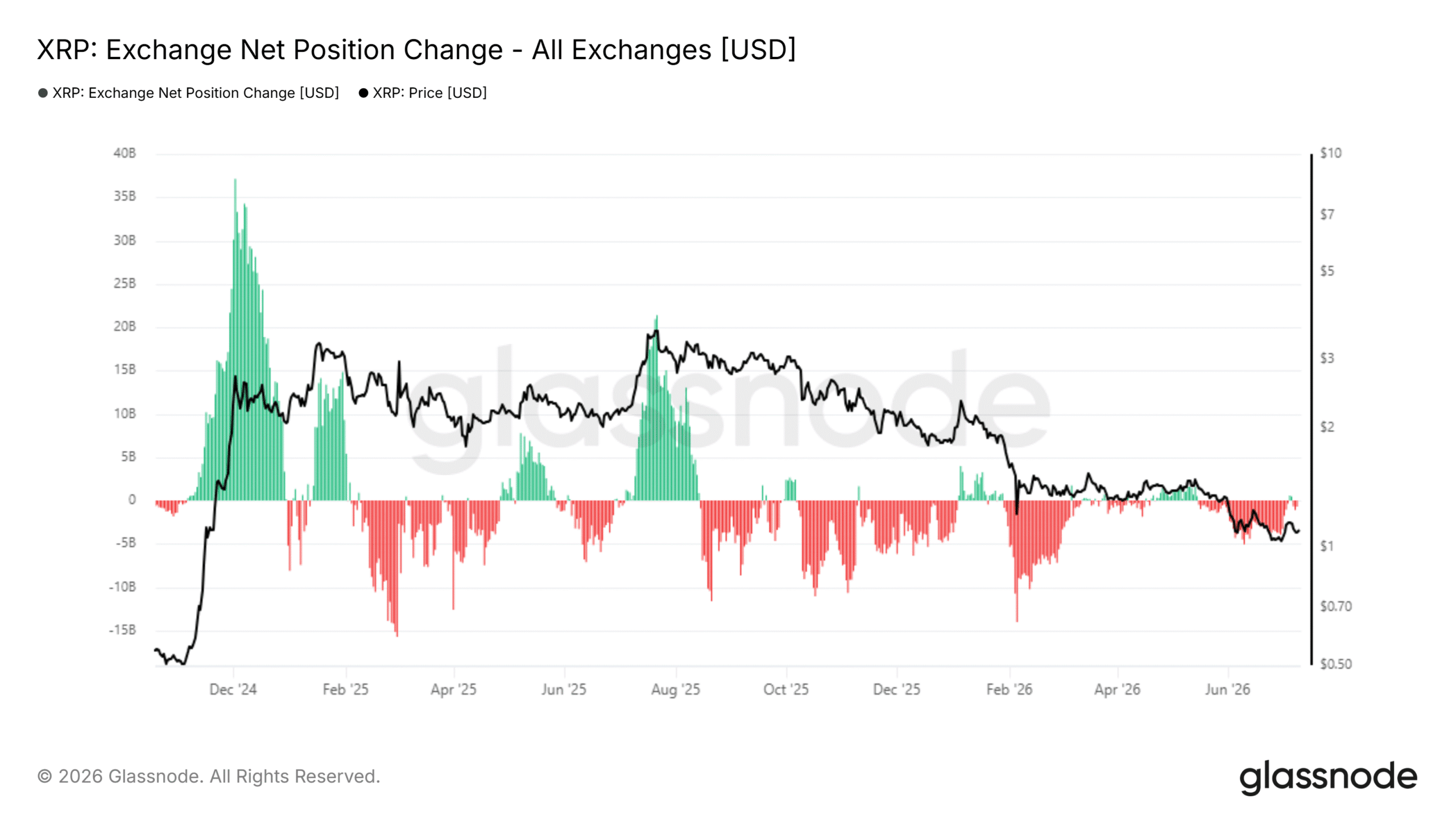
The exchange net position change has been negative in recent months. Negative values imply XRP tokens flowing out of exchanges, likely to cold storage and accumulation.

However, for context, it was not as heavy as the outflow bouts in 2025.

XRP funding rates stay at extreme lows
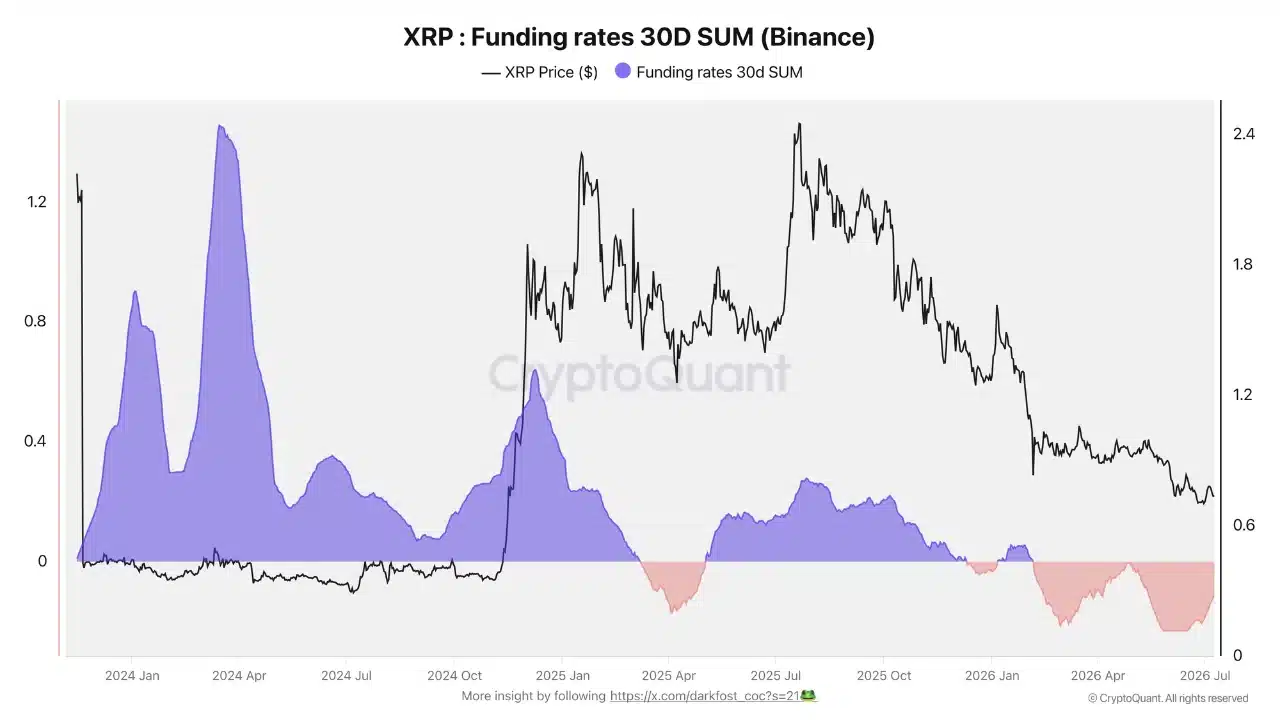
Source: CryptoQuant

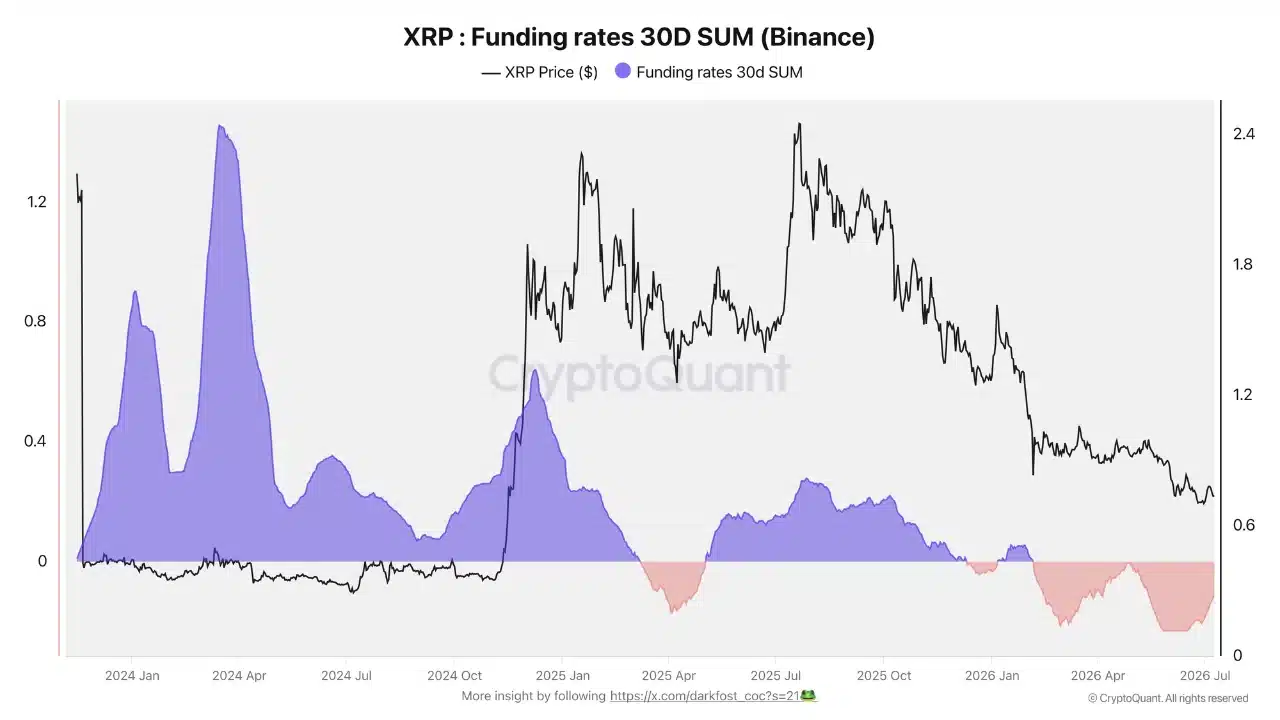
Against this backdrop of muted spot buying pressure on XRP, analyst Darkfost believes that the altcoin’s speculative bais might also be firmly bearish.

The 30-day aggregate of funding rates has been negative throughout 2026. Despite the over 70% correction since the coin hit $3.66 in July 2025, the bearish consensus can serve as a clue for a medium-term reversal.

In April 2025 too, sustained negative aggregate funding rates were seen. This correction was followed by a 126% rally, the analyst observed.

Only time will tell if a similar scenario will play out. Spot volume trends need to undergo a big shift to enable such a rally, that is for sure.


Final Summary

  • XRP’s spot demand has been falling and the price was moving sideways about the $1.10 support.
  • Strong bearish consensus even after a deep price correction might be a medium-term bullish reversal sign.

Perguntas relacionadas

QWhat does the unusually low XRP Ledger activity in early July 2026 indicate about trader behavior according to Santiment?

AIt indicates that traders and investors are on the sidelines, waiting for a significant price move rather than chasing shallow bounces.

QWhat do the negative values of the exchange net position change metric suggest for XRP?

ANegative values suggest that XRP tokens are flowing out of exchanges, which likely indicates accumulation or movement to cold storage.

QAccording to analyst Darkfost, what might the sustained negative aggregate funding rates for XRP signal?

AThe sustained negative aggregate funding rates, despite a deep price correction, could be a clue for a medium-term bullish reversal, similar to a pattern observed in April 2025.

QWhat was the key condition mentioned for a potential significant price rally in XRP to occur?

ASpot volume trends would need to undergo a major shift to enable such a rally.

QBased on the article, what were the two specific low figures reported for XRP network activity on July 9th and 10th, 2026?

AThe network saw only 25,350 and 24,887 daily active addresses on July 9th and 10th, 2026, respectively.

Leituras Relacionadas

Behind Robinhood's Chain Launch and Tokenized Stocks: No Equity Rights, How Far Can This Packaging Game Go?

Robinhood is launching its own Layer 2 blockchain (Robinhood Chain) and "tokenized stocks," but these are not actual equity shares. The tokens are legally structured as debt securities or derivatives, offering economic exposure to a reference stock without granting voting rights or direct ownership. This move represents Robinhood's strategy to expand from a traditional brokerage into a "financial super app," building a user-friendly, programmable financial interface on top of complex, legally compliant, and jurisdiction-specific backend structures. The company's existing business remains strong, driven by options, event contracts, and stock trading. The new blockchain and tokenization efforts are an ambitious layer of infrastructure built atop this core, aiming to make financial products more portable and globally accessible via crypto rails. Key components include the Robinhood Wallet, Bitstamp acquisition (for institutional reach), the Lighter perpetual contracts platform, and Robinhood Earn (DeFi yield). The central challenge is the "brokerage chain paradox": maintaining a simple, intuitive user experience while the underlying assets are highly structured, regulated, and legally distinct from direct ownership. The success of this strategy depends on users, developers, and regulators accepting this model. If the complexity is misunderstood or deemed misleading, it could create product liability issues and stall expansion. The initiative is a significant infrastructure play, but its long-term viability hinges on navigating this fundamental tension between simplicity and legal reality.

marsbitHá 56m

Behind Robinhood's Chain Launch and Tokenized Stocks: No Equity Rights, How Far Can This Packaging Game Go?

marsbitHá 56m

Zhipu, Afraid of Becoming the Next MiniMax

Title: Zhipu, Fearing to Become the Next MiniMax In July 2026, amid the success of its coding-focused AI, Zhipu's founder, Tang Jie, issued an internal letter titled "The Giant Wave Has Come." It notably avoided celebrating recent triumphs, such as Zhipu's trillion-HKD market cap and booming MaaS revenue driven by its GLM-5.2 model in coding applications. Instead, the letter pivoted the narrative to future-oriented concepts like Long Horizon Task, Autonomous Agents, Self-Evolving systems, and AGI. This strategic shift in messaging followed the sharp devaluation of its competitor, MiniMax. After its lock-up period expired, MiniMax's stock plummeted as the market began evaluating it with traditional SaaS metrics like ARR and user growth, rather than as a frontier AI pioneer. Seeing this, Tang Jie aimed to preempt a similar revaluation of Zhipu. He fears that if the market starts viewing Zhipu primarily as a profitable "AI coding company," its valuation would become anchored to conventional financial metrics, losing the premium associated with AGI potential. Therefore, the letter reframed Zhipu's mission. While acknowledging that coding was the current commercial driver, Tang positioned Zhipu on the "infrastructure path," akin to OpenAI and Anthropic. The new focus is on developing agents capable of complex, long-term planning and autonomous operation—moving from assisting individuals (OPC: One Person Company) to automating entire organizations (NPC: No People Company). This "Touch High" plan explicitly prioritizes long-term AGI research over short-term monetization. The article frames this as a critical divergence in China's AI landscape: the "commercialization path" (exemplified by MiniMax) versus the "infrastructure path" (chosen by Zhipu). The former risks being judged harshly by internet-era metrics once growth slows, while the latter risks failing if technological breakthroughs stall. Tang Jie's letter is thus a calculated move to secure Zhipu's identity as an AGI contender, buying time before the inevitable market demand for commercial proof. The core question remains: can Zhipu's "mo gao" (reach high) plan achieve genuine technological leaps fast enough to outpace the market's diminishing patience for stories over substance?

marsbitHá 56m

Zhipu, Afraid of Becoming the Next MiniMax

marsbitHá 56m

Trading

Spot
活动图片