Hong Kong proceeds with licensing regimes for virtual asset dealers and custodians

cointelegraphPublicado em 2025-12-24Última atualização em 2025-12-24

Resumo

Hong Kong regulators are moving forward with new licensing requirements for cryptocurrency dealers and custodians following the conclusion of consultations. The Financial Services and the Treasury Bureau (FSTB) and the Securities and Futures Commission (SFC) announced the decision, which is part of a broader effort to strengthen oversight of the digital asset sector. This builds on the city’s existing regulatory framework, which already mandates licensing for crypto trading platforms and recently enacted a stablecoin licensing regime. Hong Kong aims to position itself as a trusted crypto hub with comprehensive regulations covering stablecoins, tokenization, and now dealer and custody services. Separately, the SFC also launched a consultation for licensing crypto advisory and management service providers, linking the proposals to anti-money laundering and counter-terrorist financing rules.

Hong Kong regulators will proceed with legislating licensing regimes for crypto dealers and custodians after wrapping up consultations, as part of a broader push to tighten oversight.

In a Wednesday announcement, the city’s Financial Services and the Treasury Bureau (FSTB) and the Securities and Futures Commission (SFC) said that they had concluded consultations on proposed licensing regimes, which would require firms providing crypto dealings or custody services in Hong Kong to obtain licenses once the framework takes effect.

The move adds to the city’s expanding crypto licensing framework. Earlier in 2025, Hong Kong brought its Stablecoin Ordinance into force, opening a new licensing regime for stablecoin issuers.

Hong Kong already requires crypto trading platforms to be licensed. The current mandatory regime builds on earlier opt-in framework introduced in 2020, with 11 companies having received approval from the SFC to date.
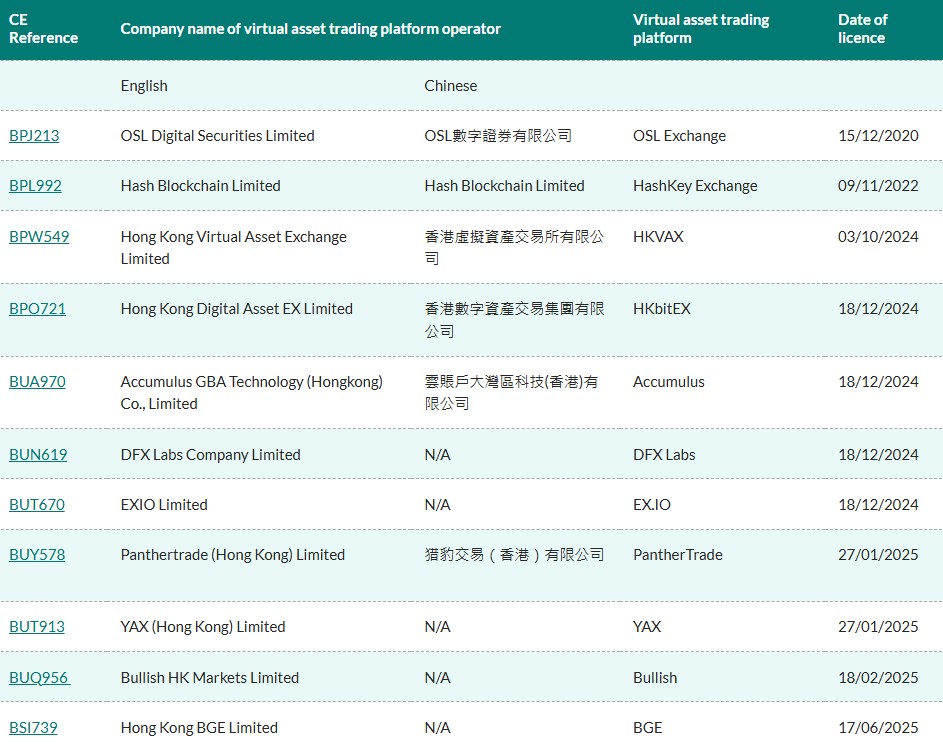
Hong Kong has rejected more applicants for its crypto exchange license than it approved. Source: SFC

Related: Crypto may enter insurers’ portfolios as Hong Kong reviews capital rules

Hong Kong’s broader crypto initiatives

Hong Kong has long expressed its ambitions to develop into a crypto hub. The city already functions as a financial hub with its business-friendly tax regimes and its reputation as a finance gateway between mainland China and global capital markets.

Beyond crypto licensing rules, Hong Kong has also tested tokenization initiatives. In Thursday’s announcement, regulators added that the pending introduction of licensing regimes for crypto dealers and custodians is part of the city’s effort to establish a comprehensive regulatory framework for digital assets alongside stablecoins and tokenization.

​Julia Leung, CEO of the SFC, said that the further development of Hong Kong’s crypto regulatory framework would help the city maintain its position in global digital asset market developments by “fostering a trusted, competitive and sustainable ecosystem.”

Related: Hong Kong launches CARF crypto tax consultation to combat evasion

New advisory and management consultation

The SFC also published a consultation paper on the same day, seeking public feedback on proposals to introduce licensing regimes for crypto advisory service providers and management service providers.

The consultation links the proposed regimes to Hong Kong’s existing Anti‐Mone‐Laundering (AML) framework and Counter‐Terrorist Financing Ordinance, and sets out how advisory and management activities involving digital assets will be brought within the regulatory framework.

It also invites comments on matters such as licensing scope, regulatory powers, sanctions and appeal arrangements, which will be taken into account in finalizing the proposals.


Perguntas relacionadas

QWhat are the key licensing regimes that Hong Kong is proceeding with for virtual assets?

AHong Kong is proceeding with licensing regimes for virtual asset dealers and custodians, as well as for advisory service providers and management service providers.

QWhich regulatory bodies announced the conclusion of consultations on the proposed licensing frameworks?

AThe Financial Services and the Treasury Bureau (FSTB) and the Securities and Futures Commission (SFC) announced the conclusion of consultations on the proposed licensing regimes.

QWhat earlier crypto-related licensing regime did Hong Kong bring into force in 2025?

AIn early 2025, Hong Kong brought its Stablecoin Ordinance into force, which opened a new licensing regime for stablecoin issuers.

QAccording to the SFC CEO, what is the goal of further developing Hong Kong's crypto regulatory framework?

AAccording to SFC CEO Julia Leung, the goal is to help Hong Kong maintain its position in global digital asset market developments by 'fostering a trusted, competitive and sustainable ecosystem'.

QWhat existing frameworks are the proposed licensing regimes for advisory and management services linked to?

AThe proposed regimes are linked to Hong Kong's existing Anti-Money Laundering (AML) framework and Counter-Terrorist Financing Ordinance.

Leituras Relacionadas

MoneyGram: Why Did We Launch Our Own Stablecoin?

MoneyGram, a global leader in cross-border remittances for over 80 years, has launched its own stablecoin, MGUSD. The initiative aims to evolve from single-transaction services to becoming a more integral part of users' financial lives. By allowing customers to hold a stable US dollar balance within the MoneyGram app, MGUSD enables not only remittances but also everyday spending, currency exchange, cash access, and future financial services. Targeting the billions globally who face challenges like currency volatility or lack of bank accounts, MGUSD leverages Stellar blockchain technology with a self-custody wallet architecture. This gives users control over their assets while providing a secure, compliant experience through a trusted brand. The approach focuses on solving existing customer pain points within MoneyGram's established network, rather than competing for broad crypto market liquidity. A key advantage is MoneyGram's hybrid model, combining digital services with the world's largest physical network for crypto-to-cash conversions. The stablecoin also modernizes the company's internal infrastructure, streamlining treasury management and partner settlements, with annual forex volume via stablecoins already reaching $2 billion. The project was delivered in about a year, driven by a reorganization into agile, cross-functional teams that operate with startup-like speed while leveraging decades of institutional expertise. Partners include Stablecoin (issuance), Crossmint (wallet APIs), Fireblocks (enterprise treasury), m0 (smart contracts), and the Stellar network. MoneyGram emphasizes that enhancing direct consumer offerings strengthens its partner ecosystem. The future direction is clear: to provide users worldwide with stable value storage, better financial tools, and greater control over their funds through a trusted, existing network.

Foresight NewsHá 24m

MoneyGram: Why Did We Launch Our Own Stablecoin?

Foresight NewsHá 24m

BIP-110 Controversy Intensifies: Bitcoin May Face Its Most Divisive Hard Fork Battle in Years

Bitcoin is approaching a critical block height of 961,632, which could activate the controversial BIP-110 proposal. This proposal aims to restrict the amount of non-financial data, such as inscriptions and other large data payloads, within Bitcoin transactions. Supporters, including some node operators and Bitcoin purists, argue that BIP-110 is necessary to preserve Bitcoin's core function as a monetary settlement layer by reducing network congestion and node operational burdens caused by non-essential data. They frame it as a correction to keep the network true to its original purpose. However, critics, including prominent figures like Blockstream's Adam Back and developer Jameson Lopp, warn that the proposal's implementation mechanism is dangerously flawed. They highlight that its low 55% miner signaling threshold, coupled with a contentious enforcement mechanism allowing nodes to unilaterally reject non-compliant blocks, significantly increases the risk of a chain split. Opponents argue this sets a dangerous precedent for transaction censorship, undermines Bitcoin's protocol neutrality, and creates excessive uncertainty for developers and businesses, especially since the rule is proposed as a temporary one-year measure. Market analysts, such as those from Bitfinex, suggest a full-scale network split is unlikely due to a lack of broad economic consensus. Major mining pools remain neutral, and adoption of the new rules is minimal. They view the situation more as a governance stress test. The primary risk is operational disruption: if a minority chain persists, major exchanges and custodians may need to temporarily suspend Bitcoin deposits and withdrawals to manage security and liquidity, potentially unsettling newer institutional investors. While BIP-110 is not expected to succeed in overtaking the main chain, its approach has ignited a significant debate about Bitcoin's governance, core values, and resilience.

Foresight NewsHá 1h

BIP-110 Controversy Intensifies: Bitcoin May Face Its Most Divisive Hard Fork Battle in Years

Foresight NewsHá 1h

Crypto Market Makers Are Collectively Seeking Change as Money Becomes Harder to Earn

**Summary: Crypto Market Makers Adapt as Margins Shrink** Leading crypto market maker GSR exemplifies a broader industry shift, moving beyond traditional market-making to become a full-service "Web3 investment bank." Its recent strategic acquisitions—including an SEC-registered broker-dealer, rebranded as GSR Securities—and purchases of token advisory firms aim to create an integrated platform covering token design, fundraising, listing, liquidity provision, and asset management. This includes launching an ETF and investing in tokenization platforms like Libeara, backed by a strategic investment from Standard Chartered's SC Ventures. This transformation is not unique to GSR. Other major players like Keyrock, B2C2, Wintermute, and DWF Labs are also expanding geographically, pursuing regulatory licenses (especially under frameworks like MiCA in the EU), and diversifying into over-the-counter (OTC) trading, asset management, and real-world asset tokenization. The driving force behind this collective pivot is a rapidly changing market. Profits from traditional altcoin market-making are declining due to fewer viable projects, reduced client budgets, increased competition, and smarter, more demanding clients. Simultaneously, regulatory pressures are mounting, making compliance a baseline cost. Extreme market events further expose teams lacking robust risk controls. Consequently, the crypto market-making business model is evolving from one reliant on information asymmetry and volatility to a more institutionalized, regulated, and service-diverse industry. Survival now depends on building systemic capabilities beyond mere liquidity provision.

marsbitHá 2h

Crypto Market Makers Are Collectively Seeking Change as Money Becomes Harder to Earn

marsbitHá 2h

Trading

Spot
Futuros

Artigos em Destaque

Como comprar VIRTUAL

Bem-vindo à HTX.com!Tornámos a compra de Virtuals Protocol (VIRTUAL) simples e conveniente.Segue o nosso guia passo a passo para iniciar a tua jornada no mundo das criptos.Passo 1: cria a tua conta HTXUtiliza o teu e-mail ou número de telefone para te inscreveres numa conta gratuita na HTX.Desfruta de um processo de inscrição sem complicações e desbloqueia todas as funcionalidades.Obter a minha contaPasso 2: vai para Comprar Cripto e escolhe o teu método de pagamentoCartão de crédito/débito: usa o teu visa ou mastercard para comprar Virtuals Protocol (VIRTUAL) instantaneamente.Saldo: usa os fundos da tua conta HTX para transacionar sem problemas.Terceiros: adicionamos métodos de pagamento populares, como Google Pay e Apple Pay, para aumentar a conveniência.P2P: transaciona diretamente com outros utilizadores na HTX.Mercado de balcão (OTC): oferecemos serviços personalizados e taxas de câmbio competitivas para os traders.Passo 3: armazena teu Virtuals Protocol (VIRTUAL)Depois de comprar o teu Virtuals Protocol (VIRTUAL), armazena-o na tua conta HTX.Alternativamente, podes enviá-lo para outro lugar através de transferência blockchain ou usá-lo para transacionar outras criptomoedas.Passo 4: transaciona Virtuals Protocol (VIRTUAL)Transaciona facilmente Virtuals Protocol (VIRTUAL) no mercado à vista da HTX.Acede simplesmente à tua conta, seleciona o teu par de trading, executa as tuas transações e monitoriza em tempo real.Oferecemos uma experiência de fácil utilização tanto para principiantes como para traders experientes.

398 Visualizações TotaisPublicado em {updateTime}Atualizado em 2026.06.02

Como comprar VIRTUAL

Discussões

Bem-vindo à Comunidade HTX. Aqui, pode manter-se informado sobre os mais recentes desenvolvimentos da plataforma e obter acesso a análises profissionais de mercado. As opiniões dos utilizadores sobre o preço de VIRTUAL (VIRTUAL) são apresentadas abaixo.

活动图片