From ETH to SOL: Why Will L1s Ultimately Lose to Bitcoin?

coinvoicePublicado em 2025-12-08Última atualização em 2025-12-08

Resumo

The article "From ETH to SOL: Why L1s Will Ultimately Lose to Bitcoin?" argues that Bitcoin (BTC) is increasingly dominating the "cryptomoney" narrative, leaving little room for other Layer-1 (L1) blockchains to compete for monetary premium. The core of the argument is that approximately 81% of the total crypto market cap is invested in assets viewed as money or potential money, with BTC alone accounting for 55%. While L1s like ETH, XRP, BNB, and SOL represent a significant portion of the remaining value, their valuations are not primarily driven by revenue or real economic activity. Data shows that L1 revenues have been declining annually, yet their price-to-earnings ratios have soared, suggesting their market caps are almost entirely propped up by speculation on future monetary premium, not fundamentals. The performance of L1s against BTC further supports this. Since December 2022, eight of the top ten L1s have underperformed BTC, with six lagging by over 40%. Solana (SOL) was a notable exception, outperforming BTC by 87%. However, this gain is put into perspective by its ecosystem's explosive growth: a ~3,000% increase in DeFi TVL, fees, and DEX volume. This indicates that an L1 must achieve astronomical, orders-of-magnitude growth to merely eke out a modest performance lead over BTC. The conclusion is that the trend of BTC consolidating monetary premium at the expense of L1s is irreversible. The narrative that an L1 could become "money" is losing credibility as investo...

Original Title:Can L1s Compete Against BTC as Cryptomoney?

Original Author: AvgJoesCrypto, Messari

Original Compilation: Dingdang, Odaily Planet Daily

Editor's Note: Recently, Haseeb Qureshi, a well-known partner at Dragonfly, published a lengthy article rejecting cynicism and embracing exponential thinking, unexpectedly bringing the community discussion back to the core issue: How much value do L1s really have left? The following content is excerpted from the upcoming "The Crypto Theses 2026" by @MessariCrypto, compiled by Odaily Planet Daily.

Cryptocurrency Drives the Entire Industry

It is crucial to refocus the discussion on "cryptocurrency" itself, as most capital in the crypto industry is ultimately seeking exposure to "monetized assets." The total market capitalization of the crypto market is currently $3.26 trillion, with BTC accounting for $1.80 trillion, or 55%. Of the remaining $1.45 trillion, approximately $0.83 trillion is concentrated in various L1 public chains. This means that about $2.63 trillion, or roughly 81% of the entire market's capital, is invested in assets that the market already views as money or believes may gain a monetary premium in the future.
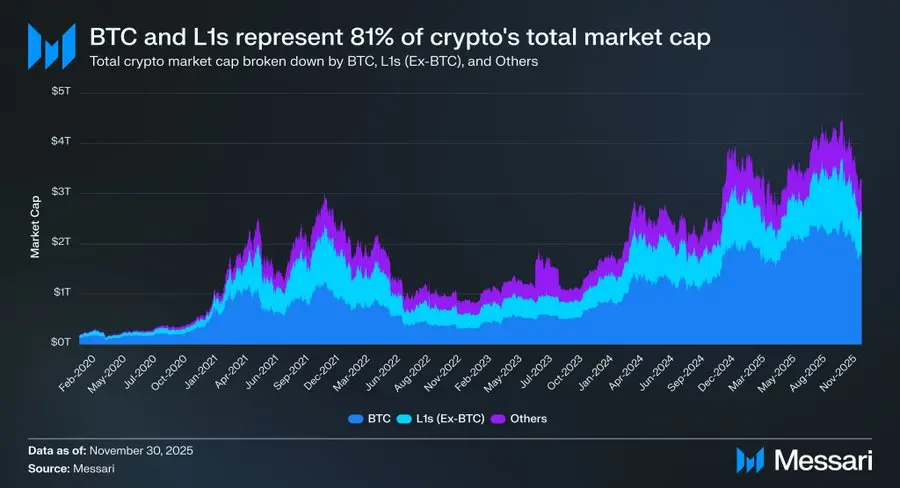
In this context, whether you are a trader, investor, capital manager, or developer, understanding how the market assigns or withdraws monetary premiums is essential. In the crypto industry, nothing drives valuation changes more than the market's willingness to view an asset as "money." Therefore, predicting which assets will gain monetary premiums in the future is arguably the most critical variable when building an investment portfolio.

So far, we have focused primarily on BTC, but it is also necessary to discuss those L1 assets among the remaining $0.83 trillion that "may or may not be money." As mentioned earlier, we expect BTC to continue capturing market share from gold and other non-sovereign stores of value in the coming years. But this raises a question: How much room is left for L1s? When the tide rises, will all boats (assets) rise (benefit)? Or will BTC, in its pursuit of gold, also absorb some of the monetary premium from L1 public chains?
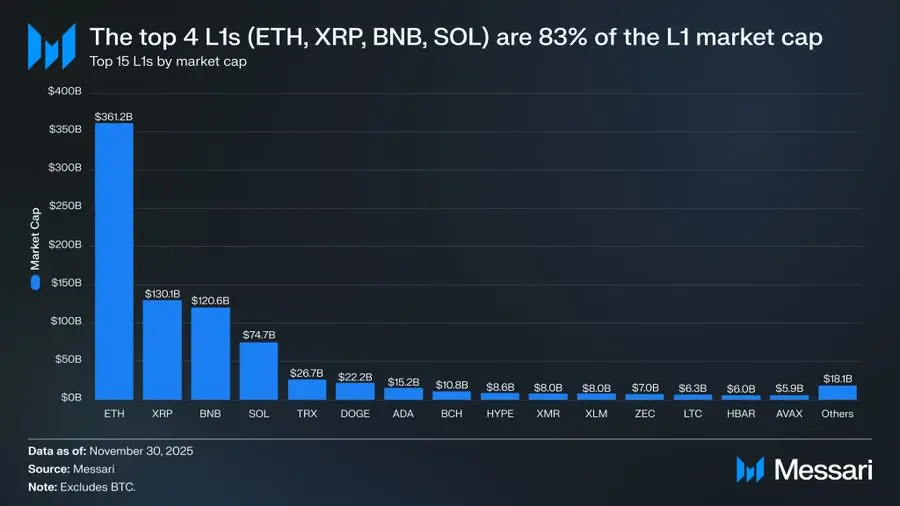
To answer these questions, we first need to look at the current valuation landscape of L1s. The top four L1s by market cap—ETH ($361.15 billion), XRP ($130.11 billion), BNB ($120.64 billion), and SOL ($74.68 billion)—have a combined market cap of $686.58 billion, accounting for 83% of the entire L1 sector. After these top four, there is a significant gap in market cap (e.g., TRX at $26.67 billion), but the tail end still holds considerable value. The total market cap of L1s outside the top 15 is still $18.06 billion, representing 2% of the total L1 market cap.

More importantly, L1 market cap is not equivalent to pure "monetary premium." There are three main valuation frameworks for L1s:

(i) Monetary Premium

(ii) Real Economic Value (REV)

(iii) Economic Security Demand

Therefore, a project's market cap is not solely determined by the market viewing it as money.

What Drives L1 Valuations Is Monetary Premium, Not Revenue

Despite the existence of multiple valuation frameworks, the market is increasingly inclined to evaluate L1s from the perspective of "monetary premium" rather than a "revenue-driven" angle. Over the past few years, the overall price-to-earnings (P/E) ratio for all L1s with a market cap exceeding $1 billion has generally remained between 150x and 200x. However, this aggregate data is misleading because it includes TRON and Hyperliquid. Over the past 30 days, TRX and HYPE contributed 70% of the revenue in this group but accounted for only 4% of the total market cap.
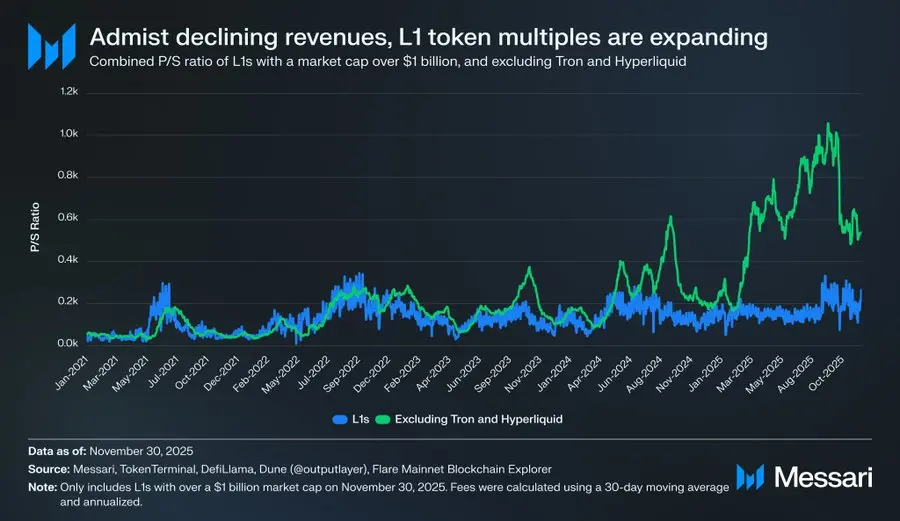
After removing these two outliers, the real story emerges. Despite continuously declining revenue, L1 valuations are rising. The adjusted P/E ratio shows a clear upward trend:

· November 30, 2021: 40x

· November 30, 2022: 212x

· November 30, 2023: 137x

· November 30, 2024: 205x

· November 30, 2025: 536x

If interpreted from an REV perspective, one might argue that the market is pricing in future revenue growth. However, this explanation does not hold, as revenue for the same group (still excluding TRON and Hyperliquid) has declined almost every year:

· 2021: $12.33 billion

· 2022: $4.89 billion (YoY -60%)

· 2023: $2.72 billion (YoY -44%)

· 2024: $3.55 billion (YoY +31%)

· 2025: Annualized $1.70 billion (YoY -52%)

In our view, the simplest and most straightforward explanation is: These valuations are primarily driven by monetary premium, not current or future revenue.

L1s Have Consistently Underperformed Bitcoin

If L1 valuations are primarily driven by the market's expectation of their monetary premium, the next question is: What shapes this expectation? A simple method is to compare their price performance with BTC's. If changes in monetary premium mainly reflect BTC's movements, these assets should perform similarly to BTC's "beta coefficient"; if the monetary premium comes from each L1's unique factors, their correlation with BTC should be weaker, and their performance should be more idiosyncratic.
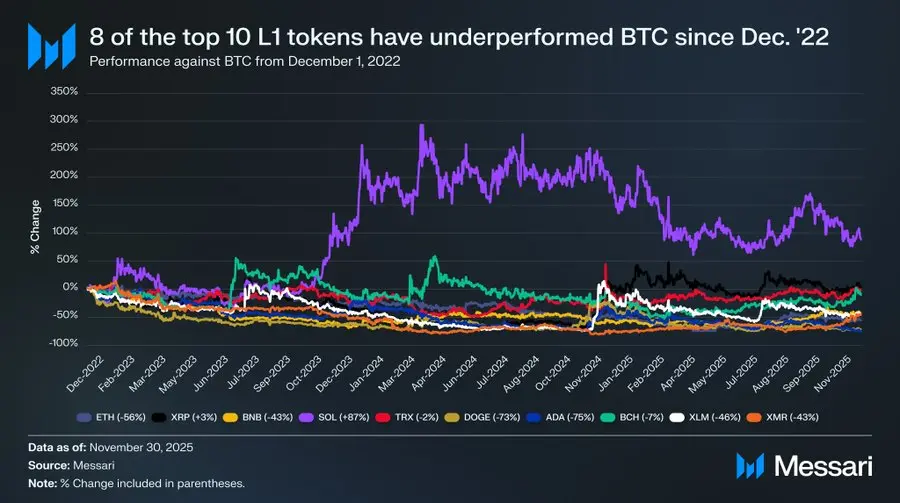
As representatives of L1s, we selected the top ten L1 tokens by market cap (excluding HYPE) and measured their performance relative to BTC since December 1, 2022. These ten assets represent about 94% of the L1 market cap, making them highly representative. During this period, eight assets underperformed BTC in absolute returns, with six lagging by more than 40%. Only two assets outperformed BTC: XRP and SOL. However, XRP's excess return was only 3%, and given its history of being driven by retail capital, we will not overinterpret this. The only asset with significant excess returns was SOL, which beat BTC by 87%.
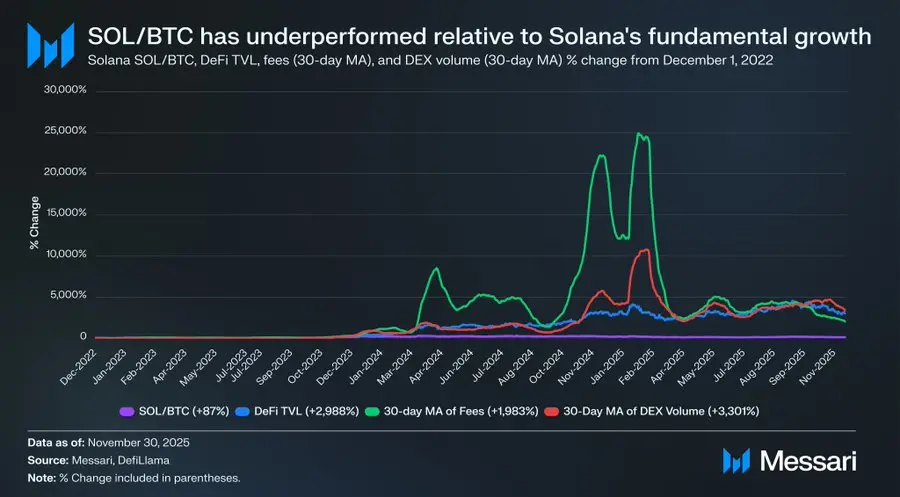
But upon closer examination, SOL's "outperformance" may not be as strong as it appears. During the same period that SOL outperformed BTC by 87%, Solana's fundamentals experienced exponential growth: DeFi TVL increased by 2,988%, fees grew by 1,983%, and DEX trading volume surged by 3,301%. By any reasonable measure, the Solana ecosystem expanded by 20 to 30 times since the end of 2022, yet SOL's price only outperformed BTC by 87%.

Please read that sentence again.

To achieve truly significant excess returns against BTC, an L1 doesn't need ecosystem growth of 200% or 300%—it needs growth of 2,000%-3,000% just to barely gain a few dozen percentage points of outperformance.

Combining the above, our judgment is: Although the market still prices L1s based on the expectation that they "may gain monetary premium in the future," confidence in these expectations is quietly waning. Meanwhile, the market's monetary premium for BTC as "cryptomoney" remains unshaken, and one could even argue that BTC's lead over various L1s is continuously widening.

Although cryptocurrency itself does not require fees or revenue to support its valuation, these metrics are crucial for L1s. Unlike BTC, the narrative for L1s depends on building an ecosystem (applications, users, throughput, economic activity, etc.) to support their token value. However, if an L1's ecosystem is showing annual declines (partly reflected in decreasing revenue and fees), it loses its only competitive advantage relative to BTC. Without real economic growth, its "cryptomoney" story becomes increasingly difficult for the market to accept.

Looking Ahead

Looking ahead, we do not believe this trend will reverse in 2026 or beyond. With few possible exceptions, we expect the L1 sector to continue losing market share, further squeezed by BTC. Since their valuations primarily rely on expectations of future monetary premium, as the market gradually concludes that BTC has the strongest claim to the "cryptomoney" narrative, L1 valuations will continue to contract. Although BTC will also face challenges in the coming years, these issues remain too distant and variable to provide effective support for the monetary premium of competing L1s.

For L1s, the bar for proving their value has been raised. Their narratives are no longer sufficiently attractive compared to BTC's, nor can they rely on market euphoria to support their valuations long-term. The era when the story of "we might become money in the future" could support trillion-dollar market caps is closing. Investors now have a decade of data proving that an L1's monetary premium can only be sustained when the ecosystem experiences extreme growth. Once growth stalls, L1s will consistently underperform BTC, and the monetary premium will dissipate.


Criptomoedas em alta

Perguntas relacionadas

QWhat percentage of the total crypto market capitalization is currently held by assets that the market views as or expects to become monetized assets?

AApproximately 81% of the total market capitalization, or about $2.63 trillion, is held in assets the market views as money or expects to gain a monetary premium.

QAccording to the article, what are the three main valuation frameworks for Layer-1 (L1) blockchains?

AThe three main valuation frameworks for L1s are: (i) Monetary Premium, (ii) Real Economic Value (REV), and (iii) Economic Security Demand.

QWhat trend does the article identify regarding the price-to-earnings (P/E) ratios of major L1s when excluding outliers like TRON and Hyperliquid?

AThe article identifies a clear upward trend in the adjusted P/E ratios of major L1s, rising from 40x in November 2021 to 536x in November 2025, even as their revenues have been declining.

QWhich was the only major L1 asset that significantly outperformed Bitcoin (BTC) in terms of price performance from December 2022, and by what percentage?

ASolana (SOL) was the only major L1 that significantly outperformed Bitcoin, beating it by 87%.

QWhat is the article's primary conclusion about the future trend of L1 valuations relative to Bitcoin?

AThe article concludes that the trend of L1s losing market share to Bitcoin will not reverse; it expects the L1 sector to continue being squeezed by BTC as the market increasingly sees Bitcoin as having the strongest claim to the 'cryptomoney' narrative, causing L1 valuations to contract.

Leituras Relacionadas

Only 153 Venture Capital Firms Invested in July: Is the Crypto VC Industry Experiencing a 'Mass Extinction'?

In July 2026, only 153 unique venture capital firms participated in disclosed crypto funding rounds, marking the lowest monthly count since November 2020. This figure represents an 87% decline from the peak of 1,177 firms in 2022. Overall, the first seven months of 2026 saw crypto projects raise approximately $11.78 billion across 481 rounds. This crypto VC contraction contrasts sharply with the broader venture capital landscape, where global VC investment reached a record $560.4 billion in H1 2026, heavily fueled by major AI company financings. This shift in capital allocation has drawn funds away from the crypto sector. Within crypto, funding is highly concentrated. Trading platforms, prediction markets, and payment sectors absorbed 53% of the total capital. While early-stage deals remain frequent, the largest sums flow to a few late-stage rounds and mergers & acquisitions, which surged to $7.23 billion in Q2 2026. The market is consolidating around top funds like a16z crypto and Dragonfly, which successfully raised new multi-billion dollar funds, while many smaller firms have retreated. Analysts describe this as a "great extinction" for crypto VCs, where capital is becoming more selective, favoring proven business models and assets over early-stage speculation. This raises the bar for project quality, funding efficiency, and viable exit paths.

marsbitHá 3m

Only 153 Venture Capital Firms Invested in July: Is the Crypto VC Industry Experiencing a 'Mass Extinction'?

marsbitHá 3m

Strategy's Loss in the Second Quarter Reaches $8.22 Billion Amid Bitcoin Decline

Strategy, the largest corporate holder of Bitcoin, reported a net loss of $8.22 billion for the second quarter. This loss was primarily driven by an $8.32 billion unrealized loss on its Bitcoin holdings due to a decline in the asset's price during the period. Despite these paper losses, the company increased its Bitcoin holdings to 843,775 BTC, a 25% growth since the start of the year. As part of a new monetization strategy, Strategy sold approximately $218.4 million worth of Bitcoin, mainly to fund dividends for preferred shareholders, with $216 million of that sold after Q2 ended. The company also built a $3.75 billion cash reserve, which it claims is sufficient to cover over two years of dividend and interest payments, aiming to insulate itself from Bitcoin's volatility while meeting obligations. Following the earnings release, Strategy's stock (MSTR) rose 4.7% in regular trading but corrected slightly after-hours. This pattern reflects how the company's accounting results are heavily tied to Bitcoin's price swings, even as its long-term strategy remains unchanged. The report indicates that Strategy is maintaining its core strategy of accumulating Bitcoin while building a financial buffer. This quarterly loss follows a recognizable pattern, with the company posting significant unrealized losses in previous quarters (e.g., $12.4 billion in Q4 2025 and ~$12.5 billion in Q1 2026) due to fair-value accounting. A key technical shift is its new monetization program, which introduces periodic selling pressure on the market, transitioning Strategy from a pure accumulator to a participant that occasionally adds supply. A critical question remains: how long can the cash reserve cover dividend obligations if a Bitcoin price downturn persists beyond two years?

cryptonews.ruHá 23m

Strategy's Loss in the Second Quarter Reaches $8.22 Billion Amid Bitcoin Decline

cryptonews.ruHá 23m

Will Terrorist Durov Ban Russian Officials?

Telegram founder Pavel Durov publicly reacted to being labeled a "terrorist" by Russian authorities, stating the designation came after he refused demands for mass surveillance and censorship on the platform. In a Telegram post, he highlighted that this status formally bans him from "publishing information online." Durov concluded with a statement widely circulated: Russian officials "clearly don't understand who can ban whom on the internet." This remark suggests Durov could potentially restrict official Russian government and officials' channels on Telegram, which continue to operate on the platform despite its formal blocking in Russia. The situation parallels previous, slow-moving state directives, like switching officials to domestic cars, contrasted with the current push to migrate all government communication to the Russian-made messenger MAX by 2030. However, reports indicate many officials still use Telegram via workarounds, fearing surveillance on MAX, while alternatives like BiP and KakaoTalk recently became inaccessible in Russia without a VPN. Durov has not specified any immediate actions against state channels. His statement is an initial response, with further developments depending on the authorities' reaction. The dynamic differs from 2020 when Russian regulators lifted a block on Telegram; now, Durov implies control from within the platform itself over the official accounts that persisted through that earlier blockade.

cryptonews.ruHá 23m

Will Terrorist Durov Ban Russian Officials?

cryptonews.ruHá 23m

DeepSeek V4 Official Version Arrives, New Capabilities Emerge, Value-for-Money King Enters the Fray

On July 31st, DeepSeek officially launched the public API beta for its DeepSeek-V4-Flash model. A key highlight is its performance on multiple Agent benchmark tests, reportedly nearing or even surpassing the level of the V4-Pro preview version from three months ago. Notably, the Flash model achieves this with significantly smaller scale (130B active parameters vs. Pro's 490B), suggesting that post-training optimization and data quality may be as crucial as raw model size. DeepSeek emphasized that the V4-Flash-0731 uses the same model architecture and size as its preview version, with improvements attributed solely to "re-trained post-training." The update also marks the official debut of DeepSeek's self-developed Agent framework, "Harness." The move signals DeepSeek's strategic push to position its cost-effective Flash model as a competitive base for Agent applications—scenarios requiring autonomous planning, tool usage, and complex task execution—where inference speed and cost are critical. By natively supporting OpenAI's Responses API format and adapting for code-generation scenarios, DeepSeek aims not just to be a cheaper alternative but to establish its own ecosystem in the Agent era. This release follows DeepSeek's record-breaking ~$50 billion fundraising round roughly two months prior, underscoring market confidence in its technology and commercialization prospects. The company is reportedly preparing for another funding round at a valuation of approximately $71 billion. The Flash model's advancement represents a step in fulfilling the high expectations that come with this valuation, setting the stage for the impending release of the V4-Pro official version and intensifying competition in the global Agent landscape.

marsbitHá 27m

DeepSeek V4 Official Version Arrives, New Capabilities Emerge, Value-for-Money King Enters the Fray

marsbitHá 27m

Trading

Spot

Artigos em Destaque

O que é BITCOIN

Compreender o HarryPotterObamaSonic10Inu (ERC-20) e a Sua Posição no Espaço Cripto Nos últimos anos, o mercado de criptomoedas assistiu a um aumento na popularidade das moedas meme, cativando não apenas os traders, mas também aqueles que procuram envolvimento comunitário e valor de entretenimento. Entre estes tokens únicos está o HarryPotterObamaSonic10Inu (ERC-20), um projeto intrigante que mistura referências culturais no tecido das criptomoedas. Este artigo explora os principais aspetos do HarryPotterObamaSonic10Inu, examinando os seus mecanismos, a sua ética orientada pela comunidade e o seu envolvimento com o vasto panorama cripto. O que é o HarryPotterObamaSonic10Inu (ERC-20)? Como o nome sugere, o HarryPotterObamaSonic10Inu é uma moeda meme construída na blockchain Ethereum, classificada sob o padrão ERC-20. Ao contrário das criptomoedas tradicionais, que podem enfatizar a utilidade prática ou o potencial de investimento, este token prospera no valor de entretenimento e na força da sua comunidade. O projeto visa promover um ambiente onde utilizadores envolvidos possam reunir-se, partilhar ideias e participar em atividades inspiradas por diversos fenómenos culturais. Uma característica notável do HarryPotterObamaSonic10Inu é a zero taxa sobre transações. Este elemento atraente visa encorajar a negociação e o envolvimento da comunidade, isento de encargos adicionais que podem desencorajar os traders de pequena escala. A oferta total da moeda está fixada em mil milhões de tokens, uma cifra que marca a sua intenção de manter uma circulação substancial dentro da comunidade. Criador do HarryPotterObamaSonic10Inu (ERC-20) As origens do HarryPotterObamaSonic10Inu estão um pouco envoltas em mistério; os detalhes sobre o criador permanecem desconhecidos. O desenvolvimento deste token carece de uma equipa identificável ou de um plano explícito, o que não é raro no setor das moedas meme. Em vez disso, o projeto surgiu de forma orgânica, com o seu progresso a depender fortemente do entusiasmo e da participação da sua comunidade. Investidores do HarryPotterObamaSonic10Inu (ERC-20) No que diz respeito a investimentos externos e apoios, o HarryPotterObamaSonic10Inu também permanece ambíguo. O token não lista quaisquer fundações de investimento conhecidas ou apoio organizacional significativo. Em vez disso, o “sangue vital” do projeto é a sua comunidade de base, que informa o seu crescimento e sustentabilidade através da ação coletiva e do envolvimento no espaço cripto. Como Funciona o HarryPotterObamaSonic10Inu (ERC-20)? Como uma moeda meme, o HarryPotterObamaSonic10Inu opera principalmente fora dos quadros tradicionais que muitas vezes governam o valor dos ativos. Existem vários aspetos distintivos que definem como o projeto funciona: Transações Sem Taxas: Sem taxas sobre transações, os utilizadores podem comprar e vender o token livremente, sem a preocupação de custos ocultos. Envolvimento da Comunidade: O projeto prospera na interação da comunidade, aproveitando plataformas de redes sociais para criar entusiasmo e facilitar a participação. Discussões, partilha de conteúdo e envolvimento são elementos cruciais que ajudam a expandir o seu alcance e a fomentar a lealdade entre os apoiantes. Sem Utilidade Prática: Deve ser notado que o HarryPotterObamaSonic10Inu não oferece utilidade concreta dentro do ecossistema financeiro. Em vez disso, é classificado como um token principalmente para entretenimento e atividades comunitárias. Referência Cultural: O token incorpora de forma inteligente elementos da cultura popular para atrair interesse, conectando-se tanto com entusiastas de memes como com seguidores de criptomoedas. HarryPotterObamaSonic10Inu exemplifica como as moedas meme operam de forma diferente de projetos de criptomoedas mais tradicionais, entrando no mercado como construções sociais inovadoras em vez de ativos utilitários. Linha do Tempo do HarryPotterObamaSonic10Inu (ERC-20) A história do HarryPotterObamaSonic10Inu é marcada por vários marcos notáveis: Criação: O token surgiu de um meme viral, capturando a imaginação de muitos entusiastas de criptomoedas. Datas específicas de criação não estão disponíveis, sublinhando a sua ascensão orgânica. Listagem em Exchanges: O HarryPotterObamaSonic10Inu conseguiu entrar em várias exchanges, permitindo um acesso e negociação mais fáceis pela comunidade. Iniciativas de Envolvimento da Comunidade: Atividades contínuas direcionadas a melhorar a interação comunitária, incluindo concursos, campanhas em redes sociais e geração de conteúdo por fãs e defensores. Planos de Expansão Futura: O roteiro do projeto inclui o lançamento de uma coleção de NFTs, mercadorias e um site de eCommerce relacionado aos seus temas culturais, envolvendo ainda mais a comunidade e tentando adicionar mais dimensões ao seu ecossistema. Pontos-Chave sobre o HarryPotterObamaSonic10Inu (ERC-20) Natureza Orientada pela Comunidade: O projeto prioriza a contribuição coletiva e a criatividade, assegurando que o envolvimento dos utilizadores está na vanguarda do seu desenvolvimento. Classificação como Moeda Meme: Representa o epítome da criptomoeda baseada em entretenimento, destacando-se dos veículos de investimento tradicionais. Sem Afiliação Direta com o Bitcoin: Apesar da semelhança no nome do ticker, o HarryPotterObamaSonic10Inu é distinto e não tem qualquer relação com o Bitcoin ou outras criptomoedas estabelecidas. Foco na Colaboração: O HarryPotterObamaSonic10Inu é projetado para criar um espaço de colaboração e partilha de histórias entre os seus detentores, proporcionando uma via para a criatividade e o fortalecimento da comunidade. Perspectivas Futuras: A ambição de expandir além da sua premissa inicial para NFTs e mercadorias delineia um caminho para o projeto potencialmente entrar em avenidas mais mainstream dentro da cultura digital. À medida que as moedas meme continuam a capturar a imaginação da comunidade cripto, HarryPotterObamaSonic10Inu (ERC-20) destaca-se devido aos seus laços culturais e abordagem centrada na comunidade. Embora possa não se encaixar no molde típico de um token orientado para utilidade, a sua essência reside na alegria e camaradagem fomentadas entre os seus apoiantes, destacando a natureza em evolução das criptomoedas em uma era cada vez mais digital. À medida que o projeto continua a desenvolver-se, será importante observar como as dinâmicas comunitárias influenciam a sua trajetória no panorama em constante mudança da tecnologia blockchain.

1.9k Visualizações TotaisPublicado em {updateTime}Atualizado em 2024.12.03

O que é BITCOIN

Como comprar BTC

Bem-vindo à HTX.com!Tornámos a compra de Bitcoin (BTC) simples e conveniente.Segue o nosso guia passo a passo para iniciar a tua jornada no mundo das criptos.Passo 1: cria a tua conta HTXUtiliza o teu e-mail ou número de telefone para te inscreveres numa conta gratuita na HTX.Desfruta de um processo de inscrição sem complicações e desbloqueia todas as funcionalidades.Obter a minha contaPasso 2: vai para Comprar Cripto e escolhe o teu método de pagamentoCartão de crédito/débito: usa o teu visa ou mastercard para comprar Bitcoin (BTC) instantaneamente.Saldo: usa os fundos da tua conta HTX para transacionar sem problemas.Terceiros: adicionamos métodos de pagamento populares, como Google Pay e Apple Pay, para aumentar a conveniência.P2P: transaciona diretamente com outros utilizadores na HTX.Mercado de balcão (OTC): oferecemos serviços personalizados e taxas de câmbio competitivas para os traders.Passo 3: armazena teu Bitcoin (BTC)Depois de comprar o teu Bitcoin (BTC), armazena-o na tua conta HTX.Alternativamente, podes enviá-lo para outro lugar através de transferência blockchain ou usá-lo para transacionar outras criptomoedas.Passo 4: transaciona Bitcoin (BTC)Transaciona facilmente Bitcoin (BTC) no mercado à vista da HTX.Acede simplesmente à tua conta, seleciona o teu par de trading, executa as tuas transações e monitoriza em tempo real.Oferecemos uma experiência de fácil utilização tanto para principiantes como para traders experientes.

4.4k Visualizações TotaisPublicado em {updateTime}Atualizado em 2026.06.02

Como comprar BTC

O que é $BITCOIN

OURO DIGITAL ($BITCOIN): Uma Análise Abrangente Introdução ao OURO DIGITAL ($BITCOIN) OURO DIGITAL ($BITCOIN) é um projeto baseado em blockchain que opera na rede Solana, com o objetivo de combinar as características dos metais preciosos tradicionais com a inovação das tecnologias descentralizadas. Embora partilhe um nome com o Bitcoin, frequentemente referido como “ouro digital” devido à sua percepção como uma reserva de valor, o OURO DIGITAL é um token separado projetado para criar um ecossistema único dentro da paisagem Web3. O seu objetivo é posicionar-se como um ativo digital alternativo viável, embora os detalhes sobre as suas aplicações e funcionalidades ainda estejam em desenvolvimento. O que é o OURO DIGITAL ($BITCOIN)? OURO DIGITAL ($BITCOIN) é um token de criptomoeda explicitamente projetado para uso na blockchain Solana. Em contraste com o Bitcoin, que fornece um papel amplamente reconhecido como armazenamento de valor, este token parece focar em aplicações e características mais amplas. Aspectos notáveis incluem: Infraestrutura Blockchain: O token é construído na blockchain Solana, conhecida pela sua capacidade de lidar com transações de alta velocidade e baixo custo. Dinâmicas de Oferta: O OURO DIGITAL tem um fornecimento máximo limitado a 100 quatrilhões de tokens (100P $BITCOIN), embora os detalhes sobre o seu fornecimento circulante ainda não tenham sido divulgados. Utilidade: Embora as funcionalidades precisas não estejam explicitamente delineadas, existem indicações de que o token poderia ser utilizado para várias aplicações, potencialmente envolvendo aplicações descentralizadas (dApps) ou estratégias de tokenização de ativos. Quem é o Criador do OURO DIGITAL ($BITCOIN)? Neste momento, a identidade dos criadores e da equipa de desenvolvimento por trás do OURO DIGITAL ($BITCOIN) permanece desconhecida. Esta situação é típica entre muitos projetos inovadores no espaço da blockchain, particularmente aqueles alinhados com finanças descentralizadas e fenómenos de moedas meme. Embora tal anonimato possa fomentar uma cultura orientada pela comunidade, intensifica as preocupações sobre governança e responsabilidade. Quem são os Investidores do OURO DIGITAL ($BITCOIN)? As informações disponíveis indicam que o OURO DIGITAL ($BITCOIN) não tem apoiantes institucionais conhecidos ou investimentos proeminentes de capital de risco. O projeto parece operar num modelo peer-to-peer focado no apoio e adoção da comunidade, em vez de rotas de financiamento tradicionais. A sua atividade e liquidez estão principalmente situadas em exchanges descentralizadas (DEXs), como a PumpSwap, em vez de plataformas de negociação centralizadas estabelecidas, destacando ainda mais a sua abordagem de base. Como Funciona o OURO DIGITAL ($BITCOIN) A mecânica operacional do OURO DIGITAL ($BITCOIN) pode ser elaborada com base no seu design de blockchain e nas características da rede: Mecanismo de Consenso: Ao aproveitar o exclusivo proof-of-history (PoH) da Solana combinado com um modelo de proof-of-stake (PoS), o projeto assegura uma validação eficiente das transações, contribuindo para o alto desempenho da rede. Tokenomics: Embora mecanismos deflacionários específicos não tenham sido extensivamente detalhados, o vasto fornecimento máximo de tokens implica que pode atender a microtransações ou casos de uso de nicho que ainda estão por definir. Interoperabilidade: Existe o potencial para integração com o ecossistema mais amplo da Solana, incluindo várias plataformas de finanças descentralizadas (DeFi). No entanto, os detalhes sobre integrações específicas permanecem não especificados. Cronologia de Eventos Chave Aqui está uma cronologia que destaca marcos significativos relacionados ao OURO DIGITAL ($BITCOIN): 2023: O lançamento inicial do token ocorre na blockchain Solana, marcado pelo seu endereço de contrato. 2024: O OURO DIGITAL ganha visibilidade ao tornar-se disponível para negociação em exchanges descentralizadas como a PumpSwap, permitindo que os utilizadores o negociem contra SOL. 2025: O projeto testemunha atividade de negociação esporádica e potencial interesse em envolvimentos liderados pela comunidade, embora não tenham sido documentadas parcerias ou avanços técnicos notáveis até ao momento. Análise Crítica Forças Escalabilidade: A infraestrutura subjacente da Solana suporta altos volumes de transações, o que pode aumentar a utilidade do $BITCOIN em vários cenários de transação. Acessibilidade: O potencial preço de negociação baixo por token pode atrair investidores de retalho, facilitando uma participação mais ampla devido a oportunidades de propriedade fracionada. Riscos Falta de Transparência: A ausência de apoiantes, desenvolvedores ou um processo de auditoria publicamente conhecidos pode gerar ceticismo em relação à sustentabilidade e confiabilidade do projeto. Volatilidade do Mercado: A atividade de negociação depende fortemente do comportamento especulativo, o que pode resultar em volatilidade significativa dos preços e incerteza para os investidores. Conclusão O OURO DIGITAL ($BITCOIN) surge como um projeto intrigante, mas ambíguo, dentro do ecossistema em rápida evolução da Solana. Embora tente aproveitar a narrativa do “ouro digital”, a sua divergência do papel estabelecido do Bitcoin como reserva de valor sublinha a necessidade de uma diferenciação mais clara da sua utilidade pretendida e estrutura de governança. A aceitação e adoção futuras dependerão provavelmente da abordagem da atual opacidade e da definição mais explícita das suas estratégias operacionais e económicas. Nota: Este relatório abrange informações sintetizadas disponíveis até outubro de 2023, e desenvolvimentos podem ter ocorrido além do período de pesquisa.

199 Visualizações TotaisPublicado em {updateTime}Atualizado em 2025.05.13

O que é $BITCOIN

Discussões

Bem-vindo à Comunidade HTX. Aqui, pode manter-se informado sobre os mais recentes desenvolvimentos da plataforma e obter acesso a análises profissionais de mercado. As opiniões dos utilizadores sobre o preço de BTC (BTC) são apresentadas abaixo.

活动图片