Fed Rate Cut Tonight Almost Certain, This Meeting More Like a 'Political Pressure Test'!

marsbitPublicado em 2025-12-10Última atualização em 2025-12-10

Resumo

This week's Federal Reserve policy meeting is set to be one of the most contentious in recent years. With key economic data missing due to a 43-day U.S. government shutdown, the meeting has evolved into a stress test of the Fed’s independence and decision-making process. Market expectations for a rate cut have surged from 30% to 97%, reflecting both data uncertainty and growing political influence. Internally, the Fed is deeply divided, with a 4-4 split among key officials between holding rates and cutting. The dot plot shows a rare "bimodal distribution," with 7 officials favoring no change and 8 supporting a 50-basis-point cut. Doves point to a weakening labor market—unemployment rose to 4.3% in August, a four-year high—while hawks emphasize persistent inflation, with core PCE at 2.7%, above the 2% target. Political pressure has intensified, notably through appointments like Stephen Milan, who voted for a deeper cut just one day into his role, aligning with former President Trump’s public demands. The upcoming Fed leadership transition adds further uncertainty, as officials may be positioning for future roles. Amid data gaps and political interference, the Fed faces a complex risk-management dilemma: balancing concerns over slowing employment against inflation risks and soaring government debt interest costs. Communication challenges are heightened by internal divisions, forcing the Fed to rely more on high-frequency and alternative data. This meeting may mark a shift to...

This week's Federal Reserve policy meeting will be one of the most controversial decisions in recent years.

Against the backdrop of a 43-day U.S. government shutdown that has led to a lack of key economic data, this meeting has transcended the realm of pure monetary policy, evolving into a stress test for the Fed's independence and decision-making mechanisms.
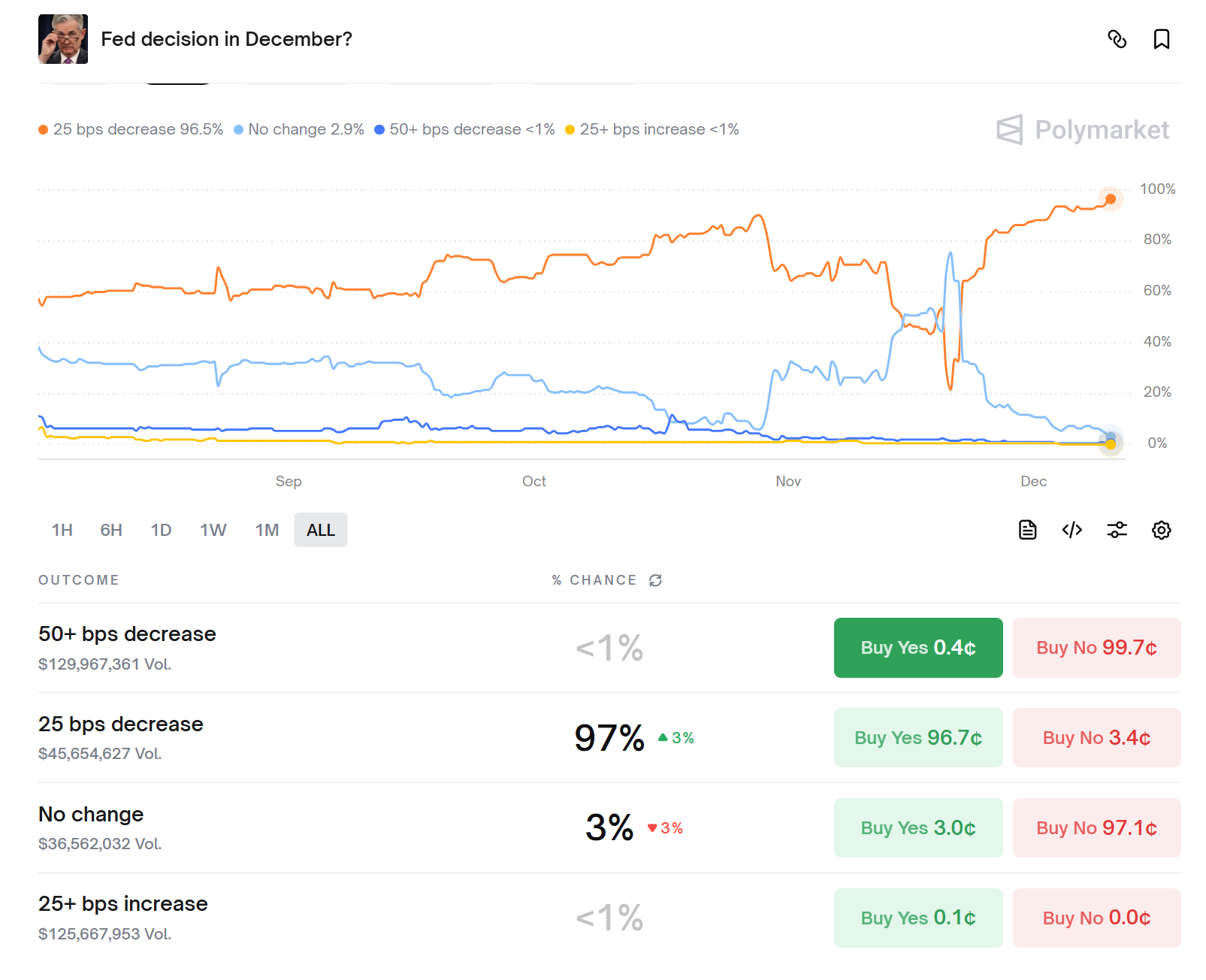
Market expectations for a rate cut have surged from 30% three weeks ago to 97% currently. This dramatic shift not only reflects collective anxiety in a data vacuum but also reveals that political pressure's influence on monetary policy is becoming more explicit.

Data Fog and Internal Divisions

The decision-making environment for the Fed at this meeting is exceptionally unique—the record 43-day U.S. government shutdown has resulted in the absence of most key economic data. This leaves the Fed, which has long emphasized being "data-dependent," seemingly navigating through a fog without clear coordinates for decision-making.

The absence of key official economic data, combined with the "mixed" nature of other alternative data, means the macroeconomic situation lacks a clear, objective anchor, leading to significant divergence in interpretations from various parties. Internal disagreements have become public and are trending toward polarization.

Currently, the stance on rate cuts among Federal Reserve Board members plus the New York Fed President presents a delicate 4-to-4 deadlock. This division is directly reflected in the dot plot, showing a rare "bimodal distribution"—7 officials support keeping rates unchanged for the full year, while 8 believe rates should be cut by 50 basis points.

More notably, the reasoning from both sides is equally compelling. Dovish officials argue the job market has clearly deteriorated, with the unemployment rate rising to 4.3% in August, a four-year high, and nonfarm payrolls increasing by only 22,000, far below expectations. Hawkish officials, however, are focused on inflation issue, with the core PCE price index rising 2.7% year-on-year, still above the Fed's long-term 2% target.


Pathways of Political Pressure Infiltration

The uniqueness of this meeting stems not only from the lack of economic data but also from the fact that political pressure is介入 (intervening in) the monetary policy arena in an unprecedentedly direct manner.

The Trump administration is directly influencing the structure of the Fed's decision-making layer through personnel appointments, breaking the long-standing tradition of "political neutrality" at the Fed.

The appointment of new Governor Stephen Milan is of symbolic significance. As a Fed governor simultaneously serving as Chairman of the White House Council of Economic Advisers, Milan cast a dissenting vote just one day after taking office, advocating for a more aggressive 50 basis point rate cut.

This policy stance highly aligns with Trump's public demand to "cut rates immediately and by a larger margin," raising deep concerns about the Fed's independence. More alarmingly, the Trump administration has clearly indicated that a nomination for the next Fed Chairperson might be announced before the end of December.

For the current core Fed decision-makers, this meeting might be their last chance to state their position and choose sides. Policy decisions during this power transition period inevitably involve considerations of personal career prospects.

The Fed faces not just a technical decision on interest rate adjustments but a severe test of its institutional independence. The balance between political pressure and professional judgment has become a key variable affecting the outcome of this meeting.


The Dilemma of Risk Management

Under the dual challenges of data absence and political pressure, the Fed's decision this time is essentially a complex risk management practice, requiring finding a balance between conflicting objectives. On one hand, the Fed needs to address the downside risks from a weakening labor market. Nonfarm payrolls increased by only 22,000 in August, a significant drop from the revised 79,000 in July, and the unemployment rate rose to a four-year high of 4.3%. If this slowing trend continues, it could trigger a vicious cycle of consumption contraction and economic recession.

On the other hand, inflation risks persist. Although current price pressures mainly stem from supply-side factors (such as import costs pushed up by tariff policies) rather than demand-pull from an overheating economy, whether inflation expectations can be effectively anchored remains uncertain. If the rate cut is too large, it could increase inflation risks, even triggering a wage-price spiral.

Making it more complex, the U.S. government's interest expense on debt has reached $1.1 trillion annually. While rate cuts could ease fiscal pressure, they might also fuel asset bubbles. This权衡 (trade-off) under multiple objectives complicates the Fed's decision-making framework, going beyond the traditional "dual mandate."


Institutional Resilience and Communication Challenges

This meeting tests not only the Fed's decision-making wisdom but also its institutional resilience and communication capabilities. With serious internal divisions, how to form a consensus and effectively communicate policy signals is a key challenge facing Chair Powell.

The divergence in the dot plot is phenomenal. Among the 19 policymakers, 6 believe no further rate cuts are needed, 9 support two more cuts, and there is also one clear outlier (likely Milan) hoping for an additional 125 basis points of cuts this year. This dispersed forecast distribution increases market skepticism about the Fed's communication strategy.

The Fed might address this challenge by strengthening forward guidance. A possible strategy is to emphasize the principle of "deciding meeting-by-meeting," avoiding clear commitments to the future path while stressing that policy will remain flexible. While this strategy might temporarily sidestep internal disagreements, it could weaken the effectiveness of policy signals.

A more profound challenge is how to gain market trust for decisions made in a data-deficient environment. The Fed may rely more heavily on high-frequency data (like weekly jobless claims) and alternative indicators (such as business surveys and the Beige Book) as references for decision-making. This shift in decision-making mode itself is a test of its communication ability.

As 2025 draws to a close, the Fed's future path remains full of unknowns. The分散的 (scattered) predictions on the dot plot indicate that officials hold differing views on the economic outlook and policy path for 2026. This meeting might inaugurate a全新的 (brand new) monetary policy framework: data absence will become the norm, not the exception; political pressure will move from behind the scenes to the forefront; and the Fed's independence will depend on its ability to maintain policy resolve in a complex environment.


Criptomoedas em alta

Perguntas relacionadas

QWhy is the Federal Reserve's upcoming policy meeting considered a 'political pressure test'?

AThe meeting is seen as a political pressure test because it is occurring amid unprecedented political influence, including direct demands from the Trump administration for rate cuts and the appointment of a Fed governor who also serves as a White House economic advisor, challenging the Fed's traditional independence.

QWhat makes the decision-making environment for this Fed meeting particularly unusual?

AThe decision-making environment is unusual due to the 43-day U.S. government shutdown, which has resulted in a lack of key economic data, leaving the Fed to operate in a 'data fog' without clear benchmarks for its typically data-dependent approach.

QHow are the Fed officials divided on the issue of interest rates according to the dot plot?

AThe dot plot shows a rare bimodal distribution: 7 officials support keeping rates unchanged for the year, while 8 expect a 50 basis point cut. One outlier, likely Stephen Milan, even advocates for a 125 basis point cut by year-end.

QWhat are the key risks the Fed must balance in its rate decision?

AThe Fed must balance the risk of a weakening labor market, with unemployment at a four-year high, against persistent inflation concerns, as core PCE remains above the 2% target, while also considering the impact on government debt costs and potential asset bubbles.

QWhat challenges does the Fed face in communicating its policy amid internal divisions?

AThe Fed faces challenges in forming a consensus and effectively signaling policy due to stark internal divisions. It may emphasize a 'meeting-by-meeting' approach and rely more on high-frequency and alternative data, but this could weaken the clarity of its policy guidance.

Leituras Relacionadas

Intern, Earning 120,000 Monthly

An article titled "Intern, Monthly Income of 120,000 RMB" discusses the intense competition for top AI talent in China, highlighted by a viral social media post. A Tsinghua University student from the prestigious Yao Class reportedly received a staggering internship offer from the AI company DeepSeek with a daily salary of 5,500 RMB (pre-tax), translating to over 120,000 RMB per month. This case exemplifies the fierce "talent war" raging among major tech firms. Companies like DeepSeek, Huawei, Tencent, and ByteDance are aggressively recruiting interns and fresh graduates with unprecedented compensation packages, high conversion rates to full-time positions, and even company stock options for top performers like those in Moonshot AI's "Time Travel Plan." The trend shows recruitment starting earlier, even targeting high school students. The driving force is the belief that a few exceptional individuals can be pivotal in the AI race. Salaries for elite AI researchers have skyrocketed from around one million RMB annually to tens of millions. Young, highly-educated talents from top schools, seen as adaptable "AI Natives," are being placed at the forefront of core projects. Examples include Tencent appointing a 27-year-old former OpenAI researcher as its Chief AI Scientist. In essence, the competition is shifting from just models and computing power to a battle for talent density. A new generation of young experts is rapidly rising to central roles, poised to reshape the future AI landscape.

marsbitHá 6h

Intern, Earning 120,000 Monthly

marsbitHá 6h

Trading

Spot

Artigos em Destaque

Como comprar O

Bem-vindo à HTX.com!Tornámos a compra de O1 exchange (O) simples e conveniente.Segue o nosso guia passo a passo para iniciar a tua jornada no mundo das criptos.Passo 1: cria a tua conta HTXUtiliza o teu e-mail ou número de telefone para te inscreveres numa conta gratuita na HTX.Desfruta de um processo de inscrição sem complicações e desbloqueia todas as funcionalidades.Obter a minha contaPasso 2: vai para Comprar Cripto e escolhe o teu método de pagamentoCartão de crédito/débito: usa o teu visa ou mastercard para comprar O1 exchange (O) instantaneamente.Saldo: usa os fundos da tua conta HTX para transacionar sem problemas.Terceiros: adicionamos métodos de pagamento populares, como Google Pay e Apple Pay, para aumentar a conveniência.P2P: transaciona diretamente com outros utilizadores na HTX.Mercado de balcão (OTC): oferecemos serviços personalizados e taxas de câmbio competitivas para os traders.Passo 3: armazena teu O1 exchange (O)Depois de comprar o teu O1 exchange (O), armazena-o na tua conta HTX.Alternativamente, podes enviá-lo para outro lugar através de transferência blockchain ou usá-lo para transacionar outras criptomoedas.Passo 4: transaciona O1 exchange (O)Transaciona facilmente O1 exchange (O) no mercado à vista da HTX.Acede simplesmente à tua conta, seleciona o teu par de trading, executa as tuas transações e monitoriza em tempo real.Oferecemos uma experiência de fácil utilização tanto para principiantes como para traders experientes.

162 Visualizações TotaisPublicado em {updateTime}Atualizado em 2026.06.29

Como comprar O

Como comprar PROS

Bem-vindo à HTX.com!Tornámos a compra de Pharos (PROS) simples e conveniente.Segue o nosso guia passo a passo para iniciar a tua jornada no mundo das criptos.Passo 1: cria a tua conta HTXUtiliza o teu e-mail ou número de telefone para te inscreveres numa conta gratuita na HTX.Desfruta de um processo de inscrição sem complicações e desbloqueia todas as funcionalidades.Obter a minha contaPasso 2: vai para Comprar Cripto e escolhe o teu método de pagamentoCartão de crédito/débito: usa o teu visa ou mastercard para comprar Pharos (PROS) instantaneamente.Saldo: usa os fundos da tua conta HTX para transacionar sem problemas.Terceiros: adicionamos métodos de pagamento populares, como Google Pay e Apple Pay, para aumentar a conveniência.P2P: transaciona diretamente com outros utilizadores na HTX.Mercado de balcão (OTC): oferecemos serviços personalizados e taxas de câmbio competitivas para os traders.Passo 3: armazena teu Pharos (PROS)Depois de comprar o teu Pharos (PROS), armazena-o na tua conta HTX.Alternativamente, podes enviá-lo para outro lugar através de transferência blockchain ou usá-lo para transacionar outras criptomoedas.Passo 4: transaciona Pharos (PROS)Transaciona facilmente Pharos (PROS) no mercado à vista da HTX.Acede simplesmente à tua conta, seleciona o teu par de trading, executa as tuas transações e monitoriza em tempo real.Oferecemos uma experiência de fácil utilização tanto para principiantes como para traders experientes.

153 Visualizações TotaisPublicado em {updateTime}Atualizado em 2026.06.29

Como comprar PROS

O que é VERONA

I. Introdução ao Projeto VERONA é uma blockchain construída para todos, em todo o lado, através da abstração da cadeia. Utilizando a sua camada de Abstração Generalizada, a VERONA distingue-se por integrar funcionalidades complexas de blockchain, como contas, assinaturas e interoperabilidade, diretamente ao nível do protocolo. Esta abordagem permite a interação com aplicações de blockchain sem a necessidade de compreender as tecnologias subjacentes.1) Informação Básica Nome: VERONA (VERONA)III. Links Relacionados Link do site oficial: https://xion.burnt.com/ Whitepaper: https://xion.burnt.com/whitepaper.pdf Exploradores: https://explorer.burnt.com/ Mídias Sociais: https://x.com/burnt_xion Nota: A introdução ao projeto provém dos materiais publicados ou fornecidos pela equipa oficial do projeto, que é apenas para referência e não constitui aconselhamento de investimento. A HTX não se responsabiliza por quaisquer perdas diretas ou indiretas resultantes.

777 Visualizações TotaisPublicado em {updateTime}Atualizado em 2026.06.22

O que é VERONA

Discussões

Bem-vindo à Comunidade HTX. Aqui, pode manter-se informado sobre os mais recentes desenvolvimentos da plataforma e obter acesso a análises profissionais de mercado. As opiniões dos utilizadores sobre o preço de A (A) são apresentadas abaixo.

活动图片