ETH Price Holds Near $3,000 as ETF Outflows Offset Market Gains

TheNewsCryptoPublicado em 2026-01-28Última atualização em 2026-01-28

Resumo

Ethereum (ETH) is trading near $3,004, showing modest gains while remaining range-bound between key support and resistance levels. Despite a 24-hour trading volume of $26.56 billion, ETH faces subdued medium-term momentum, trading below key moving averages. Institutional flows show a net outflow of $63.53 million from Ethereum ETFs, with BlackRock’s fund contributing significantly. While some products saw minor inflows, they weren’t enough to offset outflows, though cumulative net inflows since launch stand at $12.36 billion. Technical indicators like RSI and MACD suggest balanced buying and selling pressure, with near-term movement likely confined between $2,900 support and $3,150–$3,200 resistance.

Ethereum (ETH) is trading near $3,004, showing a modest gain over the past day as price action remains around the $3,000 level. Over the last 24 hours, ETH moved between an intraday low of $2,916.22 and a high of $3,040.72, while its market capitalization stands at $362.66 billion and trading volume is around $26.56 billion. This reflects ongoing interest in the asset even as broader market dynamics evolve.

Meanwhile, institutional flows into Ethereum’s exchange-traded products remain a key focus. According to the latest data SoSoValue, the total net flow for January 27 showed a net outflow of about $63.53 million, with BlackRock’s ETHA fund accounting for the largest portion of that outflow.
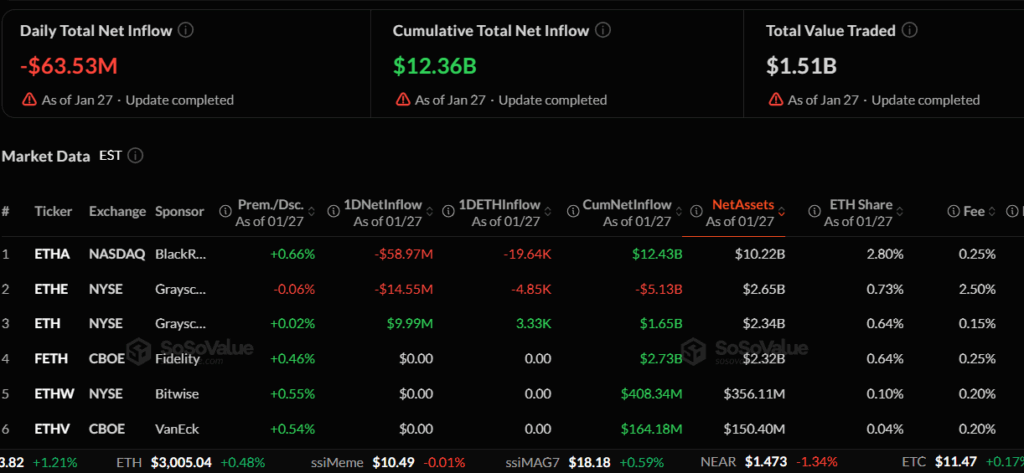
At the same time, some other products, such as the Grayscale Ethereum Mini Trust ETF, recorded smaller net inflows, but they were not large enough to offset the overall outflow figure. The cumulative total net inflow into Ethereum spot ETFs now stands near $12.36 billion since these products launched.

Ethereum Trades Near $3,000 as Price Action Remains Range-Bound

On the weekly chart, Ethereum is still trading below its 9-week moving average (near $3,050) and below the 21-week moving average (around $3,515). This suggests that medium-term trend momentum remains subdued. Weekly price action has seen lower highs after peaks near $3,800, indicating that sellers have been active at higher levels and the broader structure has not yet turned decisively upward. The lack of a fresh bullish crossover keeps upside momentum restrained for now.

The RSI (14) on the weekly timeframe sits around 44–45, below neutral levels. This highlights a lack of strong momentum in either direction, with buying and selling pressures broadly balanced. Meanwhile, the MACD indicator remains below its signal line with the histogram in negative territory, pointing to continued range-bound conditions rather than a firm trend reversal.

Zooming in, The Bull Bear Power Trend (BBPT) shows reduced bearish pressure, but bullish strength is still limited. This aligns with the current sideways movement.

Looking at short-term price action, daily charts show ETH consolidating above $2,900, with buyers defending dips and sellers stepping in near resistance levels. From a longer-term perspective, Ethereum remains above several key support bands but below major resistance zones formed earlier in the year, reflecting a period of correction and consolidation following earlier gains.

In the near term, support is seen near $2,900, while resistance is located around $3,150–$3,200. Until price clears these levels with conviction, ETH’s movement is likely to remain range-bound, shaped by both technical levels and broader market flows.


TagsAltcoinCrypto MarketETHETHEREUM

Perguntas relacionadas

QWhat is the current trading price of Ethereum (ETH) and what is its market capitalization?

AEthereum (ETH) is trading near $3,004, and its market capitalization stands at $362.66 billion.

QWhat was the total net flow for Ethereum exchange-traded products on January 27, and which fund had the largest outflow?

AThe total net flow for January 27 showed a net outflow of about $63.53 million, with BlackRock's ETHA fund accounting for the largest portion of that outflow.

QWhat do the weekly RSI and MACD indicators suggest about Ethereum's current market momentum?

AThe weekly RSI (14) sits around 44–45, below neutral levels, indicating a lack of strong momentum in either direction. The MACD remains below its signal line with the histogram in negative territory, pointing to continued range-bound conditions rather than a firm trend reversal.

QWhat are the key near-term support and resistance levels for Ethereum's price?

AIn the near term, support is seen at $2,900, while resistance is located around $3,150–$3,200.

QWhat is the cumulative total net inflow into Ethereum spot ETFs since their launch?

AThe cumulative total net inflow into Ethereum spot ETFs now stands near $12.36 billion since these products launched.

Leituras Relacionadas

The AI Agent Era Accelerates Its Arrival: Questflow Defines a New Paradigm of Financial Intelligence with On-Chain AI Brokerage

The AI Agent era is accelerating, with the CB Insights AI 100 list highlighting global investment confidence. The focus has shifted from whether AI works to its speed of deployment and ability to manage complex workflows, with autonomous AI Agents driving this transformation. At the forefront is Questflow, a Singapore-based startup redefining financial intelligence through its on-chain AI brokerage. Unlike tools that merely provide data dashboards, Questflow deploys AI Agents that proactively scan markets, form judgments, and execute trades via a conversational interface—operating 24/7 without requiring manual confirmation for each decision. This embodies the new AI paradigm of agents capable of executing multi-step workflows autonomously. Questflow's mission is to democratize institutional-grade trading intelligence. Historically reserved for the ultra-wealthy, this capability is now accessible starting from just $1 through Questflow's "AI Clone + Copy Trade" model. The platform charges only a 1% execution fee, aligning its incentives directly with users and eliminating traditional management or performance fees. The timing is opportune, aligning with key trends identified by CB Insights: the scalable deployment of AI Agents, accelerated AI adoption in financial services, and the maturation of on-chain infrastructure. With robust liquidity on platforms like Hyperliquid and Polymarket, alongside advancements in AI reasoning and non-custodial wallet security, Questflow is positioned to merge the roles of broker, fund, and exchange into a single, accessible platform for millions.

链捕手Há 29m

The AI Agent Era Accelerates Its Arrival: Questflow Defines a New Paradigm of Financial Intelligence with On-Chain AI Brokerage

链捕手Há 29m

Why Pricing Social Interactions is Doomed to Fail?

Titled "Why Putting a Price on Social Interaction Is Doomed to Fail," this article critiques attempts to monetize social networks directly through SocialFi models, arguing their inevitable failure stems from a fundamental misunderstanding of media dynamics. Using Marshall McLuhan's theory of "hot" and "cold" media, the author posits that social networks are inherently "cold" media. Their value isn't contained in individual posts but is co-created through user participation, interpretation, and fragmented, ongoing interaction (e.g., replies, shares). This ambiguity and need for user involvement are core to their function. The article asserts that SocialFi projects like Friend.tech failed because introducing real-time, tradable financial pricing (a definitive "hot" signal) into this "cold" environment doesn't add a layer—it replaces the medium's essence. The unambiguous price signal overshadows and nullifies the nuanced, participatory social signal. Users become traders, not participants, and when speculative profits vanish, the underlying social ecosystem—never genuinely cultivated—collapses entirely. This principle extends beyond crypto. The author argues platforms like Twitter have gradually "heated up" through metrics (likes, retweets counts, algorithmically defined value), shifting users from participants to performers and eroding organic engagement. The solution isn't to abandon capital but to manage its entry point. Successful models like Substack, Patreon, or Bandcamp allow capital to "condense" at specific, isolated nodes (e.g., subscriptions, one-time payments) without permeating and "heating" every social interaction. They preserve the core "cold," participatory medium while enabling monetization at designated boundaries. The NFT boom and bust serves as a stark parallel: the ancient "cold" medium of collecting (valued for story, community, gradual accumulation) was rapidly destroyed by platforms that introduced real-time floor prices, rarity scores, and trading dashboards, transforming collectors into speculators and vaporizing cultural value when prices fell. The core lesson: "Liquidity equals heat." Injecting high liquidity and definitive pricing into a "cold" participatory medium doesn't optimize it; it fundamentally alters and destroys its value-creating mechanism. The future lies not in pricing every social gesture but in finding precise, non-invasive points for capital to condense without overheating the entire ecosystem.

marsbitHá 37m

Why Pricing Social Interactions is Doomed to Fail?

marsbitHá 37m

Trading

Spot
Futuros
活动图片




