Drift Protocol incident uncovered: Did ‘negligence’ lead to the $285M loss?

ambcryptoPublicado em 2026-04-06Última atualização em 2026-04-06

Resumo

Drift Protocol's $285 million hack underscores a critical industry lesson: security cannot be sacrificed for scalability. This incident, potentially linked to the same group behind the 2024 Radiant Capital hack, reveals a meticulously planned attack where perpetrators posed as a legitimate firm to gain trust. In response, Drift froze protocol functions and collaborated with law enforcement, though market confidence remained shaken. The timing is significant, as Solana recently tested quantum-resistant upgrades that slowed the network by 90%, highlighting the inherent trade-offs between security and performance. Public scrutiny has intensified, with some labeling the breach "civil negligence," signaling a shift in the 2026 cycle toward prioritizing security, accountability, and quantum-threat preparedness over mere scalability.

This cycle clearly favors security over scalability, which marks a big shift from previous years.

Back in 2025, protocols like Ethereum [ETH] and Solana [SOL] focused on scaling the network, boosting transaction throughput, reducing congestion, and staying competitive in the fast-growing DeFi space. Their goal was simple: make the blockchain more scalable, even if that meant taking on extra risk under the hood.

However, the recent Drift protocol incident drives home a clear lesson: you cannot trade security for speed. In this context, could the attack actually act as a blessing in disguise, pushing the community and protocol teams to rethink operational security and put integrity above scalability?
Source: X

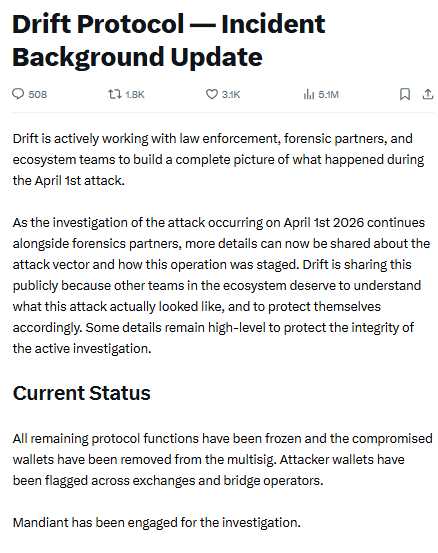
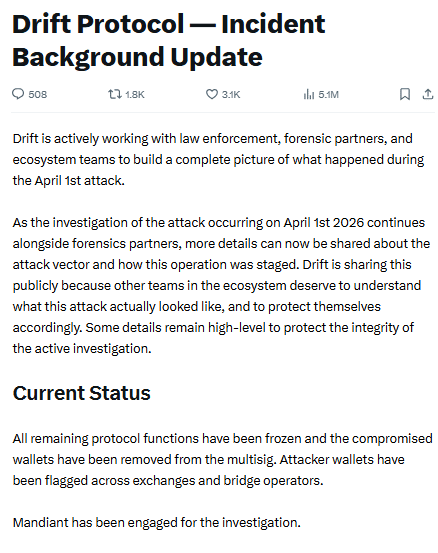
According to the official statement, the team is working closely with law enforcement and forensic experts to investigate the Drift incident. Because of this, they froze all protocol functions, removed compromised wallets, and flagged attacker wallets across exchanges.

Interestingly, early evidence ties the attack to the same group behind the October 2024 Radiant Capital hack, though final attribution is still pending. The big takeaway? This was a months-long, carefully planned operation. The attackers posed as a legitimate trading firm, building trust through in-person meetings, and even deposited over $1 million to appear credible.

On paper, Drift’s response shows accountability in action, but the market reaction didn’t really reflect confidence. So, the question is, does this Drift incident expose security weaknesses and force the industry to rethink operational practices to prevent similar attacks in the future?

Drift incident sparks public pressure and industry wake-up call

Even with the massive $285 million hack, the Drift incident highlights some important lessons.

According to AMBCrypto, the “timing” makes this attack especially relevant. Solana recently tested a quantum-resistant model to prepare for future quantum threats, but the experiment slowed the network by 90%, showing that security upgrades can come at a cost.

In this light, the Drift incident clearly shows that security can’t be an afterthought, even as protocols chase speed, scalability, and new features. Put simply, even with Solana’s 90% slowdown, the focus must stay on robust, practical security, something the Drift incident helped bring into sharp focus.
Source: X

Beyond the technical lessons, the public scrutiny that followed, though, adds another layer of pressure.

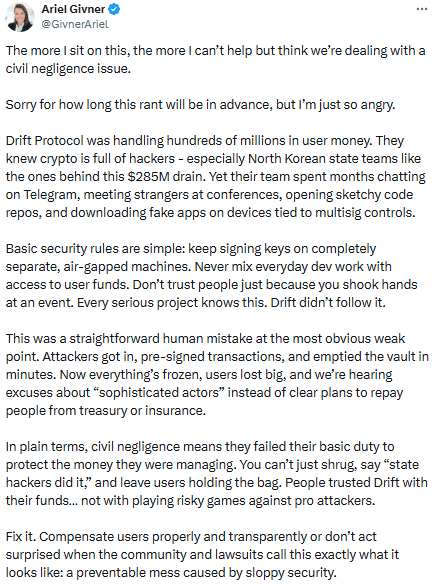
As the post above highlights, some reactions even called the hack “civil negligence,” implying that the protocol itself carried responsibility for the breach, alongside the attackers. This perspective isn’t too far-fetched, given the industry’s approach to security over the past few cycles.

Looking at it this way, the Drift protocol incident could be the wake-up call the market needed to move away from last year’s “scalability-first” mindset. The 2026 cycle is therefore shaping up to be security-driven, fueled by accountability, public pressure, and growing concerns around quantum threats.


Final Summary

  • The Drift incident highlights that security must come before speed, forcing protocols to rethink operational practices.
  • Public scrutiny and industry pressure are pushing the 2026 cycle to be security-driven, with quantum-threat preparedness taking center stage.


Perguntas relacionadas

QWhat was the main focus of blockchain protocols like Ethereum and Solana in 2025, according to the article?

AIn 2025, protocols like Ethereum and Solana focused on scaling the network, boosting transaction throughput, reducing congestion, and staying competitive in the fast-growing DeFi space, even if it meant taking on extra risk.

QWhat is the primary lesson the Drift protocol incident is said to drive home?

AThe primary lesson is that you cannot trade security for speed, and it should push the community to rethink operational security and put integrity above scalability.

QHow did the attackers gain the trust of the Drift protocol before the exploit?

AThe attackers posed as a legitimate trading firm, building trust through in-person meetings, and deposited over $1 million to appear credible.

QWhat broader industry shift is the Drift incident sparking for the 2026 cycle?

AThe incident is sparking a shift towards a security-driven cycle, fueled by accountability, public pressure, and growing concerns around quantum threats, moving away from the previous 'scalability-first' mindset.

QWhat was the estimated financial loss from the Drift Protocol incident?

AThe estimated financial loss from the Drift Protocol incident was $285 million.

Leituras Relacionadas

Huawei Cloud Rejects Token Price War, Zhou Yuefeng Seeks a New Winning Formula for AI Cloud

At the 2026 Huawei Cloud INSPIRE Creator Conference, CEO Zhou Yuefeng outlined Huawei Cloud's distinct strategy in the competitive AI cloud market. Instead of engaging in price wars based on token volume or Maas revenue—a common focus for rivals like Alibaba Cloud and ByteDance's Volcano Engine—Huawei Cloud is shifting the competition towards real-world productivity gains. Zhou highlighted three core differentiators: a fully domestic computing stack (Ascend, Kunpeng), a focus on government and enterprise clients rather than consumer internet, and a deep commitment to open-source ecosystems. To this end, Huawei Cloud launched a suite of new products under the "Agentic Infra" paradigm, including the AICS Lingqu computing cluster, AMS memory storage, and the ModelArts Next platform. These aim to solve enterprise challenges in deploying AI agents, such as latency, memory, scheduling, and security. The strategy further involves creating specialized industry zones ("AI Dream Factories") for sectors like healthcare and embodied intelligence. For example, a smart medical zone developed with Shanghai Ruijin Hospital aims to democratize expert-level diagnostic capabilities. In essence, Huawei Cloud is positioning itself not as a commodity token provider, but as the foundational infrastructure for industrial AI, leveraging its domestic supply chain and hybrid cloud solutions to serve sectors where productivity, not just scale, is the ultimate measure of value.

marsbitHá 42m

Huawei Cloud Rejects Token Price War, Zhou Yuefeng Seeks a New Winning Formula for AI Cloud

marsbitHá 42m

70% of the Public Opposes AI, Americans Hope the U.S. Loses the AI War

70% of Americans believe AI development is moving too fast, with growing public resistance evolving from online criticism to real-world protests and violence. This widespread anti-AI sentiment stems from fears of job losses, rising utility costs, environmental damage, threats to democracy, and financial instability. Key incidents illustrate the backlash: Google's former CEO Eric Schmidt was loudly booed at a graduation for promoting AI; AI company ads are vandalized; protests and even violent attacks target AI firms and data centers. Polls show deep public pessimism and strong local opposition to data center construction, often surpassing resistance to nuclear power plants. The core grievances are economic and practical: AI is seen as automating jobs, concentrating wealth, and increasing household electricity and water bills due to massive data center resource demands. Environmentalists also oppose AI's high energy use and carbon emissions. This opposition has turned AI into a major political issue in the US. While the Trump administration prioritizes AI innovation for global competition, bipartisan pushback is growing. Democrats and factions within the MAGA movement are forming temporary alliances to support stricter regulations and local bans on new data centers, pressuring the administration to choose between its tech industry backers and its voter base. The situation highlights a profound national divide over AI's future.

marsbitHá 1h

70% of the Public Opposes AI, Americans Hope the U.S. Loses the AI War

marsbitHá 1h

Trading

Spot
Futuros

Artigos em Destaque

Como comprar DRIFT

Bem-vindo à HTX.com!Tornámos a compra de Drift Protocol (DRIFT) simples e conveniente.Segue o nosso guia passo a passo para iniciar a tua jornada no mundo das criptos.Passo 1: cria a tua conta HTXUtiliza o teu e-mail ou número de telefone para te inscreveres numa conta gratuita na HTX.Desfruta de um processo de inscrição sem complicações e desbloqueia todas as funcionalidades.Obter a minha contaPasso 2: vai para Comprar Cripto e escolhe o teu método de pagamentoCartão de crédito/débito: usa o teu visa ou mastercard para comprar Drift Protocol (DRIFT) instantaneamente.Saldo: usa os fundos da tua conta HTX para transacionar sem problemas.Terceiros: adicionamos métodos de pagamento populares, como Google Pay e Apple Pay, para aumentar a conveniência.P2P: transaciona diretamente com outros utilizadores na HTX.Mercado de balcão (OTC): oferecemos serviços personalizados e taxas de câmbio competitivas para os traders.Passo 3: armazena teu Drift Protocol (DRIFT)Depois de comprar o teu Drift Protocol (DRIFT), armazena-o na tua conta HTX.Alternativamente, podes enviá-lo para outro lugar através de transferência blockchain ou usá-lo para transacionar outras criptomoedas.Passo 4: transaciona Drift Protocol (DRIFT)Transaciona facilmente Drift Protocol (DRIFT) no mercado à vista da HTX.Acede simplesmente à tua conta, seleciona o teu par de trading, executa as tuas transações e monitoriza em tempo real.Oferecemos uma experiência de fácil utilização tanto para principiantes como para traders experientes.

276 Visualizações TotaisPublicado em {updateTime}Atualizado em 2026.06.02

Como comprar DRIFT

Discussões

Bem-vindo à Comunidade HTX. Aqui, pode manter-se informado sobre os mais recentes desenvolvimentos da plataforma e obter acesso a análises profissionais de mercado. As opiniões dos utilizadores sobre o preço de DRIFT (DRIFT) são apresentadas abaixo.

活动图片