Dogecoin Targets Japan In New RWA And Adoption Push

bitcoinistPublicado em 2026-01-09Última atualização em 2026-01-09

Resumo

Dogecoin's corporate arm, House of Doge, has partnered with two Japan-focused firms, abc Co., Ltd. and ReYuu Japan Inc., to drive localized adoption and real-world asset (RWA) initiatives in Japan. The collaboration aims to explore gold-backed stablecoins, regulatory-compliant RWA tokenization under Japan's "green list" framework, and the establishment of a joint fund. This move signals a strategic shift for Dogecoin towards practical utility, including payments and financial products, beyond its meme-centric origins. The partnership emphasizes responsible innovation and ecosystem growth, though specific details on assets, timelines, or merchants were not disclosed. At the time of writing, DOGE was trading at $0.14276.

House of Doge, the corporate arm of the Dogecoin Foundation, says it has struck a partnership framework with two Japan-focused firms to explore localized Dogecoin adoption and real-world asset (RWA) initiatives, putting Japan at the center of its next ecosystem expansion effort.

Dogecoin Plots Japan Expansion

In a Thursday press release dated Jan. 8, House of Doge said it has agreed a tripartite cooperation framework with abc Co., Ltd. and ReYuu Japan Inc. The arrangement is framed as a roadmap for “future collaboration,” rather than a single product launch, but it spells out several lines of work that point toward regulated tokenization and payments-style integrations tailored to the Japanese market.

“This partnership reflects our continued focus on supporting thoughtful, real-world expansion of the Dogecoin ecosystem,” Marco Margiotta, CEO of House of Doge, said in the release. “Japan represents a natural and culturally aligned market for DOGE given its strong embrace of digital innovation and we are pleased to explore opportunities alongside abc and ReYuu Japan that support responsible innovation, real-world utility, and long-term ecosystem growth.”

House of Doge said the agreement outlines potential cooperation areas designed to “leverage the strengths of each party” in support of ecosystem growth. The framework highlights efforts around promoting and adopting gold asset-backed stablecoins, as well as regulatory-oriented work connected to listing RWA tokens under Japan’s “green list” framework. It also references establishing a joint fund within the Dogecoin ecosystem and pushing “next-generation Web3” through real-world use cases.

The inclusion of a “green list” pathway is notable because it foregrounds compliance and market-structure considerations rather than the meme-driven branding that has historically defined DOGE in the public imagination. At the same time, the release does not specify which assets would be tokenized, what a gold-backed stablecoin would look like in practice, or whether any on-chain issuance would be directly tied to Dogecoin versus adjacent infrastructure.

The partners are positioned as complementary: ReYuu Japan is described as supporting business development and localization in Japan, while abc is presented as bringing “token-economy design, smart-contract development, and regulatory alignment,” with a focus on RWA and compliant Web3 integration. House of Doge’s role is framed as ecosystem coordination and infrastructure investment, with the press release casting the partnership as part of a broader international strategy.

Together, the companies say they intend to support “localized and responsible” expansion of Dogecoin-related initiatives in Japan, though the release stops short of naming specific merchants, financial institutions, pilot programs, or timelines.

House of Doge used the announcement to reinforce its broader narrative: that Dogecoin’s next phase is about practical utility; payments, financial products, and tokenization rather than purely cultural relevance. “House of Doge is the official corporate arm of the Dogecoin Foundation, committed to advancing Dogecoin as a widely accepted and decentralized global currency. By investing in the necessary infrastructure to integrate Dogecoin into everyday commerce, House of Doge is building secure, scalable, and efficient systems for real-world use.”

It adds that its scope spans “payments and financial products to real-world asset tokenization and cultural partnerships,” arguing this is “the next era of crypto utility, where Dogecoin goes beyond the meme.”

At press time, DOGE traded at $0.14276.
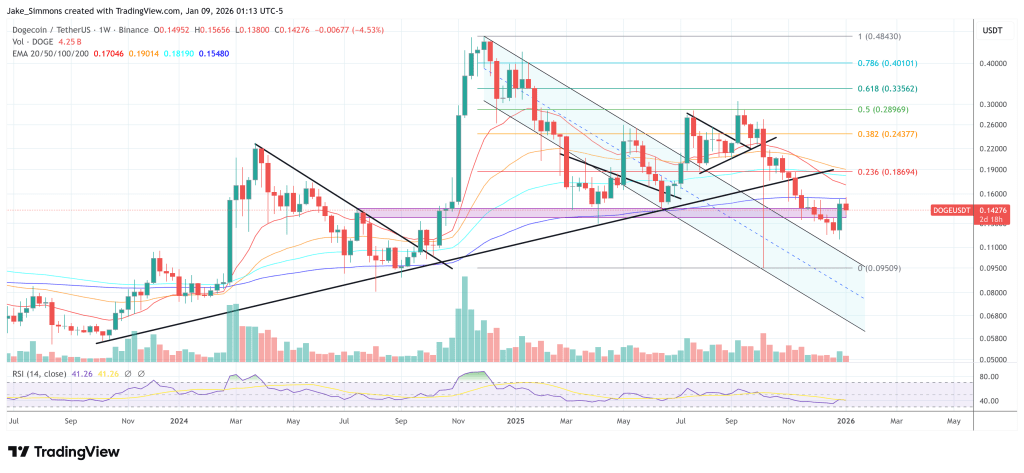
DOGE remains below the 200-week EMA, 1-week chart | Source: DOGEUSDT on TradingView.com

Perguntas relacionadas

QWhat is the main focus of the partnership between House of Doge, abc Co., Ltd., and ReYuu Japan Inc. in Japan?

AThe partnership focuses on exploring localized Dogecoin adoption and real-world asset (RWA) initiatives, including promoting gold asset-backed stablecoins, regulatory work for RWA token listings, establishing a joint fund, and pushing next-generation Web3 through real-world use cases in the Japanese market.

QWhich two Japan-focused companies did House of Doge partner with for its expansion efforts?

AHouse of Doge partnered with abc Co., Ltd. and ReYuu Japan Inc. for its expansion efforts in Japan.

QWhat role does ReYuu Japan play in this partnership framework?

AReYuu Japan supports business development and localization efforts in Japan for the partnership.

QHow does House of Doge describe the next phase of Dogecoin's development in this announcement?

AHouse of Doge describes Dogecoin's next phase as being about practical utility, including payments, financial products, and tokenization, moving beyond purely cultural relevance and meme-driven branding.

QWhat specific regulatory framework in Japan is mentioned in relation to listing RWA tokens?

AThe partnership framework highlights regulatory-oriented work connected to listing RWA tokens under Japan's 'green list' framework.

Leituras Relacionadas

Vitalik: We Need to Create Sanctuaries, Not Fight AI

In a recent interview, Vitalik Buterin, founder of Ethereum, addresses the central anxiety of the AI era. He argues the primary risk isn't AI's intelligence, but human passivity—ceding decisions, privacy, and agency to centralized systems or "super AIs" for a sense of "disempowering safety." His solution is not to fight AI, but to build "sanctuary technologies." These are optional, non-totalizing spaces that protect users while preserving their sovereignty and privacy. Ethereum is presented as a prime example, offering a parallel financial system one can freely choose, not a fix for the old one. Reflecting on his journey from a 19-year-old on "autopilot" to an active "pilot," Vitalik notes the world reinvents itself every 5-10 years. To keep up, individuals must actively pilot their lives, not be passive passengers. He stresses that active learning vastly outperforms passive learning, even with equal time invested. His practical advice for builders and individuals in the AI age includes: periodically forcing oneself to do tasks manually to keep the mind engaged; prioritizing active learning and verification over outsourcing answers; building tools that help retain human agency; not outsourcing all strategic thinking to AI; and preserving serendipity through real-world interactions. Ultimately, Buterin redefines Ethereum/crypto's role: not to win against or fix the old world, but to provide a free, optional alternative. The core message is that as AI grows more powerful, the truly scarce resource will be proactive humans who retain their sovereignty, privacy, and capacity for independent thought. The era demands not less tool use, but more intentional and active use of technology.

链捕手Há 1h

Vitalik: We Need to Create Sanctuaries, Not Fight AI

链捕手Há 1h

Conversation with Patagon Founder: Revealing the Inside Story of Anthropic's Secondary Market

**Summary: Inside Anthropic's Massive, Opaque Secondary Market** In a revealing interview, Patagon founder Dio Casares pulls back the curtain on the booming, high-risk secondary market for shares in companies like Anthropic. This private market, fueled by companies staying private longer and massive funding rounds, is estimated to involve hundreds of billions of dollars. Casares distinguishes between two types of "secondary" trading: 1. **Company-approved SPV (Special Purpose Vehicle) sales:** Where new capital flows into the company, often facilitated by select private equity firms. Anthropic supports this to manage liquidity and pre-IPO selling pressure. 2. **The "gray" market:** Platforms like Hive and Forge that match buyers and sellers, often creating pricing confusion and competing with official funding rounds. These intermediaries are widely disliked by companies. The market structure is complex and fragmented, relying heavily on personal connections. Brokers connect buyers and sellers, often layering multiple SPVs to pool capital, with single transaction fees as high as 10%. Strikingly, some finance professionals earn more from this trading than from their primary investment roles. **Key risks highlighted include:** * **High Fraud Rates:** An estimated 10-20% of transactions involve fake stock certificates or sellers who take payment without having the shares. * **Complex, Risky Structures:** Nested SPVs, "forward contracts" on employee equity, and tokenized private equity create layers of opacity. This is exemplified by a recent incident where an xAI employee's shares were revoked after an espionage allegation, leaving buyers empty-handed. * **Post-IPO "Settlement Hell":** After an IPO, delays in distributing shares through multiple SPV layers and decisions by fund managers to hold onto shares could trigger years of lawsuits as downstream investors are locked out. **For small investors** holding positions through tokenized vehicles or layered SPVs, it's often impossible to verify the underlying asset. Casares advises caution: if the investment feels wrong, consider exiting. As the private market now surpasses IPO fundraising, this "wild west" ecosystem faces a looming reckoning. While it will likely professionalize, the post-IPO period for a company like Anthropic could unleash a wave of disputes, exposing the vulnerabilities built into this frenzied, largely unregulated marketplace.

marsbitHá 3h

Conversation with Patagon Founder: Revealing the Inside Story of Anthropic's Secondary Market

marsbitHá 3h

Trading

Spot
Futuros

Artigos em Destaque

Como comprar PUSH

Bem-vindo à HTX.com!Tornámos a compra de Push Protocol (PUSH) simples e conveniente.Segue o nosso guia passo a passo para iniciar a tua jornada no mundo das criptos.Passo 1: cria a tua conta HTXUtiliza o teu e-mail ou número de telefone para te inscreveres numa conta gratuita na HTX.Desfruta de um processo de inscrição sem complicações e desbloqueia todas as funcionalidades.Obter a minha contaPasso 2: vai para Comprar Cripto e escolhe o teu método de pagamentoCartão de crédito/débito: usa o teu visa ou mastercard para comprar Push Protocol (PUSH) instantaneamente.Saldo: usa os fundos da tua conta HTX para transacionar sem problemas.Terceiros: adicionamos métodos de pagamento populares, como Google Pay e Apple Pay, para aumentar a conveniência.P2P: transaciona diretamente com outros utilizadores na HTX.Mercado de balcão (OTC): oferecemos serviços personalizados e taxas de câmbio competitivas para os traders.Passo 3: armazena teu Push Protocol (PUSH)Depois de comprar o teu Push Protocol (PUSH), armazena-o na tua conta HTX.Alternativamente, podes enviá-lo para outro lugar através de transferência blockchain ou usá-lo para transacionar outras criptomoedas.Passo 4: transaciona Push Protocol (PUSH)Transaciona facilmente Push Protocol (PUSH) no mercado à vista da HTX.Acede simplesmente à tua conta, seleciona o teu par de trading, executa as tuas transações e monitoriza em tempo real.Oferecemos uma experiência de fácil utilização tanto para principiantes como para traders experientes.

506 Visualizações TotaisPublicado em {updateTime}Atualizado em 2025.03.21

Como comprar PUSH

Discussões

Bem-vindo à Comunidade HTX. Aqui, pode manter-se informado sobre os mais recentes desenvolvimentos da plataforma e obter acesso a análises profissionais de mercado. As opiniões dos utilizadores sobre o preço de PUSH (PUSH) são apresentadas abaixo.

活动图片