Dogecoin drops, but whales buy 470 mln DOGE tokens – What’s next?

ambcryptoPublicado em 2026-03-23Última atualização em 2026-03-23

Resumo

Dogecoin (DOGE) has declined amid broader market weakness linked to geopolitical tensions, dropping over 1.25% in 24 hours to $0.09. Despite the bearish sentiment, large investors accumulated 470 million DOGE tokens between March 18–21, 2026, signaling confidence in a potential rebound. Derivatives data shows a mild bearish tilt, with more short positions than longs. However, technical analysis indicates DOGE is trading near a key support level of $0.088 within a parallel channel. If it holds, a 15% rise toward $0.1038 is possible, repeating historical patterns. The ADX indicator confirms a strong trend, supporting the chance of upward movement.

The popular meme-based cryptocurrency Dogecoin [DOGE] has garnered widespread attention from market participants amid the ongoing West Asia crisis.

The impact of this situation is evident across the broader crypto and global financial markets, which have experienced a significant downturn as the crisis enters its 24th day.

As of press time, DOGE declined by over 1.25% in the past 24 hours and was trading at $0.090. Over the past month, however, the memecoin has fallen by nearly 10%.

Whales add 470 million DOGE amid market dip

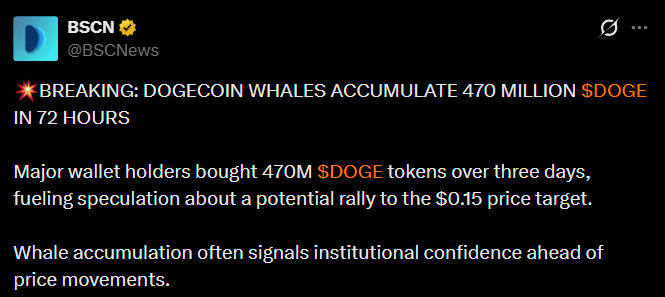
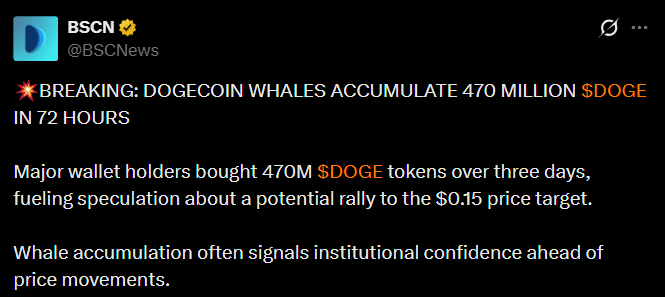
Despite the continued price decline, a well-followed local news outlet reported that whales are heavily accumulating amid the market dip. In a post on X, it was revealed that between the 18th and the 21st of March 2026, large holders purchased 470 millionn DOGE tokens.
Source: X/BSCNews

The report further noted that DOGE could potentially reach the $0.15 level in the coming days.

This significant accumulation amid weak market sentiment indicates growing confidence among large investors. It also suggests that major players may be positioning themselves ahead of a potential move, raising questions about whether the current price level presents a buying opportunity.

Derivative tool flashes a mild bearish sentiment

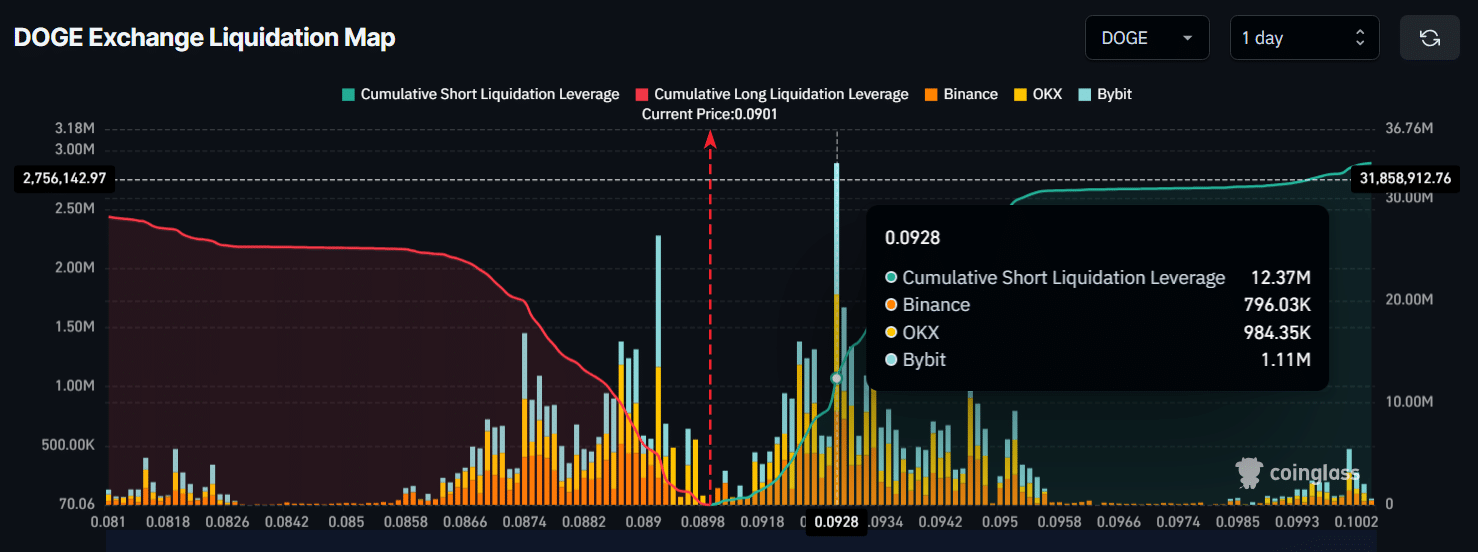
According to the derivatives analytics tool CoinGlass, DOGE’s short-term market sentiment is mildly bearish. Data from the DOGE Exchange Liquidation Map showed that intraday traders were heavily tilted toward short-leveraged positions rather than long ones.

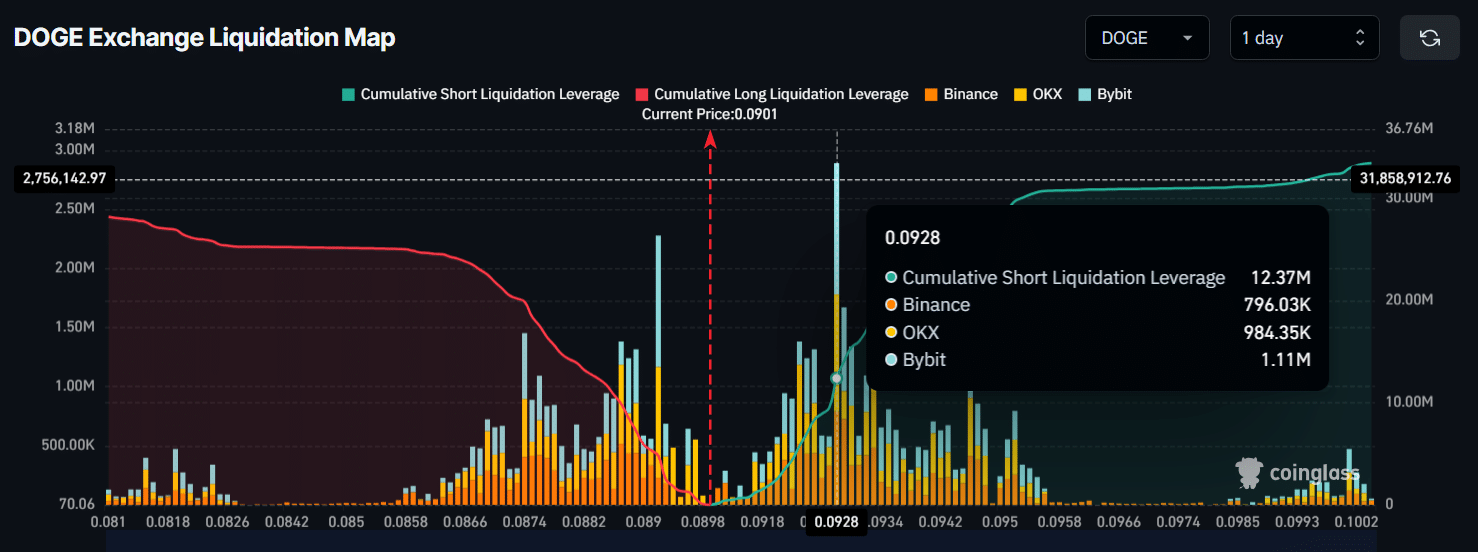
Currently, $0.0892 on the downside and $0.0928 on the upside are the two major levels where traders are overleveraged, with $4.13 million worth of long positions and $12.37 million worth of short positions built up.
Source: CoinGlass

This bearish outlook is further demonstrated by another derivatives indicator, the Long/Short Ratio, which was at 0.9504 at the time of writing. So, short positions slightly outweighed long positions, reflecting cautious bearish sentiment.

DOGE chart signals potential 15% price jump

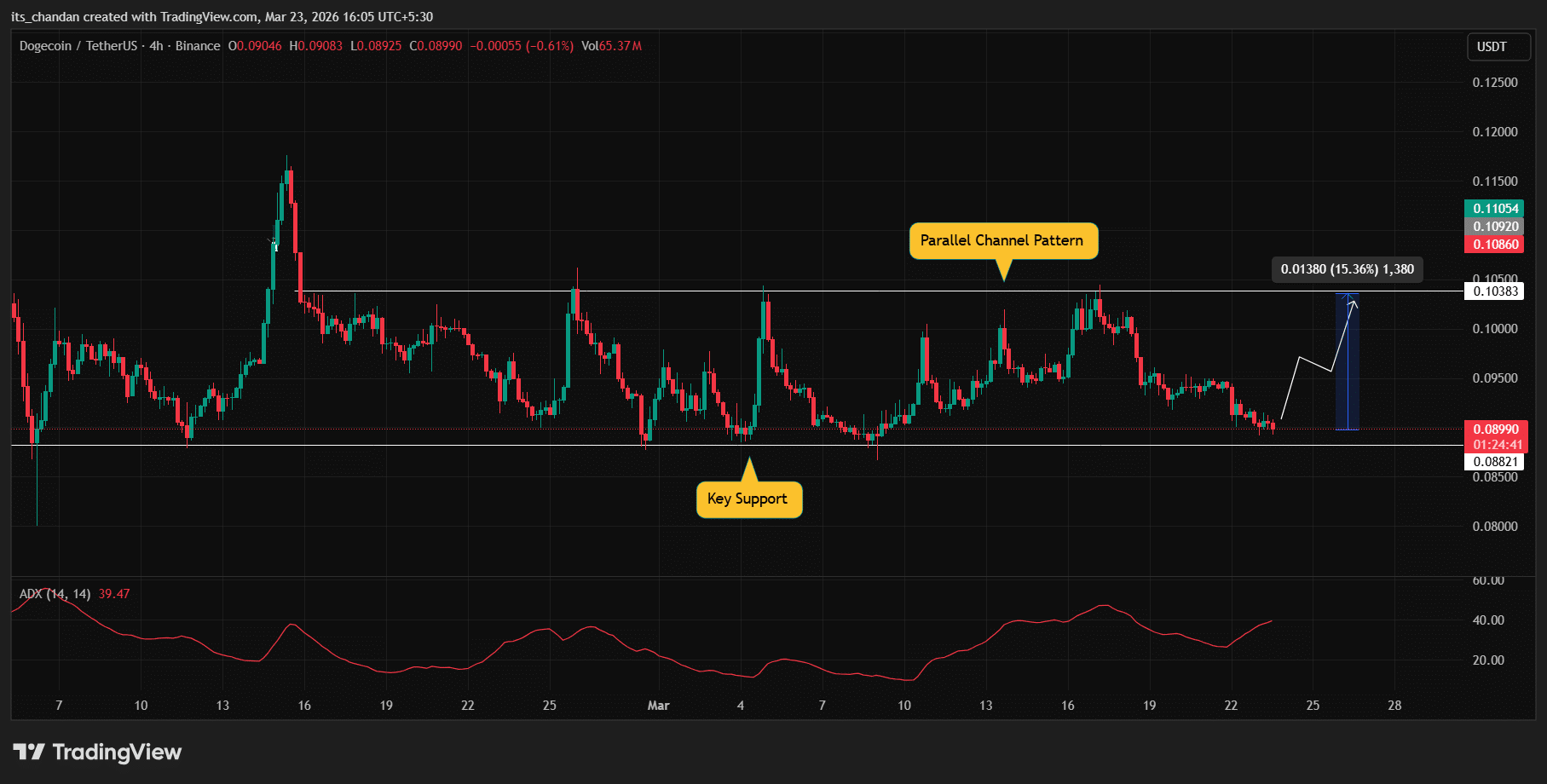
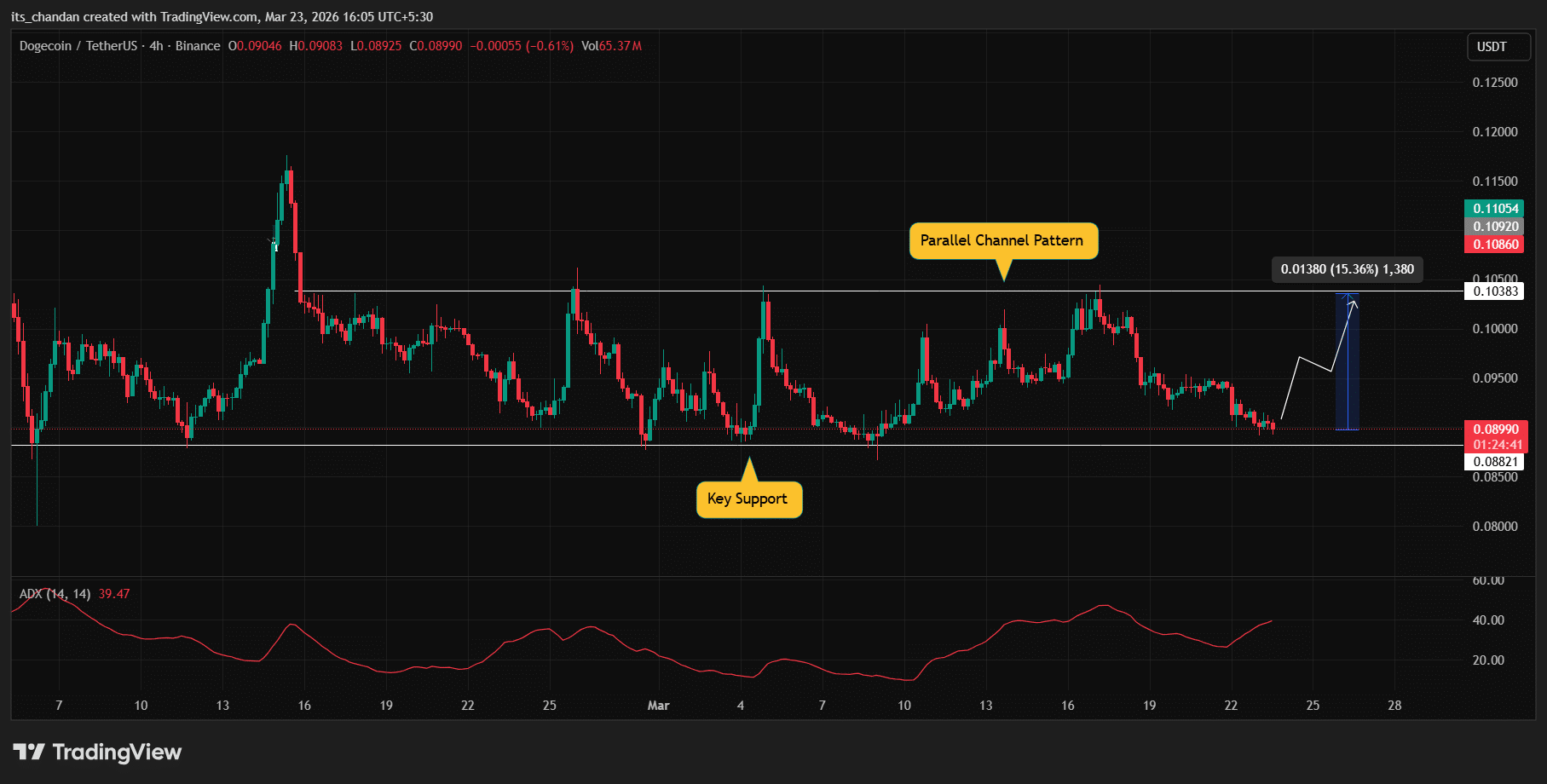
Dogecoin’s four-hour chart shows that the memecoin continues to trade within a prolonged parallel channel pattern between the lower and upper boundaries of $0.088 and $0.10383. The memecoin has traded within this range since late February 2026.
Source: TradingView

This is not the first time DOGE has reached the current level. In particular, the price has touched this zone multiple times, each time recording a strong reversal with an upward move.

Based on the current price action, if DOGE remains above the $0.0882 level, it may repeat its historical pattern and potentially reach the $0.1038 level. On the other hand, a downside move is only likely if DOGE fails to hold its key support level at $0.088.

At press time, the Average Directional Index (ADX), an indicator that measures trend strength, reached 39.47, well above the key threshold of 25, indicating a strong trend in the market, with the current momentum likely to persist.


Final Summary

  • Whales added 470 million DOGE as the price hovered near a historic reversal area amid the ongoing market dip.
  • Price action suggests that a potential 15% jump could be on the horizon, as the memecoin is trading near the lower boundary of a parallel channel pattern.


Criptomoedas em alta

Perguntas relacionadas

QWhat is the current trading price of Dogecoin (DOGE) and how much has it declined in the past 24 hours and month?

AAs of press time, DOGE was trading at $0.090. It declined by over 1.25% in the past 24 hours and has fallen by nearly 10% over the past month.

QHow many DOGE tokens did whales accumulate between March 18th and 21st, 2026, and what does this activity suggest?

ABetween March 18th and 21st, 2026, whales accumulated 470 million DOGE tokens. This significant buying amid a market dip suggests growing confidence among large investors and that they may be positioning themselves for a potential future price move.

QAccording to the DOGE Exchange Liquidation Map data from CoinGlass, what is the current market sentiment and what are the key leverage levels?

AThe short-term market sentiment is mildly bearish. The key leverage levels are $0.0892 on the downside and $0.0928 on the upside, with $4.13 million in long positions and $12.37 million in short positions built up at these levels.

QWhat price movement does the four-hour chart suggest is possible for DOGE if it holds above a key support level?

AThe four-hour chart shows DOGE trading within a parallel channel. If it remains above the $0.0882 support level, it could potentially jump 15% to reach the upper boundary of the channel at $0.1038.

QWhat does the Average Directional Index (ADX) value of 39.47 indicate about the current market trend for Dogecoin?

AAn ADX value of 39.47, which is well above the key threshold of 25, indicates that there is a strong trend currently in the market, and this momentum is likely to persist.

Leituras Relacionadas

Two Legends Lost in Three Days: Is Google's AI Talent Dam Cracking?

In three days, Google lost two AI legends. On June 18, Noam Shazeer, co-author of the seminal "Attention is All You Need" paper and Gemini co-lead, left for OpenAI. Just 48 hours later, John Jumper, 2024 Nobel laureate and AlphaFold lead, departed DeepMind for Anthropic. This follows Andrej Karpathy joining Anthropic in May. These moves highlight a structural trend: top AI talent is concentrating at mission-driven, pre-IPO firms like OpenAI and Anthropic, while Google becomes a primary source. The exodus stems from a core mission mismatch. Google's ad-centric model often subordinates AI research to product and revenue goals, creating friction for pioneers like Shazeer, who returned in 2024 only to leave again. In contrast, OpenAI and Anthropic offer singular focus on pushing AI boundaries, whether towards AGI or safety-aligned models, which deeply appeals to top researchers like Jumper. Financial incentives amplify the pull. With both OpenAI and Anthropic nearing IPO, employees stand to gain immensely from equity, an upside Google's mature stock cannot match. Furthermore, the 2023 merger of Google Brain and DeepMind, intended to consolidate strength, has instead created cultural tension and slowed the path from research to product, as evidenced by Gemini's pace. This talent redistribution is reshaping the AI landscape. While Google retains vast data and compute resources, its true crisis is the quiet, continuous loss of the people who define the field's future. The real moat in AI is not infrastructure, but the concentration of brilliant minds—a battle Google is currently losing.

marsbitHá 36m

Two Legends Lost in Three Days: Is Google's AI Talent Dam Cracking?

marsbitHá 36m

Behind the AI Report Card, Lies a Chinese 'Exam Setter'

Beyond the familiar performance charts like MMLU-Pro and MMMU, which major AI models strive to ace, stands a key "examiner": Chinese-Canadian researcher Wenhu Chen. An assistant professor at the University of Waterloo and founder of TIGERLab, Chen addresses the crucial need for more rigorous AI evaluation. As models like GPT-4 began scoring near-perfect results on older benchmarks like MMLU, it became difficult to distinguish their true capabilities. In response, Chen introduced MMLU-Pro in 2024, featuring harder, more reasoning-focused questions with more answer choices, successfully reintroducing meaningful performance gaps. His work extends to multi-modal evaluation with MMMU and its enhanced version, MMMU-Pro. These benchmarks test a model's ability to understand and reason with complex information from images, charts, and text across diverse academic subjects, exposing the significant challenges even top models face in genuine comprehension. Chen's background in complex QA, table reasoning, and his experience at Google DeepMind on projects like Gemini inform his approach. He understands that effective benchmarks must anticipate how models might "cheat" by memorizing data or avoiding visual analysis. His lab also actively researches video understanding and generation models (e.g., UniVideo, Vamba), ensuring his evaluation work is grounded in practical model-building challenges. Now at Meta's Super Intelligence Lab, Chen continues his focus on multi-modal data and evaluation, representing the deep yet often unseen contributions of Chinese talent in shaping the fundamental tools of the AI industry.

marsbitHá 47m

Behind the AI Report Card, Lies a Chinese 'Exam Setter'

marsbitHá 47m

Alliance Co-founder's Letter to Entrepreneurs: Written at the Moment Cursor Sold for $600 Billion

Alliance Co-founder's Letter to Entrepreneurs: On Cursor's $60 Billion Sale Many aspiring founders see massive exits like Cursor's $60B sale and wonder why they can't achieve the same, often concluding opportunities are exhausted. But great companies aren't built in obvious, crowded spaces. Cursor, like Stripe, Figma, and Shopify before it, started with a non-consensus belief about the future. Before ChatGPT, they believed AI would transform knowledge work. They focused on a genuinely exciting domain, became their own customer, and obsessed over power users. Their journey involved years of "glass-chewing" effort before the market was ready. The pattern is consistent: identify a long-term technological shift, find a missed entry point, and execute for years before the trend becomes obvious. First-generation products (PayPal, Adobe, Amazon) prove a market exists. Second-generation winners (Stripe, Figma, Shopify) rebuild that market around new insights, technology, or changing customer behaviors. Founders must identify their phase in the cycle. Early entrants like Coinbase or Cursor focus on making new technology usable for power users. Later entrants find the "yin" to the established "yang"—the blind spots incumbents miss as they grow distant from individual users. The key is deep market immersion. Use every product in your space. Talk to users. Build an audience. Stop looking for ideas and start *seeing* them everywhere. Then, choose one. The idea must offer a 10x improvement or solve a "hair-on-fire" pain point—something severe enough that users are already crafting workarounds. When building, avoid feature bloat. Ask: why would someone switch? Great startups rarely force new behaviors; they improve familiar workflows with drastically lower friction (e.g., Cursor forked VS Code instead of creating a new editor). Distribution is the underestimated moat. Before product-market fit, achieve distribution-market fit. How do customers discover new tools? Founders like those at Airbnb, Stripe, and Cursor did unscalable, manual work to recruit early users. The final, unteachable ingredient is resilience. Cursor built for years pre-market, faced rejection, and persisted. So did Airbnb, Nvidia, and Rain (which launched post-FTX collapse). The lesson isn't that these founders were smarter, but that they stayed in the game long enough for their insights to compound. Framework: Spot technological cycles. Cultivate unique insight. Obsess over your market. Talk to customers. Find a hair-on-fire problem. Build the simplest wedge. Win your distribution channel. Above all, don't quit when it gets hard. Most people won't do these things consistently. The few who do build the next generation of great companies. Go build.

marsbitHá 51m

Alliance Co-founder's Letter to Entrepreneurs: Written at the Moment Cursor Sold for $600 Billion

marsbitHá 51m

Weekly Editor's Picks (0613-0619)

Weekly Editor's Picks (0613-0619): Market Insights & Analysis This weekly digest curates in-depth analysis often lost in the information flow, focusing on key insights across macro trends, investment, and technology. **Macro & Geopolitics:** With the Strait of Hormuz reopening and military conflict shifting to negotiation, markets are pivoting from "war shock" to "supply restoration." Trades include shorting crude risk premiums, longing airlines/tourism, Asian energy importers, and bond duration, while shorting inflation expectations. LNG, fertilizer, and chemical chains are also being repriced. **Investment & VC:** Ray Dalio advises against betting on concentrated AI giants dominating indices, advocating for diversified portfolios of high-quality, low-correlation assets instead. Analysis covers the 4-year crypto cycle, predicting the core surviving product by 2029 will be asset trading markets. Current BTC metrics suggest a potential bottoming zone, presenting a patient accumulation window. SpaceX's high-profile IPO at a $2.1T valuation faces scrutiny over fundamentals, with key watchpoints being its likely inclusion in the Nasdaq index and Q2 earnings. Concerns are raised about potential "gamma squeeze" and systemic risks if its narrative-driven valuation gets amplified by passive index funds. Robinhood (HOOD) is noted for breaking its high correlation with crypto, bolstered by its stock trading and new underwriting business. **Web3 & AI:** A warning highlights ~$1.8T in off-balance-sheet AI infrastructure commitments (purchase commitments, leases) as a potential systemic risk if AI monetization lags. AI models are being used for World Cup predictions, adding a new layer for betting markets. A cost breakdown of a $20 AI subscription reveals the supply chain from model companies to cloud, GPUs, and power. **Prediction Markets:** The emergence of prediction market "concept stocks" is noted, with Robinhood developing its own platform, Rothera, signaling a shift from market competition to a "channel war" for user access. **CeFi & DeFi:** The SpaceX IPO tested perpetual contract mechanisms for pre-IPO assets, highlighting challenges in handling corporate actions like stock splits on-chain. The de-pegging of STRC (Strategy's preferred share) to ~$89 reflects market concerns over MicroStrategy's capital structure and BTC-backed leverage model. BlackRock's covered-call Bitcoin ETF (BITA) offers yield but caps upside, appealing to yield-seeking institutions. **Ethereum:** An opinion piece argues Ethereum's core strength is its vast developer community and composability, solidifying its role as the default operating system for the financial internet. **Weekly Hot Topics:** Include the US-Iran deal reopening the Strait of Hormuz, Fed's hawkish hold, Anthropic restricting model access, SpaceX acquiring Cursor, and a humorous stock surge for "Liuliumei" due to its "LLM" ticker.

marsbitHá 56m

Weekly Editor's Picks (0613-0619)

marsbitHá 56m

Alliance's Co-Founder's Letter to Entrepreneurs: Written on the Occasion of Cursor's $60 Billion Sale

In this letter to entrepreneurs, Alliance reflects on the success of Cursor's $60 billion sale to Elon Musk, using it as a case study to counter the misconception that opportunities in crowded fields like AI or crypto are exhausted. The piece argues that great companies like Cursor, Stripe, Figma, and Shopify are not built by geniuses with perfect ideas, but by founders who start with a non-consensus belief about the future and build for years before that future becomes obvious to everyone. They identify long-term shifts, find overlooked entry points, and execute relentlessly. The framework for success involves: 1. **Identifying your place in the technology cycle**: Early-stage opportunities focus on making new tech usable for power users (e.g., Coinbase, Cursor). Later-stage opportunities involve finding the "yin" to an existing "yang"—the blind spots of first-generation players (e.g., Stripe vs. PayPal, Figma vs. Adobe). 2. **Cultivating unique insights**: Immerse yourself deeply in the market. Use every product, talk to users, and build an audience. Insights will emerge naturally from deep engagement. 3. **Finding a "hair-on-fire" problem**: Look for a 10x improvement or a severe, urgent pain point. The strongest signal is people already building clumsy workarounds. 4. **Building a focused MVP**: Don't just add features because you can. Ask why users would abandon their current tool for yours. The best startups rarely force new behaviors; they improve familiar workflows with drastically lower friction. 5. **Winning a distribution channel**: Distribution is often the moat. Before product-market fit, achieve channel-market fit. Find where your customers are and build an engine to reach them, even through unscalable, manual efforts initially. 6. **Persistence**: The final, unteachable ingredient is resilience. Success stories like Cursor, Airbnb, and Nvidia involved years of grinding, rejection, and perseverance when the path forward seemed unclear. The conclusion is that there is no secret. Most people fail to consistently execute these steps over the long term. The few who do build the companies that define the next era. The world is yours to create.

链捕手Há 1h

Alliance's Co-Founder's Letter to Entrepreneurs: Written on the Occasion of Cursor's $60 Billion Sale

链捕手Há 1h

Trading

Spot
Futuros

Artigos em Destaque

O que é POO DOGE

Poo Doge: Um Jogador Inovador no Espaço Cripto Introdução No panorama em rápida evolução das criptomoedas e da tecnologia blockchain, novos projetos surgem continuamente para capturar a atenção de investidores e entusiastas da tecnologia. Um desses projetos é o Poo Doge ($POO DOGE), lançado em 2022 como uma oferta única dentro do ecossistema Web3. Operando na plataforma Dogechain, o Poo Doge conquistou um nicho como uma ferramenta descentralizada que visa melhorar a forma como os usuários gerem os seus ativos digitais. Este artigo explora os aspectos centrais do Poo Doge, analisando os seus objetivos, funcionalidade, criadores e as características únicas que o distinguem num mercado saturado. O que é Poo Doge? O Poo Doge é uma criptomoeda descentralizada concebida especificamente para o ecossistema Dogechain. Utilizando a Máquina Virtual Ethereum (EVM), funciona como um rastreador de portefólios versátil e fácil de usar. O objetivo principal deste projeto é proporcionar aos usuários a capacidade de monitorizar e gerir múltiplos tokens de forma eficaz dentro da estrutura Dogechain. Como uma moeda descentralizada, o Poo Doge distingue-se pelo seu foco na segurança e simplicidade na gestão de ativos. Os usuários podem acompanhar os seus investimentos e gerir portefólios de tokens sem as complexidades frequentemente associadas às plataformas cripto tradicionais. Esta abordagem centrada no usuário na gestão de ativos é sem igual, particularmente no contexto único do Dogechain, que proporciona um ambiente leve e orientado para a comunidade. Quem é o Criador do Poo Doge? A informação relativa aos indivíduos específicos ou equipa responsáveis pela criação do Poo Doge não é divulgada. Numa indústria onde a transparência é frequentemente considerada um valor fundamental, a falta de detalhes públicos sobre o criador pode levantar questões entre potenciais usuários e investidores. No entanto, esta anonimidade não diminui os objetivos do projeto e o impacto previsto no espaço Web3. Quem são os Investidores do Poo Doge? Neste momento, não existe informação pública disponível sobre investidores específicos ou organizações de investimento que apoiem o projeto Poo Doge. Esta ausência pode sugerir que o projeto é auto-financiado ou que ainda não atraiu a atenção de entidades de investimento maiores, tipicamente associadas a iniciativas cripto mais extensas. Embora a falta de apoio identificável possa ser vista com ceticismo, não é incomum que projetos emergentes, especialmente aqueles focados em tecnologia descentralizada, operem inicialmente sem apoio institucional notável. À medida que o Poo Doge continua a desenvolver-se e a expandir a sua base de usuários, uma maior integração com potenciais investidores pode ocorrer. Como Funciona o Poo Doge? O Poo Doge opera com base nos princípios da descentralização, aproveitando a Dogechain (EVM) para fornecer uma solução definitiva de rastreamento de portefólios. Aqui estão os aspectos-chave de como o projeto funciona: Plataforma Descentralizada Sendo construído sobre uma estrutura descentralizada, o Poo Doge é concebido para eliminar pontos centrais de falha, que muitas vezes representam um risco nos sistemas bancários e financeiros tradicionais. Esta descentralização não só melhora a segurança, mas também promove a transparência, uma vez que todas as transações são verificáveis na blockchain. Rastreio de Portefólios A característica distintiva do Poo Doge é o seu papel como rastreador de portefólios, o primeiro do seu tipo na blockchain original de meme coin do Dogechain. Esta abordagem inovadora permite que os usuários gerenciem eficientemente os seus investimentos em vários tokens. Os usuários podem obter insights sobre as suas posses, volatilidade e desempenho histórico, permitindo decisões de investimento mais informadas. Compatibilidade com EVM O Poo Doge tira partido da Máquina Virtual Ethereum, permitindo uma integração e interoperabilidade sem costuras com outras blockchains compatíveis com EVM. Esta capacidade técnica é crucial no ecossistema cripto interconectado, permitindo que o Poo Doge ofereça funcionalidades melhoradas, facilite transações cross-chain e atraia uma base de usuários mais ampla. Linha do Tempo do Poo Doge Para melhor compreender a evolução do Poo Doge no panorama das criptomoedas, aqui está uma breve linha do tempo destacando marcos significativos na sua história: 2022: O Poo Doge ($POO DOGE) foi oficialmente lançado, fazendo a sua entrada no mercado de criptomoedas. Desenvolvimento em 2022: O projeto concentrou-se em construir e otimizar as suas operações dentro do ambiente Dogechain, focando na sua função principal como rastreador de portefólios. Suprimento de Tokens: Um suprimento total de 1.000.000.000.000 tokens foi estabelecido, embora se note que nenhum token está alegadamente em circulação neste momento, sugerindo que o projeto ainda pode estar na sua fase inicial de desenvolvimento. Características Únicas O Poo Doge destaca-se de outros projetos de várias maneiras importantes: Vantagem do Primeiro Chegador: Como o primeiro rastreador de portefólios no Dogechain, o Poo Doge ocupa um espaço único que pode atrair primeiros adotantes e melhorar a sua posição no mercado. Focado no Usuário: O projeto enfatiza a simplicidade e a facilidade de uso, garantindo que mesmo aqueles que podem não ter um amplo conhecimento em blockchain conseguem gerir eficazmente os seus ativos digitais. Descentralizado e Seguro: Ao operar dentro de uma estrutura descentralizada, os usuários podem desfrutar de uma segurança aumentada e da confiança de que os seus portefólios estão protegidos contra possíveis hacks que podem afetar plataformas centralizadas. Abordagem Orientada pela Comunidade: A dependência do Poo Doge em relação ao envolvimento e feedback da comunidade é fundamental no seu desenvolvimento, podendo resultar num produto que se alinha mais estreitamente com as necessidades dos usuários. Conclusão O Poo Doge ($POO DOGE) representa um desenvolvimento fascinante no panorama Web3 e das criptomoedas. Embora existam lacunas notáveis na informação pública disponível sobre os seus criadores e investidores, a abordagem inovadora do projeto em relação às finanças descentralizadas e à gestão de ativos detém uma promissora consideração. Com o seu foco na experiência do usuário e o conceito pioneiro de um rastreador de portefólios no Dogechain, o Poo Doge está preparado para atrair atenção à medida que continua a evoluir. À medida que o panorama das criptomoedas cresce e amadurece, iniciativas como o Poo Doge sublinham a transição contínua em direção à descentralização e ao empoderamento do usuário nas finanças, abrindo caminho para uma nova era de gestão de ativos digitais.

365 Visualizações TotaisPublicado em {updateTime}Atualizado em 2024.12.03

O que é POO DOGE

Como comprar DOGE

Bem-vindo à HTX.com!Tornámos a compra de Dogecoin (DOGE) simples e conveniente.Segue o nosso guia passo a passo para iniciar a tua jornada no mundo das criptos.Passo 1: cria a tua conta HTXUtiliza o teu e-mail ou número de telefone para te inscreveres numa conta gratuita na HTX.Desfruta de um processo de inscrição sem complicações e desbloqueia todas as funcionalidades.Obter a minha contaPasso 2: vai para Comprar Cripto e escolhe o teu método de pagamentoCartão de crédito/débito: usa o teu visa ou mastercard para comprar Dogecoin (DOGE) instantaneamente.Saldo: usa os fundos da tua conta HTX para transacionar sem problemas.Terceiros: adicionamos métodos de pagamento populares, como Google Pay e Apple Pay, para aumentar a conveniência.P2P: transaciona diretamente com outros utilizadores na HTX.Mercado de balcão (OTC): oferecemos serviços personalizados e taxas de câmbio competitivas para os traders.Passo 3: armazena teu Dogecoin (DOGE)Depois de comprar o teu Dogecoin (DOGE), armazena-o na tua conta HTX.Alternativamente, podes enviá-lo para outro lugar através de transferência blockchain ou usá-lo para transacionar outras criptomoedas.Passo 4: transaciona Dogecoin (DOGE)Transaciona facilmente Dogecoin (DOGE) no mercado à vista da HTX.Acede simplesmente à tua conta, seleciona o teu par de trading, executa as tuas transações e monitoriza em tempo real.Oferecemos uma experiência de fácil utilização tanto para principiantes como para traders experientes.

1.7k Visualizações TotaisPublicado em {updateTime}Atualizado em 2026.06.02

Como comprar DOGE

O que é DOGE M

Doge Matrix ($doge m): A Nova Raça de Criptomoeda Orientada pela Comunidade Introdução No panorama em constante evolução das criptomoedas, novos projetos surgem constantemente, cada um visando captar o interesse de investidores e entusiastas. Um dos mais recentes entrantes neste domínio é o Doge Matrix, representado pelo símbolo de ticker $doge m. Este projeto atraiu atenção graças às suas raízes na popular cultura de memes em torno do Dogecoin, estabelecendo o seu lugar dentro do espaço web3. Este artigo visa fornecer uma análise abrangente do Doge Matrix, cobrindo a sua visão geral, criador, investidores, funcionalidade, cronologia e aspetos notáveis. O que é o Doge Matrix ($doge m)? O Doge Matrix é um projeto de criptomoeda orientado pela comunidade que aparentemente se baseia no apelo generalizado do Dogecoin, uma moeda digital conhecida pelo seu mascote Shiba Inu e pelas suas origens em memes. Embora os objetivos gerais do Doge Matrix não estejam extensivamente definidos, caracteriza-se por um compromisso em aproveitar o envolvimento e o apoio da comunidade. Ao contrário das criptomoedas tradicionais que muitas vezes enfatizam a utilidade ou o valor intrínseco através de tecnologias subjacentes, o Doge Matrix posiciona-se dentro de um espaço que abraça o fenómeno cultural das criptomoedas, apelando particularmente àqueles que se identificam com a ética dos ativos baseados em memes. Aproveitando as forças da comunidade Dogecoin, o Doge Matrix opera como parte de um ecossistema mais amplo, convidando à participação e ao envolvimento de utilizadores que partilham um interesse pela criptomoeda e pelo espaço digital. Quem é o Criador do Doge Matrix ($doge m)? A identidade do criador do Doge Matrix permanece desconhecida. Esta falta de transparência não é uma ocorrência incomum no espaço das criptomoedas, onde alguns projetos são lançados sem revelar as identidades dos seus fundadores. A ausência de informação sobre a equipa fundadora pode levantar questões entre potenciais investidores sobre a responsabilidade e a direção do projeto. Quem são os Investidores do Doge Matrix ($doge m)? Atualmente, não há informações disponíveis publicamente que detalhem os investidores ou as fundações de investimento que apoiam o Doge Matrix. O projeto parece depender principalmente do apoio da comunidade em vez de investimento institucional. Este modelo alinha-se com a natureza orientada pela comunidade da iniciativa, promovendo um ambiente onde a direção do projeto é moldada pelos seus participantes em vez de ser ditada por um pequeno grupo de financiadores. Como Funciona o Doge Matrix ($doge m)? Os detalhes sobre os mecanismos operacionais do Doge Matrix são um tanto vagos, refletindo uma tendência mais ampla de projetos no espaço das moedas meme, onde funcionalidades inovadoras nem sempre são claramente articuladas. No entanto, o Doge Matrix parece ser projetado para aproveitar o ecossistema existente de criptomoedas, incentivando a participação dos utilizadores enquanto se liga às referências culturais familiares associadas ao Dogecoin. As suas características potencialmente únicas derivam das interações da comunidade em vez de avanços tecnológicos, enfatizando experiências partilhadas e colaboração entre os detentores de tokens. Embora as inovações exatas não tenham sido explicitamente delineadas, o projeto parece criar um espaço onde os membros da comunidade podem interagir, partilhar ideias e impulsionar o potencial do projeto para a frente. Cronologia do Doge Matrix ($doge m) Refletir sobre a cronologia do projeto revela eventos notáveis que definiram a sua jornada até agora: 25 de Novembro de 2024: O Doge Matrix alcançou o seu valor máximo histórico, marcando um marco significativo na sua história inicial. 1 de Janeiro de 2025: Por outro lado, o Doge Matrix atingiu o seu valor mínimo histórico, ilustrando a volatilidade frequentemente associada às criptomoedas, especialmente nas fases iniciais do ciclo de vida de um projeto. Em Curso: O projeto continua a ser ativamente negociado e apoiado pela sua comunidade, embora marcos ou objetivos futuros específicos ainda não tenham sido divulgados. Pontos Chave Sobre o Doge Matrix ($doge m) Foco na Comunidade No coração do Doge Matrix está um compromisso com o envolvimento da comunidade. O projeto prospera na premissa de colaboração e objetivos partilhados entre os seus membros, enfatizando a importância do esforço coletivo. Ao contrário de projetos centralizados que muitas vezes têm uma estrutura de liderança definida, o Doge Matrix apresenta atualmente uma abordagem mais fluida à governança, onde a voz de cada membro da comunidade importa. Volatilidade O mercado de criptomoedas é notório pela sua volatilidade, e o Doge Matrix não é exceção. A sua história de preços reflete flutuações significativas entre valores altos e baixos, o que é típico de muitas novas criptomoedas, mas sublinha os riscos associados ao investimento em tokens emergentes. Falta de Informação Detalhada Uma das características mais marcantes do Doge Matrix é a escassez de informação detalhada sobre os seus fundamentos tecnológicos e mecanismos operacionais. Esta ambiguidade exige que potenciais investidores realizem uma diligência prévia minuciosa antes de se envolverem com o projeto. Conclusão Em resumo, o Doge Matrix ($doge m) ilustra uma nova onda de projetos de criptomoeda que dependem fortemente do envolvimento da comunidade e da relevância cultural. Embora falte em certos pormenores—como liderança clara, objetivos definidos e funcionalidade detalhada—o projeto conseguiu gerar interesse dentro da comunidade cripto, aproveitando o apelo estabelecido da cultura de memes. Como em qualquer investimento no espaço das criptomoedas, compreender os riscos inerentes e realizar uma pesquisa abrangente é essencial para potenciais participantes. O Doge Matrix serve como um lembrete da natureza dinâmica, por vezes imprevisível, da indústria cripto, marcada por uma evolução constante e entusiasmo por iniciativas orientadas pela comunidade.

479 Visualizações TotaisPublicado em {updateTime}Atualizado em 2025.02.03

O que é DOGE M

Discussões

Bem-vindo à Comunidade HTX. Aqui, pode manter-se informado sobre os mais recentes desenvolvimentos da plataforma e obter acesso a análises profissionais de mercado. As opiniões dos utilizadores sobre o preço de DOGE (DOGE) são apresentadas abaixo.

活动图片












