Berkshire Hathaway's Q2 13F Portfolio Reshuffle: Increased Stakes in Google and Delta Air Lines, Consecutive Quarter of Cutting Bank of America

marsbitPublicado em 2026-08-16Última atualização em 2026-08-16

Resumo

Berkshire Hathaway's second-quarter 13F filing, released August 14th, reveals significant portfolio shifts under new leadership. The total portfolio value rose to approximately $299.3 billion. Key highlights include a major increase in Alphabet (Google) holdings. Berkshire's stake in Google-A surged 45.24% to $28.16 billion, while its Google-C holdings jumped 658% to $9.61 billion, making Alphabet the firm's third-largest combined holding after Apple and American Express. Conversely, Bank of America was the largest reduction, with shares cut by 5.89% for the second consecutive quarter, though it remains the fifth-largest holding. Berkshire also increased positions in Delta Air Lines (up 44%) and homebuilder Lennar, while initiating a small new position in D.R. Horton. The consumer sector saw Constellation Brands completely sold off. Overall, the portfolio reflects a continued move toward technology and specific cyclical sectors like housing and airlines, while trimming some financial and consumer stakes. Apple remains the top holding at 22% of the portfolio.

Author: Wall Street News

Following 'Oracle of Omaha' Warren Buffett's resignation as CEO, Berkshire Hathaway has released its second 13F filing.

According to documents disclosed on August 14, Eastern Time, Berkshire's 13F equity portfolio value was approximately $299.3 billion at the end of the second quarter, an increase of 12.09% from approximately $263.1 billion at the end of the first quarter. Overall, Berkshire initiated a position in 1 new stock, added to 7 stocks, reduced holdings in 6 stocks, and completely exited 1 stock in the second quarter.

It is evident that under the leadership of Greg Abel, Berkshire has been continuously increasing its bets on Alphabet, housing, and airlines, while gradually trimming traditional financials and some consumer holdings.
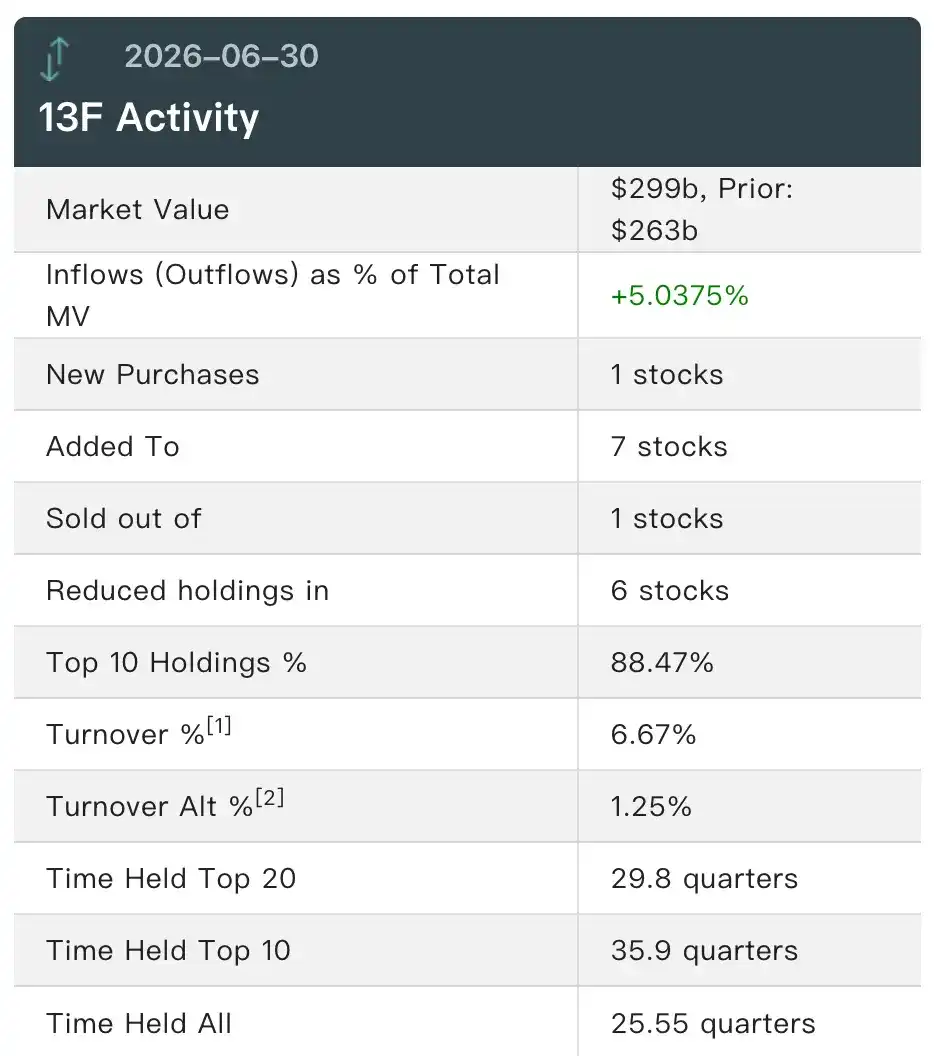
When consolidating Alphabet's two share classes, Berkshire's current top ten holdings are Apple, American Express, Alphabet, Coca-Cola, Bank of America, Chevron, Occidental Petroleum, Chubb, Moody's, and Kraft Heinz.
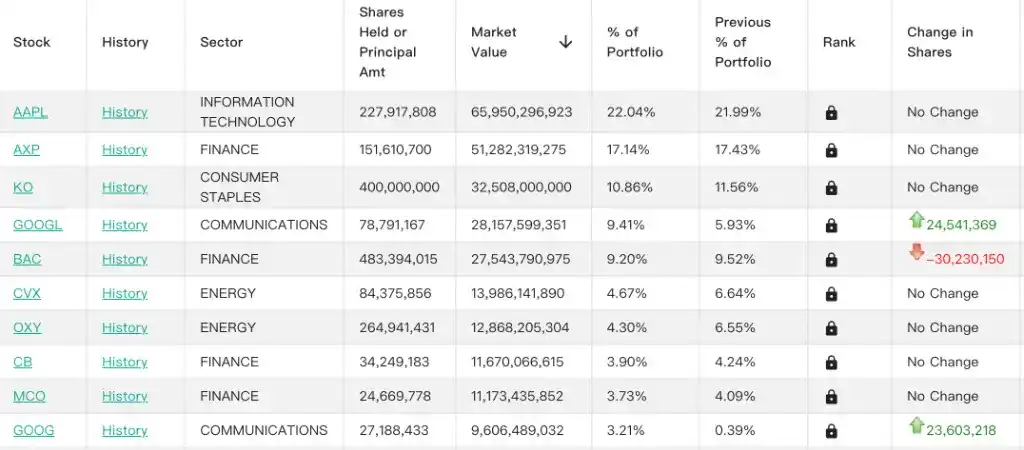
Apple remains Berkshire's largest holding, with a portfolio value of approximately $65.950 billion, accounting for about 22% of the 13F portfolio value. American Express ranks second with a value of approximately $51.282 billion, a 17.14% share. The combined Alphabet holds the third position. Coca-Cola and Bank of America rank fourth and fifth, respectively.

In the second quarter of this year, Berkshire continued to significantly increase its stake in Alphabet (Google's parent company). Berkshire added approximately 24.54 million shares of Alphabet-A, an increase of 45.24%, bringing the total holding to about 78.79 million shares valued at approximately $28.158 billion. It also added approximately 23.60 million shares of Alphabet-C, a staggering increase of 658.35%, bringing the total holding to about 27.19 million shares valued at approximately $9.606 billion.

This brings the combined value of Alphabet-A and Alphabet-C to approximately $37.764 billion at the end of Q2, representing about 12.62% of the 13F portfolio value, surpassing Coca-Cola to become Berkshire's third-largest holding after Apple and American Express on a consolidated basis.

Additionally, among the top ten holdings, the only stock that was reduced was Bank of America. In the quarter, Berkshire sold approximately 30.20 million shares (based on the period-end price, the reduction was about 30.23 million shares), a decrease of 5.89%, representing a reduction in value of approximately $1.72 billion. This made Bank of America the largest reduction for the quarter. At quarter-end, Berkshire still held 483 million shares of Bank of America valued at approximately $27.544 billion, accounting for 9.2% of the 13F portfolio value, making it the fifth-largest holding. Bank of America remains a significant investment for Berkshire but has now been reduced for two consecutive quarters.

Otherwise, Berkshire's holdings in the remaining top ten stocks remained unchanged in the second quarter.

Regarding other additions, in the second quarter of this year, Berkshire increased its stake in Delta Air Lines by approximately 17.51 million shares, an increase of about 44%, bringing the total holding to 57.32 million shares valued at approximately $5.369 billion. It added about 3.01 million shares of Lennar Corporation Class A, an increase of nearly 30%, and also added about 60,000 shares of Lennar Corporation Class B. Berkshire increased its stake in Macy's by approximately 4.31 million shares, a 141.82% increase. It slightly added about 550,000 shares of The New York Times Company.

The only new position initiated by Berkshire in the second quarter was D.R. Horton, with a small initiation of 3,564 shares worth approximately $580,000.

Regarding reductions, apart from Bank of America, Berkshire also reduced holdings in Ally Financial, Capital One Financial, kidney dialysis service provider DaVita, grocer Kroger, and steel manufacturer Nucor. The alcoholic beverage producer Constellation Brands, which was significantly reduced in the first quarter, was completely sold off by Berkshire in the second quarter.


Criptomoedas em alta

Perguntas relacionadas

QAccording to the 13F filing, which company became Berkshire Hathaway's third largest holding when Google's Class A and C shares are combined?

AAlphabet (Google's parent company) became Berkshire Hathaway's third largest holding, with a combined value of approximately $37.764 billion, surpassing Coca-Cola.

QWhat were the main categories of stocks that saw increased investment from Berkshire Hathaway in Q2 under Greg Abel's leadership?

AUnder Greg Abel's leadership, Berkshire Hathaway increased investments in technology (Alphabet), housing (Lennar, Horton), and airlines (Delta Air Lines).

QWhich stock was the largest reduction for Berkshire Hathaway in Q2 2024, and was this part of a trend?

ABank of America was the largest reduction, with approximately 30.23 million shares sold (worth about $1.72 billion). This was part of a trend, as it was the second consecutive quarter of减持.

QWhat was the total market value of Berkshire Hathaway's 13F stock portfolio at the end of Q2 2024, and how did it change from the previous quarter?

AThe total market value was approximately $299.3 billion at the end of Q2 2024, representing an increase of 12.09% from the approximately $263.1 billion at the end of Q1.

QWhich company did Berkshire Hathaway completely exit (sell its entire position in) during the second quarter of 2024?

ABerkshire Hathaway completely exited its position in Constellation Brands during the second quarter of 2024.

Leituras Relacionadas

Upbit is Anxious: A Hasty Counterattack Aimed at Regaining Stablecoin Market Share

Title: Upbit's Rushed Counterattack to Reclaim Stablecoin Market Share Facing a dramatic shift in South Korea's stablecoin market, leading exchange Upbit launched a promotional campaign from July 26 to August 9, waiving the 0.05% trading fee for stablecoins paired with the Korean Won (KRW) and rapidly listing new stablecoins like RLUSD and USDG. This move is a direct response to its plummeting market share in this sector. Historically a duopoly with Bithumb, the market has been reshaped since October 2025 when Coinone permanently removed fees for USDC trading. By June 2026, Coinone led with 34.8% of stablecoin volume, followed by Bithumb (31.1%) and Upbit (30.1%). This contrasts sharply with the overall crypto market, where Upbit commands 60%. The data shows stablecoin demand is highly sensitive to fees, as users primarily buy them to transfer capital overseas for derivatives trading or forex arbitrage. South Korean exchanges have seen a net outflow of stablecoins for 18 consecutive months, totaling approximately 14.9 trillion KRW, underscoring their role as a cross-border capital conduit. Upbit's limited-time promotion initially boosted its daily stablecoin volume by 162%, but the surge was almost entirely in USDT (98.1% of volume). The newly listed stablecoins saw negligible, fleeting interest. Furthermore, the promotional effect quickly waned in the second week, with volume dropping 33% on weekdays. A concurrent weakening of the KRW also contributed to the trading spike, independent of the fee waiver. The analysis suggests that once the promotion ends, Upbit is unlikely to retain its temporary gains unless it matches Coinone's permanent zero-fee policy, forcing a choice between market share and fee revenue. Upbit's strategic push may be less about immediate profit and more about preparing for future regulatory shifts. With South Korea's *Digital Asset Basic Act* on the horizon, which will regulate KRW-backed stablecoins, and following Dunamu's (Upbit's parent) integration into Naver Financial to build a payment ecosystem, securing a dominant position in the dollar stablecoin distribution channel holds long-term strategic value. However, potential regulatory conflicts could prevent Upbit from listing a future Naver-issued KRW stablecoin, making the current fight for dollar stablecoin flow even more critical.

marsbitHá 8m

Upbit is Anxious: A Hasty Counterattack Aimed at Regaining Stablecoin Market Share

marsbitHá 8m

Michael Saylor Compares Bitcoin and Gold!

Michael Saylor, founder of MicroStrategy, argues that Bitcoin fundamentally changes how wealth is stored and transferred by transforming digital scarcity into economic value. He describes Bitcoin as the first digital monetary network, combining computers, digital networks, and cryptography. It digitizes monetary assets, allowing their supply to be controlled by public protocols rather than institutions, thus converting economic value into information transmissible over global networks. Comparing Bitcoin to gold, Saylor states that while increasing Bitcoin's supply is harder, its integration with software and transfer is easier. He highlights Bitcoin's proof-of-work mechanism, which ties it to the physical world by consuming real energy to secure the ledger, making past transactions immutable. This creates a shared security system involving miners, energy companies, and investors. Saylor suggests "digital monetary energy" is a more accurate term than "digital gold." He emphasizes that the Bitcoin network is an adaptive ecosystem of miners, nodes, developers, and users. Its core design is intentionally simple, focused on maintaining a secure ledger for scarce digital assets, with complex functionalities built in higher-layer applications. This architecture allows Bitcoin to serve as a foundation for transmitting value and fostering innovation in payments and financial services. Saylor notes Bitcoin's deeper impact lies in creating digital sovereignty, where private keys give individuals permissionless control over their economic power, with ownership verified mathematically, not by institutions. He concludes that while gold's physical scarcity makes it money, Bitcoin's digital scarcity does the same, characterizing Bitcoin as the monetary energy of the digital age.

cryptonews.ruHá 1h

Michael Saylor Compares Bitcoin and Gold!

cryptonews.ruHá 1h

Trading

Spot

Artigos em Destaque

O que é $BANK

Bank AI: Um Passo Revolucionário no Futuro da Banca Introdução Em uma era marcada por avanços rápidos na tecnologia, o Bank AI está na interseção da inteligência artificial (IA) e dos serviços bancários. Este projeto inovador visa redefinir o panorama financeiro, melhorando a eficiência operacional, as medidas de segurança e as experiências dos clientes através do poder da IA. Ao embarcarmos nesta exploração do Bank AI, iremos aprofundar no que o projeto implica, suas dinâmicas operacionais, seu contexto histórico e marcos significativos. O que é o Bank AI? No seu cerne, o Bank AI representa uma iniciativa transformadora com o objetivo de integrar a inteligência artificial em várias operações bancárias. Este projeto aproveita as capacidades da IA para automatizar processos, melhorar os protocolos de gestão de risco e melhorar a interação com os clientes através de serviços personalizados. Os principais objetivos do Bank AI incluem: Automatização das Funções Bancárias: Ao aproveitar as tecnologias de IA, o Bank AI visa automatizar tarefas rotineiras, reduzindo o peso sobre os recursos humanos e aumentando a eficiência. Gestão de Risco Melhorada: O projeto utiliza algoritmos de IA para prever e identificar riscos, fortalecendo assim as medidas de segurança contra fraudes e outras ameaças. Personalização dos Serviços Bancários: O Bank AI foca em oferecer produtos e serviços financeiros ajustados, analisando dados e comportamentos dos clientes. Melhoria da Experiência do Cliente: A implementação de soluções impulsionadas por IA, como chatbots e assistentes virtuais, visa proporcionar aos usuários interações mais humanizadas, revolucionando a forma como os clientes se envolvem com os bancos. Com esses objetivos, o Bank AI posiciona-se como um ator crucial para tornar a banca mais eficiente, segura e centrada no usuário. Quem é o Criador do Bank AI? Os detalhes sobre o criador do Bank AI permanecem desconhecidos. Assim, nenhuma pessoa ou organização específica foi identificada nas informações disponíveis. O anonimato que cerca a origem do projeto levanta questões, mas não diminui a sua ambiciosa visão e objetivos. Quem são os Investidores do Bank AI? Semelhante ao criador do projeto, informações específicas sobre os investidores ou organizações que apoiam o Bank AI não foram divulgadas. Sem essas informações, é difícil delinear o apoio financeiro e institucional que pode estar impulsionando o projeto para frente. No entanto, a importância de ter uma sólida base de investimento é fundamental para sustentar o desenvolvimento em um campo tão inovador. Como Funciona o Bank AI? O Bank AI opera em várias frentes inovadoras, focando em fatores únicos que o diferenciam das estruturas bancárias tradicionais. Abaixo estão as principais características operacionais: Automatização: Ao aplicar algoritmos de aprendizado de máquina, o Bank AI automatiza vários processos manuais dentro dos bancos. Isso resulta na redução dos custos operacionais e permite que os trabalhadores humanos redirecionem os seus esforços para atividades mais estratégicas. Gestão de Risco Avançada: A integração da IA nas práticas de gestão de risco equipa os bancos com ferramentas para prever com precisão potenciais ameaças, como fraudes, garantindo que as informações e ativos dos clientes permaneçam seguros. Recomendações Financeiras Personalizadas: Através do aprendizado contínuo a partir das interações com os clientes, os sistemas de IA desenvolvem uma compreensão sutil das necessidades dos usuários, permitindo oferecer conselhos adaptados sobre decisões financeiras. Interações Melhoradas com os Clientes: Utilizando chatbots e assistentes virtuais alimentados por IA, o Bank AI permite uma experiência de cliente mais envolvente, permitindo que os usuários tenham suas dúvidas resolvidas rapidamente, reduzindo assim os tempos de espera e melhorando os níveis de satisfação. Juntas, estas características operacionais posicionam o Bank AI como um pioneiro no setor bancário, estabelecendo novos padrões para a prestação de serviços e a excelência operacional. Cronologia do Bank AI Compreender a trajetória do Bank AI requer uma análise do seu contexto histórico. Abaixo está uma cronologia que destaca marcos e desenvolvimentos importantes: Início de 2010: A conceituação da integração da IA nos serviços bancários começou a ganhar atenção à medida que instituições bancárias reconheciam os potenciais benefícios. 2018: Ocorreu um aumento significativo na implementação de tecnologias de IA, quando os bancos começaram a usar ferramentas de IA como chatbots para atendimento ao cliente básico e sistemas de gestão de risco para melhorar o tratamento de segurança. 2023: A sofisticação da IA continuou a avançar, com a introdução de IA generativa para tarefas mais complexas, como processamento de documentos e análise de investimentos em tempo real. Este ano marcou um salto significativo nas capacidades proporcionadas aos bancos pela tecnologia de IA. 2024-Estado Atual: Neste ano, o Bank AI está em uma trajetória ascendente, com pesquisas e desenvolvimentos em andamento prontos para aprimorar ainda mais as capacidades nas operações bancárias. A exploração contínua das aplicações de IA sugere desenvolvimentos emocionantes por vir. Pontos Chave Sobre o Bank AI Integração da IA na Banca: O Bank AI foca na adoção da inteligência artificial para simplificar os processos bancários e melhorar as experiências dos usuários. Automatização e Foco em Gestão de Risco: O projeto enfatiza fortemente essas áreas, visando transferir o peso das tarefas rotineiras enquanto melhora as estruturas de segurança através de análises preditivas. Soluções Bancárias Personalizadas: Ao aproveitar os dados dos clientes, o Bank AI possibilita serviços bancários ajustados que atendem às necessidades individuais dos usuários. Compromisso com o Desenvolvimento: O Bank AI permanece comprometido com contínuas pesquisas e esforços de desenvolvimento, garantindo a sua adaptabilidade e relevância contínua à medida que a tecnologia continua a evoluir. Conclusão Em resumo, o Bank AI exemplifica um passo crucial em frente na indústria bancária, aproveitando a inteligência artificial para remodelar paradigmas operacionais, melhorar a segurança e promover a satisfação do cliente. Apesar das lacunas de informação em torno do criador e dos investidores, os objetivos claros e os mecanismos funcionais do Bank AI fornecem uma base sólida para sua evolução contínua. À medida que a tecnologia de IA continua a avançar e se fundir com o setor bancário, o Bank AI está bem posicionado para impactar significativamente o futuro dos serviços financeiros, aprimorando a maneira como entendemos e interagimos com a banca.

217 Visualizações TotaisPublicado em {updateTime}Atualizado em 2024.12.03

O que é $BANK

Como comprar BANK

Bem-vindo à HTX.com!Tornámos a compra de Lorenzo Protocol (BANK) simples e conveniente.Segue o nosso guia passo a passo para iniciar a tua jornada no mundo das criptos.Passo 1: cria a tua conta HTXUtiliza o teu e-mail ou número de telefone para te inscreveres numa conta gratuita na HTX.Desfruta de um processo de inscrição sem complicações e desbloqueia todas as funcionalidades.Obter a minha contaPasso 2: vai para Comprar Cripto e escolhe o teu método de pagamentoCartão de crédito/débito: usa o teu visa ou mastercard para comprar Lorenzo Protocol (BANK) instantaneamente.Saldo: usa os fundos da tua conta HTX para transacionar sem problemas.Terceiros: adicionamos métodos de pagamento populares, como Google Pay e Apple Pay, para aumentar a conveniência.P2P: transaciona diretamente com outros utilizadores na HTX.Mercado de balcão (OTC): oferecemos serviços personalizados e taxas de câmbio competitivas para os traders.Passo 3: armazena teu Lorenzo Protocol (BANK)Depois de comprar o teu Lorenzo Protocol (BANK), armazena-o na tua conta HTX.Alternativamente, podes enviá-lo para outro lugar através de transferência blockchain ou usá-lo para transacionar outras criptomoedas.Passo 4: transaciona Lorenzo Protocol (BANK)Transaciona facilmente Lorenzo Protocol (BANK) no mercado à vista da HTX.Acede simplesmente à tua conta, seleciona o teu par de trading, executa as tuas transações e monitoriza em tempo real.Oferecemos uma experiência de fácil utilização tanto para principiantes como para traders experientes.

655 Visualizações TotaisPublicado em {updateTime}Atualizado em 2026.06.02

Como comprar BANK

Discussões

Bem-vindo à Comunidade HTX. Aqui, pode manter-se informado sobre os mais recentes desenvolvimentos da plataforma e obter acesso a análises profissionais de mercado. As opiniões dos utilizadores sobre o preço de BANK (BANK) são apresentadas abaixo.

活动图片