Dogecoin Bullish Divergence Says A 500% Price Rally Is Coming, But The Real Target Is Much Higher

bitcoinistPublicado em 2026-05-14Última atualização em 2026-05-14

Resumo

A crypto analyst identifies a bullish divergence on Dogecoin's three-day chart, signaling a potential massive breakout. This pattern suggests DOGE could rally approximately 500% from current levels, targeting $0.6533, which is near its all-time high. The analyst further projects an even higher target of $1.25 upon reaching the first milestone. Another analyst notes DOGE has broken out of a descending channel, with bulls taking control and setting nearer-term price targets at $0.135, $0.153, $0.182, and $0.206, advising profit-taking around the latter level. Despite recent declines, the overall bullish structure for the meme coin is considered intact.

A crypto analyst has identified a Bullish Divergence on a three-day Dogecoin (DOGE) price chart that is pointing toward a fresh breakout to new highs. He believes that the emergence of this formation suggests that Dogecoin could be gearing up for a massive 500% price rally. However, his optimistic forecast does not stop there, as the analyst projects an even higher price target above $1 once that first target is reached.

Dogecoin Bullish Divergence Signals Move To $1.25

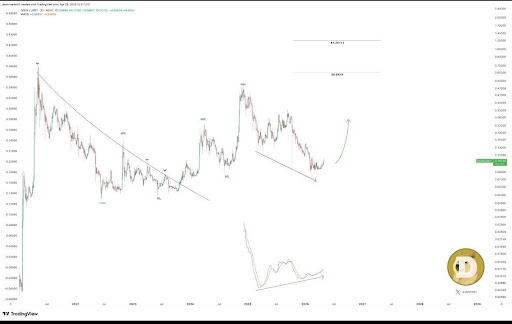
Javon Marks, a well-known crypto analyst on X, has shared a new analysis for Dogecoin, predicting two bullish targets that are drawing attention from investors and traders. According to the analyst, Dogecoin is now responding even more positively to a key Bullish Divergence that has been holding up well on the Moving Average Convergence Divergence (MACD).

Marks’ accompanying chart shows that this divergence has been forming since 2025, taking enough time and strength to develop. Usually, when the MACD indicator signals a Bullish Divergence, it suggests that a cryptocurrency that has spent a long time declining or trading sideways has quietly been building significant momentum beneath the surface.
Source: X

Given that strong foundation, Marks predicts that DOGE’s recent recovery near $0.10 could be the early signal of a much greater move to the upside. He suggests the breakout is pointing toward a staggering price rally of about 500%, which, from current prices, could catapult DOGE straight toward $0.6533. This bullish level puts the meme going just 11.4% below its all-time high of roughly $0.73 set in May 2021.

Once Dogecoin reaches $0.6533, Marks projects an even bigger and stronger price surge toward $1.25. He noted that $0.6533 will likely be the resistance that opens up the path for Dogecoin to hit that historical milestone. According to the analyst, DOGE’s current Bullish Divergence has been laying the groundwork for a huge “running season” that could soon completely transform the meme coin’s price.

Analyst Says DOGE Bulls Are Finally Taking Control

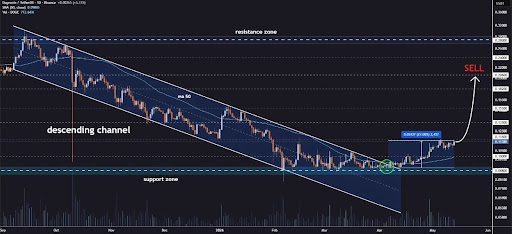
Meanwhile, in a separate analysis, market expert Jonathan Carter stated that the Dogecoin bulls are now taking control of the market as the price shows signs of a potential rally. The analyst revealed that DOGE recently broke out of a descending channel on the daily timeframe, reinforcing his optimistic outlook on the meme coin.

Carter believes that once this breakout is confirmed with momentum, the meme coin could attract strong buying pressure as investors head back into the market. Despite its recent price declines and bearish sentiment, the analyst maintains that Dogecoin’s bullish structure remains intact.
Source: X

He has outlined four potential upside targets for the meme coin this year, starting with a run to $0.135, then $0.153, $0.182, and ultimately $0.206. While his chart suggests that DOGE still has more room to rally to $0.28, he urges investors to sell and take profits around the $0.206 area.

DOGE continues sideways movement | Source: DOGEUSDT on Tradingview.com

Perguntas relacionadas

QWhat key technical indicator does analyst Javon Marks identify in the Dogecoin (DOGE) price chart, and what does it signal?

AJavon Marks identifies a Bullish Divergence on the Moving Average Convergence Divergence (MACD) indicator on a three-day Dogecoin price chart. This signals that DOGE, after a period of decline or sideways movement, has been building significant momentum beneath the surface, potentially indicating an upcoming major price rally.

QAccording to Javon Marks, what is the first major price target for Dogecoin following the anticipated breakout?

AJavon Marks's first major price target following the anticipated breakout is approximately $0.6533, which would represent a rally of about 500% from the price level mentioned in the analysis near $0.10.

QWhat is Javon Marks's even higher price target for Dogecoin after it reaches his initial target of $0.6533?

AAfter Dogecoin reaches the initial target of $0.6533, Javon Marks projects an even bigger price surge toward $1.25, suggesting that the first target will act as a resistance level that opens the path to this historical milestone.

QWhat market structure does analyst Jonathan Carter say Dogecoin recently broke out of, reinforcing his bullish outlook?

AAnalyst Jonathan Carter stated that Dogecoin recently broke out of a descending channel on the daily timeframe, which reinforces his optimistic outlook on the meme coin.

QWhat are the four potential upside price targets for Dogecoin outlined by analyst Jonathan Carter for this year?

AJonathan Carter outlined four potential upside targets for Dogecoin this year: $0.135, $0.153, $0.182, and ultimately $0.206. His analysis suggests taking profits around the $0.206 area, even though the chart indicates room to rally further to $0.28.

Leituras Relacionadas

Will There Be a Next Wave of Web3 Games? Veteran Player's Review: At the Peak of Hype, You Should at Least Sell Half

**Title: Is There Another Wave for Web3 Gaming? A Veteran Player's Review: When Hype Peaks, You Must Exit at Least Half** **Summary:** In an interview, veteran player "Earn Money Chicken" shares his journey and reflections on Web3 gaming. He transitioned from being a traditional in-game trader to a Web3 gamer, having profited from games like Mobox, StepN, and Seraph, but also experiencing significant losses. He defines himself primarily as a player, not an investor, attracted to Web3 games for the blend of earning potential, engaging gameplay, and the satisfaction of researching game mechanics. While he enjoys strategic "gambling" within games, he emphasizes it's not about zero-sum competition with other players. The interview explores the complex, often adversarial relationship between players, projects, and major investors (whales). The player's experience as a traditional game merchant helped develop his analytical mindset for spotting opportunities, but wasn't directly transferable. He identifies the core sources of profit in early Web3 gaming as **"era红利" (era-specific红利)** and strategic foresight, not just simple calculations. He warns that the biggest mistake ordinary players make is calculating their return-on-investment (ROI) period at peak hype, as asset and yield depreciation can trap them. Reflecting on his wins and losses, he now advocates for managing expectations. His most successful exit was from Seraph, where he sold at a relatively good time. The key problem with current Web3 games, he argues, is that most are not mature games first. A successful Web3 game must primarily be a **good, fun game** with a genuine player base willing to spend money for enjoyment, not just participants seeking profit. The blockchain element should solve problems within that context, not be the primary driver. While he believes the sector might see another speculative boom (possibly another strong "Ponzi" model attracting hype), a truly mature and sustainable Web3 game likely needs to come from a traditional major game studio. It would leverage a proven IP, mature content, a functional NFT trading system, and attract both traditional and crypto-native players, offering more normalized returns rather than extreme暴利. His final advice: Newcomers without prior experience should avoid the space now, as it's like searching for a diamond in the rough. For those remaining, the rule is: be brave when assets are low and overlooked, but **when everyone is talking about it (at peak hype), you must sell at least half your holdings.**

marsbitHá 1m

Will There Be a Next Wave of Web3 Games? Veteran Player's Review: At the Peak of Hype, You Should at Least Sell Half

marsbitHá 1m

The Most Hidden AI Winners

"The Most Under-the-Radar AI Winners" While core AI giants and their direct suppliers have dominated headlines, a group of seemingly unrelated, decades-old manufacturing companies have emerged as major beneficiaries. A key example is Japan's TOTO, famous for bathroom fixtures. Its stock soared 145% in a year, driven not by its mainstay toilet business but by its nearly 40-year-old semiconductor ceramic component unit. Specifically, TOTO manufactures electrostatic chucks—critical, hard-to-replace parts for advanced chip manufacturing processes like etching and EUV lithography. This segment, though only 9% of revenue, contributed over 54% of operating profit in FY2025 with a 43% margin. High barriers to entry, including deep know-how in high-purity ceramic sintering and long supplier certification cycles (5+ years), secure its position. This pattern repeats across industries. Nitto Boseki, a 128-year-old glass fiber maker, saw its stock rise 325% due to near-monopoly supply of T-glass, an essential low-expansion material for AI chip substrates. Similarly, Ajinomoto, the global MSG leader, commands 80-95% of the market for ABF film, a vital insulating layer in chip packaging. These "hidden" segments, often born from deep materials science expertise, are now bottleneck supplies in the AI hardware chain, enjoying pricing power and high margins. In China's A-share market, the theme combines this AI-driven demand with domestic substitution. Companies like Zhongci Electronic (advancing in electrostatic chucks) and Honghe Technology & Feilihua (in high-end electronic glass fabrics) are gaining traction. The investment thesis hinges on whether these domestic players can rapidly scale qualified capacity to capture the supply gap within the critical time window. Ultimately, these cases show that in the AI supply chain, high-profit concentrations exist not only at the cutting-edge tech frontier but also in indispensable, difficult-to-replicate materials and components. Market recognition often lags behind fundamental profit shifts, creating potential for significant re-ratings as traditional industrial firms are re-evaluated as key enablers of advanced semiconductor manufacturing.

marsbitHá 26m

The Most Hidden AI Winners

marsbitHá 26m

The Most Secretive Winners of the AI Boom

"The Most Hidden AI Winners" An unlikely group of companies are emerging as major beneficiaries of the AI boom, not from designing chips, but from supplying critical materials and components essential for advanced semiconductor manufacturing. These 'hidden winners' are traditional manufacturers whose deep expertise in materials science has become indispensable. Japanese companies are leading this trend. Toto, globally known for bathroom fixtures, has seen its stock surge 145% over the past year, driven by its 40-year-old semiconductor ceramics business, which now contributes over half of its operating profit. Its electrostatic chucks are vital for advanced chip production and require years of expertise to manufacture. Similarly, Nittobo, a 128-year-old textile firm, controls 90% of the market for T-glass, a low-expansion glass fiber essential for AI chip substrates. Ajinomoto, the world's largest MSG producer, dominates the market (80-95% share) for ABF insulating film used in chip packaging. The core insight is that chasing "advanced" chips paradoxically increases reliance on traditional, high-precision material science where supply cannot be quickly replicated. These materials are now critical bottlenecks in the AI supply chain. This trend is mirrored in China's A股 market, framed by the theme of 'import substitution'. Companies like Zhongci Dianzi (electrostatic chucks) and Honghe Technology (ultra-thin electronic cloth) are making progress, but face the test of scaling production and matching Japanese rivals' quality. The key tension lies in the slow change of market perception. While profit structures rapidly shift towards high-margin tech components, these firms retain their traditional industry classifications, creating a valuation gap that is gradually closing as their roles in the AI ecosystem become undeniable.

链捕手Há 34m

The Most Secretive Winners of the AI Boom

链捕手Há 34m

DeFi Enters a Moment of Value Reassessment: Risks and Opportunities Behind the $70 Billion TVL

DeFi Enters a Moment of Value Reassessment: Peril and Opportunity Behind $70 Billion TVL On July 1st, the total value locked (TVL) across all DeFi protocols fell below $70 billion to approximately $69.358 billion, hitting its lowest point since February 2024. This decline signals a significant contraction in DeFi liquidity and marks a new adjustment phase for the industry, far from its 2021 peak of over $180 billion. The primary drivers of this TVL drop are a general decrease in crypto market risk appetite, which leads capital to exit volatile sectors like DeFi first, and the fading effectiveness of the high-yield liquidity incentive models that fueled the initial DeFi boom. Many protocols' high TVL figures were built on temporary subsidy-driven capital rather than genuine demand. Furthermore, capital is migrating to newer narratives like AI, RWA, and modular infrastructure. This cooldown exposes DeFi's growth bottlenecks: innovation has slowed with rampant protocol copycats, real yields have normalized to single digits, and poor user experience continues to hinder mass adoption beyond crypto-natives. However, the TVL decline does not spell the end for DeFi. The metric itself is limited, as it fluctuates with underlying asset prices. The industry is shifting from capital accumulation to efficiency competition, leveraging Layer 2 solutions and modular architecture to do more with less locked value. Crucially, DeFi is expanding into real-world financial use cases like the tokenization of real-world assets (RWA) and the growth of the stablecoin ecosystem, moving its value proposition from speculative token subsidies to real cash flows. In conclusion, while short-term pressures from liquidity contraction and user growth stagnation persist, the sector is undergoing a necessary value reassessment. DeFi is transitioning from a subsidy-driven, hype-based era toward a more mature, rational, and efficiency-focused phase, with long-term growth hinging on meeting real-world financial needs through RWA, stablecoins, and robust infrastructure.

marsbitHá 53m

DeFi Enters a Moment of Value Reassessment: Risks and Opportunities Behind the $70 Billion TVL

marsbitHá 53m

Trading

Spot
活动图片