DeFi stops the liquidation leak: Protocols reclaim billions lost to MEV bots

ambcryptoPublicado em 2026-03-30Última atualização em 2026-03-30

Resumo

DeFi protocols are addressing a major inefficiency by reclaiming billions in value that was previously extracted by MEV bots during liquidations. For years, these bots profited from liquidation events, draining value from users and weakening protocol sustainability. With over $2 billion in liquidatable positions on Ethereum alone, protocols like Aave are now implementing new mechanisms such as Smoothing Varying Rate (SVR) to internalize this value. Aave has already recaptured $16.7 million in MEV on Ethereum and is expanding SVR to Arbitrum and Base. This shift turns liquidations into controlled revenue channels, strengthening protocol economics and sustainability. While Aave’s revenue has increased—reaching a $76 million annual run rate—long-term growth remains dependent on sustained market activity and volatility.

DeFi is addressing a key inefficiency as protocols move to reclaim value once captured by external Maximal Extractable Value (MEV) bots during liquidations.

For years, bots exploited liquidation windows, extracting profits while value leaked from users and weakened protocol sustainability over time.

As this leakage grew too large to ignore, Ethereum’s [ETH] lending markets started holding about $2.16 billion in liquidatable positions.

Within this, Compound accounted for $1.23 billion, while Sky held around $801 million, highlighting persistent extraction opportunities during volatility.
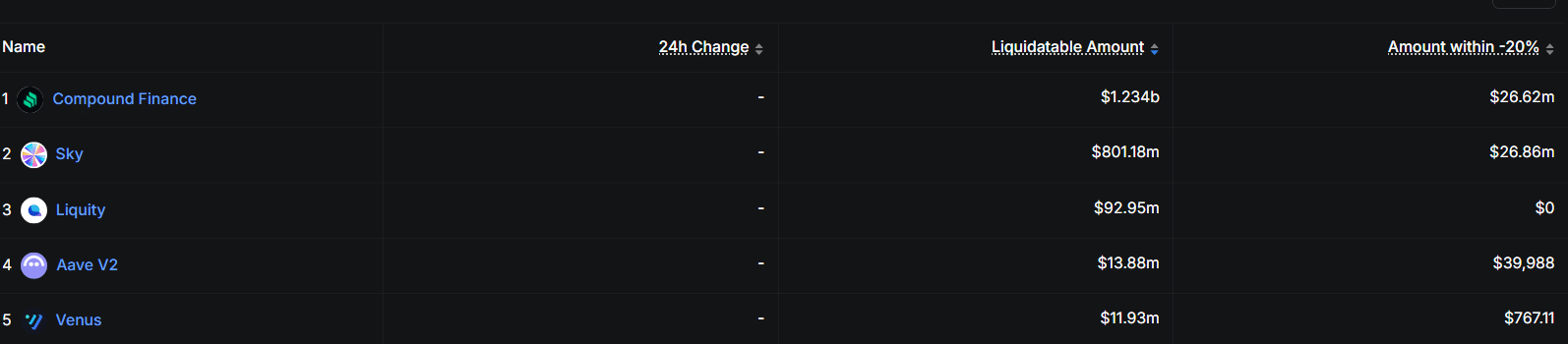
Source: DeFiLlama

However, protocols are redesigning mechanisms through auctions and controlled liquidations to retain value internally rather than letting it escape. This shift changes who benefits from market stress, allowing protocols to capture and recycle value instead of losing it.

As a result, DeFi strengthens its economic structure, improving sustainability and reinforcing long-term resilience

Aave reclaims MEV as SVR reshapes liquidation flows

Aave [AAVE] is not just refining its system; it is expanding a model that is already changing how value moves during liquidations. After proving effective on Ethereum, where Aave recaptured over $16.7 million in MEV, the protocol now extends SVR to Arbitrum and Base.
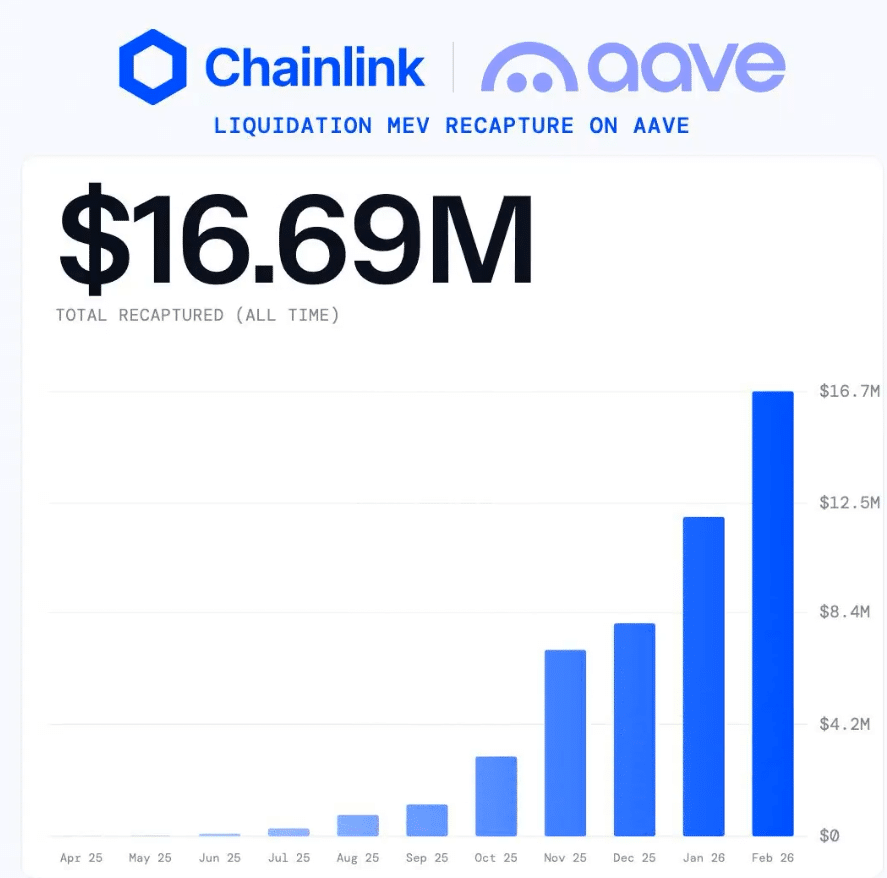
Source: ChainLink/X

This expansion is happening because the previous model left too much value on the table. Bots consistently captured liquidation profits, especially during volatility, while protocols saw little benefit. SVR changes this by redirecting that flow back into Aave’s ecosystem.

As this rollout scales across chains, liquidation events no longer act as pure extraction points. Instead, they become controlled revenue channels that strengthen the protocol.

The implication of these changes is clear. Aave is turning volatility into income, which improves sustainability and sets a precedent for how DeFi protocols capture value going forward.

SVR boosts revenue, but sustainability remains uncertain

As SVR begins to scale across networks, the focus shifts from early success to whether these gains can actually hold over time. The initial results look strong, yet they raise a deeper question about durability.

Aave now sits near $23.87 billion in TVL, while revenue reaches $6.24 million over 30 days, pointing to a $76 million annual run rate. This growth is not accidental, since liquidation activity is now feeding directly into protocol income.

This shift happens because value no longer escapes to bots and instead flows back into the ecosystem, strengthening internal cash flow. However, this strength is conditional. Revenue rises with volatility and lending demand, yet fades when activity slows.

All in all, this approach leaves a clear outcome. SVR improves Aave’s economics, but only sustained market activity can turn these gains into durable value growth.


Final Summary

  • The Aave protocol internalizes MEV through SVR, strengthening DeFi’s shift toward sustainable value capture.
  • AAVE shows rising revenue and improved efficiency, yet long-term growth remains dependent on volatility.


Perguntas relacionadas

QWhat is the main problem that DeFi protocols are addressing with their new liquidation mechanisms?

ADeFi protocols are addressing the problem of value leakage during liquidations, where external Maximal Extractable Value (MEV) bots were extracting profits, weakening protocol sustainability and causing billions in losses to users.

QHow much MEV value has Aave recaptured on Ethereum after implementing its new system?

AAave has recaptured over $16.7 million in MEV on Ethereum after implementing its SVR (Smart Vault Recovery) system.

QWhat are the two major Ethereum lending markets mentioned, and what were their respective liquidatable positions?

AThe two major Ethereum lending markets mentioned are Compound, with about $1.23 billion in liquidatable positions, and Aave (referred to as 'Sky' in the context, likely a typo for Aave), with around $801 million.

QWhat is the key change that protocols like Aave are making to their liquidation process?

AProtocols like Aave are redesigning their liquidation mechanisms through auctions and controlled processes (like SVR) to retain value internally, turning liquidation events into controlled revenue channels for the protocol instead of allowing value to be extracted by external bots.

QWhat is the primary condition for Aave's SVR model to generate sustainable revenue growth, according to the article?

AThe primary condition for sustainable revenue growth from Aave's SVR model is sustained market activity and volatility, as the revenue gains are dependent on lending demand and market stress, and can fade when activity slows down.

Leituras Relacionadas

Michael Saylor's Latest Article: Bitcoin Must Find Balance Between Uniqueness and Universal Value

Michael Saylor outlines four key Bitcoin ideologies shaping its future: * **Bitcoin Maximalists** see Bitcoin as the dominant digital monetary network and a breakthrough in economic empowerment, emphasizing its superior property rights and role as a sound money solution. * **Bitcoin Capitalists** focus on integration, believing Bitcoin must embed into the global economy—through institutions, capital markets, and financial products—to reach its full potential as digital capital. * **Bitcoin Technologists** advocate for continuous protocol improvements in scalability, privacy, and security to adapt to evolving needs and threats, while acknowledging the high bar for change. * **Bitcoin Fundamentalists** guard Bitcoin's core principles of self-custody, decentralization, and censorship resistance, warning against dilution from institutions or risky modifications. Saylor argues that a healthy Bitcoin ecosystem requires a balance of these perspectives. Bitcoin's path forward involves disciplined expansion: preserving its immutable core (Fundamentalist insight), recognizing its dominant status (Maximalist view), integrating with the global economy (Capitalist drive), and enabling careful innovation, primarily in higher layers (Technologist role). The challenge is to maintain Bitcoin's unique properties while making it useful for the world, ensuring it remains Bitcoin as it grows.

Foresight NewsHá 16m

Michael Saylor's Latest Article: Bitcoin Must Find Balance Between Uniqueness and Universal Value

Foresight NewsHá 16m

Reddit Weekly Hot Stock Watch: RKLB/LUNR/ASTS Plunge Collectively, Is the Space Sector Still Worth Considering?

Reddit's stock communities witnessed a concentrated surge in discussion around space stocks last week, with SPCE, RKLB, LUNR, and ASTS leading the chatter. This often signals an underlying catalyst for investor attention. However, despite being grouped as "space plays," these companies have vastly different fundamentals and recent performances. While SPCE (Virgin Galactic) saw a 22% single-day surge—potentially fueled by short covering and fallout from Blue Origin's rocket test anomaly—the other three stocks declined sharply. RKLB dropped 15%, LUNR fell 13%, and ASTS was down 7%. This divergence highlights they are not a monolithic sector. The downturn for RKLB, LUNR, and ASTS stemmed from multiple headwinds converging: Blue Origin's New Glenn rocket explosion (directly impacting ASTS's launch plans), anticipation of SpaceX's massive IPO drawing funds away from these "alternative" public space stocks, and insider selling at RKLB after significant rallies. A closer look reveals key differences: RKLB stands out with substantial, growing revenue ($113.9M in Q1) and a $2.2B backlog, though its high valuation (~80x Forward P/S) prices in success for its upcoming Neutron rocket. LUNR's reported revenue growth is largely acquisition-driven, with its core moon landing business facing a crucial test with the upcoming IM-3 mission. ASTS has a large potential market in space-based cellular connectivity but faces significant execution risk, especially after the Blue Origin launch setback. SPCE, despite high discussion volume, has minimal revenue and its recent spike appears driven more by sentiment than fundamentals. The analysis suggests it's premature to call a "buying opportunity" for the sector broadly. RKLB is considered the most fundamentally sound but may be more attractive at a lower price point ($96-$102). For the others, investors are advised to wait for specific catalysts: LUNR's IM-3 mission outcome, clarity on ASTS's revised launch timeline, and for SPCE, to avoid the speculative frenzy. The long-term space thesis remains, but short-term valuations have run ahead of fundamentals for most names.

marsbitHá 30m

Reddit Weekly Hot Stock Watch: RKLB/LUNR/ASTS Plunge Collectively, Is the Space Sector Still Worth Considering?

marsbitHá 30m

Why Does Crypto Always Build 'Casinos', But Rarely Creates 'Indispensable Products'?

The article explores why cryptocurrency has primarily fostered speculation rather than essential, "sticky" consumer products. It introduces the concept of "sofalarity"—the point where a platform's convenience becomes so ingrained that leaving feels unthinkable. While Big Tech creates this lock-in through ecosystem control and data harvesting, crypto lacks equivalent everyday utility. Its appeal hinges on the variable rewards of price volatility, akin to gambling, which drives engagement but not dependency. The author argues crypto's core promise—fixing opaque backend systems like correspondent banking—solves problems most people never see or feel, failing to deliver a tangible "aha moment" of improved daily life. This need for explanation hinders mass adoption. Meanwhile, platforms like Google and Meta monetize vast behavioral data, a treasure trove crypto's transparent ledgers (recording only financial transactions) cannot match for predictive insight. The piece further questions whether crypto's potential lies in consumer super-apps or, more plausibly, in becoming enterprise-grade infrastructure—modern settlement rails. It concludes with a critical look at Real-World Asset (RWA) tokenization, suggesting it may merely digitize and accelerate corporate extraction (e.g., in housing or healthcare) rather than democratize access, as the technology itself is a neutral tool. True disruption, the author implies, requires building sovereign systems outside exploitative platforms.

marsbitHá 31m

Why Does Crypto Always Build 'Casinos', But Rarely Creates 'Indispensable Products'?

marsbitHá 31m

Trading

Spot
Futuros
活动图片




