December 18 Market Analysis: Why the Drop Today? BTC, ETH, BNB, SOL, ACT, HMSTR, SOMI, TOWNS Altcoin Trading Suggestions

金色财经Publicado em 2025-12-18Última atualização em 2025-12-18

Resumo

Crypto Market Drops 1.37% Amid Macro Fears and ETF Outflows The cryptocurrency market fell 1.37% in 24 hours, with a weekly loss of 7.2%. Key factors include macroeconomic concerns ahead of U.S. CPI data, a net outflow of $2.3 billion from spot Bitcoin ETFs this month, and increased leverage liquidations. Over $544 million was liquidated in 24 hours, with 158,687 traders affected—$388 million from long positions and $156 million from shorts. Bitcoin (BTC) is hovering around $86,836. Key resistance is at $87,000; a break above could lead to a bounce toward $88,000–$90,300, while failure may test supports at $85,220–$82,170. Ethereum (ETH) fell 3.65% to $2,838, with resistance at $2,860 and support near $2,790–$2,720. BNB and SOL also declined, testing key levels at $847 and $124, respectively. Market sentiment is "Extreme Fear" (index 18). Bitcoin’s dominance rose to 59.39%; a break above 60% may signal a flight to safety, while a drop could favor altcoins. Top gainers: ACT (+25%), HMSTR (+23%), BARD (+14%). Top losers: SOMI (-19%), TOWNS (-17%), FORM (-16%). Other major altcoins like DOGE, ADA, and SHIB also saw declines.

? Over the past 24 hours, the cryptocurrency market has fallen by 1.37%, with a cumulative weekly decline of 7.2%. The main factors leading to this decline include: market concerns about the macroeconomy ahead of the release of US inflation data, outflows from Bitcoin ETFs, and pressure on the derivatives market.

1. Macroeconomic Concerns — The release of the Consumer Price Index (CPI) (December 18) increased the possibility of the Federal Reserve implementing tighter monetary policy; the 7-day correlation between Bitcoin and the Nasdaq index is +0.89.

2. Institutional Fund Outflows — Spot Bitcoin ETFs have seen a net outflow of $2.3 billion this month.

3. Leverage Liquidations — Open interest decreased by 0.89%, while Bitcoin liquidation volume increased by 152% in 24 hours, totaling $142 million.

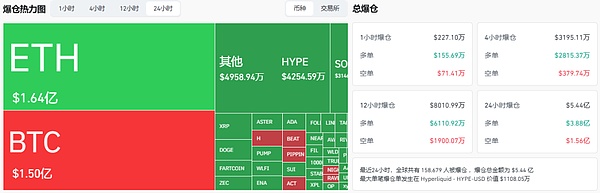
? Liquidation Alert:

Across the entire network in 24 hours, 158,687 people were liquidated, totaling $544 million. Long positions were brutally crushed ($388 million), and short positions were not spared either ($156 million).
? Major Coin Performance:

1. Bitcoin (BTC): Price ~$86,836, down 0.08% in 24h

Today, watch the key level of $87,000. If it can hold above this level, a rebound is possible on the 4-hour chart, with upside resistance near $88,000, $89,080, and $90,300.

If it fails to hold above, weak rebounds on smaller timeframes could lead to further declines to test support levels near $85,220, $83,830, and $82,170.

2. Ethereum (ETH): Price ~$2,838, down 3.65% in 24h

Today, use $2,860 as an observation point. If it holds, there's a chance for a rebound on the 1-2 hour chart, with upside resistance near $2,900, $2,945, and $2,980.

If it fails to hold, the rebound momentum will be insufficient, potentially testing support near $2,790, $2,761, and $2,720.

3. BNB: Price ~$834, down 4.01% in 24h

Today, focus on the $847 level. Holding above could lead to a rebound on the 1-2 hour chart, looking towards resistance near $859, $876, and $892.

If unable to hold above, it may continue to weaken, with downside support near $833, $815, and $801.

4. SOL: Price ~$123, down 3.98% in 24h

Today, watch the $124 line. Holding above could lead to a short-term rebound, with resistance near $126, $130, and $134.

If it fails to hold, the rebound will be limited, requiring attention to support near $121, $117, and $112.

?️ Market Sentiment:

Today, the total cryptocurrency market cap is approximately $3.01 trillion, with a 24-hour total trading volume of about $129 billion.

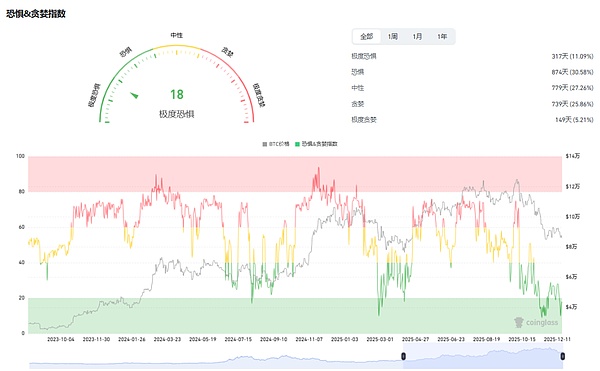
The current market sentiment is 18 (Extreme Fear). The market is currently bearish due to panic selling and macroeconomic instability. However, Bitcoin's oversold technical indicators, coupled with its history of a 660% gain based on RSI signals from 2022 to 2025, suggest a potential rebound. Additionally, Bitcoin's market dominance is now 59.39%, up 0.6% in 24 hours — if dominance breaks above 60%, it indicates funds are flowing into the safe-haven asset BTC; if dominance turns downward, it might be a good opportunity to position in altcoins.
Today's Crypto Gainers & Losers?

? Top 3 Gainers:

1. ACT: Price $0.0258, up 25% in 24h

2. HMSTR: Price $0.000244, up 23% in 24h

3. BARD: Price $0.8806, up 14% in 24h

? Top 3 Losers:

1. SOMI: Price $0.2617, down 19% in 24h

2. TOWNS: Price $0.00554, down 17% in 24h

3. FORM: Price $0.3415, down 16% in 24h

Other Major Coin Performance:

Dogecoin (DOGE): Price $0.12490, down 4.74% in 24h

TRON (TRX): Price $0.2773, down 1.11% in 24h

Cardano (ADA): Price $0.3627, down 4.93% in 24h

Hyperliquid (HYPE): Price $24.173, down 10.98% in 24h

Avalanche (AVAX): Price $11.78, down 3.76% in 24h

Stellar (XLM): Price $0.2091, down 4.26% in 24h

Sui (SUI): Price $3956, down 5.94% in 24h

Chainlink (LINK): Price $12.19, down 4.62% in 24h

Hedera (HBAR): Price $0.10848, down 3.73% in 24h

Bitcoin Cash (BCH): Price $530.9, down 2.75% in 24h

Shiba Inu (SHIB): Price $0.00000746, down 4.48% in 24h

Litecoin (LTC): Price $75.33, down 4.67% in 24h

Pepe (PEPE): Price $0.00000388, down 4.90% in 24h

Toncoin (TON): Price $1.465, down 4.62% in 24h

Criptomoedas em alta

Perguntas relacionadas

QWhat are the three main factors that caused the recent decline in the cryptocurrency market according to the article?

AThe three main factors are: 1. Macroeconomic concerns ahead of the U.S. CPI data release, increasing the possibility of tighter monetary policy from the Fed. 2. Institutional capital outflows, with a net outflow of $2.3 billion from spot Bitcoin ETFs this month. 3. Leverage liquidations, with open interest decreasing by 0.89% and Bitcoin liquidations increasing by 152% in 24 hours, totaling $142 million.

QWhat is the current market sentiment indicator and what does it suggest about potential future market movement?

AThe current market sentiment is 18, indicating 'Extreme Fear'. The article suggests that Bitcoin's oversold technical indicators and its historical 660% gain based on RSI signals from 2022 to 2025 hint at a potential rebound.

QWhat is the key price level to watch for Bitcoin (BTC) and what are the potential support and resistance levels mentioned?

AThe key level to watch for Bitcoin is $87,000. If it holds above this level, a rebound could occur with resistance levels at $88,000, $89,080, and $90,300. If it fails to hold, the price may test support levels at $85,220, $83,830, and $82,170.

QWhich three cryptocurrencies were the top gainers in the last 24 hours, and what were their approximate price increases?

AThe top three gainers were: 1. ACT, priced at $0.0258 with a 25% increase. 2. HMSTR, priced at $0.000244 with a 23% increase. 3. BARD, priced at $0.8806 with a 14% increase.

QWhat does the Bitcoin dominance rate (currently at 59.39%) indicate about market capital flow according to the analysis?

AThe Bitcoin dominance rate indicates capital flow trends. If the dominance rate breaks above 60%, it suggests that capital is flowing into Bitcoin as a safe-haven asset. If the dominance rate turns downward, it could present a good opportunity to position in altcoins.

Leituras Relacionadas

Agent Race Ends, Super Workbench Takes Over

The era of fragmented AI agents is ending. Over the past month, China's tech giants—Tencent, Alibaba, and ByteDance—have simultaneously shifted strategy: instead of launching new, standalone AI agents, they are consolidating their various agent projects into unified "super workbenches." Tencent integrated its QClaw teams into WorkBuddy, a strategic product hailed as a potential third flagship after QQ and WeChat. Alibaba is merging its QoderWork, Wukong, and MuleRun agents into a new "Qianwen Office" platform under DingTalk's leadership. ByteDance rebranded its TRAE SOLO coding agent to TRAE Work, signaling a broader focus on workflow collaboration. This convergence marks a pivotal industry consensus. The initial exploration phase, where companies rapidly built numerous overlapping agents for different scenarios, proved costly and inefficient. With open-source tools eroding technical barriers, competition has shifted from agent creation to resource consolidation and cost control. Historically, platform wars are won not by creating more products, but by simplifying them—as seen with browsers unifying web access and super-apps consolidating services. Now, the "super workbench" aims to become the unified AI entry point for work. This reflects a deeper market realization: the primary audience for AI is no longer just programmers (a market in the tens of millions) but all knowledge workers (a market of billions). The real opportunity lies in augmenting everyday tasks—managing emails, documents, data, and meetings—across the entire workday. The core battleground is becoming control over the primary AI entry point that employees use daily. Tencent's WorkBuddy leverages WeChat and Tencent Docs; Alibaba's Qianwen Office taps into DingTalk's organizational data; ByteDance's TRAE Work integrates with Feishu's workflows. Whoever owns this "super workbench" gains strategic control over orchestrating enterprise data and APIs. This shift is redefining enterprise software. Traditional SaaS applications, valued for their user interfaces, will recede into the background. Their core functionalities will be exposed as standardized "Skills" or APIs for the super workbench's agents to invoke. Software value will shift from selling user seats to charging based on API calls and outcomes delivered. The evolution of agents is moving through clear stages: first as novel standalone products, then as consolidated primary work entry points, and finally as pervasive, invisible capabilities embedded into the digital fabric. The recent moves by major tech firms signal the transition from the first stage into the second, accelerating toward the third. In the end, the most successful agent technology may become invisible—like electricity or the HTTP protocol—a fundamental, unnamed infrastructure powering work itself.

marsbitHá 6m

Agent Race Ends, Super Workbench Takes Over

marsbitHá 6m

Michael Saylor: 110 Reasons to Oppose BIP-110

Michael Saylor presents 110 arguments against Bitcoin Improvement Proposal (BIP) 110, a soft fork aimed at restricting certain non-monetary data storage uses (like inscriptions) on the Bitcoin blockchain. He acknowledges the proponents' valid concerns—such as node costs, fee pressure, and preserving Bitcoin's monetary focus—but fundamentally disagrees with the proposed solution. Saylor argues that BIP 110 represents a dangerous precedent of using consensus rules to enforce value judgments on transaction validity, moving away from Bitcoin's core principles of neutrality and permissionless innovation. His key objections are organized into eleven categories: 1) It violates neutrality and hard consensus by banning currently valid transactions. 2) It fails to meet the high burden of proof required for a consensus change, lacking concrete data on the alleged crisis. 3) Its seven bundled technical restrictions are overly broad, targeting generic script functionalities and blocking future upgrade paths. 4) It sacrifices compatibility and future optionality by closing off designed upgrade hooks. 5) Its temporary rules add significant complexity (grandfathering, expiry states) without sufficient justification. 6) The economic and security impacts, particularly on miner revenue and fee markets, are uncertain and unmodeled. 7) Superior, market-based tools (fee markets, relay/mining policies) already exist to manage blockchain load. 8) It stifles innovation by creating a chilling effect for developers. 9) Its modified activation mechanism (55% threshold, forced signaling) is aggressive and risks network splits. 10) The precedent it sets—using consensus to suppress disliked but legal uses—is more dangerous than the problem it aims to solve. 11) A better path exists: improving measurements, refining resource-based policies, and allowing market forces to work. Saylor concludes that Bitcoin's strength lies in its neutral rules, open markets, and hard consensus. Changing these foundational elements to target specific use cases is an unnecessary and risky "iatrogenic" intervention. He advocates for guarding Bitcoin's neutrality rather than acting as its redeemer.

marsbitHá 22m

Michael Saylor: 110 Reasons to Oppose BIP-110

marsbitHá 22m

Trading

Spot

Artigos em Destaque

Como comprar TOWNS

Bem-vindo à HTX.com!Tornámos a compra de TOWNS (TOWNS) simples e conveniente.Segue o nosso guia passo a passo para iniciar a tua jornada no mundo das criptos.Passo 1: cria a tua conta HTXUtiliza o teu e-mail ou número de telefone para te inscreveres numa conta gratuita na HTX.Desfruta de um processo de inscrição sem complicações e desbloqueia todas as funcionalidades.Obter a minha contaPasso 2: vai para Comprar Cripto e escolhe o teu método de pagamentoCartão de crédito/débito: usa o teu visa ou mastercard para comprar TOWNS (TOWNS) instantaneamente.Saldo: usa os fundos da tua conta HTX para transacionar sem problemas.Terceiros: adicionamos métodos de pagamento populares, como Google Pay e Apple Pay, para aumentar a conveniência.P2P: transaciona diretamente com outros utilizadores na HTX.Mercado de balcão (OTC): oferecemos serviços personalizados e taxas de câmbio competitivas para os traders.Passo 3: armazena teu TOWNS (TOWNS)Depois de comprar o teu TOWNS (TOWNS), armazena-o na tua conta HTX.Alternativamente, podes enviá-lo para outro lugar através de transferência blockchain ou usá-lo para transacionar outras criptomoedas.Passo 4: transaciona TOWNS (TOWNS)Transaciona facilmente TOWNS (TOWNS) no mercado à vista da HTX.Acede simplesmente à tua conta, seleciona o teu par de trading, executa as tuas transações e monitoriza em tempo real.Oferecemos uma experiência de fácil utilização tanto para principiantes como para traders experientes.

244 Visualizações TotaisPublicado em {updateTime}Atualizado em 2026.06.02

Como comprar TOWNS

Discussões

Bem-vindo à Comunidade HTX. Aqui, pode manter-se informado sobre os mais recentes desenvolvimentos da plataforma e obter acesso a análises profissionais de mercado. As opiniões dos utilizadores sobre o preço de TOWNS (TOWNS) são apresentadas abaixo.

活动图片










