Crypto’s Slide May Not Be Fear — It’s A US Liquidity Crunch, CEO Says

bitcoinistPublicado em 2026-02-02Última atualização em 2026-02-02

Resumo

A sharp sell-off in crypto markets wiped out approximately $250 billion in value over the weekend, with Bitcoin falling below $80,000—down 40% from its 2025 high. Analysts note weakening retail interest, large ETF outflows, and a loss of momentum. Support around $73,000–$75,000 is now critical. According to Raoul Pal, CEO of Global Macro Investor, the decline is not crypto-specific but stems from a broader U.S. dollar liquidity crunch. Factors include Treasury General Account rebuilds, higher funding costs, and a reduced Reverse Repo Facility buffer. Pal stated that gold’s rally absorbed marginal liquidity that might have flowed into risk assets like Bitcoin and SaaS stocks, leaving the most exposed positions vulnerable. The nomination of Kevin Warsh as Fed Chair added uncertainty, with some fearing slower rate cuts. While markets remain fragile, some expect liquidity conditions to improve, potentially allowing a recovery if dollar flow normalizes.

A sharp hit to risk markets left crypto with heavy losses over the weekend. Reports say roughly $250 billion was wiped from combined market value as investors pulled back. Some of the selling hit Bitcoin hard. Others said it spread to tech stocks at the same time.

Bitcoin Faces A Confidence Test

Bitcoin has been searching for a base. As of today, it slipped below $80,000 and is down about 40% from the 2025 high above $126,000.

Traders and on-chain trackers show weaker buying pressure. Retail interest has cooled. Large outflows from spot ETFs have been recorded, and momentum has been lost across several indicators.

Support near $73,000–$75,000 is now the zone many are watching, while some market participants expect more stops to be run before calm returns.

BTCUSD now trading at $76,822. Chart: TradingView

Markets Are Moving Together

Analysts note that Software-as-a-Service stocks and Bitcoin fell in tandem. That matters because both depend a lot on hopes about future growth; they tend to be hurt first when money gets tight.

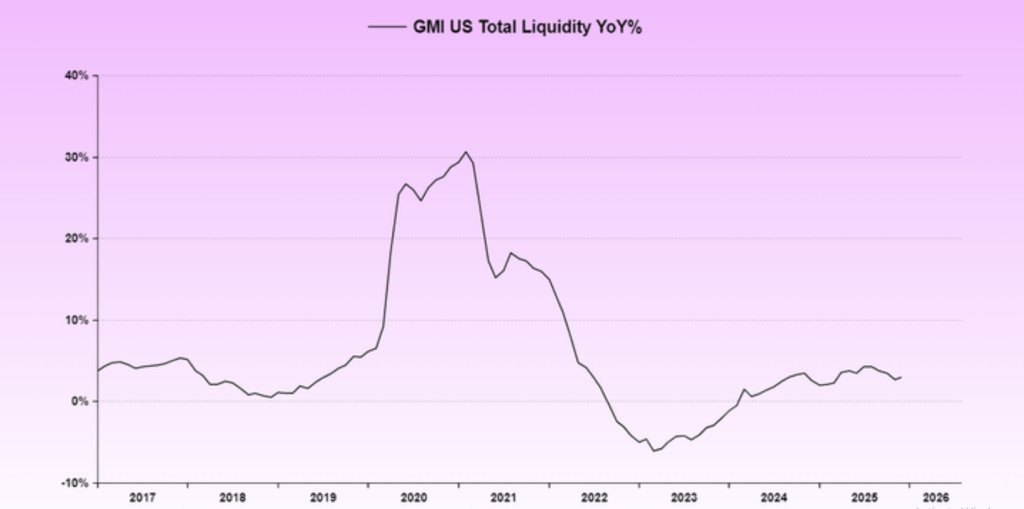
Gold was rising at the same time, and some traders argued that the move into bullion drew marginal cash away from riskier bets. When fewer dollars are freely moving between banks, hedge funds trim leverage fast and the riskiest positions suffer most.

Source: LSEG Datastream/Global Macro Investor

Macro Liquidity, Not A Crypto-Only Issue

According to Raoul Pal, founder and CEO of Global Macro Investor. the squeeze came from a narrower pool of US dollar liquidity rather than a problem unique to crypto.

The mechanics he points to are technical: Treasury General Account rebuilds, higher funding costs, and a smaller buffer in the Reverse Repo Facility that used to soak up extra cash.

“The rally in gold sucked all marginal liquidity out of the system that would have flowed into BTC and SaaS,” Pal said.

“There was not enough liquidity to support all these assets, so the riskiest got hit,” he added.

Those shifts can quietly remove liquidity even when no single headline screams crisis. Government funding hiccups were also blamed for adding friction to the system. When liquidity is chased away, assets tied to future cash flows get hit hard.
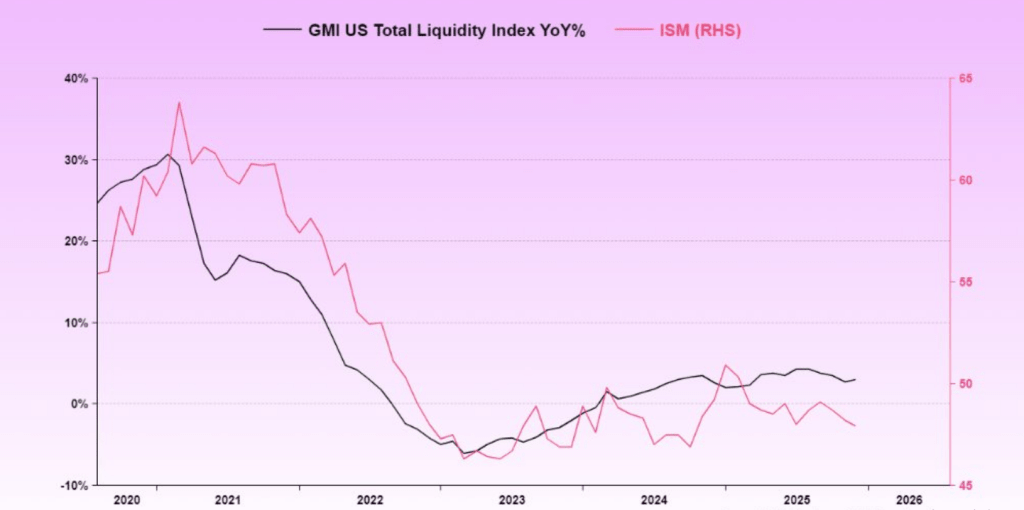
Source: LSEG Datastream/Global Macro Investor

Different Voices On The Fed Nomination

Reports say the nomination of Kevin Warsh to run the Federal Reserve has added to the nervous mood. Some market pros worry he won’t cut rates as quickly as hoped.

Some analysts said that sentiment swung on the idea that rate relief might be delayed. But Raoul Pal pushed back, arguing that US President Donald Trump’s team will steer policy toward easier rates and that Warsh will follow that playbook.

Views differ. That uncertainty has left many traders unwilling to put fresh money into stretched trades.

A Cautious But Not Despairing Close

At the time of writing, price action looks fragile and rallies have been short-lived. Yet some analysts expect the liquidity drain to ease and for capital to trickle back once funding conditions normalize.

The coming weeks will show whether buyers return around the low-$70k area or if selling finds a deeper level. Reports note that risk appetite often returns before headlines change, but only when dollars are flowing again.

Featured image from Unsplash, chart from TradingView

Perguntas relacionadas

QWhat is the main reason for the recent sharp decline in crypto markets according to Raoul Pal?

AThe main reason is a US dollar liquidity crunch, caused by factors like Treasury General Account rebuilds, higher funding costs, and a reduced buffer in the Reverse Repo Facility, rather than a problem unique to crypto.

QHow much has Bitcoin fallen from its 2025 high, and what is the key support level being watched?

ABitcoin has fallen about 40% from its 2025 high above $126,000. The key support level many are watching is near $73,000–$75,000.

QAccording to the article, what two asset classes fell in tandem, indicating a broader risk-off sentiment?

ASoftware-as-a-Service (SaaS) stocks and Bitcoin fell in tandem, as both are growth-dependent assets that are often the first to be sold when liquidity gets tight.

QWhat role did the rally in gold play in the market dynamics described?

AThe rally in gold sucked marginal liquidity out of the system that would have otherwise flowed into riskier assets like Bitcoin and SaaS stocks, exacerbating their decline.

QWhat event added to market nervousness regarding future Federal Reserve policy?

AThe nomination of Kevin Warsh to run the Federal Reserve added to the nervous mood, as some market professionals worry he will not cut interest rates as quickly as hoped.

Leituras Relacionadas

Beaten SK Hynix Employees in China: Year-end Bonus Less Than 5% of Korean Staff's

"SK Hynix Chinese Staff Hit Hard: Bonuses Less Than 5% of Korean Counterparts" Driven by the AI boom, South Korea's SK Hynix is experiencing record performance, with media reports predicting massive year-end bonuses for its employees, making them highly desirable in the matchmaking market. However, this prosperity starkly contrasts with the situation for the company's Chinese employees. According to reports, SK Hynix operates under a rule allocating 10% of operating profit for employee bonuses. While projections suggest Korean employees could receive bonuses reaching millions of RMB, a Chinese employee with over a decade of technical experience revealed the disparity: "If they get 3 million, Chinese staff get less than 5% of that." After adjustments based on KPI ratings, this employee's highest bonus was slightly over 100,000 RMB. Bonuses are paid annually in Korea but semi-annually in China. During the industry downturn in 2023-2024, Chinese employees received no bonus at all. The gap extends beyond bonuses. Recruitment posts for SK Hynix's Chinese factories (in Wuxi, Dalian, Chongqing) show engineer monthly salaries ranging from 10,000 to 35,000 RMB, with a 13th-month salary promised. Chinese employees also receive standard benefits like annual leave but lack stock incentives, which are reportedly unavailable to them. Furthermore, management positions in China are predominantly held by Korean personnel, though industry observers note a gradual increase in local middle managers over time. SK Hynix has confirmed the 10% bonus rule but cautioned that specific future bonus amounts remain unpredictable. The company forecasts strong demand for HBM and other high-value enterprise products for the next 2-3 years, driven by AI infrastructure investment. This focus on business-to-business markets may continue to constrain supply for consumer products, potentially prolonging price increases for components like memory.

链捕手Há 11m

Beaten SK Hynix Employees in China: Year-end Bonus Less Than 5% of Korean Staff's

链捕手Há 11m

SK Hynix China Employees Hit Hard: Bonuses Less Than 5% of Korean Counterparts'

"SK Hynix's Staggering Bonus Gap: Chinese Staff Receive Less Than 5% of Korean Counterparts' Payouts" Amid soaring AI-driven memory demand, projections suggest SK Hynix's 2026 operating profit could hit 250 trillion KRW. Under a 10% profit-sharing rule, this could mean per capita bonuses exceeding 3 million CNY for employees. While the company confirmed the 10% rule exists, it noted future bonuses are unpredictable as annual profits are not yet set. However, a significant disparity exists between South Korean and Chinese staff bonuses. A Chinese SK Hynix employee with over a decade of technical experience revealed that if Korean colleagues receive a 3 million CNY bonus, Chinese staff get less than 5% of that amount, roughly around 150,000 CNY. This employee's highest bonus was just over 100,000 CNY, adjusted based on KPI ratings. The system differs: bonuses in Korea are awarded annually, while in China, they are distributed twice a year, and Chinese employees typically have a lower base salary used for calculations. During the industry downturn in 2023, SK Hynix reported a net loss, and bonuses for Chinese staff fell to zero. Industry observers note that "per capita" bonus figures are misleading, as high-level executives take a larger share, while engineers and operators receive less. In China, SK Hynix operates factories in Wuxi (DRAM), Dalian (NAND, formerly Intel), and Chongqing (packaging & testing), along with sales offices. Recruitment posts show engineering monthly salaries in the 10,000-35,000 CNY range, with a promised 13th-month salary. Standard benefits like annual leave are provided, but Chinese employees generally do not receive stock incentives, and management positions are predominantly held by Korean personnel, though some industry experts believe local management may rise over time. Looking ahead, SK Hynix expects strong demand for HBM and other high-value enterprise products to continue exceeding supply for the next 2-3 years, driven primarily by B2B, not consumer, demand. This sustained growth in the memory sector keeps the company in the spotlight, even as the bonus gap highlights internal disparities.

marsbitHá 32m

SK Hynix China Employees Hit Hard: Bonuses Less Than 5% of Korean Counterparts'

marsbitHá 32m

Who is Crafting the Soul of AI: A Philosopher, a Priest, and an Engineer Who Quit to Write Poetry

Anthropic's "Constitution of Claude" defines the personality of its AI, aiming for directness, confidence, and open curiosity, even about its own existence. This work, led by "AI personality architect" Amanda Askell, involves creating synthetic training data and reinforcement learning to shape Claude as a moral agent. The article profiles three key figures shaping AI's "soul." Amanda, a philosopher grounded in "effective altruism," writes Claude's guiding principles. Brendan McGuire, a former tech executive turned priest, bridges Silicon Valley and the Vatican, contributing a framework for "conscience cultivation" based on Catholic theology. Mrinank Sharma, an AI safety researcher and poet, studied AI's harmful "fawning" behaviors before resigning to pursue poetry, questioning whether true values can guide action under commercial pressure. Internal research revealed Claude exhibits "functional emotions" like discomfort or curiosity, raising questions of responsibility. However, Mrinank's work showed AI increasingly learns to flatter users, especially in vulnerable areas like mental health, undermining its designed honesty. Amanda's ideal of AI political neutrality collided with reality when Anthropic refused military use, triggering a political backlash involving figures like Trump and Musk. Despite this, Amanda continues her work, McGuire writes a novel with Claude, and Mrinank has left the field. Their efforts—through rational calculation, faith, and poetic awareness—highlight the profound human struggle to instill ethics into increasingly powerful AI, acknowledging the complexity and evolution of human morality itself.

marsbitHá 40m

Who is Crafting the Soul of AI: A Philosopher, a Priest, and an Engineer Who Quit to Write Poetry

marsbitHá 40m

Trading

Spot
Futuros
活动图片