Crypto Should Be Judged By Economic Role, Not Tech Design: ASIC Fintech Chief

bitcoinistPublicado em 2026-03-11Última atualização em 2026-03-11

Resumo

According to Rhys Bollen, head of fintech at the Australian Securities and Investments Commission (ASIC), consumer harm in crypto primarily stems from intermediaries—exchanges, custodians, lenders—rather than the tokens themselves. In a paper presented at the Melbourne Money and Finance Conference, Bollen argued that Australia should regulate digital assets based on their economic function, not their technological design. Tokens that act like securities should be treated as such, stablecoins moving money should fall under payments law, and consumer protection rules should cover the rest. This approach contrasts with jurisdictions like the U.S. and EU, which are creating crypto-specific laws. Australia is already implementing this through its Digital Asset Framework bill, which integrates digital assets into existing financial regulations rather than building a separate legal structure.

Most harm done to consumers in the crypto space has come not from the tokens themselves, but from the platforms handling them — the exchanges, custodians, lenders, and yield services.

That finding sits at the center of a new paper delivered this week by Rhys Bollen, the head of fintech at the Australian Securities and Investments Commission, who argues Australia should stop treating digital assets as something categorically new and start applying the financial laws already on the books.

Regulating What It Does, Not What It’s Called

Bollen made the case at the Melbourne Money and Finance Conference, where he argued that crypto tokens should be judged by their economic function. A token that acts like a security should be treated as one. A stablecoin that moves money should fall under payments law.

Consumer protection rules should pick up whatever else remains. His argument strips away the technological wrapping and asks a simpler question: what does this thing actually do?
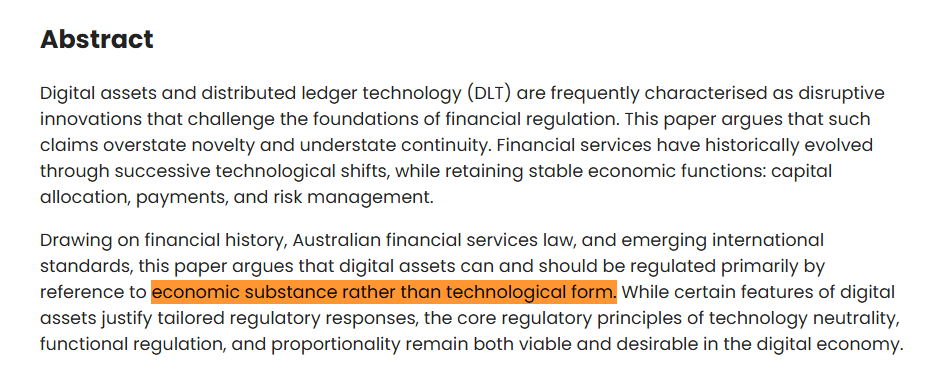
Paper presented at the Melbourne Money & Finance Conference, University of Melbourne by Dr. Rhys Bollen, Senior Executive Leader, FinTech

Crypto-Specific Law

That framing puts Australia at odds with how other countries have gone about it. The US is pushing the CLARITY Act, a purpose-built crypto framework. The European Union has rolled out its Markets in Crypto-Assets rules, known as MiCA. Both create dedicated regulatory structures for digital assets.

Bollen’s position, by contrast, is that building a separate system from scratch misses the point — and leaves gaps that bad actors will find.

“Opportunities for regulatory arbitrage” is how Bollen describes those gaps. Build a crypto-specific law, and someone will structure a product to fall outside it. Attach crypto to existing law based on what the product does, and that exit shrinks.

BTCUSD trading at $69,615 on the 24-hour chart: TradingView

Australia Already Writing It Into Law

Australia isn’t waiting on theory. The country’s Digital Asset Framework bill, currently moving through parliament, doesn’t attempt to replace the Corporations Act.

Reports indicate the bill amends it — slotting digital asset platforms into the existing regulatory structure rather than building a lane beside it.

ASIC’s own guidance document, Information Sheet 225, has already confirmed that existing definitions of financial products and services under the Corporations Act can apply to crypto, depending on how a given asset functions.

Bollen was direct about what that means in practice. Regulators, he said, should be focused on intermediaries — the companies sitting between users and their crypto — rather than on the tokens themselves. That’s where the consumer harm has actually shown up.

Featured image from Cyber Security News, chart from TradingView

Perguntas relacionadas

QAccording to Rhys Bollen, where has most consumer harm in the crypto space originated from?

AMost consumer harm has come not from the tokens themselves, but from the platforms handling them, such as exchanges, custodians, lenders, and yield services.

QWhat is the core argument made by the ASIC FinTech chief regarding how crypto should be regulated?

ACrypto tokens should be judged by their economic function rather than their technological design, meaning a token that acts like a security should be treated as one, and existing financial laws should be applied based on what the product actually does.

QHow does Australia's proposed regulatory approach for digital assets differ from that of the US and EU?

AAustralia is amending its existing Corporations Act to slot digital assets into the current regulatory structure, whereas the US is pushing the purpose-built CLARITY Act and the EU has created a dedicated framework called MiCA.

QWhat does the term 'regulatory arbitrage' refer to in the context of crypto regulation, as mentioned by Bollen?

A'Regulatory arbitrage' refers to the opportunities for bad actors to structure crypto products in a way that falls outside the scope of a purpose-built, crypto-specific regulatory framework, thereby creating gaps in consumer protection.

QWhat is the practical focus for regulators that Bollen suggests to prevent consumer harm in the crypto space?

ARegulators should focus on the intermediaries—the companies that sit between users and their crypto, such as platforms and service providers—rather than on the tokens themselves, as that is where the actual consumer harm has occurred.

Leituras Relacionadas

Jensen Huang's CMU Speech: In the AI Era, Don't Just Watch, Build

Jensen Huang, CEO of NVIDIA and a first-generation immigrant, delivered the commencement address to Carnegie Mellon University's class of 2026. He shared his personal journey from a humble background to founding NVIDIA, emphasizing resilience, learning from failure, and the responsibility that comes with leadership. Huang framed the present moment as the dawn of the AI revolution, a shift he believes is more profound than previous computing waves. He described AI as fundamentally resetting computing—moving from human-written software to machines that understand, reason, and use tools. This will create a new industry for generating intelligence and transform every sector. While acknowledging AI's potential to automate tasks and displace some jobs, Huang distinguished between the *tasks* of a job and its core *purpose*. He argued AI will augment human capability, not replace humans. The real risk, he stated, is not AI itself, but people being left behind by those who effectively use AI. He presented AI as a generational opportunity for massive infrastructure investment—in chip factories, data centers, energy grids, and advanced manufacturing—that could re-industrialize nations like the U.S. and bridge the digital divide by making computing and intelligent tools accessible to all. Huang called for a balanced approach: advancing AI safely and responsibly, establishing prudent policies, ensuring broad access, and encouraging universal participation. He urged the graduates not to fear the future but to engage with optimism and ambition, reminding them of CMU's motto, "My heart is in the work." His core message was clear: this is their moment to actively build and shape the AI-powered future, not merely observe it.

marsbitHá 5m

Jensen Huang's CMU Speech: In the AI Era, Don't Just Watch, Build

marsbitHá 5m

The Era Has Arrived Where Human Writers Must Prove They Are Not Machines

The article describes an era where AI-generated content is flooding the market, forcing human authors to prove they are not machines. It begins with the example of dozens of AI-written, error-ridden biographies of Henry Kissinger appearing on Amazon within hours of his death, a pattern repeated for other deceased celebrities and even living experts who find fraudulent books under their names. This spam content has exploded, with monthly new book releases on platforms like Amazon reaching 300,000 by late 2025. The issue spans genres, from suspiciously high proportions of AI-written teen romance and self-help books to dangerous, AI-generated foraging guides containing lethal advice. The platforms' automated review systems, designed to catch plagiarism and banned words, are ill-equipped to detect AI-generated text that avoids these pitfalls while being nonsensical or fraudulent. The problem has infiltrated traditional publishing. A major publisher, Hachette, had to recall a bestselling horror novel after AI detection tools suggested 78% of its content was machine-generated. An acclaimed European philosophy book was later revealed to be entirely written by AI under a fake author persona. In response, authors are fighting back. At the 2026 London Book Fair, 10,000 writers published a blank book titled "Don't Steal This Book" containing only their signatures—using emptiness as a protest weapon in an age of AI overproduction. Initiatives like the "Human Author Certification" program have emerged, ironically placing the burden on humans to prove their work is not machine-made. The article warns of a vicious cycle: AI-generated low-quality books pollute the data used to train future AI models, leading to "model collapse" and an ever-worsening flood of digital waste, eroding trust in publishing and devaluing human creativity.

marsbitHá 30m

The Era Has Arrived Where Human Writers Must Prove They Are Not Machines

marsbitHá 30m

Trading

Spot
Futuros
活动图片





