Crypto Firms Propose Key Stablecoin Concessions To Advance CLARITY Act – Report

bitcoinistPublicado em 2026-02-06Última atualização em 2026-02-06

Resumo

Crypto firms are proposing key concessions to banks in an effort to advance the stalled CLARITY Act, a major US crypto market structure bill. The main point of contention is the treatment of stablecoin rewards. Banks argue that interest-bearing stablecoins threaten the financial system and distort credit creation. In response, crypto companies have offered compromises, such as giving community banks a larger role by having them hold a portion of stablecoin reserves or issue tokens. However, not all parties agree, and it's unclear if these proposals will resolve the dispute. The Senate Banking Committee's draft, which bans interest payments to passive token holders, has faced heavy criticism from crypto leaders who argue it would kill innovation. Recent White House-mediated talks ended without a resolution, but lawmakers remain hopeful a compromise can be reached.

Crypto firms are reportedly stepping up efforts to advance the highly anticipated market structure bill by proposing potential compromises to address some of the banking sector’s concerns on stablecoins.

Crypto Firms Offer Stablecoin Compromises

On Wednesday, Bloomberg reported that multiple crypto companies have been allegedly trying to “win over” banks to salvage the crypto market structure bill, known as the CLARITY Act.

The crypto bill has been stalled in the US Senate for weeks as crypto industry leaders and banks have been unable to reach an agreement on one of the bill’s main topics, stablecoin rewards, in the Senate Banking Committee’s portion of the legislation.

The US banking industry has repeatedly expressed concerns about stablecoin policies, claiming that interest payments will distort market dynamics and affect credit creation in the country. Bank of America CEO Brian Moynihan recently told investors that the banking sector, especially small- and medium-sized businesses, could face significant challenges if Congress does not prohibit interest-bearing stablecoins.

According to people familiar with the matter, industry participants are offering banks new concessions regarding these concerns, as part of their efforts to advance the long-awaited crypto legislation.

For instance, the firms have reportedly proposed giving community banks a larger role in the stablecoin system, allowing them to hold reserves or issue tokens through partnerships. Notably, they suggested requiring stablecoin issuers to maintain a portion of their reserves at community banks.

Not all crypto companies agree with the proposed ideas, Bloomberg sources noted, emphasizing that the two sides haven’t resolved their differences. Moreover, it remains unclear whether the concessions satisfactorily address banks’ concerns. However, it is “a sign that they’re redoubling efforts to keep the market-structure bill moving,” the report added.

The Stablecoin Rewards Dispute

As reported by Bitcoinist, banks have heavily criticized the landmark stablecoin legislation, the GENIUS Act, affirming that it has loopholes that could pose risks to the financial system.

For context, the crypto framework prohibits interest payments on the holding or use of payment-purpose stablecoins but only addresses stablecoin issuers. As a result, banking associations across the US pressed the Senate Banking Committee to add language to the CLARITY Act that also bans digital asset exchanges, brokers, dealers, and related entities.

The Senate Banking Committee published its draft last month, which received heavy backlash from crypto industry leaders for introducing key restrictions for stablecoin issuers.

Under the proposed draft, issuers would be able to offer rewards for specific actions, such as account openings and cashback. Nonetheless, they would be prohibited from providing interest payments to passive token holders. Coinbase’s CEO Brian Armstrong argued that “would kill rewards on stablecoins,” and allow banks to “ban their competition.”

This led to a delay of the Senate Banking Committee’s markup session, initially scheduled for mid-January, and an extended negotiation process between lawmakers and leaders from the two industries.

Earlier this week, the Trump administration oversaw a White House meeting with crypto and banking groups, including PayPal, Ripple, Coinbase, Multicoin, Circle, the American Bankers Association, and the Bank Policy Institute, to ease the regulatory debate.

The negotiation reportedly ended without an agreement on how to address the dispute but led to “constructive discussion on the risks and opportunities of stablecoin yield and rewards.”

Senate Banking Committee Chairman Senator Tim Scott recently affirmed that he is still hopeful the two sides can reach a balance. “We can protect consumers and community banks while still allowing innovation and competition to lower prices and expand access,” he stated. “Both sides are working toward a compromise that keeps innovation here in America.”
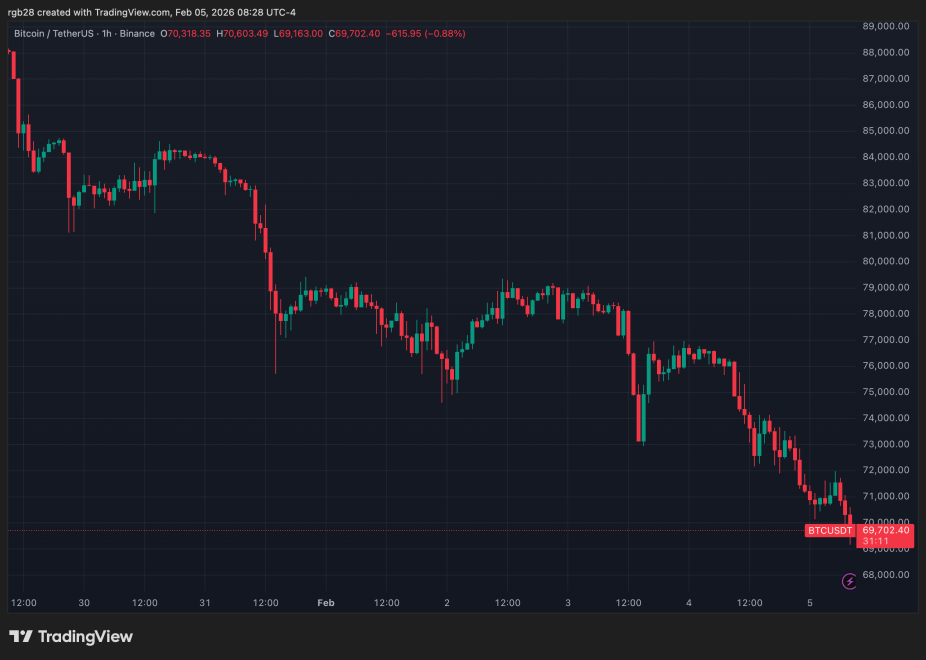
Bitcoin (BTC) trades at $69,702 on the one-week chart. Source: BTCUSDT on TradingView


Perguntas relacionadas

QWhat is the main purpose of the proposed concessions by crypto firms regarding the CLARITY Act?

AThe main purpose is to address the banking sector's concerns about stablecoins, particularly regarding interest payments, in order to advance the stalled crypto market structure bill and win over banks' support.

QWhat specific compromise did crypto firms propose to involve community banks in the stablecoin system?

ACrypto firms proposed giving community banks a larger role by allowing them to hold reserves or issue tokens through partnerships, and requiring stablecoin issuers to maintain a portion of their reserves at community banks.

QWhy have banks expressed concerns about stablecoin policies, according to Bank of America CEO Brian Moynihan?

ABanks are concerned that interest payments on stablecoins will distort market dynamics and affect credit creation, potentially posing significant challenges to the banking sector, especially small- and medium-sized businesses.

QWhat key restriction in the Senate Banking Committee's draft legislation has drawn criticism from crypto industry leaders like Coinbase's CEO?

AThe draft prohibits stablecoin issuers from providing interest payments to passive token holders, which critics argue would kill rewards on stablecoins and allow banks to ban their competition.

QWhat was the outcome of the recent White House meeting between crypto and banking groups regarding the stablecoin dispute?

AThe meeting ended without an agreement on how to address the dispute but led to a constructive discussion on the risks and opportunities of stablecoin yield and rewards.

Leituras Relacionadas

NVIDIA Begins Adding Soap to the Bubble

NVIDIA is taking on a dual role: not just as a leading chip supplier, but as a massive capital allocator across the entire AI supply chain. In 2026, the company has committed over $40 billion in investments within five months, targeting everything from optical fiber manufacturing and data center operations to foundational AI model development. This investment spree, described as a systematic "sprinkler" approach, primarily funds companies that are major buyers of NVIDIA's own GPUs. Critics, including analysts from Goldman Sachs, label this a "circular revenue" loop—comparable to a supplier financing a customer to buy more of its products. A prominent example is NVIDIA's investment in OpenAI, which is expected to generate around $13 billion in revenue for NVIDIA, much of which may be reinvested back into OpenAI. While CEO Jensen Huang dismisses the "circular financing" critique as "absurd," arguing the investments are confidence votes in long-term generational shifts, some analysts express discomfort. They note that while investments in critical supply chain components like optics are strategically sound, funding new cloud providers like CoreWeave feels like "pre-paying for your own GPUs." The strategy carries significant risks. If the AI investment cycle turns, the market may question how much demand is genuine versus artificially sustained by NVIDIA's own balance sheet. Despite posting record-breaking earnings—$215.9 billion in annual revenue and $120 billion in net profit for FY2026—NVIDIA's stock fell after its report, signaling that "beating expectations" may no longer be enough to assure investors about the duration of the AI spending boom. The article concludes that while a bubble isn't necessarily a fraud, NVIDIA's actions resemble adding soap to a bubble—making it appear more robust and durable. This creates a complex scenario requiring extreme冷静 from investors to distinguish between real structural growth and financial engineering.

marsbitHá 6m

NVIDIA Begins Adding Soap to the Bubble

marsbitHá 6m

Short Positions Have Been Squeezed Out: Will the Next Leg of the U.S. Stock AI Rally Continue in Seoul?

"Short Squeeze Exhausted: Will the Next Leg of the AI Rally Continue in Seoul?" A Nomura report suggests the US AI stock rally, which saw the S&P 500 rise ~16.6% in 28 days largely driven by 10 key stocks, may be pausing. The fuel from short covering, CTA fund positioning, and volatility-control strategies is nearing its limit. For the rally to continue, new momentum from retail and sentiment-driven FOMO (Fear Of Missing Out) is needed. South Korea's market provided a potential answer on the very day the report was published. The KOSPI index surged 4.32%, triggering a buy-side circuit breaker, led by massive gains in chip giants SK Hynix (+11.98%) and Samsung. This surge is characterized by retail "hynix FOMO" and overseas funds precisely buying into AI themes via chip-focused ETFs, shifting from broad Korean market ETFs. The Korean rally is a high-beta extension of the US AI capital expenditure story, as major cloud providers plan massive infrastructure spending, directly benefiting memory chip leaders. However, this linkage also implies vulnerability. The sustainability of this next leg depends on whether US tech stocks correct, the trajectory of US inflation (with upcoming CPI data key), and geopolitical tensions around the Strait of Hormuz. Seoul has emerged as the new epicenter of the AI trade, but its fate remains tied to these broader macro and market dynamics.

marsbitHá 11m

Short Positions Have Been Squeezed Out: Will the Next Leg of the U.S. Stock AI Rally Continue in Seoul?

marsbitHá 11m

Borrowing Money from a Hundred Years Later, Building Incomprehensible AI

Tech giants like Alphabet, Amazon, Meta, and Microsoft are undergoing a radical financial transformation due to AI. Their traditional "light-asset, high-free-cash-flow" model is being dismantled by staggering capital expenditures on AI infrastructure—data centers, GPUs, and power. Combined 2026 guidance exceeds $700 billion, a 4.5x increase from 2022, causing free cash flow to plummet (e.g., Amazon's fell 95%). To fund this, they are borrowing unprecedented sums through long-dated, multi-currency bonds (e.g., Alphabet's 100-year bond). The world's most conservative capital—pensions, insurers—is now funding Silicon Valley's most speculative bet. This shift makes these companies resemble heavy-asset industrials (railroads, utilities) rather than software firms, threatening their premium valuations. Historically, such infrastructure booms (railroads, fiber optics) followed a pattern: genuine technology, overbuilding fueled by competitive frenzy, aggressive debt financing, and a crash triggered by financial conditions—not technology failure. The infrastructure remained, but many original builders and financiers did not survive. The core gamble is a "time arbitrage": using cheap debt today to build scale and lock in customers before AI capabilities commoditize. They are betting that AI revenue will materialize before debt comes due. Their positions vary: Amazon is under immediate cash pressure; Meta's path to monetization is unclear; Alphabet has a robust core business buffer; Microsoft has the shortest path from infrastructure to revenue. The contract is set: the most risk-averse global capital has lent its time to Silicon Valley, awaiting a future that is promised but uncertain.

marsbitHá 1h

Borrowing Money from a Hundred Years Later, Building Incomprehensible AI

marsbitHá 1h

Trading

Spot
Futuros
活动图片




