The market enters a critical phase of contention this week.
At the macro level, marginal changes in Fed policy expectations continue to dictate the pricing rhythm of risk assets. In the crypto market, following the previous period of volatile consolidation, the divergence between bulls and bears is becoming concentrated around key price levels.
This weekly review continues our established framework: basing analysis on multi-cycle price structure, combined with quantitative model signals, to provide a judgment on the week's market trends for both BTC and HYPE, and to formulate specific medium and short-term operational plans.
It is necessary to specifically state that all content in this article is a record of personal technical analysis, serving solely as a reference framework and review basis for my own trading decisions, and does not constitute investment advice in any form. The market is always more complex than predictions. Strict adherence to risk control and stop-loss discipline is always the first priority.
Summary of Core Trading Views for This Week:
- Analysis of BTC's Hourly Chart Structure (Detailed in Part 1)
- BTC Market Outlook and Medium/Short-Term Trading Strategies for This Week (Detailed in Part 2)
- Analysis of HYPE's Hourly Chart Structure (Detailed in Part 3)
- HYPE Market Outlook and Short-Term Trading Strategy for This Week (Detailed in Part 4)
Review of Last Week's Trading Strategies and Core Views Against the Market:
- Verification of BTC Market Trend Forecast: Last week, we strictly followed trading discipline and decisively established a short position of approximately 20% when the market presented an entry opportunity. The medium-term trading plan outlined in the weekly review article was executed.
一、In-Depth Analysis of Bitcoin's Hourly Chart Structure
Bitcoin _4-Hour Candlestick Chart
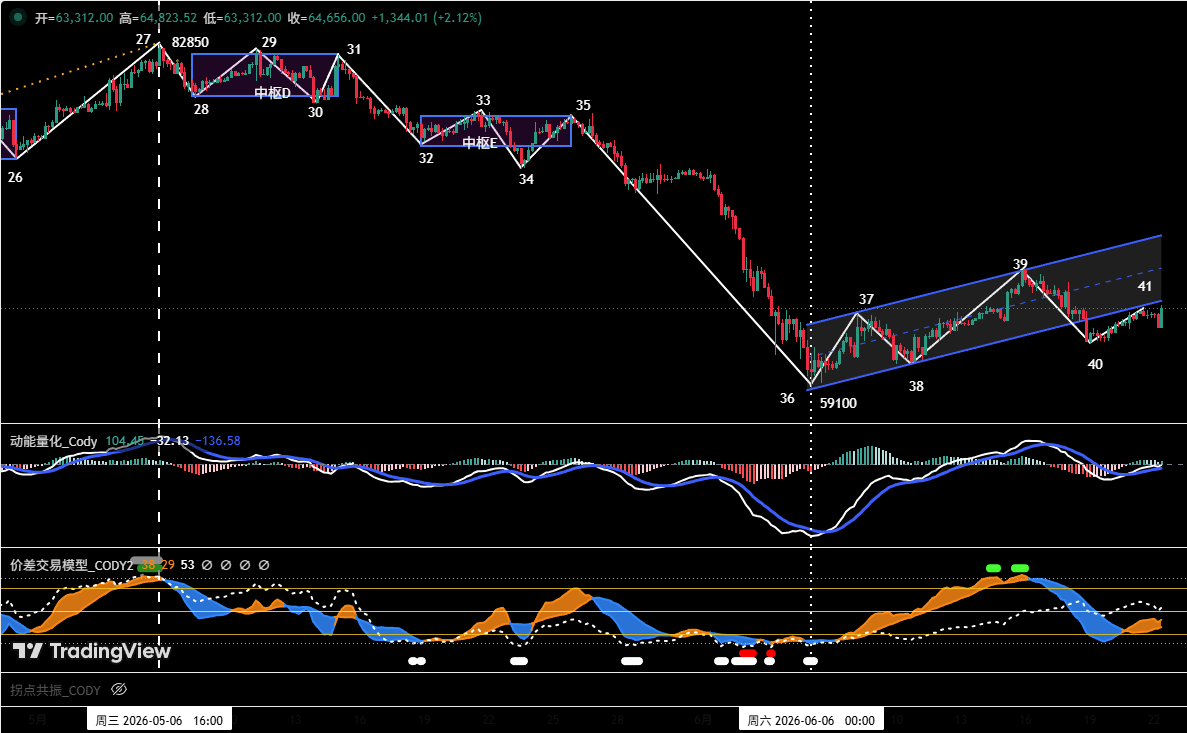
Figure 1
1 As shown in (Figure 1): From a 4-hour structural perspective, since the rebound initiated from the low of $59,100 on June 5th, the price action can be subdivided into a five-wave structure, corresponding sequentially to waves 36-37, 37-38, 38-39, 39-40, and 40-41.
2 The overall movement shows a short-term ascending channel pattern (blue channel in the chart): its upper boundary is formed by connecting the two rebound highs at (point 37) and (point 39), while the lower boundary is established by connecting the two correction lows at (point 36) and (point 38). The chart shows that the price has already broken below the channel's lower boundary at (point 40). The current rebound wave (40-41) can be seen as a stage of retesting and confirming the breakdown of the channel's lower boundary. If (point 41) cannot firmly regain a position above the channel's lower boundary, the probability of the price revisiting the previous support low of $59,100 will increase significantly.
二、Bitcoin Market Outlook and Trading Strategies for This Week
1、BTC Market Outlook for This Week:
Core View for the Week: Focus on the result of the price's retest and confirmation of the short-term channel's lower boundary.
- If it successfully holds above this level, the price may continue its rebound along the short-term ascending channel, potentially challenging the core resistance zone of $69,500~$70,500.
- If it breaks below effectively, the market may test the core support zone of $59,000~$60,000 once again.
2、Core Resistance Levels:
- First Resistance Zone: $64,500~$65,000 area (near the short-term ascending channel's lower boundary)
- Second Resistance Zone: $69,500~$70,500 area (previous high-volume consolidation area)
3、Core Support Levels:
- First Support Level: $59,000~$60,000 area (previous important support level)
- Second Support Level: Around $55,000 (previous significant support level)
4、Operational Strategies for This Week (Excluding the impact of unexpected news)
1 Medium-term Strategy:
Bitcoin _ Daily Candlestick Chart (Position Monitoring Model)
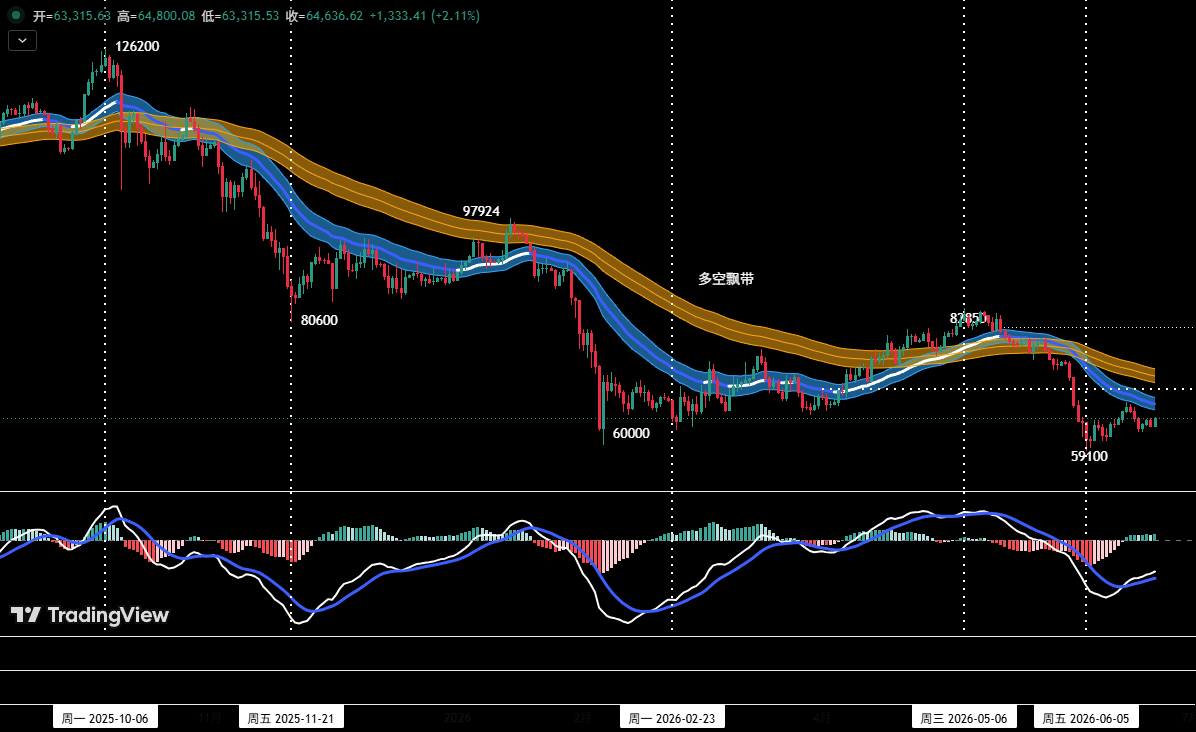
Figure 2
Position Monitoring Model: As shown in (Figure 2), the current price has effectively broken below the "Bull-Bear Channel," confirming a shift in market structure to a bear-dominated pattern. Following our established plan last week, we entered short positions near $64,500, with the initial medium-term position controlled at around 20% of total capital. We will follow stop-loss discipline going forward and await the next opportunity to add to the position.
2 Short-term Strategy: Utilize 30% of capital to seek "price differential" opportunities based on support and resistance levels, using 30-minute/60-minute cycles for operations, while setting stop-loss points.
3 In short-term operations, to dynamically respond to the market's complex evolution, we have pre-formulated three specific operational contingency plans: A/B/C.
Plan A: Tentative Positioning in Resistance Zone
- Entry: If the price rebounds to the $64,500~$65,000 zone showing signs of stalling, combined with quantitative model top signals, an initial short position of around 15% can be established.
- Risk Control: Set initial stop-loss.
- Exit: Gradually close the position to take profits when the price adjusts near important support levels combined with model signals.
Plan B: Adding to Position in Strong Resistance Zone
- Add: If the price breaks through the $65,000 resistance and continues to rebound to the $69,500~$70,500 zone, showing signs of pressure, combined with quantitative model top signals, the short position can be increased to within 30%.
- Risk Control: Set initial stop-loss.
- Exit: Gradually close the position to take profits when the price adjusts near important support levels combined with model signals.
Plan C: Effective Break of Support, Adding to Shorts Following the Trend
- Add: If the price effectively breaks below the $65,000 support, continues its adjustment, and loses the $59,000~$60,000 support zone, consider adding to the short position to within 30% when price shows signs of weakness during the retest/confirmation phase.
- Risk Control: Set initial stop-loss.
- Exit: Gradually close the position to take profits when the price declines to important support levels combined with model signals.
三、HYPE Hourly Chart Structure Analysis
HYPE_4-Hour Candlestick Chart
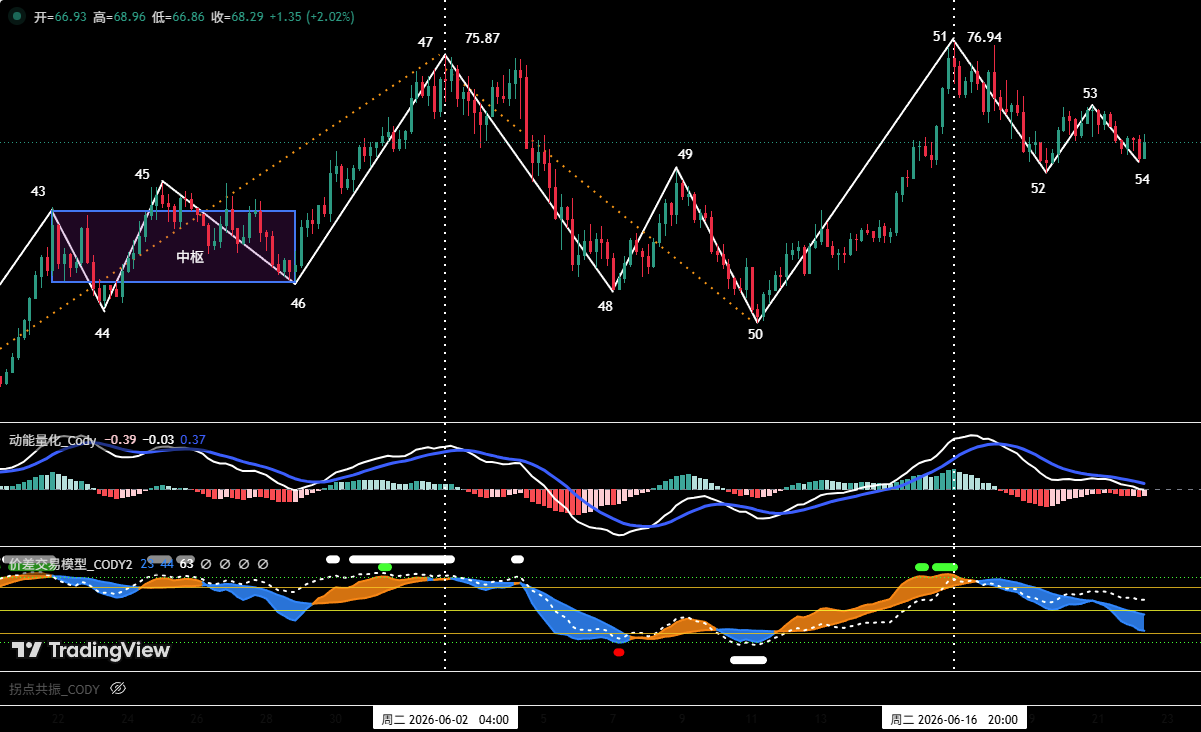
Figure 3
1 As shown in (Figure 3), on the 4-hour timeframe, HYPE started a correction from the high of $75.87 on June 2nd (point 47), explored down to around $52.62 on June 10th (point 50) where it stabilized, a correction lasting about 9 trading days. Following this, the market initiated a strong upward wave (wave 50-51), breaking the previous high in 6 trading days and setting a new high of $76.94 since the rally began in January, indicating continued strong bullish momentum.
2 The decline from the new high presents a clear three-wave corrective structure (51-52, 52-53, 53-54). The price has currently retreated again to the key support zone of $64~$66.
- Bullish Scenario: If the price finds effective support in this zone, the uptrend since (point 50) is likely to continue, with subsequent prices continuing to challenge new highs.
- Bearish Scenario: If this level is lost, the correction period will extend, and the price may test the core support band of $52~$54 again, which is the starting point of the previous uptrend.
四、HYPE Market Outlook and Short-Term Trading Strategy for This Week
1、HYPE Market Outlook for This Week:
1 Core Resistance Levels:
- First Resistance: Around $77
- Second Resistance Zone: $80~$82 area
2 Core Support Levels:
- First Support Zone: $64~$66 area
- Second Support Zone: $52~$54 area
Core View on HYPE for This Week:
- Observe the outcome of the battle between bulls and bears over the $64~$66 zone.
2、HYPE Short-Term Trading Strategy for This Week (Buy on Support)
Short-term trading in HYPE this week should follow the strategy of "buying on dips, avoiding chasing rallies."
Short-term Strategy: Testing Longs on Support Zone Stabilization
When HYPE price retests and shows signs of halting decline and stabilizing in the key support zones of $64~$66 or the deeper $52~$54, combined with bottom signals triggered by the two major models, consider lightly testing long positions. Position size must be controlled below 30%, and stop-loss discipline must be strictly adhered to.
五、Special Instructions:
- Upon Entry: Immediately set the initial stop-loss.
- When Profit Reaches 1%: Move the stop-loss to the entry price (breakeven point) to ensure capital safety.
- When Profit Reaches 2%: Move the stop-loss to the 1% profit level.
- Continuous Tracking: Thereafter, for every additional 1% profit, synchronously move the stop-loss up by 1%, dynamically protecting and locking in profits.
Financial markets are constantly changing. All market analysis and trading strategies require dynamic adjustment. All views, analytical models, and operational strategies mentioned in this article originate from personal technical analysis, are for personal trading log purposes only, and do not constitute any investment advice or operational basis. The market carries risks; investment requires caution. Do not make decisions based solely on this content.