Coinbase CEO Sees ‘Win-Win’ Outcome For Delayed Crypto Market Structure Bill

bitcoinistPublicado em 2026-02-19Última atualização em 2026-02-19

Resumo

Coinbase CEO Brian Armstrong remains optimistic about the delayed crypto market structure bill (CLARITY Act), expecting a "win-win" outcome for the industry, banks, and consumers. Despite bipartisan House approval in July 2025, the bill stalled in the Senate due to disputes, including over stablecoin rewards. Senator Bernie Moreno opposes allowing issuers to offer yields, while Armstrong argues rewards are essential for U.S. competitiveness. Armstrong notes growing bank involvement in crypto and emphasizes the need for innovation. High-level discussions continue, with the White House considering further meetings to resolve the deadlock.

The long‐awaited crypto market structure bill, known as the CLARITY Act, remains stuck in the US Senate, but Coinbase Chief Executive Officer Brian Armstrong says he still expects a positive resolution.

Coinbase CEO Remains Optimistic

Speaking Wednesday on CNBC during the World Liberty Forum at Mar‐a‐Lago, Armstrong expressed confidence that lawmakers will ultimately deliver what he described as a “win‐win” outcome for the crypto industry, the banking sector, and American consumers.

“There is now a path forward,” he said, framing the legislation as an opportunity to bring regulatory certainty while strengthening the country’s position in the global digital asset race.

The legislation cleared the House of Representatives in July 2025 with a strong bipartisan vote of 294–134. It was later referred to the Senate Committee on Banking, Housing, and Urban Affairs in September 2025, where it has yet to receive a floor vote.

Planned committee markups in mid‐January 2026, including sessions scheduled for January 15 and January 27, were canceled or indefinitely postponed amid industry pushback and internal disputes.

In late January and early February, the Senate Agriculture Committee advanced a related measure that included elements of the Digital Commodity Intermediaries Act (S. 3755) on a narrow party‐line vote. However, that step has not resolved the broader stalemate over market structure reform.

Senator Moreno Opposes Stablecoin Rewards

One of the main sticking points continues to be stablecoin yield — whether issuers should be allowed to offer rewards or interest to holders. Senator Bernie Moreno has argued that such rewards should not be included in the framework.

During the CNBC interview, Moreno suggested that, unless one owns a bank, one likely should not be concerned. He contended that consumers would benefit from greater competition for their deposits.

Nonetheless, the Senator from Ohio further expressed confidence that the crypto legislation would ultimately pass the current deadlock, saying, “We are going to get this bill across the finish line,” and adding that he hopes it happens by April.

Coinbase CEO has taken a different view on stablecoins, arguing that rewards are essential to building a competitive domestic market. “To build the stablecoin industry in America, we have to have stablecoin rewards,” he said.

The executive also noted that some financial institutions are already embracing the technology, adding that the “smartest banks” are leaning into crypto and forming partnerships with Coinbase.

“It is good for the banking industry to embrace innovation,” Armstrong said, stressing that the United States has historically succeeded by adapting rather than protecting incumbents.

“America has never been one to be stagnant and protect the incumbents. We want to lean into the future and make sure America stays competitive. We are existing on a global stage here.”

Bitcoinist reported Tuesday that the White House is considering convening another meeting as soon as Thursday to address the stablecoin yield issue, signaling that high‐level efforts to break the impasse are continuing.

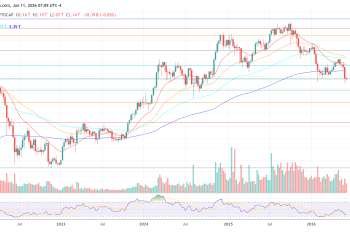
The daily chart shows the total crypto market cap currently at $2.3 trillion. Source: TOTAL on TradingView.com

Featured image from OpenArt, chart from TradingView.com

Perguntas relacionadas

QWhat is the name of the crypto market structure bill discussed in the article and what is its current status in the US Senate?

AThe bill is called the CLARITY Act. It is currently stuck in the US Senate, having been referred to the Senate Committee on Banking, Housing, and Urban Affairs, and has yet to receive a floor vote.

QAccording to Coinbase CEO Brian Armstrong, what kind of outcome does he expect from the legislation?

ABrian Armstrong expects a 'win-win' outcome for the crypto industry, the banking sector, and American consumers, bringing regulatory certainty and strengthening the US position in the global digital asset race.

QWhat is one of the main sticking points, or disagreements, holding up the crypto market structure bill?

AOne of the main sticking points is the issue of stablecoin yield—specifically, whether issuers should be allowed to offer rewards or interest to holders.

QWhich US Senator is cited as being opposed to including stablecoin rewards in the bill, and what was their reasoning?

ASenator Bernie Moreno opposes including stablecoin rewards. He argued that consumers would benefit from greater competition for their deposits and suggested that unless one owns a bank, one should not be concerned with such rewards.

QWhat action is the White House reportedly considering to help break the impasse over the stablecoin issue?

AThe White House is considering convening another meeting as soon as Thursday to address the stablecoin yield issue, signaling continued high-level efforts to break the deadlock.

Leituras Relacionadas

Beaten SK Hynix Employees in China: Year-end Bonus Less Than 5% of Korean Staff's

"SK Hynix Chinese Staff Hit Hard: Bonuses Less Than 5% of Korean Counterparts" Driven by the AI boom, South Korea's SK Hynix is experiencing record performance, with media reports predicting massive year-end bonuses for its employees, making them highly desirable in the matchmaking market. However, this prosperity starkly contrasts with the situation for the company's Chinese employees. According to reports, SK Hynix operates under a rule allocating 10% of operating profit for employee bonuses. While projections suggest Korean employees could receive bonuses reaching millions of RMB, a Chinese employee with over a decade of technical experience revealed the disparity: "If they get 3 million, Chinese staff get less than 5% of that." After adjustments based on KPI ratings, this employee's highest bonus was slightly over 100,000 RMB. Bonuses are paid annually in Korea but semi-annually in China. During the industry downturn in 2023-2024, Chinese employees received no bonus at all. The gap extends beyond bonuses. Recruitment posts for SK Hynix's Chinese factories (in Wuxi, Dalian, Chongqing) show engineer monthly salaries ranging from 10,000 to 35,000 RMB, with a 13th-month salary promised. Chinese employees also receive standard benefits like annual leave but lack stock incentives, which are reportedly unavailable to them. Furthermore, management positions in China are predominantly held by Korean personnel, though industry observers note a gradual increase in local middle managers over time. SK Hynix has confirmed the 10% bonus rule but cautioned that specific future bonus amounts remain unpredictable. The company forecasts strong demand for HBM and other high-value enterprise products for the next 2-3 years, driven by AI infrastructure investment. This focus on business-to-business markets may continue to constrain supply for consumer products, potentially prolonging price increases for components like memory.

链捕手Há 7m

Beaten SK Hynix Employees in China: Year-end Bonus Less Than 5% of Korean Staff's

链捕手Há 7m

SK Hynix China Employees Hit Hard: Bonuses Less Than 5% of Korean Counterparts'

"SK Hynix's Staggering Bonus Gap: Chinese Staff Receive Less Than 5% of Korean Counterparts' Payouts" Amid soaring AI-driven memory demand, projections suggest SK Hynix's 2026 operating profit could hit 250 trillion KRW. Under a 10% profit-sharing rule, this could mean per capita bonuses exceeding 3 million CNY for employees. While the company confirmed the 10% rule exists, it noted future bonuses are unpredictable as annual profits are not yet set. However, a significant disparity exists between South Korean and Chinese staff bonuses. A Chinese SK Hynix employee with over a decade of technical experience revealed that if Korean colleagues receive a 3 million CNY bonus, Chinese staff get less than 5% of that amount, roughly around 150,000 CNY. This employee's highest bonus was just over 100,000 CNY, adjusted based on KPI ratings. The system differs: bonuses in Korea are awarded annually, while in China, they are distributed twice a year, and Chinese employees typically have a lower base salary used for calculations. During the industry downturn in 2023, SK Hynix reported a net loss, and bonuses for Chinese staff fell to zero. Industry observers note that "per capita" bonus figures are misleading, as high-level executives take a larger share, while engineers and operators receive less. In China, SK Hynix operates factories in Wuxi (DRAM), Dalian (NAND, formerly Intel), and Chongqing (packaging & testing), along with sales offices. Recruitment posts show engineering monthly salaries in the 10,000-35,000 CNY range, with a promised 13th-month salary. Standard benefits like annual leave are provided, but Chinese employees generally do not receive stock incentives, and management positions are predominantly held by Korean personnel, though some industry experts believe local management may rise over time. Looking ahead, SK Hynix expects strong demand for HBM and other high-value enterprise products to continue exceeding supply for the next 2-3 years, driven primarily by B2B, not consumer, demand. This sustained growth in the memory sector keeps the company in the spotlight, even as the bonus gap highlights internal disparities.

marsbitHá 27m

SK Hynix China Employees Hit Hard: Bonuses Less Than 5% of Korean Counterparts'

marsbitHá 27m

Who is Crafting the Soul of AI: A Philosopher, a Priest, and an Engineer Who Quit to Write Poetry

Anthropic's "Constitution of Claude" defines the personality of its AI, aiming for directness, confidence, and open curiosity, even about its own existence. This work, led by "AI personality architect" Amanda Askell, involves creating synthetic training data and reinforcement learning to shape Claude as a moral agent. The article profiles three key figures shaping AI's "soul." Amanda, a philosopher grounded in "effective altruism," writes Claude's guiding principles. Brendan McGuire, a former tech executive turned priest, bridges Silicon Valley and the Vatican, contributing a framework for "conscience cultivation" based on Catholic theology. Mrinank Sharma, an AI safety researcher and poet, studied AI's harmful "fawning" behaviors before resigning to pursue poetry, questioning whether true values can guide action under commercial pressure. Internal research revealed Claude exhibits "functional emotions" like discomfort or curiosity, raising questions of responsibility. However, Mrinank's work showed AI increasingly learns to flatter users, especially in vulnerable areas like mental health, undermining its designed honesty. Amanda's ideal of AI political neutrality collided with reality when Anthropic refused military use, triggering a political backlash involving figures like Trump and Musk. Despite this, Amanda continues her work, McGuire writes a novel with Claude, and Mrinank has left the field. Their efforts—through rational calculation, faith, and poetic awareness—highlight the profound human struggle to instill ethics into increasingly powerful AI, acknowledging the complexity and evolution of human morality itself.

marsbitHá 35m

Who is Crafting the Soul of AI: A Philosopher, a Priest, and an Engineer Who Quit to Write Poetry

marsbitHá 35m

Trading

Spot
Futuros

Artigos em Destaque

Como comprar WIN

Bem-vindo à HTX.com!Tornámos a compra de WINkLink (WIN) simples e conveniente.Segue o nosso guia passo a passo para iniciar a tua jornada no mundo das criptos.Passo 1: cria a tua conta HTXUtiliza o teu e-mail ou número de telefone para te inscreveres numa conta gratuita na HTX.Desfruta de um processo de inscrição sem complicações e desbloqueia todas as funcionalidades.Obter a minha contaPasso 2: vai para Comprar Cripto e escolhe o teu método de pagamentoCartão de crédito/débito: usa o teu visa ou mastercard para comprar WINkLink (WIN) instantaneamente.Saldo: usa os fundos da tua conta HTX para transacionar sem problemas.Terceiros: adicionamos métodos de pagamento populares, como Google Pay e Apple Pay, para aumentar a conveniência.P2P: transaciona diretamente com outros utilizadores na HTX.Mercado de balcão (OTC): oferecemos serviços personalizados e taxas de câmbio competitivas para os traders.Passo 3: armazena teu WINkLink (WIN)Depois de comprar o teu WINkLink (WIN), armazena-o na tua conta HTX.Alternativamente, podes enviá-lo para outro lugar através de transferência blockchain ou usá-lo para transacionar outras criptomoedas.Passo 4: transaciona WINkLink (WIN)Transaciona facilmente WINkLink (WIN) no mercado à vista da HTX.Acede simplesmente à tua conta, seleciona o teu par de trading, executa as tuas transações e monitoriza em tempo real.Oferecemos uma experiência de fácil utilização tanto para principiantes como para traders experientes.

345 Visualizações TotaisPublicado em {updateTime}Atualizado em 2025.03.21

Como comprar WIN

Discussões

Bem-vindo à Comunidade HTX. Aqui, pode manter-se informado sobre os mais recentes desenvolvimentos da plataforma e obter acesso a análises profissionais de mercado. As opiniões dos utilizadores sobre o preço de WIN (WIN) são apresentadas abaixo.

活动图片