CME Group to Launch Own Digital Token and 24/7 Crypto Trading: Is $HYPER the Next Major Listing?

bitcoinistPublicado em 2026-02-05Última atualização em 2026-02-05

Resumo

CME Group, the world's largest derivatives exchange, is reportedly developing its own digital token to enable near-instant collateral movement and 24/7 trading, signaling a major shift in institutional finance. This move highlights the limitations of traditional settlement systems and emphasizes the need for high-speed blockchain infrastructure. Bitcoin Hyper ($HYPER) emerges as a key solution, serving as a high-performance Bitcoin Layer 2 that integrates Solana Virtual Machine (SVM) for sub-second transactions while leveraging Bitcoin’s security. It aims to support institutional demand for scalable liquidity and decentralized financial applications. The project has raised over $31M in its presale, with significant whale accumulation, indicating strong investor confidence. Staking mechanisms encourage long-term holding, positioning $HYPER as a potential infrastructure backbone for Bitcoin’s evolving ecosystem.

The line between traditional finance and the decentralized economy is blurring faster than regulators can keep up.

CME Group, the world’s largest derivatives exchange, is reportedly exploring the launch of its own digital token, signaling a fundamental shift in institutional market structure. The objective? Near-instant collateral movement to support 24/7 trading.

Crypto natives take this for granted, but for legacy institutions shackled by banking hours, it’s the holy grail.

It’s less about the token itself and more about what it unlocks. By tokenizing collateral, CME is effectively admitting that the existing plumbing of global finance, T+1 settlement cycles, and weekend closures, is cooked. The risk for traditional banks is real.

If a derivatives giant builds its own settlement rails, who needs intermediary clearing banks? Smart money is watching this not just as an infrastructure upgrade, but as a tacit endorsement of blockchain efficiency at the highest level of finance.

While CME focuses on the trading layer, a critical bottleneck remains on the execution layer of the world’s most valuable asset: Bitcoin itself. As institutions demand 24/7 liquidity, pressure mounts on Bitcoin’s network to handle high-frequency volume.

Frankly, the base layer’s 10-minute block times can’t support this throughput alone. That infrastructure gap triggered a rush into high-performance Layer 2 solutions. Leading the charge? Bitcoin Hyper ($HYPER), a protocol explicitly engineered to bring high-speed execution to the Bitcoin ecosystem, is positioning itself as the potential engine room for this new era of institutional liquidity.

Bitcoin Hyper Bridges The Gap Between Security And Speed

The narrative dominating this cycle isn’t just buying Bitcoin, it’s making it productive. CME Group handles how institutions trade; Bitcoin Hyper handles how the asset functions. As the first Bitcoin Layer 2 to integrate the Solana Virtual Machine (SVM), the project attempts to solve a decade-old trilemma: maintaining Bitcoin’s security while hitting the sub-second finality modern DeFi demands.
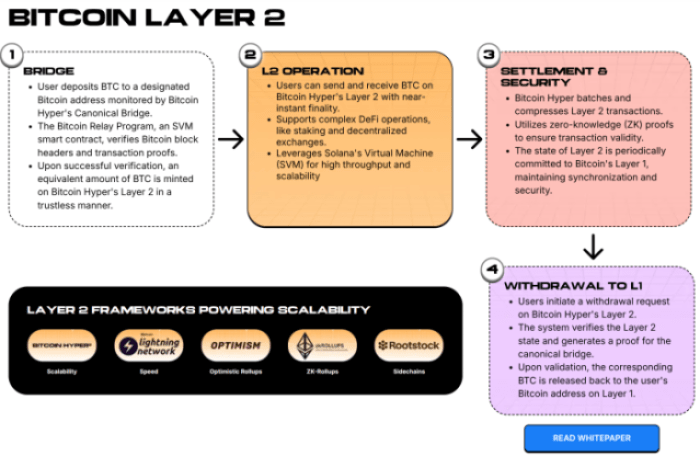
That convergence matters. It allows developers to write smart contracts in Rust, the language of choice for high-performance dApps, while anchoring final settlement on Bitcoin. Think of it as a shift from ‘digital gold’ to ‘digital oil.’

Using a modular blockchain architecture with a single trusted sequencer and periodic L1 state anchoring, Bitcoin Hyper delivers transaction speeds that reportedly outpace Solana itself, all while keeping gas fees negligible. Want a full breakdown of how it works? We’ve got you covered in our ‘What is Bitcoin Hyper‘ guide.

For an institutional market eyeing 24/7 trading, this utility is non-negotiable. A decentralized canonical bridge facilitates seamless $BTC transfers, allowing for the creation of wrapped $BTC payment rails and complex lending protocols that don’t rely on centralized custodians. The data points to a clear trend: as capital flows into Bitcoin via ETFs and futures, the demand for a scalable application layer (L2) creates an asymmetric opportunity for infrastructure plays like $HYPER.

EXplore the $HYPER presale

Smart Money Flows Into $HYPER Presale As Whales Accumulate

While legacy markets wait for regulatory clarity on CME’s potential token, on-chain metrics suggest crypto-native liquidity is already front-running the L2 narrative. Bitcoin Hyper has picked up serious steam, with the official presale raising over $31M to date. That level of capital injection hints at high conviction from investors looking for beta plays on Bitcoin’s success.

The current token price of $0.0136751 offers a low entry barrier relative to the roadmap. Whales are taking notice. Check the chain: Etherscan records show 3 whale wallets accumulated over $1M with the largest buy at $500K. High-net-worth individuals are positioning themselves before the token hits open markets.

It’s not just raw capital inflows—the protocol’s staking mechanics are driving retention too. Investors can snag high APY rewards immediately after the Token Generation Event (TGE), with a modest 7-day vesting period for presale stakers.

This structure encourages long-term holding over quick flips, aligning community interests with protocol stability. With the Bitcoin ecosystem evolving from a passive store of value to an active financial layer, projects that can successfully merge speed (SVM) with security (BTC) are likely to capture the lion’s share of developer activity.

HOP ON THE $HYPER TRAIL HERE

This article is for informational purposes only and does not constitute financial advice. Cryptocurrency investments carry inherent risks, including volatility and market unpredictability. Always conduct your own due diligence.


Perguntas relacionadas

QWhat is the primary objective behind CME Group's reported exploration of launching its own digital token?

AThe primary objective is to enable near-instant collateral movement to support 24/7 trading, addressing the limitations of traditional banking hours and settlement cycles.

QAccording to the article, which Bitcoin Layer 2 solution is positioning itself to handle high-speed execution for institutional liquidity?

ABitcoin Hyper ($HYPER) is the Bitcoin Layer 2 solution explicitly engineered to bring high-speed execution to the Bitcoin ecosystem and is positioning itself for this role.

QWhat key technological feature does Bitcoin Hyper ($HYPER) integrate to achieve high performance while maintaining security?

ABitcoin Hyper integrates the Solana Virtual Machine (SVM), allowing developers to write high-performance smart contracts in Rust while anchoring final settlement on the secure Bitcoin blockchain.

QHow much capital has the Bitcoin Hyper ($HYPER) presale raised to date, as mentioned in the article?

AThe official Bitcoin Hyper presale has raised over $31 million to date.

QWhat is one way the $HYPER tokenomics encourages long-term holding rather than short-term speculation?

AThe protocol's staking mechanics offer high APY rewards immediately after the Token Generation Event (TGE) with a modest 7-day vesting period for presale stakers, which encourages long-term holding.

Leituras Relacionadas

In-Depth Report on the On-Chain Lending Market: When Off-Chain Credit Meets On-Chain Liquidation

The on-chain lending market has evolved from a peripheral DeFi niche into core financial infrastructure. As of early 2026, total value locked (TVL) in on-chain lending protocols has reached $64.3 billion, accounting for 53.54% of total DeFi TVL, making it the largest and most mature vertical within decentralized finance. Aave dominates the sector with approximately $32.9 billion in TVL, commanding nearly half of the market—a leadership position that is unlikely to be challenged in the foreseeable future. However, the path of on-chain lending forward is not without risk. Liquidation cascades, credit defaults, and cross-chain vulnerabilities remain systemic threats hanging over the industry. At the same time, a deeper structural transformation is underway: on-chain lending is shifting from a “leverage tool for crypto-native users” to a “compliant gateway for institutional capital”. The scale of RWA (Real World Asset) lending has surpassed $18.5 billion, with U.S. Treasuries and government securities increasingly serving as core collateral. Institutional capital inflows are reshaping both the user base and risk appetite of the sector. This report systematically analyzes the evolution of on-chain lending definitions, competitive dynamics, core risks, and future trends, providing a comprehensive industry outlook for investors and trade practitioners. Key findings suggest that the “one dominant player with several strong challengers” structure will persist in the short term, while fixed-rate lending, compliant collateral, and institutional credit underwriting will define the next phase of competition. For investors focused on DeFi infrastructure, three key opportunity tracks stand out, namely, the Aave ecosystem (Morpho, Spark), RWA lending protocols (Ondo, Maple) and fixed-rate innovation (Notional, Pendle).

HTX LearnHá 4m

In-Depth Report on the On-Chain Lending Market: When Off-Chain Credit Meets On-Chain Liquidation

HTX LearnHá 4m

Fu Peng's First Public Speech in 2026: What Exactly Are Crypto Assets? Why Did I Join the Crypto Asset Industry?

Fu Peng, a renowned macroeconomist and now Chief Economist at New火 Group, delivered his first public speech of 2026 at the Hong Kong Web3 Festival. He explained his perspective on crypto assets and why he joined the industry, framing it within the context of macroeconomic trends and financial evolution. Fu emphasized that crypto assets are transitioning from an early, belief-driven phase to a mature, institutionally integrated asset class. He drew parallels to the 1970s-80s, when technological advances (like computing) revolutionized traditional finance, leading to the rise of FICC (Fixed Income, Currencies, and Commodities). Similarly, current advancements in AI, data, and blockchain are reshaping finance, with crypto assets becoming part of a new "FICC + C" (C for Crypto) framework. He noted that institutional capital, including traditional hedge funds, avoided early crypto due to its speculative nature but are now engaging as regulatory clarity emerges (e.g., stablecoin laws, CFTC classifying crypto as a commodity). Fu predicted that 2025-2026 marks a turning point where crypto becomes a standardized, financially viable asset for diversified portfolios, akin to commodities or derivatives in traditional finance. Fu defined Bitcoin not as "digital gold" in a simplistic sense but as a value-preserving, financially tradable asset. He highlighted that crypto's future lies in regulated, institutional adoption, moving away from retail-dominated trading. His entry into crypto signals this maturation, where traditional finance integrates crypto into mainstream asset management.

marsbitHá 1h

Fu Peng's First Public Speech in 2026: What Exactly Are Crypto Assets? Why Did I Join the Crypto Asset Industry?

marsbitHá 1h

Justin Sun Sues Trump Family: What $75 Million Bought Was Only a Blacklist

Justin Sun, founder of Tron, has filed a lawsuit in federal court against World Liberty Financial (WLF), alleging he was made the "primary target of a fraudulent scheme" after investing $75 million. Sun claims the investment secured him an advisor title and WLFI tokens, which were later frozen by WLF, causing "hundreds of millions in losses." The dispute began in late 2024 when Sun's investment helped revive WLF's struggling token sale, which ultimately raised $550 million. Shortly after, the SEC dropped its lawsuit against Sun following Donald Trump's inauguration. However, relations soured when Sun refused WLF's demands for additional funding. In August 2025, WLF added a "blacklist" function to its smart contract, allowing it to unilaterally freeze tokens. Sun's holdings, worth approximately $107 million, were frozen, and he was threatened with token destruction. The lawsuit highlights WLF's structure, which directs 75% of token sale profits to the Trump family, who had earned $1 billion by December 2025. WLF's CEO is Zach Witkoff, son of U.S. Middle East envoy Steve Witkoff. The project faces scrutiny for opaque operations, including a controversial loan arrangement on the Dolomite platform, co-founded by a WLF advisor. Despite Sun's history with the SEC, the case underscores centralization risks within DeFi, as WLF controls governance and holds powers to freeze assets arbitrarily. Sun's tokens remain frozen as legal proceedings begin.

marsbitHá 1h

Justin Sun Sues Trump Family: What $75 Million Bought Was Only a Blacklist

marsbitHá 1h

Trading

Spot
Futuros

Artigos em Destaque

Como comprar F

Bem-vindo à HTX.com!Tornámos a compra de Synfutures (F) simples e conveniente.Segue o nosso guia passo a passo para iniciar a tua jornada no mundo das criptos.Passo 1: cria a tua conta HTXUtiliza o teu e-mail ou número de telefone para te inscreveres numa conta gratuita na HTX.Desfruta de um processo de inscrição sem complicações e desbloqueia todas as funcionalidades.Obter a minha contaPasso 2: vai para Comprar Cripto e escolhe o teu método de pagamentoCartão de crédito/débito: usa o teu visa ou mastercard para comprar Synfutures (F) instantaneamente.Saldo: usa os fundos da tua conta HTX para transacionar sem problemas.Terceiros: adicionamos métodos de pagamento populares, como Google Pay e Apple Pay, para aumentar a conveniência.P2P: transaciona diretamente com outros utilizadores na HTX.Mercado de balcão (OTC): oferecemos serviços personalizados e taxas de câmbio competitivas para os traders.Passo 3: armazena teu Synfutures (F)Depois de comprar o teu Synfutures (F), armazena-o na tua conta HTX.Alternativamente, podes enviá-lo para outro lugar através de transferência blockchain ou usá-lo para transacionar outras criptomoedas.Passo 4: transaciona Synfutures (F)Transaciona facilmente Synfutures (F) no mercado à vista da HTX.Acede simplesmente à tua conta, seleciona o teu par de trading, executa as tuas transações e monitoriza em tempo real.Oferecemos uma experiência de fácil utilização tanto para principiantes como para traders experientes.

231 Visualizações TotaisPublicado em {updateTime}Atualizado em 2025.03.21

Como comprar F

Discussões

Bem-vindo à Comunidade HTX. Aqui, pode manter-se informado sobre os mais recentes desenvolvimentos da plataforma e obter acesso a análises profissionais de mercado. As opiniões dos utilizadores sobre o preço de F (F) são apresentadas abaixo.

活动图片