Circle moves toward privacy-focused stablecoin with USDCx project

cointelegraphPublicado em 2025-12-09Última atualização em 2025-12-09

Resumo

Circle is developing a privacy-enhanced version of its USDC stablecoin, called USDCx, in partnership with blockchain firm Aleo. Aimed at banking and enterprise users, USDCx will offer "banking-level privacy" by concealing transaction details onchain, while still allowing compliance with regulatory requests. This addresses a key hurdle for institutional adoption, as many financial firms hesitate to use public blockchains due to transparency concerns. The move comes amid growing corporate interest in stablecoins following the US GENIUS Act, with major players like Citigroup, JPMorgan, and Visa expanding their stablecoin initiatives. USDC and USDT currently dominate the dollar-pegged stablecoin market.

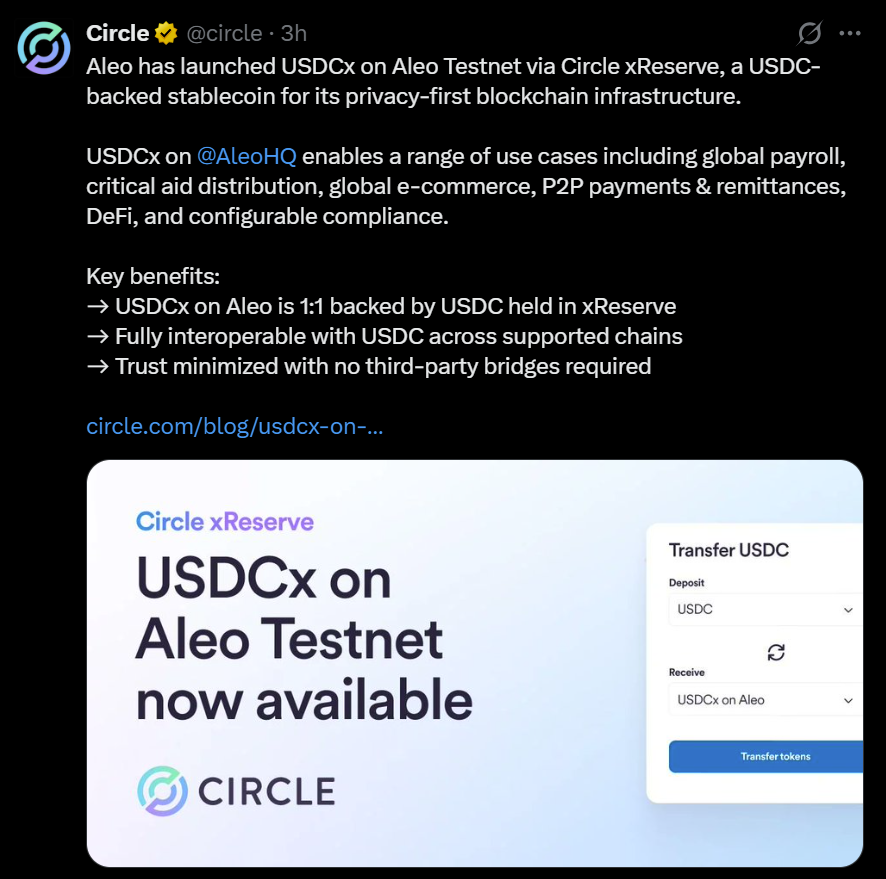
Stablecoin issuer Circle is developing a privacy-enhanced version of its US dollar-pegged USDC token, aiming to spur institutional adoption by offering greater confidentiality than traditional public blockchains allow.

The new stablecoin, called USDCx and targeting banking and enterprise users, is being built in partnership with the privacy-focused blockchain company Aleo, Fortune reported on Tuesday, citing Aleo co-founder Howard Wu.

Unlike most existing stablecoins, which have wallet addresses and transaction details fully visible onchain, USDCx is designed to provide “banking-level privacy.” Circle would still be able to provide a compliance record if law enforcement or regulators request information on specific transactions, according to the report.

The initiative aims to address a key hurdle for major financial institutions, many of which have been hesitant to utilize blockchain-based payment rails because their transaction flows would be publicly visible.
Source: Circle

Aleo has long argued that privacy is essential for the next phase of stablecoin adoption. In a May post, the company wrote that while transparency is often promoted as a core blockchain advantage, “it becomes a liability when dealing with sensitive, confidential payment data.”

Aleo isn’t the only company pushing for privacy in stablecoins. As Cointelegraph reported, digital asset infrastructure provider Taurus has developed a private smart-contract system for stablecoins, designed to enable anonymous transactions. This approach aims to boost the use of stable assets for intracompany payments and employee payrolls.

Related: Bank lobby is ‘panicking’ about yield-bearing stablecoins

Stablecoins take center stage in corporate America

Circle’s move into privacy-focused stable assets comes as more major institutions begin exploring stablecoins in the wake of the US GENIUS Act, the new regulatory framework governing US dollar–pegged tokens.

As Cointelegraph reported, a corporate stablecoin race is emerging in the wake of GENIUS. Citigroup has partnered with Coinbase to test stablecoin-based payment rails for its clients, while other Wall Street companies, including JPMorgan and Bank of America, are reportedly in the early stages of experimenting with similar technologies.

Global remittance provider Western Union is also building a digital asset settlement system on Solana, with plans to introduce a US Dollar Payment Token as part of its infrastructure overhaul. Meanwhile, global payments giant Visa has expanded its stablecoin offerings amid growing competition in the space.
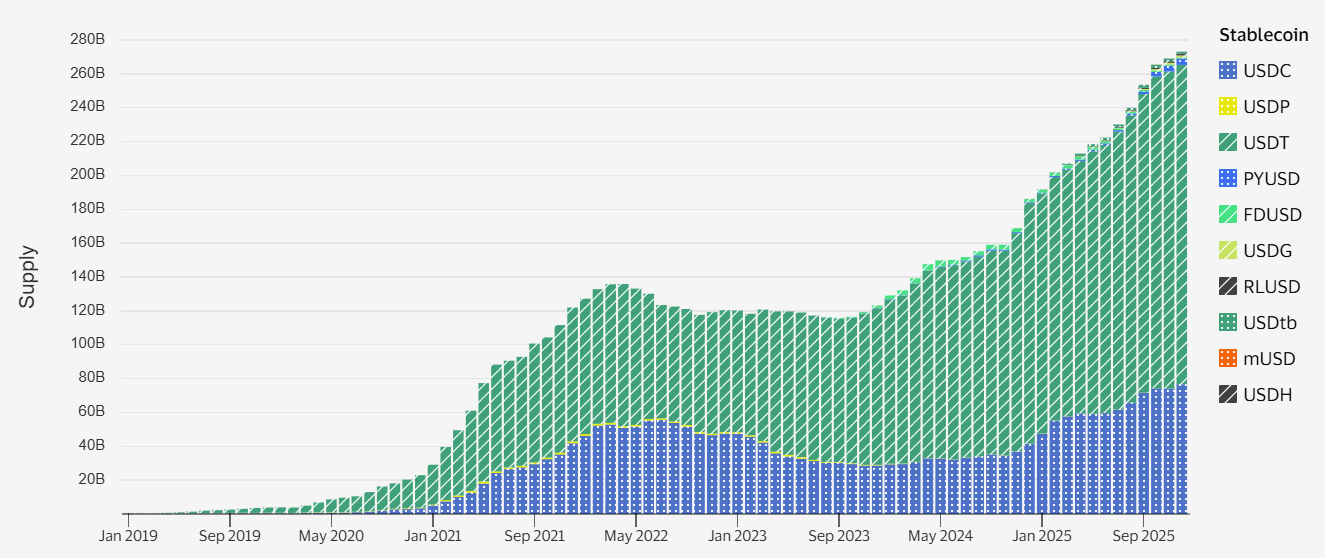
Average stablecoin supply by issuer. Source: Visa Onchain Analytics

The US dollar underpins the vast majority of global stablecoin activity. USDC (USDC) and Tether’s USDt (USDT) together account for roughly 85% of the market, while other dollar-linked tokens, including synthetic dollars and PayPal USD (PYUSD), also rank among the largest.

Related: Crypto Biz: Wall Street giants bet on stablecoins

Leituras Relacionadas

From Robinhood to Polymarket: Is the Era of Integrating All Assets on a Single Platform Coming?

From Robinhood to Polymarket: The Era of All-in-One Asset Platforms Is Coming Asset classes are rapidly converging. Platforms that once specialized in single categories—such as stocks, cryptocurrencies, or prediction markets—are now moving toward offering all three. Robinhood pioneered this model, starting with equities, adding crypto in 2018, and prediction markets in 2025. This strategy has proven resilient: when crypto revenues fell, other segments like options and stocks filled the gap. Now, prediction market leaders Polymarket and Kalshi are moving in the same direction, both announcing perpetual futures trading on April 21, 2026, pending regulatory approval. These futures will cover assets like Bitcoin, gold, and stocks such as Nvidia. This trend mirrors the consolidation seen in consumer tech, like smartphones replacing dedicated cameras and MP3 players. Younger users, accustomed to interacting with multiple asset types from an early age, will increasingly demand unified platforms. A key competitive advantage in prediction markets is collateral utilization—idle assets locked during betting periods. Polymarket’s move into perpetuals may be a strategy to generate yield from that capital, similar to earlier DeFi integrations like PolyAave. As the regulatory landscape evolves, traditional finance is also likely to incorporate crypto and prediction markets, further accelerating this convergence.

marsbitHá 17m

From Robinhood to Polymarket: Is the Era of Integrating All Assets on a Single Platform Coming?

marsbitHá 17m

OpenAI Goes Left, DeepSeek Goes Right

On April 24, 2026, DeepSeek released V4, a Chinese large language model offering a free "million-token context window," enabling it to process vast amounts of data like entire books or years of corporate documents in one go. In contrast, OpenAI’s GPT-5.5, released around the same time, is more powerful but significantly more expensive, charging up to $180 per million output tokens. DeepSeek’s strategy represents a shift from a pure AI research firm to a heavy-infrastructure player, building data centers in Inner Mongolia’s Ulanqab to bypass U.S. chip export restrictions. This move, supported by Huawei’s Ascend chips and China’s cheap green electricity, highlights a fundamental divergence in AI development models: U.S. firms focus on high-cost, high-margin services, while Chinese players like DeepSeek prioritize accessibility and affordability. Facing intense talent poaching from tech giants, DeepSeek is seeking a $44 billion valuation funding round to retain researchers and scale infrastructure. Meanwhile, Chinese manufacturers are compressing AI models to run on smartphones, making AI accessible offline and across the Global South. Through open-source models and localized solutions, Chinese AI is empowering non-English speakers and low-income users, driving a form of "digital equality." While Silicon Valley builds walled gardens, DeepSeek and others are turning AI into a public utility—like tap water—flowing freely to those previously left behind.

marsbitHá 43m

OpenAI Goes Left, DeepSeek Goes Right

marsbitHá 43m

$292 Million KelpDAO Cross-Chain Bridge Hack: Who Should Foot the Bill?

On April 18, 2026, an attacker stole 116,500 rsETH (worth ~$292M) from KelpDAO’s cross-chain bridge in 46 minutes—the largest DeFi exploit of 2026. The stolen assets were deposited into Aave V3 as collateral, causing $177–200M in bad debt and triggering a cascade of losses across nine DeFi protocols. Aave’s TVL dropped by ~$6B overnight. This legal analysis argues that KelpDAO and LayerZero Labs share concurrent liability, with fault apportioned 60%/40%. KelpDAO negligently configured its bridge with a 1-of-1 decentralized verifier network (DVN)—a single point of failure—despite LayerZero’s explicit recommendation of a 2-of-3 setup. LayerZero, which operated the compromised DVN, failed to secure its RPC infrastructure against a known poisoning attack vector. Both protocols’ terms of service cap liability at $200 (KelpDAO) or $50 (LayerZero), but these limits are likely unenforceable due to unconscionability, gross negligence exceptions, and potential securities law invalidation (if rsETH is deemed a security under the Howey test). Aave’s governance also faces fiduciary duty claims for raising rsETH’s loan-to-value ratio to 93%—far above competitors’ 72–75%—without adequately assessing bridge risks, amplifying the systemic fallout. Practical recovery targets include LayerZero Labs (a registered Canadian entity), KelpDAO’s founders, auditors, and identifiable Aave governance delegates. The incident underscores escalating legal risks for DeFi protocols, infrastructure providers, and governance participants.

marsbitHá 1h

$292 Million KelpDAO Cross-Chain Bridge Hack: Who Should Foot the Bill?

marsbitHá 1h

Trading

Spot
Futuros
活动图片




