Cash App Adds XRP, SOL, and ETH via Moonpay for 59 Million Users

cryptonews.ruPublicado em 2026-08-19Última atualização em 2026-08-19

Resumo

Cash App has integrated Cash App Pay into the MoonPay system, allowing eligible U.S. users to purchase XRP, Solana (SOL), Ether (ETH), and USDT directly from their Cash App balance. This integration is notable as Block, Cash App's parent company, has never directly listed these tokens within its own app; MoonPay handles the purchases and can send the assets to a user's external wallet of choice. This move effectively provides Cash App's 59 million active users access to a broader range of cryptocurrencies without the app needing to build its own listing and custody infrastructure for each asset. Cash App Pay becomes the third major payment method on MoonPay, joining PayPal and Venmo. After purchase, tokens can be sent to various external wallets, including Trust Wallet, MetaMask, and Ledger. MoonPay's co-founder noted the integration is a market expansion, giving tens of millions of users instant access to the digital asset ecosystem from a trusted app they already use. The integration also marks another step in expanding XRP's presence in mainstream financial apps in 2026, following earlier additions to platforms like SoFi and Rakuten Wallet. This development occurs after Block faced regulatory scrutiny, including a $40 million fine from New York regulators for past shortcomings in transaction monitoring within Cash App.

Cash App has integrated Cash App Pay as a payment method within the Moonpay system, allowing eligible U.S. users to purchase $XRP, Solana, Ether, and USDT by directing payment directly from their Cash App balance.

This move is notable because Block, Cash App's parent company, has never included these tokens directly in its app; instead, MoonPay handles the purchase and can send the assets to an external wallet of the user's choice. Thus, Cash App customers can now access tokens that the platform itself has never supported.
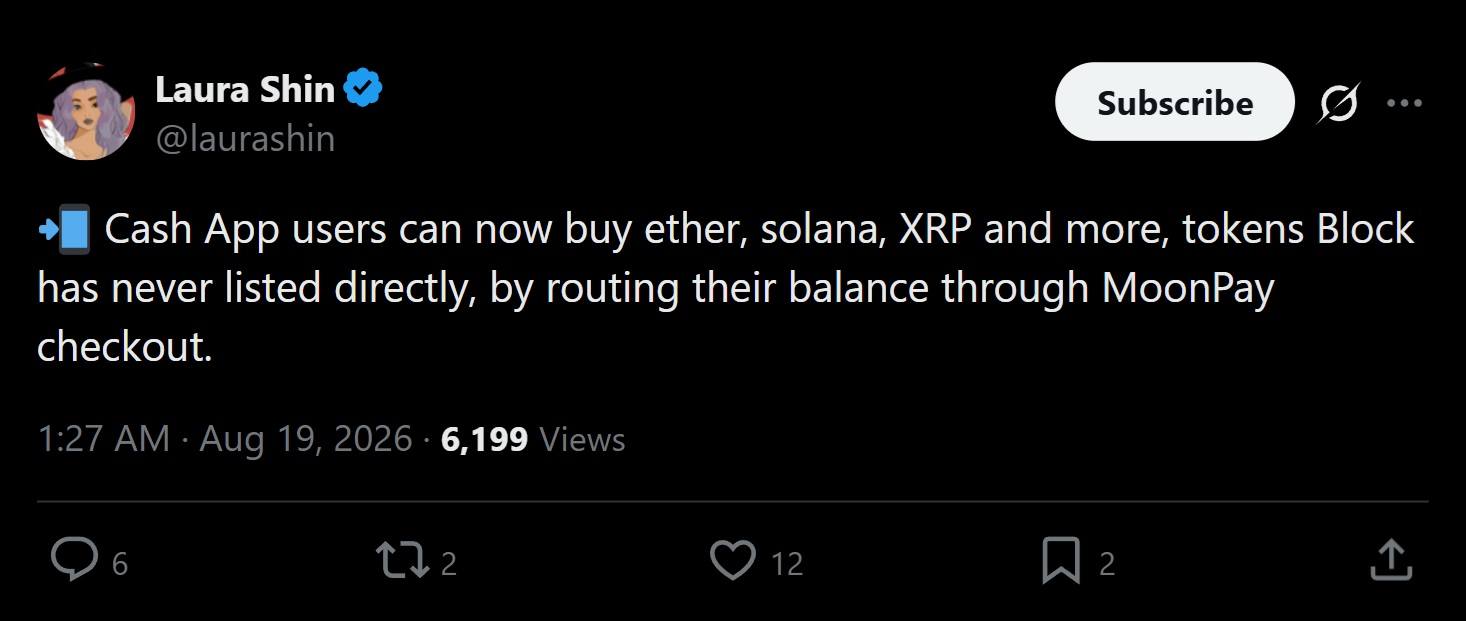
Image source: X

Bitcoin.com News has closely followed Cash App's cryptocurrency features over the years—from the launch of the "Paid in Bitcoin" paycheck conversion feature to BTC round-up tools and receiving payments via Lightning Network. However, until now, direct cryptocurrency purchases in Cash App have been limited to Bitcoin, with USDC only added earlier this year.

Consequently, the integration with Moonpay effectively allows Cash App to offer a much wider selection of tokens without needing to build its own infrastructure for listing and storing each asset.

Cash App Pay Joins a Growing List of Funding Methods

Cash App Pay is now the third major payment method supported by Moonpay for funding cryptocurrency purchases, joining PayPal, added in 2024, and Venmo. After completing a purchase, Moonpay can deliver tokens to a range of external wallets, including Trust Wallet, Bitcoin.com, Metamask, Moonshot, Ledger, Bitpay, Uniswap, Tangem, LOBSTR, and Edge, providing tens of millions of Cash App users with direct access to self-custody wallets, rather than holding funds within the Cash App itself.

Moonpay Co-founder and CEO Ivan Soto-Wright described this integration not so much as a product update but as a step to expand the market, adding:

"Cash App is an app where tens of millions of Americans already manage their money. This integration means those users will gain access to the digital asset ecosystem, funding accounts instantly from an app they already know and trust."

Given that as of June, Cash App has 59 million active users, this integration provides Moonpay with one of the country's largest fintech user bases as a channel for cryptocurrency purchases.

Growing List of Major Access Channels for $XRP

This innovation is also the latest example of expanding $XRP's presence in mainstream financial apps in 2026. Earlier this year, SoFi added support for $XRP deposits, with Ripple positioning the move as part of broader efforts to give more users direct access and practical utility.

$XRP also appeared in Rakuten Wallet, making it accessible to over 5 million merchants in Japan through that integration. Each new access channel adds a mass distribution channel independent of any single cryptocurrency exchange—a trend that began with the Moonpay integration in Cash App and is now extending to one of the largest peer-to-peer payment apps in the U.S.

Finally, it's worth noting that this expansion comes after a period that has not been entirely smooth for Cash App in terms of cryptocurrency regulatory compliance. Prior to this, Block was fined $40 million by New York regulators for violations related to monitoring Bitcoin and fiat currency transactions within Cash App, including reports that the company ignored approximately 169,000 warnings of misconduct.

end-content

Criptomoedas em alta

Perguntas relacionadas

QWhat significant feature has Cash App integrated, and which payment processor is involved?

ACash App has integrated Cash App Pay as a payment method with the payment processor MoonPay.

QThrough this integration, which specific cryptocurrencies can eligible US users now purchase directly from their Cash App balance?

AEligible US users can purchase XRP, Solana (SOL), Ether (ETH), and USDT directly from their Cash App balance through MoonPay.

QAccording to the article, why is this integration significant for Block, Cash App's parent company?

AIt is significant because Block never listed these specific tokens (XRP, SOL, ETH, USDT) directly within the Cash App. The integration allows Cash App to offer a wider range of tokens without having to build its own infrastructure for listing and custoding each asset.

QHow does MoonPay's co-founder and CEO, Ivan Soto-Wright, characterize the integration with Cash App?

AIvan Soto-Wright characterized it not so much as a product update but as a market expansion move, giving Cash App's tens of millions of US users instant access to the digital assets ecosystem from an app they already know and trust.

QBesides Cash App Pay, which other major payment methods were already supported by MoonPay for funding cryptocurrency purchases, as mentioned in the article?

ABefore adding Cash App Pay, MoonPay already supported PayPal (added in 2024) and Venmo as major payment methods for funding cryptocurrency purchases.

Leituras Relacionadas

Treasury Secretary's Move to Suppress Treasury Yields Ignites 'Currency Debasement Trade'! Gold Hits Three-Month High, Bitcoin Surges Over 25% in a Single Week

US Treasury Secretary Besant's efforts to lower long-term Treasury yields by announcing expanded buybacks had only a brief market impact. However, this move fueled a "currency devaluation trade," weakening the US dollar while boosting both gold (to a three-month high) and Bitcoin (up over 25% for the week). Analysts attribute this reaction to deepening market concerns over the massive US fiscal deficit and structural pressures keeping long-term rates elevated, including fierce competition for capital from global government borrowing and massive AI sector financing. Despite the Treasury's actions, fundamental forces like growth, inflation, and capital demand are seen as limiting its ability to sustainably suppress yields. Bitcoin's strong positive correlation with gold has reinforced its narrative as a hedge against devaluation. While equity markets have shown resilience, some strategists warn that Treasury yields nearing 5% increase pressure on the dollar and high-leverage assets. Figures like Ray Dalio have advised reducing bond exposure in favor of gold and some Bitcoin, citing US debt risks. Market opinions are divided on the sustainability of the devaluation trade, with some noting the lack of a near-term catalyst for its next leg higher. The underlying tension between the Treasury's desire for lower borrowing costs and the Federal Reserve's focus on inflation and reducing market intervention remains a key theme. Upcoming events like Nvidia's earnings and the Jackson Hole symposium will test whether AI profits can continue supporting stocks and if the Fed aligns more with Washington's preference for easier financial conditions.

华尔街日报Há 34m

Treasury Secretary's Move to Suppress Treasury Yields Ignites 'Currency Debasement Trade'! Gold Hits Three-Month High, Bitcoin Surges Over 25% in a Single Week

华尔街日报Há 34m

Alexander Shokhin: Business Needs an Interest Rate Below 10% and the Dollar at 90-95 Rubles

Alexander Shokhin, head of the Russian Union of Industrialists and Entrepreneurs (RSPP), has advocated for potentially using "non-market" tools to keep the ruble within a target exchange rate corridor. This, he argues on August 21, would help avoid excessive volatility, though he called the topic a separate discussion. Shokhin had previously raised the idea of a currency corridor in late May, noting the ruble's current exchange rate is not fully market-driven due to a limited currency segment and reduced foreign currency demand. He stated that many business community colleagues propose fixing a corridor, even through non-market methods, to ensure predictability. The business community's key targets, as outlined by Shokhin in late December 2025, are a Central Bank key rate of 12%, inflation of 4–5%, and a US dollar exchange rate of 90–95 rubles by the end of 2026. A turning point for investment, he said, would be lowering the rate to 12% with 6% inflation, though truly comfortable business conditions would require a rate below 10%. He stressed the critical importance of currency predictability for corporate investment decisions. From a data analysis perspective, the idea of a ruble corridor is not new. A similar mechanism was used in Russia from 1995 to 1998, where the central bank held the dollar within fixed boundaries through regular interventions. This regime lasted three years before ending abruptly during the 1998 default, illustrating the fragility of rigid targets under external shocks. The macro-economic link is clear: stricter corridors require more reserves to defend against currency pressure. The key unresolved technical aspect is the specific sources and volume of such interventions given the current market's limited liquidity. Whether this discussion remains theoretical or leads to concrete corridor parameters will be seen in the coming months.

cryptonews.ruHá 2h

Alexander Shokhin: Business Needs an Interest Rate Below 10% and the Dollar at 90-95 Rubles

cryptonews.ruHá 2h

Trading

Spot

Artigos em Destaque

O que é XRP 2.0

XRP 2.0: Uma Nova Fronteira no Landscape das Criptomoedas Introdução ao XRP 2.0 No reino em constante evolução das criptomoedas, novos projetos surgem continuamente, lutando por atenção e adoção. Uma dessas iniciativas promissoras é o XRP 2.0, um novo projeto de criptomoeda concebido para aproveitar a tecnologia de blockchain avançada e as metodologias de criptografia robustas. Embora o nome tenha paralelos com o XRP da Ripple, é crucial notar que o XRP 2.0 opera de forma independente, focando em melhorar a segurança das transações, a privacidade e a escalabilidade. À medida que o panorama financeiro digital abraça cada vez mais soluções descentralizadas, o XRP 2.0 visa contribuir de forma significativa para a web3 e a expansão global dos projetos de criptomoedas. O que é o XRP 2.0? No seu núcleo, o XRP 2.0 é um projeto de criptomoeda que visa criar um ecossistema de moeda digital seguro e descentralizado. Sua tecnologia fundamental integra princípios de blockchain sofisticados com técnicas de criptografia de ponta. O objetivo abrangente do XRP 2.0 é estabelecer-se como uma plataforma confiável e eficiente que possibilita a execução rápida de transações, priorizando a proteção de privacidade aprimorada para os seus usuários. O projeto é promovido como uma solução para muitas limitações enfrentadas pelas criptomoedas existentes, propondo um sistema que pode lidar com um volume maior de transações com velocidade e privacidade melhoradas. Esta versatilidade posiciona o XRP 2.0 como um concorrente significativo em um mercado repleto de várias moedas digitais. Quem é o Criador do XRP 2.0? A identidade do criador por trás do XRP 2.0 foi identificada como 'Wilbur.' No entanto, detalhes abrangentes sobre Wilbur ou a sua entidade associada permanecem elusivos. O anonimato de muitos criadores de criptomoedas não é um fenômeno incomum na indústria, muitas vezes concebido para manter um grau de privacidade e segurança. Quem são os Investidores do XRP 2.0? Até agora, informações específicas relacionadas às fundações ou organizações de investimento que apoiam o XRP 2.0 não estão disponíveis publicamente. No setor das criptomoedas, o apoio de investidores reputados pode influenciar significativamente a credibilidade e o sucesso de um projeto, no entanto, a transparência em relação aos apoiantes financeiros do XRP 2.0 não foi estabelecida. Como Funciona o XRP 2.0? O XRP 2.0 destaca-se por empregar uma combinação de tecnologia blockchain e algoritmos de criptografia avançados que asseguram transações seguras e descentralizadas. Sua estrutura inovadora inclui características únicas projetadas para fomentar o envolvimento dos usuários e ampliar as funcionalidades além das transações convencionais de criptomoedas. Entre essas características, o XRP 2.0 incorpora capacidades potenciadas por IA, como funcionalidades de texto-para-imagem e texto-para-fala. Estas adições são projetadas para melhorar a experiência interativa dos usuários, promovendo uma maior aplicabilidade em vários setores. Ao unir avanços tecnológicos com um design centrado no utilizador, o XRP 2.0 pretende captar a atenção de uma diversa gama de indivíduos e empresas que procuram integrar soluções de criptomoedas em suas estruturas operacionais. Cronologia do XRP 2.0 Compreender o XRP 2.0 requer examinar os marcos que definiram sua jornada até agora: 23 de Julho de 2023: O XRP 2.0 é apresentado como um novo projeto de criptomoeda, visando revolucionar as capacidades de transação seguras e descentralizadas no domínio do blockchain. 8 de Setembro de 2023: O lançamento de outro projeto, XRP20, ocorre, marcando o surgimento de um token ERC-20 na blockchain Ethereum que permanece não relacionado ao XRP 2.0. 13 de Novembro de 2023: O XRP Ledger passa por uma atualização significativa com o lançamento da versão 2.0.0 do software do servidor rippled. É importante notar que este desenvolvimento está desconectado do projeto de criptomoeda XRP 2.0. Pontos-chave sobre o XRP 2.0 Para destilar a essência do XRP 2.0, vários fatores críticos emergem: Características Únicas: A inclusão de características como texto-para-imagem e texto-para-fala potenciadas por IA diversifica ainda mais as aplicações potenciais do XRP 2.0. Tecnologia Blockchain: A estrutura utiliza mecanismos de blockchain avançados e protocolos de criptografia, assegurando um ambiente seguro e descentralizado para transações. Escalabilidade e Privacidade: O XRP 2.0 prioriza proteção de privacidade aprimorada nos processos de transação e a escalabilidade necessária para acomodar uma base de utilizadores crescente. Sem Afiliação com a Ripple: Importante, apesar do seu nome, o XRP 2.0 não tem qualquer lealdade ou colaboração com o XRP da Ripple, distinguindo sua estrutura operacional e objetivos dentro do ecossistema das criptomoedas. Conclusão O XRP 2.0 representa uma empreitada ambiciosa no domínio das criptomoedas, visando oferecer uma combinação de segurança, privacidade e eficiência em transações digitais. Ao integrar tecnologias sofisticadas e características amigáveis ao utilizador, o projeto propõe-se a ampliar os horizontes do que as criptomoedas podem alcançar na economia digital atual. Embora o anonimato do seu criador e a falta de investidores divulgados possam levantar questões para alguns, o foco do XRP 2.0 em funcionalidades avançadas e descentralização aumenta seu apelo num mercado de criptomoedas cada vez mais congestionado. À medida que o panorama das criptomoedas continua a evoluir, o XRP 2.0 pode ainda emergir como um jogador crucial na expansão de soluções de blockchain seguras e escaláveis.

247 Visualizações TotaisPublicado em {updateTime}Atualizado em 2024.12.03

O que é XRP 2.0

Como comprar XRP

Bem-vindo à HTX.com!Tornámos a compra de XRP (XRP) simples e conveniente.Segue o nosso guia passo a passo para iniciar a tua jornada no mundo das criptos.Passo 1: cria a tua conta HTXUtiliza o teu e-mail ou número de telefone para te inscreveres numa conta gratuita na HTX.Desfruta de um processo de inscrição sem complicações e desbloqueia todas as funcionalidades.Obter a minha contaPasso 2: vai para Comprar Cripto e escolhe o teu método de pagamentoCartão de crédito/débito: usa o teu visa ou mastercard para comprar XRP (XRP) instantaneamente.Saldo: usa os fundos da tua conta HTX para transacionar sem problemas.Terceiros: adicionamos métodos de pagamento populares, como Google Pay e Apple Pay, para aumentar a conveniência.P2P: transaciona diretamente com outros utilizadores na HTX.Mercado de balcão (OTC): oferecemos serviços personalizados e taxas de câmbio competitivas para os traders.Passo 3: armazena teu XRP (XRP)Depois de comprar o teu XRP (XRP), armazena-o na tua conta HTX.Alternativamente, podes enviá-lo para outro lugar através de transferência blockchain ou usá-lo para transacionar outras criptomoedas.Passo 4: transaciona XRP (XRP)Transaciona facilmente XRP (XRP) no mercado à vista da HTX.Acede simplesmente à tua conta, seleciona o teu par de trading, executa as tuas transações e monitoriza em tempo real.Oferecemos uma experiência de fácil utilização tanto para principiantes como para traders experientes.

1.9k Visualizações TotaisPublicado em {updateTime}Atualizado em 2026.06.02

Como comprar XRP

Discussões

Bem-vindo à Comunidade HTX. Aqui, pode manter-se informado sobre os mais recentes desenvolvimentos da plataforma e obter acesso a análises profissionais de mercado. As opiniões dos utilizadores sobre o preço de XRP (XRP) são apresentadas abaixo.

活动图片












