Cardano Lines Up An $80 Million War Chest: DDC Fund Goes Live

bitcoinistPublicado em 2026-01-14Última atualização em 2026-01-14

Resumo

The Cardano Foundation has proposed an on-chain action to allocate up to $75 million from its treasury to the new Cardano x Draper Dragon Ecosystem Fund (DDC Fund), targeting a total of $80 million with external investment. Managed by Draper Dragon, the fund will invest in Cardano-native startups over six years, aiming to generate returns for the treasury and boost ecosystem growth. Financial targets include a 3x return on capital and a 25%+ IRR, with goals to increase Cardano's total value locked (TVL) from $300 million to over $3 billion. The proposal includes a transparent governance structure and a buffer for ADA price volatility.

The Cardano Foundation is backing an on-chain “info action” that would route up to $75 million from Cardano’s treasury into a new, Draper Dragon-managed ecosystem fund targeting a total $80 million raise, with a mandate to invest in Cardano-native startups while sending proceeds back to the treasury over time.

If approved, the vehicle, dubbed the Cardano x Draper Dragon Ecosystem Fund (the “DDC Fund”), would run for at least six years, deploy venture-style capital across early-stage teams and ecosystem growth programs, and report performance via a public dashboard and quarterly disclosures, the Foundation said in a forum post published roughly a day before the announcement.

Cardano Moves To Turn Its Treasury Into A VC Engine

The proposal is designed as a budget info action that would authorize three treasury withdrawal tranches over 438 epochs: a fixed $15 million first tranche, followed by two tranches targeting $30 million each in years two and four. The withdrawals are denominated in ADA and capped at 175 million ADA in aggregate, with per-tranche caps of 50 million ADA for the first and 85 million ADA for the second and third.

The remaining $5 million to reach the $80 million headline size is expected to come from qualified external limited partners (eLPs), a structure the post frames as both incremental capital and a way to “prov[e] the value proposition of Cardano investments to a larger audience.”

Cardano’s pitch is that the fund turns the treasury from a passive pool into a compounding capital vehicle. “The goals of this proposal are straightforward and ambitious: Deliver a return multiple back to the Treasury; make Cardano self-sustaining while increasing the ecosystem’s total value locked (‘TVL’), on-chain activity, and developer participation; and transform the Treasury from a passive reserve into an active growth engine that compounds Cardano ecosystem value,” the post said.

Under the proposed structure, Draper Dragon acts as general partner and controls investment decisions. An affiliate adviser, described as an “exempt reporting adviser regulated by the Securities Exchange Commission”, would provide due diligence and advisory support. The Cardano Foundation positions itself as an enabler rather than an investment decision-maker, taking responsibility for orchestrating the legal setup and administering the proposal under the Cardano constitution.

To route economics back to the treasury, the plan creates a Cayman Islands special purpose vehicle (SPV) that would serve as the fund’s limited partner on behalf of the treasury. The SPV is described as “ownerless” and intended to exist solely for the economic benefit of the treasury, with an initial three-director setup that includes an independent director, a Foundation director, and a community-elected “Community SPV Director.”

Targets Of The DCC Fund

The DDC Fund’s financial targets are framed in institutional VC terms: a roughly 3x gross multiple on invested capital and a 25%+ IRR, benchmarked against institutional blockchain and crypto venture funds, with the post stressing projections are illustrative and not performance guarantees.

On the ecosystem side, the ambition is explicit: contribute to increasing Cardano TVL from “the current $300M to $3B+,” split between $1.5B+ in RWA and $1.5B+ in DeFi, while also pushing higher on-chain usage, network revenue, and developer participation.

The treasury-funded $75 million would be allocated across direct investments, growth capital, and educational support, plus fund and administration costs. Direct investments are slated to take the largest share ($50 million), while growth capital ($11.5 million) and educational support ($6 million) fund marketing, liquidity initiatives, exchange introductions, and Draper University programming such as accelerators and hacker houses.

Because withdrawals are voted through governance over time, the plan bakes in a 20% buffer for ADA price fluctuations, and allows the GP discretion to time conversions to USD or stablecoins and to defer capital calls for up to six months. Excess value from a rising ADA price is meant to reduce later tranches; shortfalls can be handled via the buffer, deferrals, top-up governance actions, or adjustments within the tranche and aggregate caps.

The post also outlines failure modes. If treasury withdrawals repeatedly fail, specifically, “at least three successive Treasury withdrawals fail to pass within a calendar year”, the GP may wind the fund down and liquidate assets in a controlled process.

Transparency is promised via a public KPI dashboard and quarterly fund reports, plus AMAs and roundtables, but with a clear boundary: deal terms, valuations, and certain portfolio information would remain confidential, consistent with “standard” venture fund practice.

At press time, ADA traded at $0.4215.
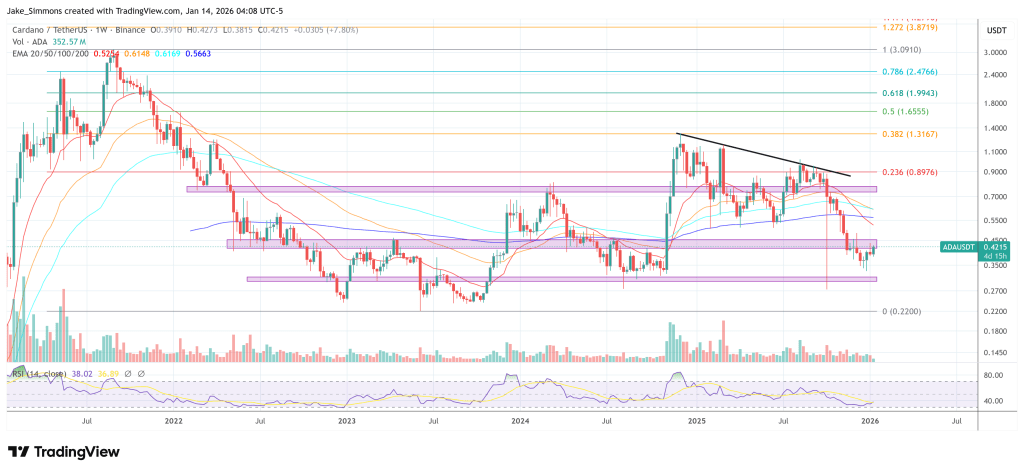
ADA faces key resistance zone, 1-week chart | Source: ADAUSDT on TradingView.com

Perguntas relacionadas

QWhat is the total target size of the Cardano x Draper Dragon Ecosystem Fund (DDC Fund) and how is it being funded?

AThe total target size of the DDC Fund is $80 million. It is being financed with up to $75 million from the Cardano treasury and the remaining $5 million is expected to come from qualified external limited partners (eLPs).

QWhat are the primary financial return targets for the DDC Fund, as stated in the proposal?

AThe fund's financial targets are a roughly 3x gross multiple on invested capital and an Internal Rate of Return (IRR) of 25% or more, benchmarked against institutional blockchain and crypto venture funds.

QWhat specific ecosystem goal does the proposal set for Cardano's Total Value Locked (TVL)?

AThe proposal aims to contribute to increasing Cardano's TVL from the current $300 million to over $3 billion, with a split of over $1.5 billion in Real World Assets (RWA) and over $1.5 billion in Decentralized Finance (DeFi).

QWhat role does the Cardano Foundation play in the proposed DDC Fund structure?

AThe Cardano Foundation positions itself as an enabler, not an investment decision-maker. It is responsible for orchestrating the legal setup, administering the proposal under the Cardano constitution, and will have a director on the board of the Cayman Islands SPV.

QHow will transparency be maintained for the fund, and what information will remain confidential?

ATransparency will be provided through a public KPI dashboard, quarterly fund reports, AMAs, and roundtables. However, consistent with standard venture fund practice, confidential information such as specific deal terms, valuations, and certain portfolio details will not be publicly disclosed.

Leituras Relacionadas

Has Hook Summer Really Arrived? sato, Lo0p, FLOOD Ignite the New Narrative of Uniswap v4

"Hook Summer" Arrives? Sato, Lo0p, FLOOD Ignite Uniswap v4 Narrative Amidst a slight market recovery, attention within the Ethereum ecosystem has shifted to Meme coins built on Uniswap v4's Hook protocol. Following ASTEROID, tokens like sato, sat1, Lo0p, and FLOOD have become market focal points, with market caps ranging from millions to tens of millions, bringing concentrated liquidity to a narrative-dry market. Uniswap v4 Hooks are "plugin smart contracts" that allow developers to inject custom logic at key points in a liquidity pool's lifecycle (initialization, adding/removing liquidity, swaps, etc.), making the AMM programmable. Recent representative projects include: * **sato**: Market cap peaked over $38M; uses a v4 curve mechanism for minting/burning, locking ETH as reserve. * **sat1**: Market cap briefly exceeded $10M, positioning as an "optimized sato," but later declined significantly. * **Lo0p**: Market cap neared $6.6M; a "lending AMM protocol" allowing users to borrow ETH against deposited LO0P tokens without immediate selling pressure. * **FLOOD**: Market cap approached $6M; channels trading reserves into Aave v3 to generate yield, which is retained in the pool. The emergence of these Hook-based tokens could drive long-term growth for the Uniswap ecosystem by attracting users and liquidity to v4 pools. Combined with Uniswap's activated fee switch (partially used to burn UNI), the long-term outlook for UNI appears positive. However, short-term UNI price appreciation is not directly guaranteed. Factors include the sustainability and lifecycle of these new tokens, their price volatility, overall market conditions, and regulatory pressures. Currently, Uniswap v4's TVL ($595M) lags behind v3 and v2, indicating Hook adoption still requires time to mature. In summary, the Hook ecosystem serves as "long-term nourishment" for UNI, but acts more as a "catalyst" than a direct "booster" in the short term. Note: These are early-stage experimental tokens and may carry unknown risks.

marsbitHá 18m

Has Hook Summer Really Arrived? sato, Lo0p, FLOOD Ignite the New Narrative of Uniswap v4

marsbitHá 18m

Has Hook Summer Truly Arrived? sato, Lo0p, FLOOD Ignite the New Uniswap v4 Narrative

With the broader market showing signs of recovery, a new wave of interest has emerged around Ethereum-based meme coins. Following ASTEROID, tokens like sato, sat1, Lo0p, and FLOOD, built upon the Uniswap v4 Hook protocol, are capturing market attention. Their market capitalizations range from millions to tens of millions of dollars, injecting much-needed focused liquidity into a market lacking narratives. This article explores whether this trend signifies an incoming "Hook Summer" and its potential impact on UNI's price. Hooks are essentially plug-in smart contracts for Uniswap v4 liquidity pools, allowing developers to inject custom logic at key points in a pool's lifecycle (like initialization, adding/removing liquidity, swaps). This transforms the AMM into programmable building blocks. Key highlighted projects include: * **sato**: Peaked over $38M market cap. It utilizes a v4 curve for minting/burning; buying locks ETH as reserve to mint new tokens, while selling redeems ETH from the reserve and burns tokens. * **sat1**: Market cap briefly exceeded $10M, promoted as an "optimized sato," but later declined significantly. * **Lo0p**: Reached nearly $6.6M. It's a lending AMM protocol where buying LO0P tokens locks them as collateral, allowing users to borrow ETH from the pool reserve at 40% LTV, aiming to improve capital efficiency for idle ETH in LPs. * **FLOOD**: Peaked near $6M. Its mechanism directs asset reserves from buys into Aave v3 to generate yield, with fees and interest retained in the pool to potentially influence the token's price long-term. In the long term, the development of the Hook ecosystem can attract users and liquidity to Uniswap v4, benefiting UNI's fundamentals—especially combined with the recent activation of the protocol fee switch, where a portion of fees is used to burn UNI. However, in the short term, these Hook-based tokens are unlikely to directly drive significant UNI price appreciation. Their impact is moderated by factors like token sustainability, price volatility, and broader market and regulatory conditions. Currently, Uniswap v4's TVL ($595M) still trails behind v2 and v3, indicating adoption and growth will take time. The article concludes that while the Hook ecosystem provides long-term "nourishment" for UNI, its short-term role is more of a "catalyst" than a "booster." Readers are cautioned that these are early-stage experimental tokens and may carry unknown risks.

Odaily星球日报Há 30m

Has Hook Summer Truly Arrived? sato, Lo0p, FLOOD Ignite the New Uniswap v4 Narrative

Odaily星球日报Há 30m

Interview with Michael Saylor: I Did Say I Would Sell Bitcoin, But Never a Net Sale

Interview with Michael Saylor: I Said We'd Sell Bitcoin, But Never Be a Net Seller In a recent podcast, MicroStrategy Executive Chairman Michael Saylor clarified the company's stance on potentially selling Bitcoin. Following MicroStrategy's earnings call statement about being prepared to sell BTC to fund dividends for its STRC (Strategic) credit product, Saylor emphasized the distinction between selling and being a "net seller." Saylor explained the core business model: MicroStrategy sells credit instruments like STRC and uses the proceeds to buy Bitcoin, which is viewed as "digital capital" expected to appreciate around 30-40% annually. A portion of these capital gains can then be used to pay the dividends on the credit products. He stressed that even if the company sells some Bitcoin for dividends, it simultaneously buys much more with new credit issuance. For example, after raising $3.2 billion from STRC sales in April, the dividend obligation was only $80-90 million, making the company a net buyer. The clarification aims to counter market narratives questioning the value of Bitcoin on MicroStrategy's balance sheet if it were never sold, and to dismiss claims of a "Ponzi scheme." Saylor reiterated his personal philosophy for investors: "Don't be a net seller of bitcoin" and ensure your Bitcoin holdings increase each year. Saylor also discussed Bitcoin's role as the foundation for "digital credit," noting that STRC has become the largest and most liquid preferred stock issue in the U.S., offering high risk-adjusted returns (Sharpe ratio). He highlighted Bitcoin's deep liquidity, stating that even large purchases by MicroStrategy do not move the market significantly, which is driven by macro factors, geopolitical tensions, and capital flows from ETFs and credit products. Finally, Saylor reflected on his early inspiration from sci-fi books, which motivated his path to MIT, and maintained his fundamental thesis on Bitcoin remains unchanged: it is superior digital capital enabling superior digital credit.

链捕手Há 34m

Interview with Michael Saylor: I Did Say I Would Sell Bitcoin, But Never a Net Sale

链捕手Há 34m

Beaten SK Hynix Employees in China: Year-end Bonus Less Than 5% of Korean Staff's

"SK Hynix Chinese Staff Hit Hard: Bonuses Less Than 5% of Korean Counterparts" Driven by the AI boom, South Korea's SK Hynix is experiencing record performance, with media reports predicting massive year-end bonuses for its employees, making them highly desirable in the matchmaking market. However, this prosperity starkly contrasts with the situation for the company's Chinese employees. According to reports, SK Hynix operates under a rule allocating 10% of operating profit for employee bonuses. While projections suggest Korean employees could receive bonuses reaching millions of RMB, a Chinese employee with over a decade of technical experience revealed the disparity: "If they get 3 million, Chinese staff get less than 5% of that." After adjustments based on KPI ratings, this employee's highest bonus was slightly over 100,000 RMB. Bonuses are paid annually in Korea but semi-annually in China. During the industry downturn in 2023-2024, Chinese employees received no bonus at all. The gap extends beyond bonuses. Recruitment posts for SK Hynix's Chinese factories (in Wuxi, Dalian, Chongqing) show engineer monthly salaries ranging from 10,000 to 35,000 RMB, with a 13th-month salary promised. Chinese employees also receive standard benefits like annual leave but lack stock incentives, which are reportedly unavailable to them. Furthermore, management positions in China are predominantly held by Korean personnel, though industry observers note a gradual increase in local middle managers over time. SK Hynix has confirmed the 10% bonus rule but cautioned that specific future bonus amounts remain unpredictable. The company forecasts strong demand for HBM and other high-value enterprise products for the next 2-3 years, driven by AI infrastructure investment. This focus on business-to-business markets may continue to constrain supply for consumer products, potentially prolonging price increases for components like memory.

链捕手Há 48m

Beaten SK Hynix Employees in China: Year-end Bonus Less Than 5% of Korean Staff's

链捕手Há 48m

Trading

Spot
Futuros

Artigos em Destaque

Como comprar ADA

Bem-vindo à HTX.com!Tornámos a compra de Cardano (ADA) simples e conveniente.Segue o nosso guia passo a passo para iniciar a tua jornada no mundo das criptos.Passo 1: cria a tua conta HTXUtiliza o teu e-mail ou número de telefone para te inscreveres numa conta gratuita na HTX.Desfruta de um processo de inscrição sem complicações e desbloqueia todas as funcionalidades.Obter a minha contaPasso 2: vai para Comprar Cripto e escolhe o teu método de pagamentoCartão de crédito/débito: usa o teu visa ou mastercard para comprar Cardano (ADA) instantaneamente.Saldo: usa os fundos da tua conta HTX para transacionar sem problemas.Terceiros: adicionamos métodos de pagamento populares, como Google Pay e Apple Pay, para aumentar a conveniência.P2P: transaciona diretamente com outros utilizadores na HTX.Mercado de balcão (OTC): oferecemos serviços personalizados e taxas de câmbio competitivas para os traders.Passo 3: armazena teu Cardano (ADA)Depois de comprar o teu Cardano (ADA), armazena-o na tua conta HTX.Alternativamente, podes enviá-lo para outro lugar através de transferência blockchain ou usá-lo para transacionar outras criptomoedas.Passo 4: transaciona Cardano (ADA)Transaciona facilmente Cardano (ADA) no mercado à vista da HTX.Acede simplesmente à tua conta, seleciona o teu par de trading, executa as tuas transações e monitoriza em tempo real.Oferecemos uma experiência de fácil utilização tanto para principiantes como para traders experientes.

1.2k Visualizações TotaisPublicado em {updateTime}Atualizado em 2025.03.21

Como comprar ADA

Discussões

Bem-vindo à Comunidade HTX. Aqui, pode manter-se informado sobre os mais recentes desenvolvimentos da plataforma e obter acesso a análises profissionais de mercado. As opiniões dos utilizadores sobre o preço de ADA (ADA) são apresentadas abaixo.

活动图片