Cardano Founder Calls For Insider Recusal In Liqwid Governance Dispute

bitcoinistPublicado em 2026-03-16Última atualização em 2026-03-16

Resumo

Cardano founder Charles Hoskinson has intervened in a governance dispute at DeFi protocol Liqwid, urging insiders to recuse themselves from a revote on the distribution of nearly $1 million in NIGHT tokens. The conflict centers on whether the protocol should honor prior public commitments to return all assets deposited in its smart contracts. Hoskinson argued that DAO legitimacy depends on broad participation and trust, not just a vote, especially when insiders could directly benefit from the outcome. He warned that failing to address the perceived breach of trust could severely damage Liqwid's credibility and growth, and recommended a new vote focused solely on whether to honor the original promises.

Cardano founder Charles Hoskinson has weighed in on a governance dispute surrounding Liqwid, arguing that insiders tied to the protocol should step aside from any revote on disputed asset distribution and let token holders decide whether earlier public commitments should be honored. His intervention matters because it cuts to a familiar pressure point in DeFi governance: whether a DAO vote is truly legitimate when founding insiders may be voting on an outcome that benefits them directly.

In a livestream from Wyoming, Hoskinson said he generally avoids involvement in the DeFi layer of the Cardano ecosystem unless there is a broader community mandate. But he said the Liqwid situation had crossed into a more serious issue of trust after October representations that “100% of the assets in the smart contracts” allocated to the protocol would be returned to their “rightful owners.”

The dispute centers on a sizeable pool of Midnight’s NIGHT tokens tied to Liqwid’s ADA market. Public governance materials indicate the allocation totals roughly 18.81 million NIGHT, which at current market prices is worth just under $1 million. That helps explain why the vote has drawn so much attention: the argument is not over a symbolic governance gesture, but over the handling of a seven-figure crypto allocation that users say was supposed to be fully returned.

Cardano Founder Urges Second Liqwid Vote

According to Hoskinson, the team later ran into a governance and legal problem inside the DAO structure itself. “I guess that team did not have, according to the user agreement of their DAO, legal authorization to do so,” he said. “It somehow violated the terms of how they’ve set things up.” Even granting that point, he argued, the more troubling issue was how the matter was then handled.

His proposed fix was straightforward: rerun the vote, but on narrower and cleaner terms. “If you have to go to the DAO for a vote, two things should be done,” Hoskinson said. “First and foremost, those who are insiders should recuse themselves if they’re going to be direct beneficiaries of a governance action of this nature. Second, the question should have been, should we honor our marketing commitments, yes or no?”

That framing goes to the heart of his criticism. In Hoskinson’s telling, users deposited funds into the relevant smart contracts on the understanding that the prior commitments would be respected. “Commitments were already made, people put money into the contracts understanding those terms and conditions and had no reasons to believe that such things would be violated,” he said. “People in a position of trust and people in a position to maintain this type of software, they frankly speaking should be a little bit better.”

Hoskinson repeatedly returned to legitimacy, not just procedure. DAOs, he said, do not derive credibility from the mere existence of a vote. They derive it from broad participation and confidence that the process is not tilted by a small cluster of insiders. “DAOs require legitimacy and the legitimacy comes from participation,” he said. “If the belief is that participation is only controlled by a small group of insiders, there’s no path forward for a DAO to have governance legitimacy.”

His recommendation was for insiders associated with the protocol’s core entities to publicly declare their holdings, recuse themselves, and let holders vote only on whether the October commitments should be honored. If the answer is yes, then the protocol should simply follow through. If the answer is no, then the community could move to a second-stage debate over alternative allocations.

Hoskinson was equally clear about the stakes if that does not happen. He said he has no special powers to reverse the outcome, no control over assets already distributed into smart contracts, and no formal authority over the Cardano ecosystem. But he warned that perception alone could do lasting damage.

“It is my belief that this violation of public trust or at least the perception of it will badly damage the protocol’s ability, Liqwid’s ability to grow and thrive in the future,” he said. “Simply put, if people can’t trust what the core accounts are saying and when votes are taken, people don’t trust those votes, it creates a reality where people will just simply move to other options.”

Overall, if Liqwid wants to restore credibility, he argued, the path is still open. But it runs through disclosure, recusal and a cleaner vote.

At press time, Cardano traded at $0.29.
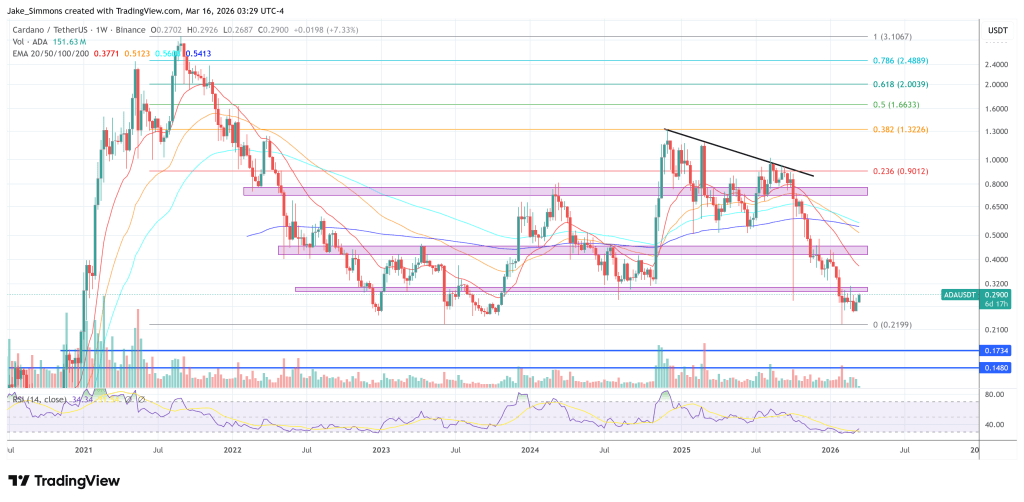
Cardano hovers below key resistance, 1-week chart | Source: ADAUSDT on TradingView.com

Perguntas relacionadas

QWhat is the core issue in the Liqwid governance dispute that Charles Hoskinson is addressing?

AThe core issue is whether insiders tied to the Liqwid protocol should be allowed to vote on a disputed asset distribution that could directly benefit them, and whether a prior public commitment to return 100% of assets in smart contracts to their rightful owners should be honored.

QWhat specific solution did Charles Hoskinson propose to resolve the Liqwid governance dispute?

AHoskinson proposed rerunning the vote with two key changes: first, insiders who are direct beneficiaries should recuse themselves; second, the vote should ask a clear yes or no question on whether the protocol should honor its prior marketing commitments.

QAccording to Hoskinson, what is the source of a DAO's legitimacy in governance?

AHoskinson stated that a DAO's legitimacy comes from broad participation and the confidence that the process is not controlled or tilted by a small group of insiders, not merely from the existence of a vote.

QWhat is the approximate value of the disputed NIGHT token allocation at the center of this controversy?

AThe disputed allocation is roughly 18.81 million NIGHT tokens, which at current market prices is worth just under $1 million.

QWhat potential consequence did Hoskinson warn about if the trust issue in Liqwid governance is not properly addressed?

AHoskinson warned that the violation of public trust, or even the perception of it, would badly damage Liqwid's ability to grow and thrive in the future, as users would lose trust in core accounts and governance votes, leading them to move to other options.

Leituras Relacionadas

Jensen Huang's CMU Speech: In the AI Era, Don't Just Watch, Build

Jensen Huang, CEO of NVIDIA and a first-generation immigrant, delivered the commencement address to Carnegie Mellon University's class of 2026. He shared his personal journey from a humble background to founding NVIDIA, emphasizing resilience, learning from failure, and the responsibility that comes with leadership. Huang framed the present moment as the dawn of the AI revolution, a shift he believes is more profound than previous computing waves. He described AI as fundamentally resetting computing—moving from human-written software to machines that understand, reason, and use tools. This will create a new industry for generating intelligence and transform every sector. While acknowledging AI's potential to automate tasks and displace some jobs, Huang distinguished between the *tasks* of a job and its core *purpose*. He argued AI will augment human capability, not replace humans. The real risk, he stated, is not AI itself, but people being left behind by those who effectively use AI. He presented AI as a generational opportunity for massive infrastructure investment—in chip factories, data centers, energy grids, and advanced manufacturing—that could re-industrialize nations like the U.S. and bridge the digital divide by making computing and intelligent tools accessible to all. Huang called for a balanced approach: advancing AI safely and responsibly, establishing prudent policies, ensuring broad access, and encouraging universal participation. He urged the graduates not to fear the future but to engage with optimism and ambition, reminding them of CMU's motto, "My heart is in the work." His core message was clear: this is their moment to actively build and shape the AI-powered future, not merely observe it.

marsbitHá 10m

Jensen Huang's CMU Speech: In the AI Era, Don't Just Watch, Build

marsbitHá 10m

The Era Has Arrived Where Human Writers Must Prove They Are Not Machines

The article describes an era where AI-generated content is flooding the market, forcing human authors to prove they are not machines. It begins with the example of dozens of AI-written, error-ridden biographies of Henry Kissinger appearing on Amazon within hours of his death, a pattern repeated for other deceased celebrities and even living experts who find fraudulent books under their names. This spam content has exploded, with monthly new book releases on platforms like Amazon reaching 300,000 by late 2025. The issue spans genres, from suspiciously high proportions of AI-written teen romance and self-help books to dangerous, AI-generated foraging guides containing lethal advice. The platforms' automated review systems, designed to catch plagiarism and banned words, are ill-equipped to detect AI-generated text that avoids these pitfalls while being nonsensical or fraudulent. The problem has infiltrated traditional publishing. A major publisher, Hachette, had to recall a bestselling horror novel after AI detection tools suggested 78% of its content was machine-generated. An acclaimed European philosophy book was later revealed to be entirely written by AI under a fake author persona. In response, authors are fighting back. At the 2026 London Book Fair, 10,000 writers published a blank book titled "Don't Steal This Book" containing only their signatures—using emptiness as a protest weapon in an age of AI overproduction. Initiatives like the "Human Author Certification" program have emerged, ironically placing the burden on humans to prove their work is not machine-made. The article warns of a vicious cycle: AI-generated low-quality books pollute the data used to train future AI models, leading to "model collapse" and an ever-worsening flood of digital waste, eroding trust in publishing and devaluing human creativity.

marsbitHá 35m

The Era Has Arrived Where Human Writers Must Prove They Are Not Machines

marsbitHá 35m

Trading

Spot
Futuros

Artigos em Destaque

Como comprar ADA

Bem-vindo à HTX.com!Tornámos a compra de Cardano (ADA) simples e conveniente.Segue o nosso guia passo a passo para iniciar a tua jornada no mundo das criptos.Passo 1: cria a tua conta HTXUtiliza o teu e-mail ou número de telefone para te inscreveres numa conta gratuita na HTX.Desfruta de um processo de inscrição sem complicações e desbloqueia todas as funcionalidades.Obter a minha contaPasso 2: vai para Comprar Cripto e escolhe o teu método de pagamentoCartão de crédito/débito: usa o teu visa ou mastercard para comprar Cardano (ADA) instantaneamente.Saldo: usa os fundos da tua conta HTX para transacionar sem problemas.Terceiros: adicionamos métodos de pagamento populares, como Google Pay e Apple Pay, para aumentar a conveniência.P2P: transaciona diretamente com outros utilizadores na HTX.Mercado de balcão (OTC): oferecemos serviços personalizados e taxas de câmbio competitivas para os traders.Passo 3: armazena teu Cardano (ADA)Depois de comprar o teu Cardano (ADA), armazena-o na tua conta HTX.Alternativamente, podes enviá-lo para outro lugar através de transferência blockchain ou usá-lo para transacionar outras criptomoedas.Passo 4: transaciona Cardano (ADA)Transaciona facilmente Cardano (ADA) no mercado à vista da HTX.Acede simplesmente à tua conta, seleciona o teu par de trading, executa as tuas transações e monitoriza em tempo real.Oferecemos uma experiência de fácil utilização tanto para principiantes como para traders experientes.

1.2k Visualizações TotaisPublicado em {updateTime}Atualizado em 2025.03.21

Como comprar ADA

Discussões

Bem-vindo à Comunidade HTX. Aqui, pode manter-se informado sobre os mais recentes desenvolvimentos da plataforma e obter acesso a análises profissionais de mercado. As opiniões dos utilizadores sobre o preço de ADA (ADA) são apresentadas abaixo.

活动图片