Can Open USD Support Stripe's Ambition?

链捕手Publicado em 2026-07-07Última atualização em 2026-07-07

Resumo

The article explores whether the newly announced Open USD (OUSD) stablecoin can support Stripe's strategic ambition to evolve beyond a payment API company into a "money movement network." It argues that OUSD is not an immediate "USDC killer" but serves as a crucial narrative shift for Stripe. The stablecoin, launched by the independent entity Open Standard with backing from Stripe, Visa, Mastercard, and others, represents an attempt to redefine the economics and governance of stablecoins by sharing reserve asset yields with distributing partners. For Stripe, OUSD is a key piece in moving from simply abstracting traditional financial rails (like card networks) to potentially defining a new settlement layer for global commerce. This aligns with Stripe's broader strategy involving its acquisitions (like Bridge for stablecoin issuance) and projects (like Tempo for payments-focused blockchain) to position itself for "agentic commerce," where AI agents and software conduct automated transactions. The article concludes that while OUSD alone cannot instantly transform Stripe's business, it concretely signals the company's ambition to organize the future infrastructure of money movement, where value may ultimately settle on a network it helped shape.

Author: Yokiiiya Stablehunter

Five months ago, I wrote an article titled Stripe | The AWS of the Financial World: Why It Becomes the Biggest Winner in the AI + Stablecoin Era, where I wrote that 'Money will run on Stripe.' Stripe is not just building a better payment button; it's transforming financial capabilities like receiving payments, making payments, issuing cards, fund accounts, tax, and invoicing into infrastructure that developers can call, just like cloud services.

But after the emergence of Open USD, we see that Stripe might want to prove more than just 'money will run on Stripe.' Rather:

Money will not only run through Stripe.

Money may settle on a network Stripe helped define.

I. OUSD is a Key Step for Stripe to Become a Money Movement Network

The significance of OUSD lies not in it being just another stablecoin, but in providing Stripe with a bigger story: from a payments API company to a money movement network.

It's unlikely to replace USDC in the short term, nor can it bypass all traditional financial systems. However, it gives Stripe the opportunity to not just connect payments, but to reorganize settlement, liquidity, and yield distribution. In the past, we often understood Stripe as a better payment gateway, but more accurately, Stripe is an aggregation layer built upon card networks, bank account systems, local clearing networks, acquiring/issuing licenses, and various traditional payment rails.

This is also its limitation.

What Stripe truly wants to break through is the strategic limitation of being merely 'the API layer on top of traditional payment networks.' If Stripe is just a better payments API, no matter how big it gets, it can easily be framed within comparison frameworks against Adyen, PayPal, Fiserv, Checkout.com, and acquirers. The market would look at its processed volume, take rate, gross margin resilience, potential increases in card network costs, and regulatory and local licensing constraints on expansion.

This would still be a very good company, but not yet a truly financial network. The significance of OUSD is that it gives Stripe the chance to advance its story from 'we help merchants connect payment methods' to 'we participate in defining the next-generation commercial settlement network.'
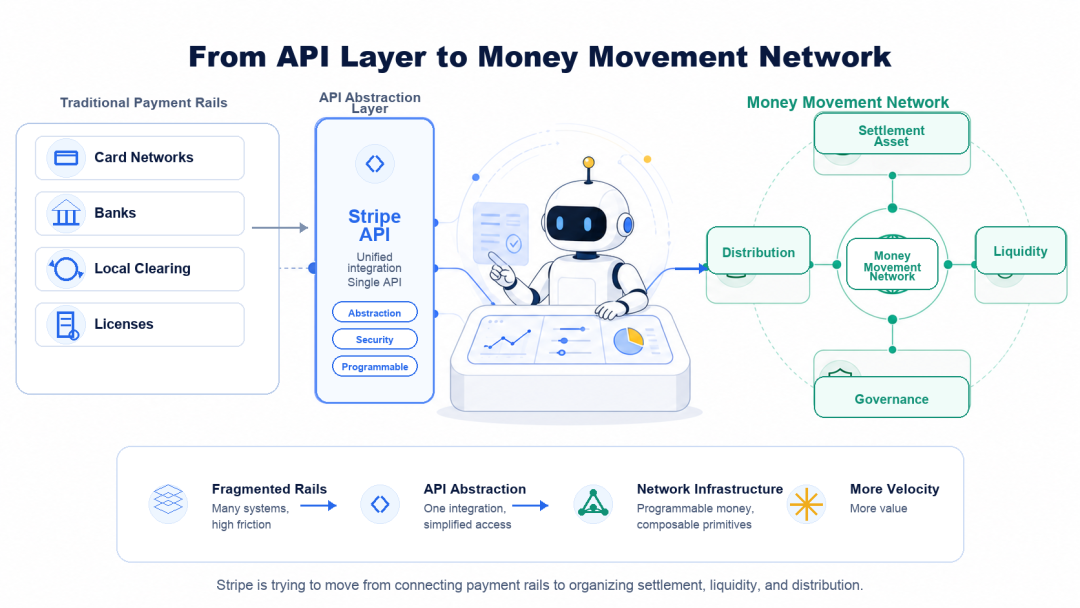
The valuation logic for these two things is completely different. The former is software and payment aggregation; the latter is a network.

In the payment industry, the most valuable thing has never been just the API, but network effects. Visa and Mastercard are valuable not because they have prettier payment buttons, but because they organize a multi-sided network: issuing banks, acquiring banks, merchants, consumers, risk rules, dispute handling, and clearing paths all operate within the same rule-based system.

If Stripe wants to tell a bigger story than 'payments API,' it must answer one question: Is it possible for Stripe to not just connect others' networks, but to organize its own network? OUSD provides the narrative entry point for this. The appeal of OUSD to Stripe isn't whether it's just another dollar stablecoin, but that it simultaneously points to four things.
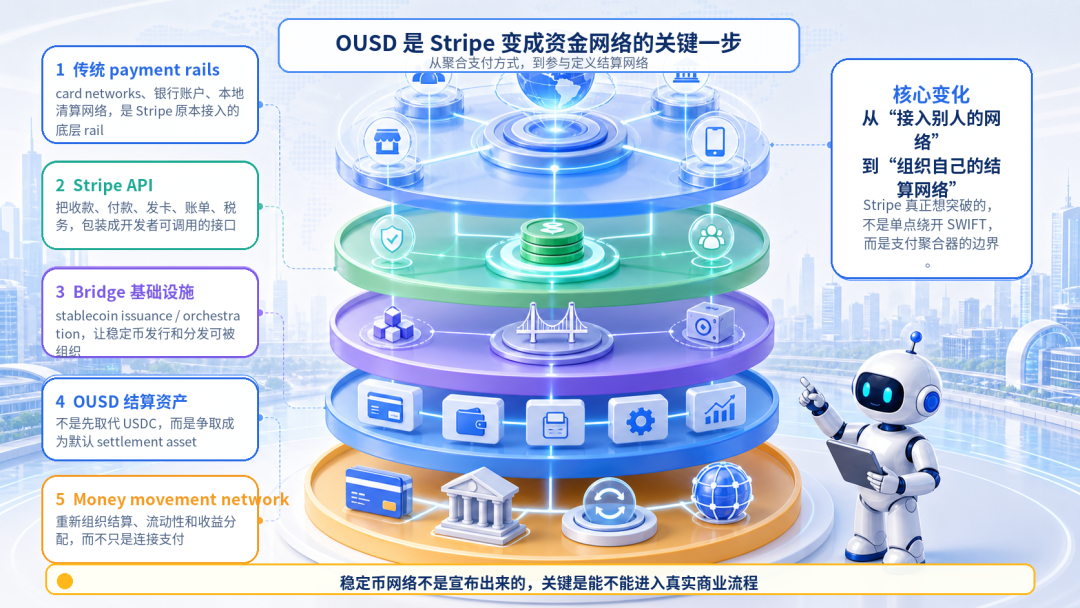
First, it gives Stripe the chance to own a default settlement asset.

In the past, Stripe helped merchants connect to Visa, Mastercard, ACH, local wallets, and bank transfers. In the future, if OUSD can become the default settlement asset for Stripe merchants, platforms, marketplaces, and AI agents, Stripe would no longer just be connecting others' networks; it would be organizing its own.

Second, it changes economic distribution.

In traditional payments, Stripe can collect processing fees, but underlying network fees, bank fees, card network fees, and some fund earnings go to others. If stablecoin reserve yields, mint/redeem, liquidity, wallets, cards, and on/off-ramps are all organized within the Stripe/Bridge system, Stripe has the opportunity to enter a deeper layer of economics.

Third, it provides a programmable money layer for agentic commerce.

If the underlying layer remains just credit cards and bank transfers, what agents can do will be constrained by authorization, risk management, settlement delays, cross-border costs, and reconciliation processes. Stablecoins can't solve all problems, but they are closer to a money rail that machines can call.

Fourth, it moves Stripe from a software company towards a network company.

If OUSD succeeds, the story Stripe can tell isn't just 'we make payments simpler,' but 'we are organizing the next-generation global commercial settlement network.' This is what truly matters. But we also need to look at it calmly.

For now, OUSD looks more like the narrative starting point for this ambition, not the already-completed infrastructure. A stablecoin network isn't announced into existence; it requires deep liquidity, stable and low-friction redemption, bank and regulatory acceptance, merchant willingness to hold or auto-settle, integration into enterprise ERP, treasury, and reconciliation systems, stable cross-chain and cross-region experiences, and governance that doesn't become a slow-moving consortium.

So, OUSD is not a USDC killer in the short term. It's more like Stripe asking the market a question: If future money flows no longer solely depend on traditional payment networks, then who will organize the new settlement assets, distribution networks, and economic distribution mechanisms?

II. What OUSD Actually Aims to Do: Not a USDC Killer, but Rewriting Stablecoin Profit Distribution

Open USD, abbreviated as OUSD, is a new dollar stablecoin announced by Open Standard on June 30, 2026. Its official definition is: a shared stablecoin for global financial activity.

It is not a 'private stablecoin' issued by Stripe alone. It is governed and operated by the independent company Open Standard, with participation from a group of payment companies, banks, fintechs, crypto infrastructure companies, and merchant platforms. The official participants listed include Stripe, Visa, Mastercard, BlackRock, BNY, Coinbase, Shopify, Bridge, Tempo, Privy, etc.
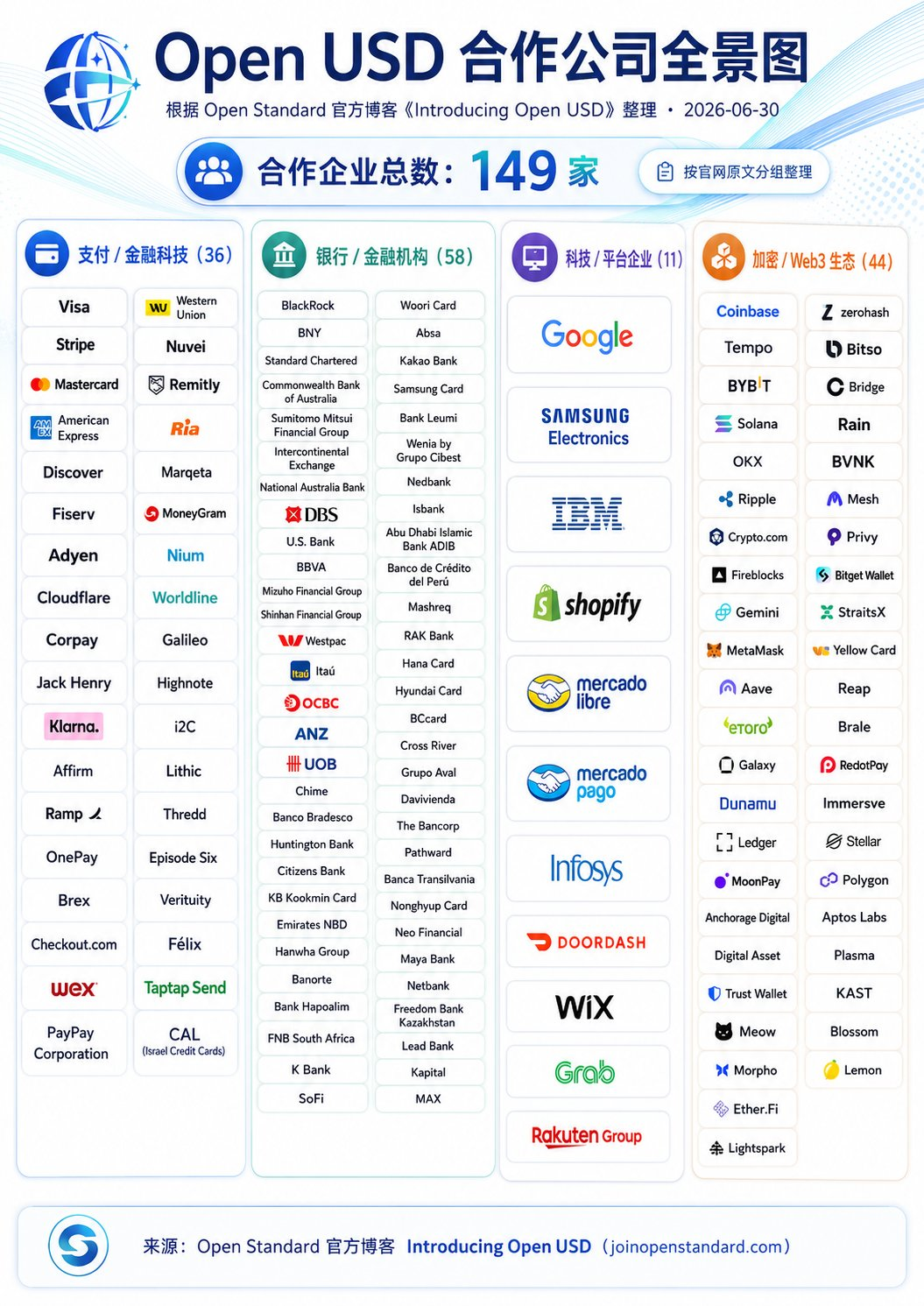
There's also a very interesting detail: OUSD was not officially launched directly by Stripe. It was announced by Open Standard, whose founding CEO is Zach Abrams. Zach Abrams is also the co-founder/CEO of Bridge, which has been acquired by Stripe.

So, from an organizational perspective, OUSD is not unrelated to Stripe. On the contrary, it clearly lies along the extended line of Stripe/Bridge's stablecoin strategy. But from a product and governance narrative perspective, it cannot be packaged as Stripe's own private stablecoin.

This is precisely what's subtle about OUSD: It needs the execution capability, payment network understanding, and future distribution power of Stripe and Bridge, but it must also present itself through the independent entity Open Standard as a stablecoin network with multi-party participation, co-governance, and shared economic benefits.
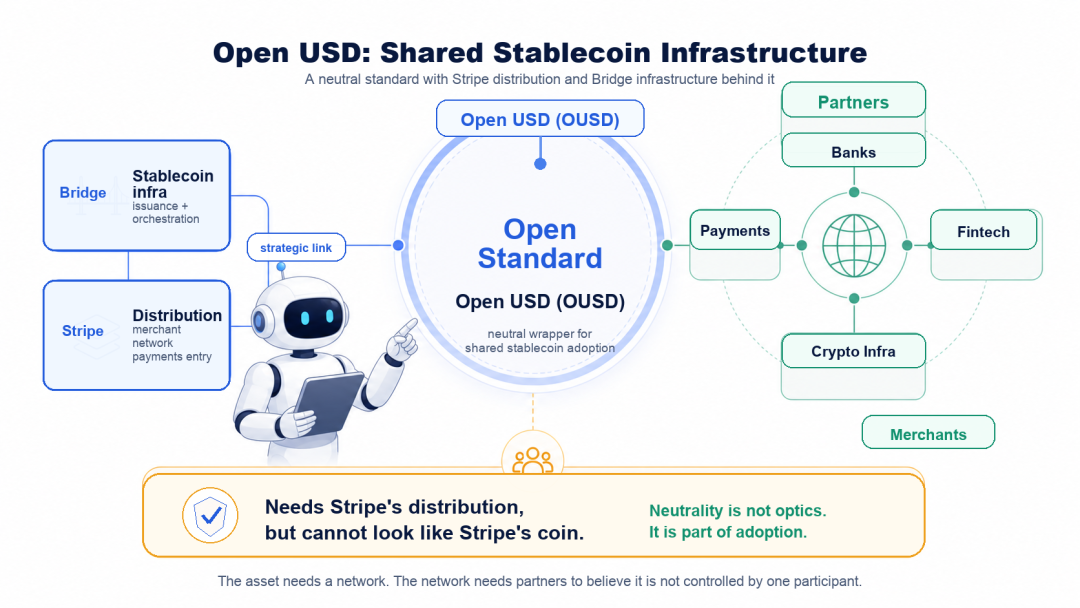
In other words, it needs Stripe's strength, but cannot appear to be just Stripe's coin. The design focus of OUSD has three points.

First, minting and redeeming incur no fees, and there are no artificially set caps on scale.

Second, the yield generated by OUSD's reserve assets, after deducting a small portion for management fees, will be distributed to partners who drive adoption and distribution.

Third, it adopts collaborative governance. The board of Open Standard consists of OUSD partners. The official vision is for it not to be a private network of a single company, but a stablecoin infrastructure co-shaped by participants. OUSD is not just another dollar stablecoin; it's attempting to answer a more commercial question:

If stablecoins are to become the infrastructure for global money flows, should the companies that use, distribute, and create transaction scenarios also participate in governance and profit distribution?

So, what is OUSD actually aiming to do? I don't think it's a USDC killer in the short term.
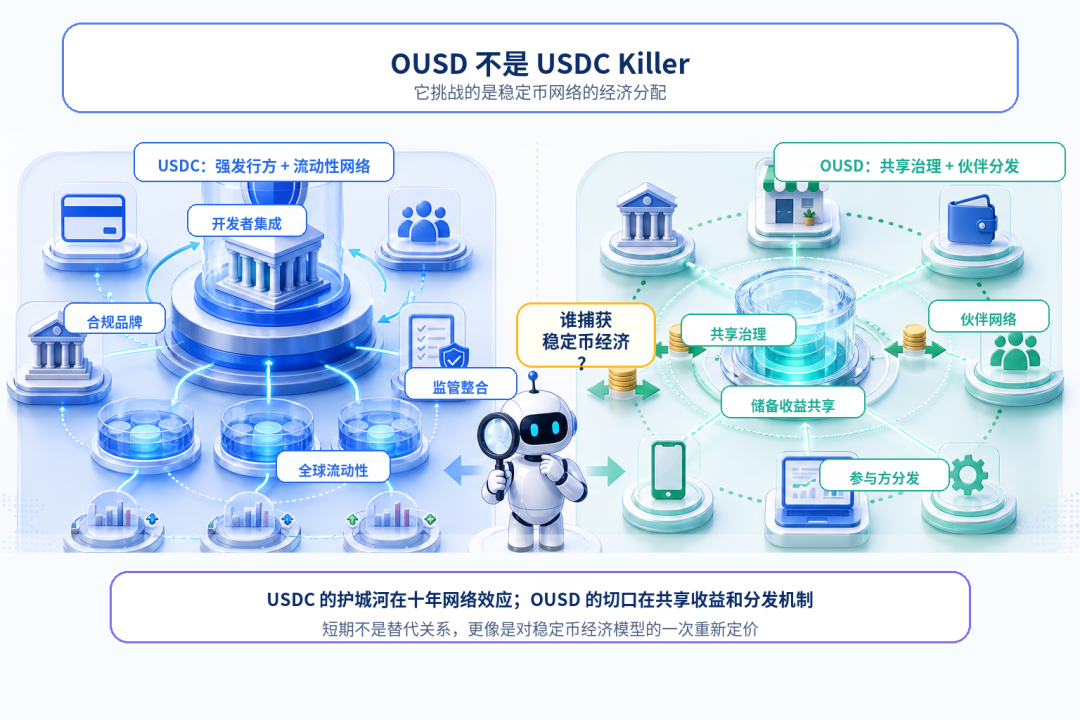
USDC's first-mover advantage is very real. It has liquidity, exchange and DeFi use cases, institutional trust, a compliance brand, and a vast number of completed integrations. Stablecoins are not something you can just migrate by changing the ticker; they involve redemption trust, liquidity depth, counterparty acceptance, and operational inertia.

Shortly after OUSD's announcement, Circle CEO Jeremy Allaire responded to the competitive concerns OUSD raised. His core message wasn't 'anyone can issue a stablecoin,' but rather the opposite: stablecoins are a long-term, accumulated platform and network effects business.

He emphasized that USDC's moat comes mainly from three things: developer and application integration, global liquidity, and regulatory and financial system integration.

In Circle's official Q1 2026 data, USDC's circulation was $77 billion, and quarterly on-chain transaction volume was $21.5 trillion. This number may not fully reflect real commercial payment penetration, but it's enough to illustrate one thing: USDC is not just a ticker that can be easily replaced; it's already an operational stablecoin network.

That's why framing OUSD as a 'USDC killer' would be an oversimplification. The truly interesting part about OUSD is not that it will immediately replace anyone, but that it has chosen another path: Instead of first competing for transaction liquidity in the crypto-native world, it is cutting in from enterprise payments, platform settlement, merchant distribution, and reserve yield distribution.

In the existing stablecoin model, many users are actually just distributors or channels. The more a stablecoin is used, the more the issuer benefits from the reserve yield. Yet, payment companies, platforms, merchants, wallets, banks, and fintechs that contribute distribution and use cases may not fully participate in the underlying economics.

This is what OUSD wants to change. It attempts to convince enterprises: you're not just using a stablecoin; you can also participate in the governance and economic distribution of this stablecoin network.

Therefore, what OUSD is challenging is not just USDC's market share. It's challenging a more fundamental issue in the stablecoin industry: Who contributes to the use cases of a stablecoin, and who should share how much of its economic benefits?

From this perspective, USDC's advantages remain strong, but what OUSD proposes is not a simple replacement relationship, but a new model for profit distribution. This also explains why it emphasizes open, neutral governance, and shared economics.

'Open' is to lower the psychological barrier for enterprise adoption and exit. 'Neutral governance' is to make participants believe this isn't a private stablecoin of a single company. 'Shared economics' is to let companies that truly bring distribution and transaction volume participate in the distribution of reserve yield and network value.

This is not a purely technical issue; it's a business organization issue. Of course, this path is also harder. The larger the alliance, the higher the coordination costs. The more participants, the more complex the governance. The more a stablecoin aims to become public infrastructure, the more it must address questions of responsibility, benefit distribution, liability, and final decision-making.

Allaire's rebuttal to 'everyone sharing profits' also touches on this exact contradiction: If all revenue is distributed out, who will continuously invest in infrastructure? This question isn't just defensive rhetoric from Circle. It's a question OUSD must answer in the future.

Circle's logic is: a strong issuer needs to retain sufficient profit to continuously build compliance, liquidity, redemption, and global financial infrastructure.

OUSD's logic is: If stablecoins are to become shared infrastructure, then participants contributing distribution, use cases, and transaction volume should also share more of the reserve economics and governance rights.

So, this isn't simple 'who is cheaper' competition. It's a competition between two ways of organizing stablecoins. OUSD is not a USDC killer in the short term.

It's more like a business counter-question to the USDC model: If stablecoins are truly to become the next-generation global payment infrastructure, should they be dominated by a strong issuer, or co-governed by a group of commercial networks that genuinely contribute traffic, use cases, and trust?

III. What Stripe Needs Isn't Just Growth, But a Bigger Corporate Narrative

Stripe is already a very large company, serving a vast number of internet companies, SaaS, platform businesses, marketplaces, and emerging AI companies globally. Its products have long gone beyond just a payment button, covering a whole suite of financial infrastructure including payments reception, disbursements, invoicing, tax, risk management, card issuance, fund accounts, and business registration.

But the problem is, capital markets don't just ask how big a company is. They also ask: What kind of company is this? This is a question Stripe has always needed to answer.

If Stripe is understood as a payment company, it gets valued within the framework of payment companies. The market will look at its transaction processing volume, take rate, gross margin, card network costs, competitive intensity, regulatory pressure, and whether it can sustain high growth in the long term.

If Stripe is understood as a software company, it faces another issue: its revenue structure includes a large portion driven by payment volume, unlike pure SaaS with very clear subscription revenue and software margin models.

Therefore, Stripe's most imaginative narrative has never been 'we are a payment company,' nor simply 'we are a SaaS company.'

Rather: We are the financial infrastructure for the internet economy. Five months ago, when I wrote it was 'the AWS of the financial world,' that's what I meant.

The core of AWS isn't that it has many APIs, but that businesses place their computing, storage, databases, networking, security, and deployment processes on it. It provides not a point solution, but the default runtime environment.

What Stripe wants to become is also not a point payment tool. It wants to become the default financial runtime environment for internet commerce. This is also why OUSD is important for Stripe.

Because if Stripe just continues to wrap more traditional financial capabilities into APIs, it's still abstracting over the existing financial system. It can become more user-friendly, more complete, and more like a financial OS, but the underlying settlement assets, clearing networks, and some of the economic benefits still reside with others.

What OUSD gives it is an opportunity to move down into the money layer. From this perspective, actions like Bridge, Open Issuance, OUSD, Privy, agentic commerce, and Tempo are not isolated. Bridge gave Stripe stablecoin issuance/orchestration capability. Open Issuance lets businesses issue and manage their own stablecoins. OUSD provides an entry point for a shared stablecoin and alliance network. Privy brings Stripe closer to wallets, identity, and user-side crypto-native onboarding. Tempo is a payments-focused blockchain incubated by Stripe and Paradigm, pointing to stablecoin payment and settlement rails. Agentic commerce provides the new use case for all this: In the future, if AI agents truly represent users, businesses, and software systems to initiate purchases, subscriptions, service calls, and settlements, then payment is no longer just an action of a person clicking a checkout button, but will become continuous fund flows between software.

Looking at these actions together, the story Stripe wants to tell is not just: we make payments simpler. It's: we enable the fund flows in the next-generation internet economy to be callable by software, manageable by businesses, and globally settled.

This is the money movement network narrative. It's bigger than payments API, and bigger than 'supporting stablecoin payments.'

Of course, this story is still just a story for now. OUSD hasn't become a real default settlement asset, and agentic commerce hasn't entered large-scale commercialization yet. Questions remain unanswered: Will businesses be willing to hold stablecoins? Can financial systems integrate? How will regulators view it? How will traditional payment networks react?

But corporate narratives don't emerge only after everything is complete; they often appear when a company is about to cross its existing boundaries.

The boundary Stripe is now trying to cross is from 'I help you connect payments' to 'I help you organize money flows.'

OUSD isn't just another competitor in the stablecoin market. It is a signal that Stripe is pushing itself from a payment company towards a money movement network.

IV. Agentic Payment Competes Not for Payment Gateways, But for the Settlement Layer of Machine Transactions

It's worth looking at OUSD alongside agentic payment, not because AI agents will definitely only use OUSD for payments in the future.

In fact, the most common and mature stablecoin asset in agentic payment today is still USDC. Many agent wallets, x402, and on-chain micropayment solutions more easily build around USDC by default. USDC's advantage isn't just its compliance brand; it's that it's already integrated into developer tools, wallets, exchanges, payment infrastructure, and on-chain liquidity networks.

Visa and Mastercard are not bystanders either. They won't sit back and let stablecoins replace them. A more realistic scenario is that card networks are also transforming themselves into payment networks usable by agents: finer-grained authorization, stronger tokenized credentials, risk controls, limits, and settlement rules more suitable for machine transactions.

In June 2026, Visa announced a set of AI, stablecoin, and token innovations to support smarter, programmable commercial transactions. Mastercard also launched Agent Pay for Machines, explicitly supporting multi-rail settlement with cards, accounts, and stablecoins.

So, the future of agentic payment won't be a simple 'stablecoins replace card networks' story.
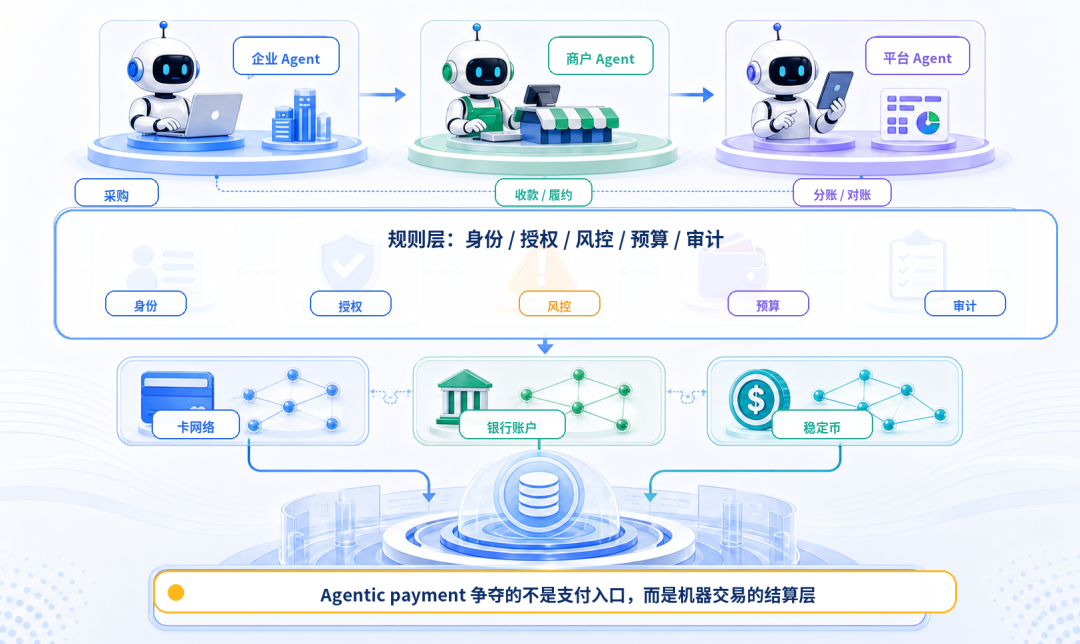
What's more likely to happen is: card networks, bank accounts, stablecoins, wallets, on-chain settlement, and merchant systems will all compete for the same position: Who will become the settlement layer that agents can call, businesses can control, merchants can accept, and finance can reconcile?

That's why Stripe's moves are worth looking at together:

OUSD is the attempt at a settlement asset.

Tempo is the attempt at a payment chain and stablecoin settlement rail.

Bridge is the infrastructure for stablecoin issuance/orchestration.

Privy is the gateway for wallets, identity, and user onboarding.
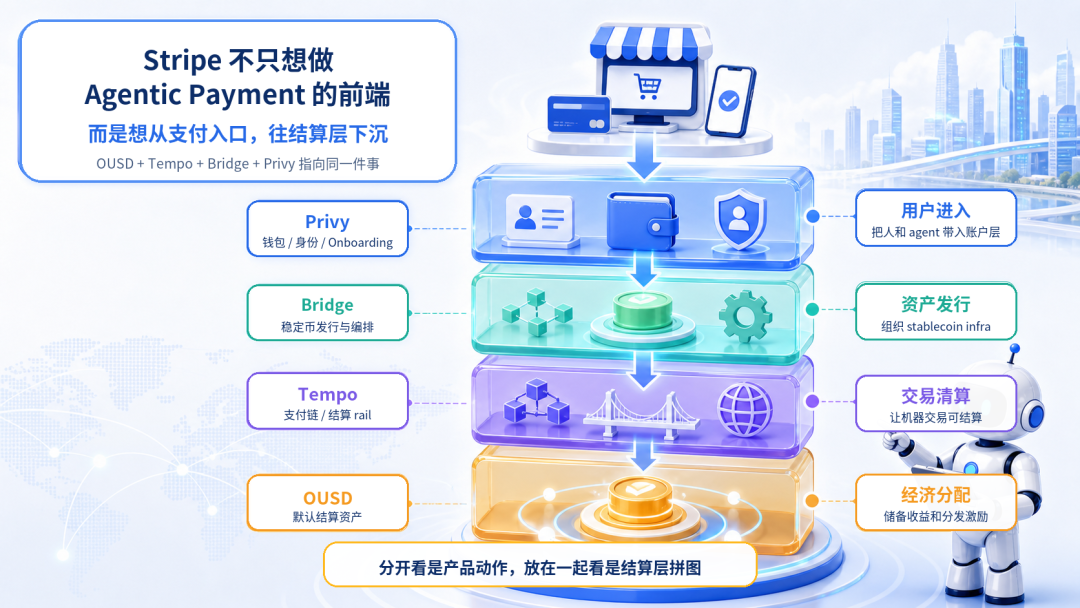
If these are viewed separately, each is just a product move. But viewed together, they point to the same question: Stripe doesn't just want to participate in the front-end checkout of agentic payment. It wants to move from the payment gateway down to the settlement layer. This is also where the real dynamic lies between Stripe and traditional card networks.

Visa and Mastercard's advantage lies in their existing global merchant networks, issuing bank networks, risk rules, and dispute handling systems. Their most natural path is to transform their existing networks into payment networks that agents can also call.

Stripe's strength is not owning the card networks themselves, but standing on the side of merchants, developers, platforms, and emerging software companies, packaging complex financial capabilities into APIs. It's closer to the application layer and merchant side, and easier to enter the workflows of AI-native companies, agent tools, SaaS, and marketplaces.

So, if agentic payment truly develops, Stripe won't be content with just helping agents call Visa or Mastercard.

What it wants more is: to let agents safely use money within Stripe's rule system. The key here isn't 'can it pay,' but the whole set of issues after payment:

Who authorizes? Who sets the budget? Who bears the risk? Who handles KYC? Who processes refunds and disputes? Who syncs the transaction into the company's accounting system? Who decides how much an agent can spend, on which services, and with which asset for settlement?

This is the real complexity of machine transactions. An agent buying an API, calling data, subscribing to a tool, paying for compute power, completing a cross-border task—superficially, it's a payment; in reality, behind it lies a set of permission, identity, risk, budget, audit, and reconciliation issues.

Stablecoins can solve some settlement efficiency issues, but they can't solve all commercial payment problems alone. Card networks can continue to provide authorization, risk control, and merchant acceptance, but they also need to adapt to low-value, high-frequency, cross-platform, software-initiated transaction patterns.

What Stripe is competing for is precisely the middle layer between these two:

on one side, connecting merchants and developers; on the other side, organizing stablecoins, wallets, identity, risk, settlement, and reconciliation.

From this perspective, OUSD is not the whole answer to agentic payment; it's a piece of the puzzle for Stripe to move down to the settlement layer.

The real ambition is to turn agentic payment into a money movement network that Stripe can organize.

V. So, Can OUSD Support Stripe's Ambition?

Back to the initial question: Can Open USD support Stripe's ambition? My answer is: Not in the short term, but it makes this ambition more concrete for the first time.

It can't immediately free Stripe from traditional payment networks—Visa, Mastercard, ACH, local banks, card organizations, acquirers, issuers, regulatory licenses, KYC, AML, tax, reconciliation—these things won't disappear just because a stablecoin is announced. Commercial payments in the real world have never been as simple as 'money moves from A to B.'

Stablecoins can solve part of the transmission problem; they can make funds flow faster, cheaper, and more programmably. But they can't automatically solve the landing problem.

After the money arrives, who's responsible for booking it? Who does KYC? Who bears the fraud risk? Who handles refunds and disputes? Who ensures the merchant receives funds they can use? Who connects this transaction into the company's ERP, financial, and tax processes?

These questions still require a lot of traditional financial and commercial infrastructure. That's also why Stripe won't become a pure crypto company because of OUSD.

It's more likely to take another path: making stablecoins part of its existing financial infrastructure. That is, if OUSD succeeds, it won't be because it made Stripe leave the traditional financial system, but because it gave Stripe an additional settlement layer it can help define, outside the traditional financial system.

This layer might not replace everything, but it can change Stripe's position in money flows.

In the past, Stripe was more like an excellent translator, translating complex financial systems into APIs developers could call, turning capabilities like payments, invoicing, tax, card issuance, risk, and fund accounts into modules businesses could embed into their products.

But OUSD points to something else: Stripe is not just translating existing financial systems. It's starting to participate in defining new financial systems. That's why I think this is worth writing about. Not because OUSD will definitely win, but because it exposes the most important strategic question for Stripe's next phase:

Does Stripe want to become a better payment processor, or does it want to become the money movement network for the next-generation internet commerce?

These two things seem only slightly different, but in reality, they are worlds apart. The value of a payment processor comes from transaction processing, risk control, access efficiency, and merchant coverage. The value of a money movement network comes from network effects, default settlement assets, rule-making ability, liquidity organization capability, and economic distribution mechanisms.

The former is a service; the latter is infrastructure.

What Stripe has done best over the past fifteen years is turning financial services into software interfaces. But if it wants to support AI commerce, the global platform economy, cross-border payouts, stablecoin settlement, and agentic payment in the future, it can't just stay at the interface layer.

It needs to get closer to the money itself. OUSD gives it an entry point to get closer to the money itself. Of course, whether this entry point can become a real network depends on the coming years. It depends on whether OUSD finds real use cases, whether Stripe deeply embeds it into merchant, platform, and developer tools, whether participants truly bring distribution rather than just putting their logos on the announcement page, whether regulators accept this consortium stablecoin structure, and how Circle, Tether, banks, card networks, and other payment companies will react.

This won't be answered quickly, but it has already made one thing clear: Stablecoins are no longer just trading assets in the crypto world. They are becoming tools for payment companies, banks, platforms, merchants, and AI companies to compete for the gateway to the next-generation money network.

From this perspective, OUSD is not Stripe's endpoint; it's a signal that Stripe is trying to push itself from a payments API company towards a money movement network.

Five months ago, I wrote: Money will run on Stripe.

Looking at it today, this statement can be pushed one step further. What Stripe wants to prove is:

Money may settle on a network Stripe helped define.

Criptomoedas em alta

Perguntas relacionadas

QWhat is the primary significance of Open USD (OUSD) for Stripe's strategic narrative, according to the article?

AAccording to the article, Open USD (OUSD) is significant not as just another stablecoin, but as a strategic move that provides Stripe with a larger narrative: transitioning from a payments API company to a 'money movement network.' It allows Stripe to potentially move beyond being an abstraction layer on top of traditional financial networks and towards defining and organizing a new settlement network, thereby changing its valuation logic from a software/payments aggregator to a network operator.

QHow does the article describe the key design and value proposition of Open USD (OUSD), and what is it *not* trying to be in the short term?

AThe article describes OUSD's key design features as: no fees for minting/redeeming, no artificial size limits, distributing the yield from reserve assets (after minimal management fees) to partners who drive adoption, and collaborative governance through the Open Standard entity with a board of participating companies. Its value proposition is a new commercial model that asks: if stablecoins become global payment infrastructure, should the companies that contribute distribution, scenarios, and transaction volume share in the governance and economic benefits? In the short term, it is explicitly *not* trying to be a 'USDC killer,' but rather offers an alternative organizational and profit-sharing model.

QWhat is the 'agentic payment' opportunity discussed in the article, and how does Stripe's strategy position it in this emerging field?

AThe 'agentic payment' opportunity refers to AI agents, software, or machines autonomously initiating payments for services, subscriptions, or API calls. The article argues that the competition is not just for the payment button, but for the underlying 'settlement layer' that handles authorization, risk control, budgeting, auditing, and reconciliation for machine-initiated transactions. Stripe's strategy, through pieces like OUSD (settlement asset), Tempo (payment rail), Bridge (issuance), and Privy (wallet/onboarding), positions it to build an intermediate layer that connects merchants/developers and organizes stablecoins, identity, and risk controls, aiming to make 'agentic payment' part of a Stripe-organized money movement network.

QWhat core strategic question does the article suggest Open USD (OUSD) forces Stripe to confront about its future identity?

AThe article suggests OUSD forces Stripe to confront this core strategic question: 'Does Stripe want to become a better payment processor, or does it want to become the money movement network for the next generation of internet commerce?' The former's value comes from transaction processing efficiency and merchant coverage, while the latter's value comes from network effects, default settlement assets, rule-making power, and economic distribution mechanisms. OUSD is a signal of Stripe attempting to move towards the latter, more foundational, identity.

QAccording to the article's conclusion, what is the updated vision for Stripe that OUSD points towards, compared to the earlier idea of 'Money will run on Stripe'?

AThe article's conclusion updates the vision from 'Money will run on Stripe' (acting as the primary financial operating system/API layer) to a more ambitious, network-defining goal: 'Money may settle on a network Stripe helped define.' This signifies a shift from being the dominant interface *on top of* existing financial rails to actively participating in the design and governance of a new settlement network layer itself.

Leituras Relacionadas

Goldman Sachs Research Report Analysis: Circle and USDC Are Moving Beyond the Crypto World, Cross-Border Payments and AI Agents Become New Battlegrounds

Goldman Sachs published a summary of its meeting with Circle Internet Group (issuer of USDC) on July 5th. The core takeaway is that stablecoins, led by USDC, are evolving from a crypto-native tool into foundational infrastructure for traditional finance and the AI economy. USDC's use cases are rapidly expanding beyond crypto trading into cross-border payments, e-commerce, capital market settlements, and notably, payments for AI agents. Circle's management emphasized that stablecoin growth is now decoupled from crypto market cycles, driven by this diversification. They outlined five key application layers and highlighted USDC's network effects, global liquidity depth, and regulatory compliance as competitive moats. Circle distinguishes USDC from bank-issued tokenized deposits, arguing the former is an open, internet-native system without bank credit risk. Strategically, Circle is building a broader fintech platform with its Arc Layer 1 blockchain, the Circle Payments Network for cross-border transfers, and an "Agentic Stack" to serve AI agent economies, where USDC already dominates. Regarding regulation, Circle views potential U.S. legislation like the CLARITY Act as a catalyst for growth rather than a constraint, expecting it to encourage broader institutional adoption and active usage. Goldman Sachs maintains a Neutral rating on Circle with a $96 price target, noting the company's shift from a pure stablecoin issuer to a financial infrastructure provider. Key risks include competition from USDT and potential earnings pressure from declining interest rates on its reserve assets.

marsbitHá 22m

Goldman Sachs Research Report Analysis: Circle and USDC Are Moving Beyond the Crypto World, Cross-Border Payments and AI Agents Become New Battlegrounds

marsbitHá 22m

The Robinhood Stock Tokens You Bought Are Just Debts from Jersey Island

The Robinhood stock tokens you buy are essentially debt securities issued by a shell company in Jersey, not real equity. These tokens merely track stock prices like NVIDIA or Apple but grant no shareholder rights like voting or dividends. If the underlying company fails, you have no claim on its assets. Instead, you hold a debt instrument from Robinhood Assets (Jersey) Limited, which promises returns based on stock performance. If this Jersey entity goes bankrupt, you become an unsecured creditor. This complex structure stems from Robinhood's past crisis during the 2021 GameStop short squeeze, where T+2 settlement caused liquidity issues. The blockchain-based tokens enable instant settlement, theoretically preventing such trading halts. The product is classified by the SEC as a "linked security" or structured note, carrying counterparty risk not borne by actual shareholders. It is available globally but excluded from the US, UK, and other major markets, while Robinhood offers a fully compliant, asset-backed token model in Europe under MiFID II. The system relies on oracles for pricing, which poses risks like manipulation and faulty liquidations seen in DeFi exploits. Robinhood profits from spreads and aims to become a full-chain settlement layer. Meanwhile, competitors like Ondo have launched SEC-registered, fully compliant equity tokens in the US with actual voting rights and dividends. Robinhood’s Jersey debt model appears as a transitional, regulatory-arbitrage product, aiming to capture market share ahead of future regulatory clarity.

Foresight NewsHá 54m

The Robinhood Stock Tokens You Bought Are Just Debts from Jersey Island

Foresight NewsHá 54m

Trading

Spot

Artigos em Destaque

O que é $S$

Compreender o SPERO: Uma Visão Abrangente Introdução ao SPERO À medida que o panorama da inovação continua a evoluir, o surgimento de tecnologias web3 e projetos de criptomoeda desempenha um papel fundamental na formação do futuro digital. Um projeto que tem atraído atenção neste campo dinâmico é o SPERO, denotado como SPERO,$$s$. Este artigo tem como objetivo reunir e apresentar informações detalhadas sobre o SPERO, para ajudar entusiastas e investidores a compreender as suas bases, objetivos e inovações nos domínios web3 e cripto. O que é o SPERO,$$s$? O SPERO,$$s$ é um projeto único dentro do espaço cripto que procura aproveitar os princípios da descentralização e da tecnologia blockchain para criar um ecossistema que promove o envolvimento, a utilidade e a inclusão financeira. O projeto é concebido para facilitar interações peer-to-peer de novas maneiras, proporcionando aos utilizadores soluções e serviços financeiros inovadores. No seu núcleo, o SPERO,$$s$ visa capacitar indivíduos ao fornecer ferramentas e plataformas que melhoram a experiência do utilizador no espaço das criptomoedas. Isso inclui a possibilidade de métodos de transação mais flexíveis, a promoção de iniciativas impulsionadas pela comunidade e a criação de caminhos para oportunidades financeiras através de aplicações descentralizadas (dApps). A visão subjacente do SPERO,$$s$ gira em torno da inclusão, visando fechar lacunas dentro das finanças tradicionais enquanto aproveita os benefícios da tecnologia blockchain. Quem é o Criador do SPERO,$$s$? A identidade do criador do SPERO,$$s$ permanece algo obscura, uma vez que existem recursos publicamente disponíveis limitados que fornecem informações detalhadas sobre o(s) seu(s) fundador(es). Esta falta de transparência pode resultar do compromisso do projeto com a descentralização—uma ética que muitos projetos web3 partilham, priorizando contribuições coletivas em vez de reconhecimento individual. Ao centrar as discussões em torno da comunidade e dos seus objetivos coletivos, o SPERO,$$s$ incorpora a essência do empoderamento sem destacar indivíduos específicos. Assim, compreender a ética e a missão do SPERO é mais importante do que identificar um criador singular. Quem são os Investidores do SPERO,$$s$? O SPERO,$$s$ é apoiado por uma diversidade de investidores que vão desde capitalistas de risco a investidores-anjo dedicados a promover a inovação no setor cripto. O foco desses investidores geralmente alinha-se com a missão do SPERO—priorizando projetos que prometem avanço tecnológico social, inclusão financeira e governança descentralizada. Essas fundações de investidores estão tipicamente interessadas em projetos que não apenas oferecem produtos inovadores, mas que também contribuem positivamente para a comunidade blockchain e os seus ecossistemas. O apoio desses investidores reforça o SPERO,$$s$ como um concorrente notável no domínio em rápida evolução dos projetos cripto. Como Funciona o SPERO,$$s$? O SPERO,$$s$ emprega uma estrutura multifacetada que o distingue de projetos de criptomoeda convencionais. Aqui estão algumas das características-chave que sublinham a sua singularidade e inovação: Governança Descentralizada: O SPERO,$$s$ integra modelos de governança descentralizada, capacitando os utilizadores a participar ativamente nos processos de tomada de decisão sobre o futuro do projeto. Esta abordagem promove um sentido de propriedade e responsabilidade entre os membros da comunidade. Utilidade do Token: O SPERO,$$s$ utiliza o seu próprio token de criptomoeda, concebido para servir várias funções dentro do ecossistema. Esses tokens permitem transações, recompensas e a facilitação de serviços oferecidos na plataforma, melhorando o envolvimento e a utilidade gerais. Arquitetura em Camadas: A arquitetura técnica do SPERO,$$s$ suporta modularidade e escalabilidade, permitindo a integração contínua de funcionalidades e aplicações adicionais à medida que o projeto evolui. Esta adaptabilidade é fundamental para manter a relevância no panorama cripto em constante mudança. Envolvimento da Comunidade: O projeto enfatiza iniciativas impulsionadas pela comunidade, empregando mecanismos que incentivam a colaboração e o feedback. Ao nutrir uma comunidade forte, o SPERO,$$s$ pode melhor atender às necessidades dos utilizadores e adaptar-se às tendências do mercado. Foco na Inclusão: Ao oferecer taxas de transação baixas e interfaces amigáveis, o SPERO,$$s$ visa atrair uma base de utilizadores diversificada, incluindo indivíduos que anteriormente podem não ter participado no espaço cripto. Este compromisso com a inclusão alinha-se com a sua missão abrangente de empoderamento através da acessibilidade. Cronologia do SPERO,$$s$ Compreender a história de um projeto fornece insights cruciais sobre a sua trajetória de desenvolvimento e marcos. Abaixo está uma cronologia sugerida que mapeia eventos significativos na evolução do SPERO,$$s$: Fase de Conceituação e Ideação: As ideias iniciais que formam a base do SPERO,$$s$ foram concebidas, alinhando-se de perto com os princípios de descentralização e foco na comunidade dentro da indústria blockchain. Lançamento do Whitepaper do Projeto: Após a fase conceitual, um whitepaper abrangente detalhando a visão, os objetivos e a infraestrutura tecnológica do SPERO,$$s$ foi lançado para atrair o interesse e o feedback da comunidade. Construção da Comunidade e Primeiros Envolvimentos: Esforços ativos de divulgação foram feitos para construir uma comunidade de primeiros adotantes e investidores potenciais, facilitando discussões em torno dos objetivos do projeto e angariando apoio. Evento de Geração de Tokens: O SPERO,$$s$ realizou um evento de geração de tokens (TGE) para distribuir os seus tokens nativos a apoiantes iniciais e estabelecer liquidez inicial dentro do ecossistema. Lançamento da dApp Inicial: A primeira aplicação descentralizada (dApp) associada ao SPERO,$$s$ foi lançada, permitindo que os utilizadores interagissem com as funcionalidades principais da plataforma. Desenvolvimento Contínuo e Parcerias: Atualizações e melhorias contínuas nas ofertas do projeto, incluindo parcerias estratégicas com outros players no espaço blockchain, moldaram o SPERO,$$s$ em um jogador competitivo e em evolução no mercado cripto. Conclusão O SPERO,$$s$ é um testemunho do potencial do web3 e das criptomoedas para revolucionar os sistemas financeiros e capacitar indivíduos. Com um compromisso com a governança descentralizada, o envolvimento da comunidade e funcionalidades inovadoras, abre caminho para um panorama financeiro mais inclusivo. Como em qualquer investimento no espaço cripto em rápida evolução, potenciais investidores e utilizadores são incentivados a pesquisar minuciosamente e a envolver-se de forma ponderada com os desenvolvimentos em curso dentro do SPERO,$$s$. O projeto demonstra o espírito inovador da indústria cripto, convidando a uma exploração mais aprofundada das suas inúmeras possibilidades. Embora a jornada do SPERO,$$s$ ainda esteja a desenrolar-se, os seus princípios fundamentais podem, de facto, influenciar o futuro de como interagimos com a tecnologia, as finanças e uns com os outros em ecossistemas digitais interconectados.

83 Visualizações TotaisPublicado em {updateTime}Atualizado em 2024.12.17

O que é $S$

O que é AGENT S

Agent S: O Futuro da Interação Autónoma no Web3 Introdução No panorama em constante evolução do Web3 e das criptomoedas, as inovações estão constantemente a redefinir a forma como os indivíduos interagem com plataformas digitais. Um projeto pioneiro, o Agent S, promete revolucionar a interação humano-computador através do seu framework aberto e agente. Ao abrir caminho para interações autónomas, o Agent S visa simplificar tarefas complexas, oferecendo aplicações transformadoras em inteligência artificial (IA). Esta exploração detalhada irá aprofundar-se nas complexidades do projeto, nas suas características únicas e nas implicações para o domínio das criptomoedas. O que é o Agent S? O Agent S é um framework aberto e agente, especificamente concebido para abordar três desafios fundamentais na automação de tarefas computacionais: Aquisição de Conhecimento Específico de Domínio: O framework aprende inteligentemente a partir de várias fontes de conhecimento externas e experiências internas. Esta abordagem dupla capacita-o a construir um rico repositório de conhecimento específico de domínio, melhorando o seu desempenho na execução de tarefas. Planeamento ao Longo de Longos Horizontes de Tarefas: O Agent S emprega planeamento hierárquico aumentado por experiência, uma abordagem estratégica que facilita a decomposição e execução eficientes de tarefas intrincadas. Esta característica melhora significativamente a sua capacidade de gerir múltiplas subtarefas de forma eficiente e eficaz. Gestão de Interfaces Dinâmicas e Não Uniformes: O projeto introduz a Interface Agente-Computador (ACI), uma solução inovadora que melhora a interação entre agentes e utilizadores. Utilizando Modelos de Linguagem Multimodais de Grande Escala (MLLMs), o Agent S pode navegar e manipular diversas interfaces gráficas de utilizador de forma fluida. Através destas características pioneiras, o Agent S fornece um framework robusto que aborda as complexidades envolvidas na automação da interação humana com máquinas, preparando o terreno para uma infinidade de aplicações em IA e além. Quem é o Criador do Agent S? Embora o conceito de Agent S seja fundamentalmente inovador, informações específicas sobre o seu criador permanecem elusivas. O criador é atualmente desconhecido, o que destaca ou o estágio nascente do projeto ou a escolha estratégica de manter os membros fundadores em anonimato. Independentemente da anonimidade, o foco permanece nas capacidades e no potencial do framework. Quem são os Investidores do Agent S? Como o Agent S é relativamente novo no ecossistema criptográfico, informações detalhadas sobre os seus investidores e financiadores não estão explicitamente documentadas. A falta de informações disponíveis publicamente sobre as fundações de investimento ou organizações que apoiam o projeto levanta questões sobre a sua estrutura de financiamento e roteiro de desenvolvimento. Compreender o apoio é crucial para avaliar a sustentabilidade do projeto e o seu impacto potencial no mercado. Como Funciona o Agent S? No núcleo do Agent S reside uma tecnologia de ponta que lhe permite funcionar eficazmente em diversos ambientes. O seu modelo operacional é construído em torno de várias características-chave: Interação Humano-Computador Semelhante: O framework oferece planeamento avançado em IA, esforçando-se para tornar as interações com computadores mais intuitivas. Ao imitar o comportamento humano na execução de tarefas, promete elevar as experiências dos utilizadores. Memória Narrativa: Utilizada para aproveitar experiências de alto nível, o Agent S utiliza memória narrativa para acompanhar os históricos de tarefas, melhorando assim os seus processos de tomada de decisão. Memória Episódica: Esta característica fornece aos utilizadores orientações passo a passo, permitindo que o framework ofereça suporte contextual à medida que as tarefas se desenrolam. Suporte para OpenACI: Com a capacidade de funcionar localmente, o Agent S permite que os utilizadores mantenham o controlo sobre as suas interações e fluxos de trabalho, alinhando-se com a ética descentralizada do Web3. Fácil Integração com APIs Externas: A sua versatilidade e compatibilidade com várias plataformas de IA garantem que o Agent S possa integrar-se perfeitamente em ecossistemas tecnológicos existentes, tornando-o uma escolha apelativa para desenvolvedores e organizações. Estas funcionalidades contribuem coletivamente para a posição única do Agent S no espaço cripto, à medida que automatiza tarefas complexas e em múltiplos passos com mínima intervenção humana. À medida que o projeto evolui, as suas potenciais aplicações no Web3 podem redefinir a forma como as interações digitais se desenrolam. Cronologia do Agent S O desenvolvimento e os marcos do Agent S podem ser encapsulados numa cronologia que destaca os seus eventos significativos: 27 de Setembro de 2024: O conceito de Agent S foi lançado num artigo de pesquisa abrangente intitulado “Um Framework Agente Aberto que Usa Computadores como um Humano”, mostrando a base para o projeto. 10 de Outubro de 2024: O artigo de pesquisa foi disponibilizado publicamente no arXiv, oferecendo uma exploração aprofundada do framework e da sua avaliação de desempenho com base no benchmark OSWorld. 12 de Outubro de 2024: Uma apresentação em vídeo foi lançada, proporcionando uma visão visual das capacidades e características do Agent S, envolvendo ainda mais potenciais utilizadores e investidores. Estes marcos na cronologia não apenas ilustram o progresso do Agent S, mas também indicam o seu compromisso com a transparência e o envolvimento da comunidade. Pontos-Chave Sobre o Agent S À medida que o framework Agent S continua a evoluir, várias características-chave destacam-se, sublinhando a sua natureza inovadora e potencial: Framework Inovador: Concebido para proporcionar um uso intuitivo de computadores semelhante à interação humana, o Agent S traz uma abordagem nova à automação de tarefas. Interação Autónoma: A capacidade de interagir autonomamente com computadores através de GUI significa um avanço em direção a soluções computacionais mais inteligentes e eficientes. Automação de Tarefas Complexas: Com a sua metodologia robusta, pode automatizar tarefas complexas e em múltiplos passos, tornando os processos mais rápidos e menos propensos a erros. Melhoria Contínua: Os mecanismos de aprendizagem permitem que o Agent S melhore a partir de experiências passadas, aprimorando continuamente o seu desempenho e eficácia. Versatilidade: A sua adaptabilidade em diferentes ambientes operacionais, como OSWorld e WindowsAgentArena, garante que pode servir uma ampla gama de aplicações. À medida que o Agent S se posiciona no panorama do Web3 e das criptomoedas, o seu potencial para melhorar as capacidades de interação e automatizar processos significa um avanço significativo nas tecnologias de IA. Através do seu framework inovador, o Agent S exemplifica o futuro das interações digitais, prometendo uma experiência mais fluida e eficiente para os utilizadores em diversas indústrias. Conclusão O Agent S representa um ousado avanço na união da IA e do Web3, com a capacidade de redefinir a forma como interagimos com a tecnologia. Embora ainda esteja nas suas fases iniciais, as possibilidades para a sua aplicação são vastas e cativantes. Através do seu framework abrangente que aborda desafios críticos, o Agent S visa trazer interações autónomas para o primeiro plano da experiência digital. À medida que avançamos mais profundamente nos domínios das criptomoedas e da descentralização, projetos como o Agent S desempenharão, sem dúvida, um papel crucial na formação do futuro da tecnologia e da colaboração humano-computador.

698 Visualizações TotaisPublicado em {updateTime}Atualizado em 2025.01.14

O que é AGENT S

Como comprar S

Bem-vindo à HTX.com!Tornámos a compra de Sonic (S) simples e conveniente.Segue o nosso guia passo a passo para iniciar a tua jornada no mundo das criptos.Passo 1: cria a tua conta HTXUtiliza o teu e-mail ou número de telefone para te inscreveres numa conta gratuita na HTX.Desfruta de um processo de inscrição sem complicações e desbloqueia todas as funcionalidades.Obter a minha contaPasso 2: vai para Comprar Cripto e escolhe o teu método de pagamentoCartão de crédito/débito: usa o teu visa ou mastercard para comprar Sonic (S) instantaneamente.Saldo: usa os fundos da tua conta HTX para transacionar sem problemas.Terceiros: adicionamos métodos de pagamento populares, como Google Pay e Apple Pay, para aumentar a conveniência.P2P: transaciona diretamente com outros utilizadores na HTX.Mercado de balcão (OTC): oferecemos serviços personalizados e taxas de câmbio competitivas para os traders.Passo 3: armazena teu Sonic (S)Depois de comprar o teu Sonic (S), armazena-o na tua conta HTX.Alternativamente, podes enviá-lo para outro lugar através de transferência blockchain ou usá-lo para transacionar outras criptomoedas.Passo 4: transaciona Sonic (S)Transaciona facilmente Sonic (S) no mercado à vista da HTX.Acede simplesmente à tua conta, seleciona o teu par de trading, executa as tuas transações e monitoriza em tempo real.Oferecemos uma experiência de fácil utilização tanto para principiantes como para traders experientes.

1.3k Visualizações TotaisPublicado em {updateTime}Atualizado em 2026.06.02

Como comprar S

Discussões

Bem-vindo à Comunidade HTX. Aqui, pode manter-se informado sobre os mais recentes desenvolvimentos da plataforma e obter acesso a análises profissionais de mercado. As opiniões dos utilizadores sobre o preço de S (S) são apresentadas abaixo.

活动图片













