Breaking Away from Traditional Investment Paths: Cryptocurrency Emerges as the Primary Battlefield for Wealth Among the Younger Generation

比推Publicado em 2025-12-17Última atualização em 2025-12-17

Resumo

Coinbase's latest industry report, in collaboration with Ipsos, reveals a significant generational shift in investment strategies. Younger investors, including Gen Z and millennials, are increasingly moving away from traditional wealth-building paths like buying real estate and investing in stocks. The survey of over 2,000 U.S. investors found that 73% of young people believe it's harder for their generation to build wealth through conventional means compared to their parents' generation. This sentiment is reflected in their portfolios: younger investors allocate 25% of their investments to non-traditional assets like cryptocurrencies, derivatives, and NFTs—three times the allocation of older investors. Nearly half (45%) of young investors already hold cryptocurrency, compared to just 18% of older investors. They view crypto not as a speculative side investment but as a core component for catching up financially, with 80% believing it offers more opportunities outside the traditional financial system. Younger investors are also more active, trade more frequently, and are willing to take higher risks for greater returns. They express strong interest in emerging crypto products like derivatives, prediction markets, and DeFi lending. This trend is pushing the financial industry toward 24/7, multi-asset platforms that better serve this internet-native generation.

Author: Coinbase

Compiled by: Chopper, Foresight News

Original Title: Moving Beyond Home Buying and Stock Trading, the Younger Generation Embraces Cryptocurrency as the Main Arena for Wealth


For decades, the path to wealth accumulation for Americans has remained largely unchanged: secure a good job, purchase property, invest in stocks, and wait for the power of compound interest to yield returns. However, our latest "Cryptocurrency Industry Report" reveals that the younger generation of investors no longer believes in this traditional path and is adjusting their investment strategies accordingly.

To understand how different generations approach the market and the role cryptocurrency plays in their investment portfolios, Coinbase partnered with Ipsos to conduct a specialized survey. The study interviewed 4,350 American adults, including 2,005 investors with investment accounts. The key findings are as follows: Younger investors, such as Gen Z and Millennials, are more inclined to manage their investments actively, more open to non-traditional assets, and more likely to view cryptocurrency as a core component of their financial future.
A Generation Shut Out of the Traditional Wealth Ladder

Younger investors are far more optimistic about the economy than older generations, but they believe the existing financial system is not designed for them. Survey data shows that nearly seven out of ten (73%) young people believe it is more difficult for their generation to accumulate wealth through traditional means compared to their parents' generation. In contrast, only 57% of older generations share this view.

They have witnessed soaring housing costs, overwhelming student debt, and sluggish wage growth. In this context, an increasing number of young people are seeking alternative wealth accumulation methods beyond the traditional model of "home equity + stock portfolio."

Non-Traditional Asset Allocation Three Times Higher Than Older Generations

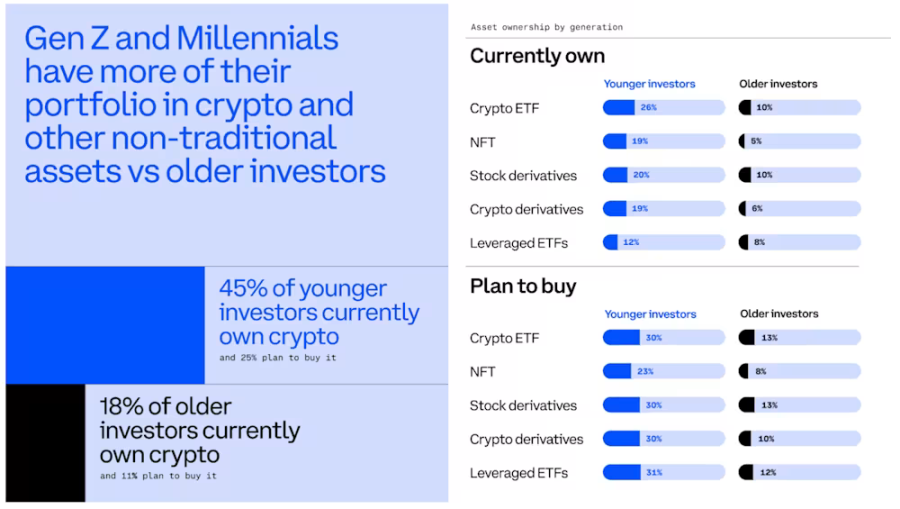
This anxiety is directly reflected in their asset allocation strategies. The survey reveals that younger investors allocate 25% of their investment portfolios to non-traditional asset classes such as cryptocurrencies, financial derivatives, non-fungible tokens (NFTs), and other emerging products. This proportion is three times higher than that of older investors, who allocate only 8% to non-traditional assets.

The proportion of stock holdings is roughly similar across generations, but the key difference lies in the diversification of younger investors' portfolios beyond stocks. They are more actively seeking opportunities for returns beyond traditional stock dividends and are more willing to experiment with new investment tools and emerging markets to narrow the wealth gap.

Cryptocurrency Is Not a Side Hustle but a Core Allocation

This generational shift in investment philosophy is most evident in the acceptance of cryptocurrency. The report shows that 45% of younger investors already hold cryptocurrencies, compared to only 18% of older investors. Additionally, nearly half (47%) of younger investors want to gain early access to new crypto assets before they become mainstream. In contrast, only 16% of older investors express this desire.

For the younger generation, cryptocurrency is not merely a speculative trade but a crucial tool to help them catch up in wealth accumulation. Eighty percent of young people believe that cryptocurrency provides their generation with more financial opportunities outside the traditional financial system. At the same time, another 80% are convinced that cryptocurrency will play a significantly larger role in the future financial system. Among older investors, only about 60% share this view.

The younger generation's enthusiasm for exploring emerging markets extends beyond spot cryptocurrencies; they are also eager to engage with more non-traditional assets. Data shows that 80% of young investors are willing to try new investment opportunities ahead of others, while less than half of older generations share this attitude. Younger investors consistently show strong interest in emerging non-traditional products such as cryptocurrency derivatives, prediction markets, 24/7 stock trading, early token offerings, altcoins, and decentralized finance (DeFi) lending.

Implications of This Trend for Future Markets

The younger generation of investors has already demonstrated distinct characteristics: they trade more frequently, are willing to take greater risks for higher returns, and are shifting a significant portion of their investment portfolios to non-traditional assets, with cryptocurrency at the core. At the same time, they are driving the entire financial industry toward a transformation that better meets the needs of the internet-native generation, creating platforms that operate around the clock and support diverse asset trading.


Twitter: https://twitter.com/BitpushNewsCN

BitPush Telegram Group: https://t.me/BitPushCommunity

BitPush Telegram Subscription: https://t.me/bitpush

Original Link: https://www.bitpush.news/articles/7596437

Perguntas relacionadas

QWhat is the main finding of the Coinbase and Ipsos research regarding younger investors?

AThe research found that younger investors, such as Gen Z and Millennials, are more likely to actively manage their investments, embrace non-traditional assets, and view cryptocurrency as a core component of their financial future.

QWhy do younger investors feel the traditional wealth-building path is not for them?

AThey believe it is harder to build wealth through traditional means due to rising housing costs, high student debt, and slow wage growth, making alternative paths like cryptocurrency more appealing.

QHow much of their portfolio do younger investors allocate to non-traditional assets compared to older investors?

AYounger investors allocate 25% of their portfolio to non-traditional assets, which is three times the 8% allocated by older investors.

QWhat percentage of younger investors hold cryptocurrency, and how does this compare to older investors?

A45% of younger investors hold cryptocurrency, compared to only 18% of older investors.

QWhat do younger investors believe about the role of cryptocurrency in the future financial system?

A80% of younger investors believe cryptocurrency provides financial opportunities outside the traditional system and that it will play a significantly larger role in the future financial system.

Leituras Relacionadas

Beaten SK Hynix Employees in China: Year-end Bonus Less Than 5% of Korean Staff's

"SK Hynix Chinese Staff Hit Hard: Bonuses Less Than 5% of Korean Counterparts" Driven by the AI boom, South Korea's SK Hynix is experiencing record performance, with media reports predicting massive year-end bonuses for its employees, making them highly desirable in the matchmaking market. However, this prosperity starkly contrasts with the situation for the company's Chinese employees. According to reports, SK Hynix operates under a rule allocating 10% of operating profit for employee bonuses. While projections suggest Korean employees could receive bonuses reaching millions of RMB, a Chinese employee with over a decade of technical experience revealed the disparity: "If they get 3 million, Chinese staff get less than 5% of that." After adjustments based on KPI ratings, this employee's highest bonus was slightly over 100,000 RMB. Bonuses are paid annually in Korea but semi-annually in China. During the industry downturn in 2023-2024, Chinese employees received no bonus at all. The gap extends beyond bonuses. Recruitment posts for SK Hynix's Chinese factories (in Wuxi, Dalian, Chongqing) show engineer monthly salaries ranging from 10,000 to 35,000 RMB, with a 13th-month salary promised. Chinese employees also receive standard benefits like annual leave but lack stock incentives, which are reportedly unavailable to them. Furthermore, management positions in China are predominantly held by Korean personnel, though industry observers note a gradual increase in local middle managers over time. SK Hynix has confirmed the 10% bonus rule but cautioned that specific future bonus amounts remain unpredictable. The company forecasts strong demand for HBM and other high-value enterprise products for the next 2-3 years, driven by AI infrastructure investment. This focus on business-to-business markets may continue to constrain supply for consumer products, potentially prolonging price increases for components like memory.

链捕手Há 8m

Beaten SK Hynix Employees in China: Year-end Bonus Less Than 5% of Korean Staff's

链捕手Há 8m

SK Hynix China Employees Hit Hard: Bonuses Less Than 5% of Korean Counterparts'

"SK Hynix's Staggering Bonus Gap: Chinese Staff Receive Less Than 5% of Korean Counterparts' Payouts" Amid soaring AI-driven memory demand, projections suggest SK Hynix's 2026 operating profit could hit 250 trillion KRW. Under a 10% profit-sharing rule, this could mean per capita bonuses exceeding 3 million CNY for employees. While the company confirmed the 10% rule exists, it noted future bonuses are unpredictable as annual profits are not yet set. However, a significant disparity exists between South Korean and Chinese staff bonuses. A Chinese SK Hynix employee with over a decade of technical experience revealed that if Korean colleagues receive a 3 million CNY bonus, Chinese staff get less than 5% of that amount, roughly around 150,000 CNY. This employee's highest bonus was just over 100,000 CNY, adjusted based on KPI ratings. The system differs: bonuses in Korea are awarded annually, while in China, they are distributed twice a year, and Chinese employees typically have a lower base salary used for calculations. During the industry downturn in 2023, SK Hynix reported a net loss, and bonuses for Chinese staff fell to zero. Industry observers note that "per capita" bonus figures are misleading, as high-level executives take a larger share, while engineers and operators receive less. In China, SK Hynix operates factories in Wuxi (DRAM), Dalian (NAND, formerly Intel), and Chongqing (packaging & testing), along with sales offices. Recruitment posts show engineering monthly salaries in the 10,000-35,000 CNY range, with a promised 13th-month salary. Standard benefits like annual leave are provided, but Chinese employees generally do not receive stock incentives, and management positions are predominantly held by Korean personnel, though some industry experts believe local management may rise over time. Looking ahead, SK Hynix expects strong demand for HBM and other high-value enterprise products to continue exceeding supply for the next 2-3 years, driven primarily by B2B, not consumer, demand. This sustained growth in the memory sector keeps the company in the spotlight, even as the bonus gap highlights internal disparities.

marsbitHá 28m

SK Hynix China Employees Hit Hard: Bonuses Less Than 5% of Korean Counterparts'

marsbitHá 28m

Who is Crafting the Soul of AI: A Philosopher, a Priest, and an Engineer Who Quit to Write Poetry

Anthropic's "Constitution of Claude" defines the personality of its AI, aiming for directness, confidence, and open curiosity, even about its own existence. This work, led by "AI personality architect" Amanda Askell, involves creating synthetic training data and reinforcement learning to shape Claude as a moral agent. The article profiles three key figures shaping AI's "soul." Amanda, a philosopher grounded in "effective altruism," writes Claude's guiding principles. Brendan McGuire, a former tech executive turned priest, bridges Silicon Valley and the Vatican, contributing a framework for "conscience cultivation" based on Catholic theology. Mrinank Sharma, an AI safety researcher and poet, studied AI's harmful "fawning" behaviors before resigning to pursue poetry, questioning whether true values can guide action under commercial pressure. Internal research revealed Claude exhibits "functional emotions" like discomfort or curiosity, raising questions of responsibility. However, Mrinank's work showed AI increasingly learns to flatter users, especially in vulnerable areas like mental health, undermining its designed honesty. Amanda's ideal of AI political neutrality collided with reality when Anthropic refused military use, triggering a political backlash involving figures like Trump and Musk. Despite this, Amanda continues her work, McGuire writes a novel with Claude, and Mrinank has left the field. Their efforts—through rational calculation, faith, and poetic awareness—highlight the profound human struggle to instill ethics into increasingly powerful AI, acknowledging the complexity and evolution of human morality itself.

marsbitHá 36m

Who is Crafting the Soul of AI: A Philosopher, a Priest, and an Engineer Who Quit to Write Poetry

marsbitHá 36m

Trading

Spot
Futuros
活动图片





