Bloomberg Terminal Earns Billions Annually from Data Intermediation, Now 6 Institutions Are Putting Data Directly On-Chain

marsbitPublicado em 2026-04-16Última atualização em 2026-04-16

Resumo

Six major financial institutions — Fidelity, Euronext, Tradeweb, OTC Markets Group, Singapore Exchange (Forex), and Exchange Data International — have begun publishing proprietary market data directly on-chain via Pyth Network. This move bypasses traditional data intermediaries like Bloomberg, which has long dominated the financial data market with annual revenues of approximately $10 billion from its terminal business alone. The shift enables developers on over 100 blockchains to access high-quality, real-time financial data — including ETF valuations, fixed income data, FX rates, and OTC securities — without long-term contracts, steep fees, or proprietary hardware. This development is critical for the scalability of real-world asset (RWA) tokenization in DeFi, as reliable, institutional-grade data must be available on-chain before assets can be traded or used as collateral in decentralized protocols. Pyth’s model differs from earlier oracle solutions like Chainlink by sourcing data directly from institutional traders and exchanges rather than aggregating from third-party sources. While this approach offers higher speed and accuracy, it also involves a more centralized network of known publishers. The move challenges the decades-old monopoly of data middlemen and could significantly reduce barriers to entry for developers building DeFi products tied to traditional financial markets.

Author: Thejaswini M A

Compiled by: Deep Tide TechFlow

Deep Tide Introduction: Six mainstream Wall Street institutions, including Fidelity, Euronext, and Tradeweb, have begun publishing market data directly onto the blockchain through Pyth, allowing any developer to access it for free. This breaks the 44-year monopoly model of data intermediaries like Bloomberg—no more two-year contracts, no more annual fees of $27,000, and no more dedicated keyboards. More importantly, this is a prerequisite for the true scaling of RWA (Real World Assets) in DeFi: data must be on-chain before assets.

In 1981, Michael Bloomberg was fired from Salomon Brothers. He was 39 years old at the time, had worked there for 15 years, and left with a $10 million severance package, deeply dissatisfied with how Wall Street handled information. His reaction to being fired, by any reasonable standard, was insane: he started showing up at Merrill Lynch's office every morning with coffee, wandering the halls, handing coffee to strangers, and explaining that he was going to build them a computer that knew everything. The traders took the coffee but were less certain about the computer.

Forty-four years later, each of these computers costs $27,000 per year. There are 350,000 of them globally, and Bloomberg earns approximately $10 billion annually from this business. Its entire structural genius lies in this: it inserted itself between the institutions that own the data and the people who need it, charging a toll for everything that passes through. The data was never Bloomberg's—Merrill Lynch had the data, Goldman Sachs had the data, every trading firm on Wall Street had the data. Bloomberg just built a tollbooth, convinced everyone that the tollbooth was the destination, and then raised prices every year because what could you do, go back to calling your broker?

This model withstood every technological change over four decades because no one could figure out a better distribution mechanism. Until last Wednesday.

On April 9, six institutions that had been feeding data into the tollbooth began publishing elsewhere: Euronext, Fidelity, Tradeweb, OTC Markets Group, Singapore Exchange's foreign exchange division, and Exchange Data International started publishing directly on-chain through Pyth's new data marketplace, accessible to any developer on 100 blockchains. You don't need a contract, a two-year minimum commitment, or a dedicated keyboard with yellow-green buttons.

Remember this: the funny thing about building a monopoly on other people's data is that those other people eventually notice.

The financial data industry is worth about $30 billion annually, one of the least discussed monopolies in the world, probably because the only people who care about it are the ones already paying for it.

Bloomberg controls about 33% of the global financial data market, with terminal business alone generating over $10 billion in annual revenue. Refinitiv, now acquired by the London Stock Exchange Group for $27 billion, holds about 20%. ICE Data Services reports market data revenue of $2.8 billion. Then there's FactSet, S&P Global, Morningstar, and some regional players serving niche markets. The top four suppliers combined control the vast majority of how financial data flows from generating institutions to demanding companies.
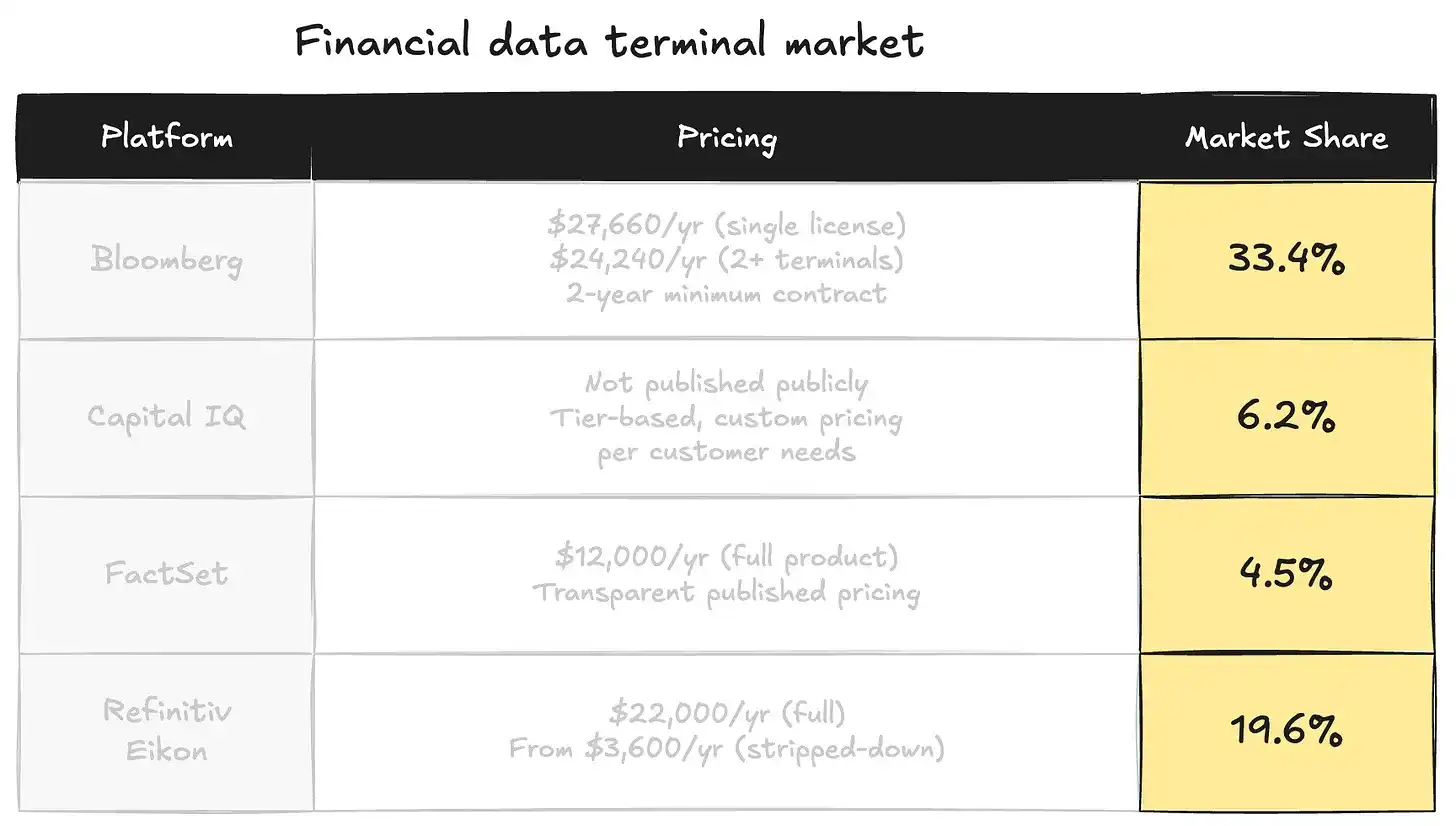
All these companies follow the same model. Institutions like exchanges, trading firms, banks, and asset managers generate pricing data as a byproduct of their work. They sell or license this data to suppliers. The suppliers package, standardize the data, add analytical tools on top, and then sell it to everyone else at a significant markup, with long-term contracts and proprietary access methods that make switching painful. Bloomberg subscriptions lock you in for two years. Canceling early costs 50% of the remaining contract value. And everything about the Bloomberg experience is designed to make leaving feel harder than staying. The keyboard is different. The data format is different. Even the messaging system that half of Wall Street uses to communicate with each other runs on Bloomberg, meaning switching terminals also means abandoning your contact list.

This has lasted forty years because suppliers solved a genuinely difficult problem: getting data from hundreds of sources, cleaning and standardizing it, and delivering it with low latency through global infrastructure. Bloomberg earned its place.

But blockchain is a better distribution mechanism. Maybe not for everything, and not yet at full scale. But for the specific problem of connecting institutions that have data with developers who want to build with it, a programmable, publicly accessible on-chain infrastructure is structurally superior to a proprietary terminal with a two-year contract. By turning data into an API without switching costs, you provide permissionless, self-service access to any developer on any chain. This is what Pyth is doing.

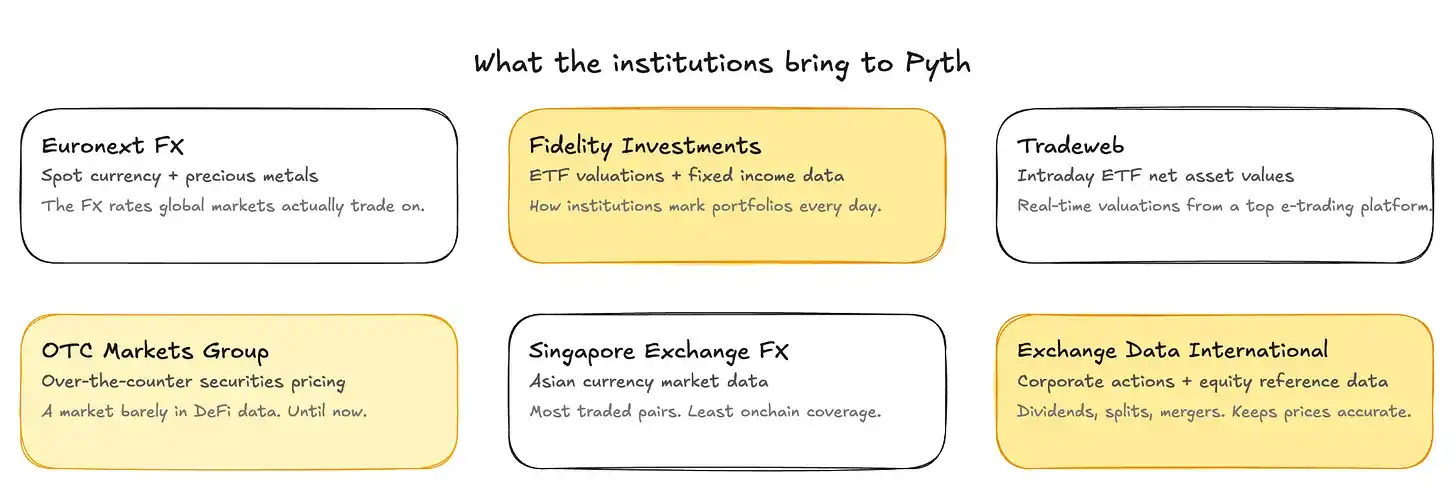
Euronext, Exchange Data International, Fidelity Investments, OTC Markets Group, Singapore Exchange's foreign exchange division, and Tradeweb are starting to publish their proprietary market data directly on-chain through Pyth's new data marketplace.

Euronext FX: Spot currencies and precious metals. Foreign exchange rates used for actual trading in global markets.

Fidelity: ETF valuations and fixed income data. Data used by institutions daily to mark their portfolios to market.

Tradeweb: Intraday ETF pricing. Real-time valuations from one of the largest electronic trading platforms.

OTC Markets Group: Over-the-counter securities. A market almost absent in today's DeFi data.

Singapore Exchange FX: Asian currency pairs. The largest but least on-chain covered foreign exchange market by trading volume.

Together, these six institutions cover a significant portion of asset classes that DeFi has never been able to reliably build because the data feeding these assets wasn't institutional-grade.
Why Data Must Precede Assets

Everyone in crypto has been talking about the tokenization wave for two years now: tokenized treasuries, tokenized bonds, tokenized stocks. The entire discussion assumes the hard part is putting the assets on-chain.

But the hard part is the data. Before you can trade tokenized treasuries in a DeFi protocol, you need to know what they are worth right now, down to the second, with the same accuracy that a Goldman Sachs trading desk uses to price this instrument. Before you can build lending protocols around real-world assets, you need continuously running price feeds from institutions that actually market-make, not scraped from a website and updated every few minutes.

DeFi protocols need accurate, real-time traditional financial data for derivatives, loans, and structured products, but have historically relied on limited or slower data sources. This is why DeFi has been mostly crypto-to-crypto since its inception. The data feeding these products wasn't reliable enough, fast enough, or from institutions with enough credibility in compliance conversations.

Pyth Pro, an institutional subscription tier launched by Pyth in September 2025, offers price feeds with 1-millisecond latency on over 2,200 instruments. Polymarket integrated Pyth Pro in April 2026 to settle new markets for traditional assets including major stock indices, commodities, and U.S. stocks, replacing manual or exchange-specific data sources with standardized data aggregated from over 125 trading firms. Hyperliquid now uses Pyth's price feeds to run perpetual contracts for oil and gold. Data quality is reaching a level where serious financial products can be built on top without apology.

The tokenization wave needs this layer to operate at scale. Without reliable fixed income price feeds, you cannot build reliable fixed income products on-chain.

The Oracle War

The original oracle problem in cryptocurrency was simple: smart contracts live on-chain, prices live off-chain. Something needed to connect the two. Chainlink was the dominant oracle for most of DeFi's history, solving this by running a large network of independent nodes that fetch prices from third-party sources (exchanges, aggregators, data APIs) and submit them on-chain. Many independent sources, many independent nodes, reasonable decentralization, acceptable latency.

Pyth took a different approach from the start, going directly to the institutions that are actually trading. Now over 120 institutions publish data through Pyth, including global exchanges, trading firms, and market makers. Jane Street doesn't secondhand describe the Bitcoin price to Pyth; it becomes a publisher. Data comes from the source, not from someone describing the source.

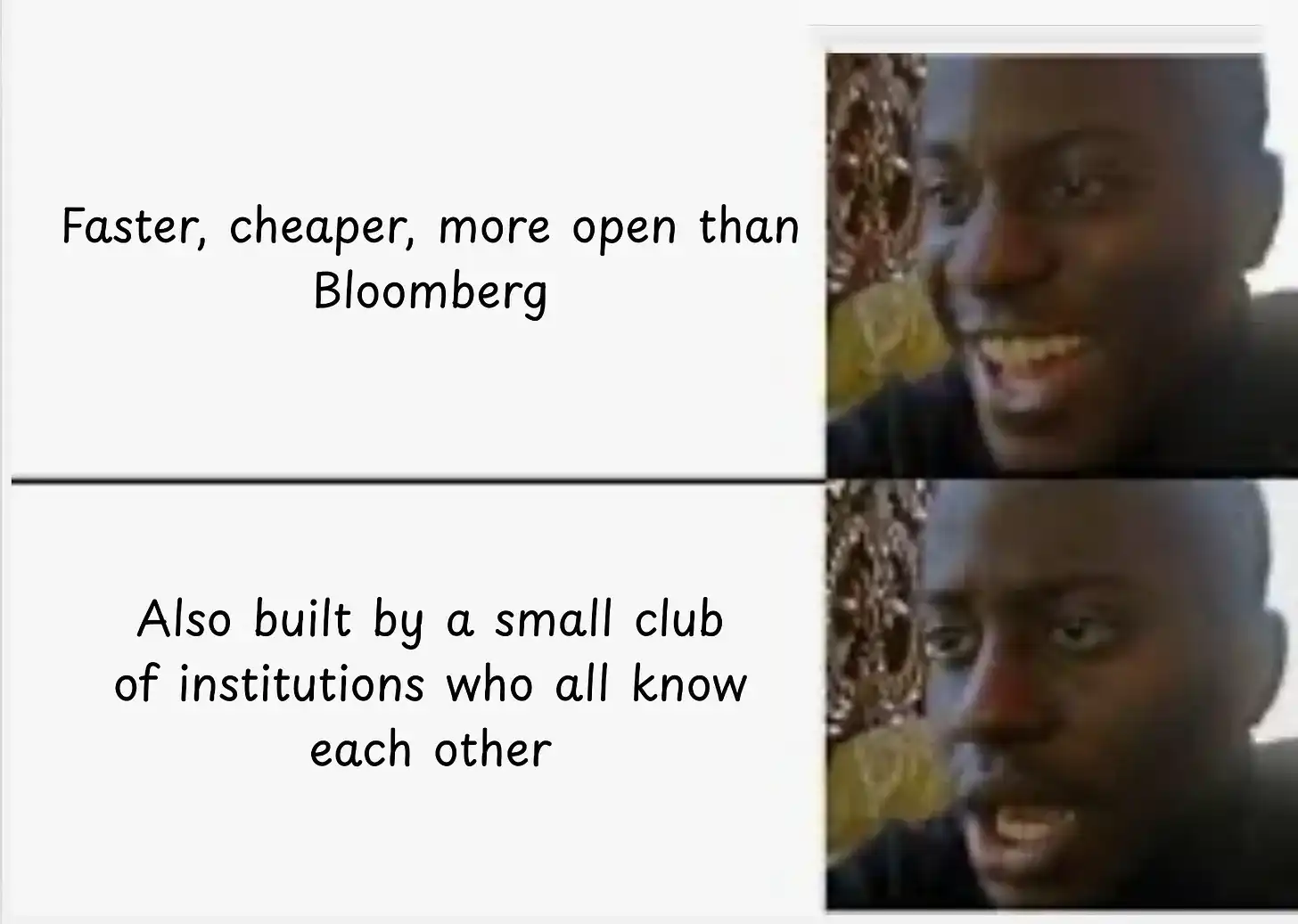
This is faster, more accurate, and more directly tied to real market activity than aggregated price feeds. In a structural sense, it's also more centralized: a smaller club of publishers who mostly know each other and validate their own data. Pyth has staking and slashing mechanisms designed to create economic incentives around accuracy. But a better way to put it is that Pyth chose speed and data quality over maximizing decentralization. For institutional finance, this might be the right trade-off.
The Cost of Centralization

Pyth was created with significant involvement from Jump Crypto, an organization that played a major role in the events of 2022, which most people in crypto prefer not to revisit. The publisher network is a small club, institutions mostly know each other and validate data amongst themselves. Staking and slashing mechanisms create economic incentives for accuracy, but Pyth is both faster and higher quality than what came before, and also more centralized than the marketing suggests. You are not replacing a monopoly with a commons. You are replacing one centralized system with another that happens to run on a blockchain.

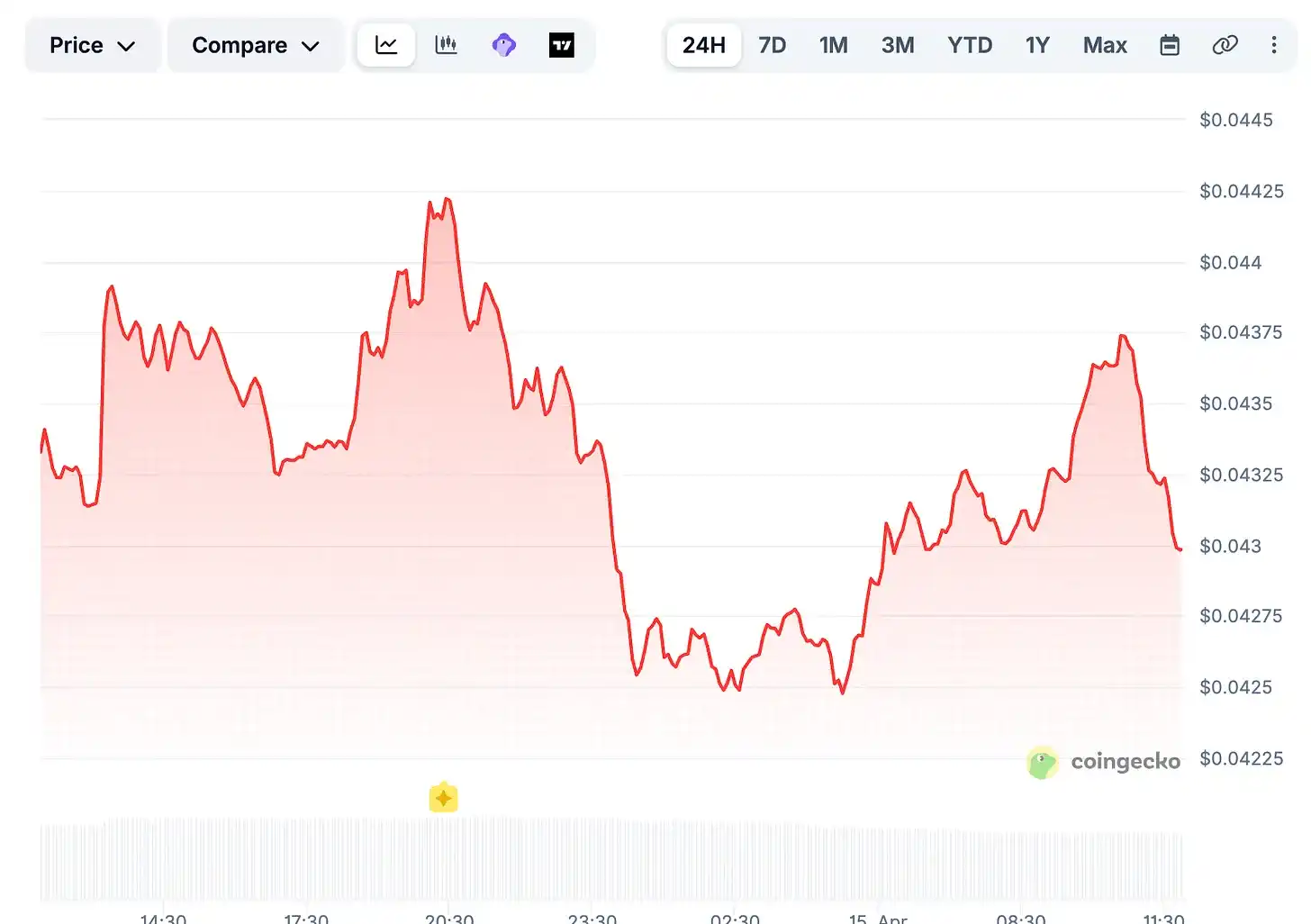
The PYTH token hit an all-time high of $1.20 in March 2024 and is currently trading around $0.046, down about 96% from its peak. The obvious reason: using Pyth's data does not require holding or buying PYTH. The network can grow significantly while the token remains range-bound, a known problem that Pyth's reserve plan is attempting to address, allocating a portion of protocol revenue for open market buybacks of PYTH.
The End of the Tollbooth

Getting data from the generating institution to the desk of the person who needs it requires hardware, proprietary networks, sales relationships, and ongoing support. Bloomberg solved all of this and charged accordingly. Data producers had no alternative distribution mechanism, so they sold their data to middlemen, who kept the profits. Blockchain eliminates that specific friction. Not the analysis, not the workflow, not the keyboard. Just the part where someone had to move data from one place to another and charge for the privilege.

But Bloomberg sells workflow. The terminal, the keyboard, the messaging system, the analysis, the support team. Traders build entire careers around it. Pyth sells none of that. It's the data layer that protocols plug into. The only overlapping part is the underlying data itself, and that part just moved.

This matters because if Fidelity publishes its ETF valuations on-chain, any developer anywhere can read that data without negotiating a license agreement, without paying $32,000 a year, without waiting for a supplier to standardize the format. Data becomes programmable infrastructure rather than a proprietary product. Institutions retain control over what they publish and keep the attribution. The middleman's job—moving data from source to user—becomes unnecessary.

These six institutions are choosing Pyth as a primary distribution channel, which is a different category of commitment than a pilot. Pilots get turned off when the advocate changes jobs. Primary distribution channels become operational dependencies.

Tokenized bonds, tokenized stocks, tokenized everything. Most of these are months or years away from meaningful scale. But the raw material that makes real-world asset products possible in DeFi is now available without contracts, without terminals, without two-year minimum commitments.

Michael Bloomberg spent months handing out free coffee in the halls of Merrill Lynch because the data he needed was locked inside institutions that had no reason to give it to him. He built an entire business on that friction.

The tollbooths won't disappear overnight. Every monopoly in data distribution ends the same way. Not with a fight, not with laws, not with a revolution. Mostly, someone somewhere asks why they are paying for something they already have.


Criptomoedas em alta

Perguntas relacionadas

QWhat is the core innovation that Pyth introduces to challenge Bloomberg's data monopoly?

APyth enables financial institutions to publish market data directly on-chain, allowing any developer to access it freely without contracts, fees, or proprietary hardware, replacing the centralized data distribution model with a permissionless, blockchain-based infrastructure.

QWhich six major institutions have started publishing data directly on-chain via Pyth's new data marketplace?

AThe six institutions are Euronext, Fidelity, Tradeweb, OTC Markets Group, Singapore Exchange Foreign Exchange, and Exchange Data International.

QWhy is high-quality, real-time data critical for the tokenization of real-world assets (RWA) in DeFi?

AAccurate, institutional-grade data is essential for pricing and trading tokenized assets like bonds or stocks reliably in DeFi protocols. Without real-time data from credible sources, building scalable and trustworthy financial products for traditional assets on-chain is impossible.

QHow does Pyth's approach to oracle data differ from Chainlink's model?

APyth sources data directly from institutional traders and exchanges (e.g., Jane Street) who are active market participants, ensuring data comes from the source. Chainlink aggregates data from multiple third-party sources and relies on a decentralized node network to submit prices on-chain.

QWhat challenges does the PYTH token face despite the growth of the Pyth network?

AThe PYTH token has declined significantly in value because using Pyth's data does not require holding or purchasing the token. Protocol usage can grow without directly impacting token demand, though Pyth's reserve plan aims to address this by allocating protocol revenue for token buybacks.

Leituras Relacionadas

Base Under Pressure

**Title: The Pressure Mounts for Base** Base, the Ethereum Layer 2 scaling solution backed by Coinbase, is facing significant pressure and public scrutiny from its leadership following the launch of Robinhood Chain. Base co-founder Jesse Pollak recently acknowledged strategic missteps, admitting that the chain's past focus on social and creator tokens (e.g., through Farcaster, Zora) failed to deliver sustainable adoption. He has refocused on core infrastructure, handing leadership of the Base App back to Coinbase's Cobie. While Base remains a top L2 contender alongside OP Mainnet and Arbitrum, and boasts the highest TVL (nearly $12B), its weaknesses are being highlighted by the new competitor. Key criticisms include its slow progress on decentralization. Base has faced issues with its single sequencer causing block production halts, and L2BEAT is reportedly considering downgrading its decentralization rating from Stage 1 to Stage 0. This contrasts sharply with the rapid initial success of Robinhood Chain, whose DEX quickly entered the top five by volume. The leadership styles of the parent companies are also being compared: Robinhood's CEO actively engages with new projects, while a recent incident where Coinbase's Brian Armstrong briefly changed his profile picture—sparking and then crashing a related meme token—drew community ire and mockery. Pollak stated Base is working with Coinbase on tokenized stocks backed 1:1 by real equity, differentiating it from Robinhood's derivatives model. However, the article argues that Base's most urgent task is to address its long-standing technical and trust issues. With more traditional finance players likely to emulate Robinhood's path, Base must use this competitive pressure to solidify its position as long-term financial infrastructure.

Foresight NewsHá 10m

Base Under Pressure

Foresight NewsHá 10m

White House Concession Removes Ethical Hurdle, Clarity Act Races Against Final Window Before Recess?

On July 21st, industry sources reported that the Trump administration has agreed to include an ethics provision in the "Clarity Act" (Digital Asset Market Clarity Act of 2025). This concession addresses the long-standing conflict-of-interest concerns regarding government officials and the crypto industry, potentially removing the final major obstacle to the bill's progress. Additionally, Patrick Witt, the executive director of the White House's Digital Asset Advisory Committee, confirmed he will remain in his role to help finalize the bill, alleviating previous concerns about his potential departure. The Clarity Act aims to establish a unified federal regulatory framework for the U.S. digital asset market. Its core objective is to resolve regulatory ambiguity by defining different types of digital assets (digital commodities, investment contract assets, and permitted payment stablecoins) and clarifying the respective oversight roles of the SEC and CFTC. This would end the long-running jurisdictional dispute between the two agencies and provide clearer compliance paths for the industry. With the ethics issue moving toward resolution, the most urgent challenge now is time. The U.S. Congress is set to begin its August recess in mid-August, leaving only a few working weeks to finalize the text and advance the bill through the Senate. Industry advocates, like the Blockchain Association's Kristin Smith, stress that this is a critical moment. If negotiations conclude successfully in the coming weeks, the Clarity Act could pass a key hurdle before the recess; otherwise, it may face significant delays. If enacted, the Clarity Act could mark a historic turning point in crypto regulation. By providing a clearer and more predictable legal framework, it aims to reduce uncertainty for businesses, developers, and traditional financial institutions looking to enter the digital asset space, potentially setting a global benchmark for market structure regulation.

Odaily星球日报Há 16m

White House Concession Removes Ethical Hurdle, Clarity Act Races Against Final Window Before Recess?

Odaily星球日报Há 16m

AI Era, Industrial Revolution, and Future Civilization Interview — Zhang Dingwen: The Future Does Not Belong to Chasers

"AI Era, Industrial Revolution and Future Civilization: An Interview with Zhang Dingwen – The Future Does Not Belong to Those Who Chase" In this interview, entrepreneur Zhang Dingwen reflects on his entrepreneurial journey and philosophy, moving beyond discussions of financing or success to emphasize understanding the "era" itself. He argues that true entrepreneurs should not chase short-term trends ("winds"), but position themselves in the direction of long-term technological and societal evolution. Zhang shares key lessons from his early days, including the realization that user value does not automatically translate to commercial value. For him, the core of entrepreneurship is not building a company but constantly upgrading one's own "cognition" – the ability to interpret information, ask the right questions, and understand the underlying "causes" behind business outcomes, not just the effects. His thinking has evolved from a focus on creating good products to a strategic focus on building "entrances" – platforms that naturally connect users to digital services. He sees smart wearables, like watches, not merely as hardware but as potential future gateways combining technological, financial, social, and even fashion attributes to create sustained user relationships and ecosystems. Ultimately, Zhang's vision transcends individual products or companies. He discusses business competition in three stages: product, platform, and finally, "civilization" – where the greatest companies influence how society operates by defining new rules and ways of life. He believes the mission of a truly great enterprise is to solve problems of its time, build enduring trust, and contribute lasting value, leaving behind not just wealth but a positive impact on how the world works. The future, he concludes, belongs not to the fastest, but to those with the correct long-term direction and a commitment to continuous learning and evolution.

marsbitHá 27m

AI Era, Industrial Revolution, and Future Civilization Interview — Zhang Dingwen: The Future Does Not Belong to Chasers

marsbitHá 27m

Cryptocurrency & Stock Market Barometer丨Strategy Cash Reserves Increase to $3.23 Billion, Halting BTC Purchases; Vanguard and Other Asset Managers Increase Holdings in Strategy Stock (July 21)

Market Overview & Warnings: The article warns of high volatility in South Korean stocks and continued dependence on U.S. stocks on geopolitics. Chinese A-shares remain under pressure. It advises against using leverage in current equity markets. For crypto-linked stocks, most have limited growth except Robinhood, with caution advised. U.S. Stock Market: Bearish bets on U.S. stocks, particularly targeting AI-related companies, have reached record highs since 2010, signaling deep skepticism about the sustainability of the AI-driven rally. Tech and chip stocks led a market decline, with the Philadelphia Semiconductor Index potentially entering a bear market. Increased expectations for Federal Reserve interest rate hikes and geopolitical tensions contributed to the negative sentiment. Bitcoin Treasury Company Updates: * Strategy: Increased its cash reserves to $3.23 billion and paused Bitcoin purchases. Several major asset managers, including Vanguard Group and Capital Group, increased their holdings of Strategy (MSTR) stock. * Global corporate Bitcoin buying slowed significantly to just $1.33 million last week. * Other notable activity: Strive purchased 21 BTC; ORANGE JUICE raised $40 million for Bitcoin acquisitions; Bitcoin Japan Corp. raised $60 million, allocating $4.08 million for its first BTC purchase. Other Crypto Treasury Holdings: * Ethereum: BitMine increased its ETH holdings to 5.78 million, nearing its 5% of supply goal. Its total crypto assets, cash, and securities are valued at $11.5 billion. * Solana: No significant corporate treasury activity reported. * Altcoins: HypeStrat made no adjustments to its treasury; its mNAV ratio fell to a long-term low. (Note: This summary is for informational purposes only and does not constitute investment advice.)

marsbitHá 28m

Cryptocurrency & Stock Market Barometer丨Strategy Cash Reserves Increase to $3.23 Billion, Halting BTC Purchases; Vanguard and Other Asset Managers Increase Holdings in Strategy Stock (July 21)

marsbitHá 28m

Trading

Spot

Artigos em Destaque

O que é $S$

Compreender o SPERO: Uma Visão Abrangente Introdução ao SPERO À medida que o panorama da inovação continua a evoluir, o surgimento de tecnologias web3 e projetos de criptomoeda desempenha um papel fundamental na formação do futuro digital. Um projeto que tem atraído atenção neste campo dinâmico é o SPERO, denotado como SPERO,$$s$. Este artigo tem como objetivo reunir e apresentar informações detalhadas sobre o SPERO, para ajudar entusiastas e investidores a compreender as suas bases, objetivos e inovações nos domínios web3 e cripto. O que é o SPERO,$$s$? O SPERO,$$s$ é um projeto único dentro do espaço cripto que procura aproveitar os princípios da descentralização e da tecnologia blockchain para criar um ecossistema que promove o envolvimento, a utilidade e a inclusão financeira. O projeto é concebido para facilitar interações peer-to-peer de novas maneiras, proporcionando aos utilizadores soluções e serviços financeiros inovadores. No seu núcleo, o SPERO,$$s$ visa capacitar indivíduos ao fornecer ferramentas e plataformas que melhoram a experiência do utilizador no espaço das criptomoedas. Isso inclui a possibilidade de métodos de transação mais flexíveis, a promoção de iniciativas impulsionadas pela comunidade e a criação de caminhos para oportunidades financeiras através de aplicações descentralizadas (dApps). A visão subjacente do SPERO,$$s$ gira em torno da inclusão, visando fechar lacunas dentro das finanças tradicionais enquanto aproveita os benefícios da tecnologia blockchain. Quem é o Criador do SPERO,$$s$? A identidade do criador do SPERO,$$s$ permanece algo obscura, uma vez que existem recursos publicamente disponíveis limitados que fornecem informações detalhadas sobre o(s) seu(s) fundador(es). Esta falta de transparência pode resultar do compromisso do projeto com a descentralização—uma ética que muitos projetos web3 partilham, priorizando contribuições coletivas em vez de reconhecimento individual. Ao centrar as discussões em torno da comunidade e dos seus objetivos coletivos, o SPERO,$$s$ incorpora a essência do empoderamento sem destacar indivíduos específicos. Assim, compreender a ética e a missão do SPERO é mais importante do que identificar um criador singular. Quem são os Investidores do SPERO,$$s$? O SPERO,$$s$ é apoiado por uma diversidade de investidores que vão desde capitalistas de risco a investidores-anjo dedicados a promover a inovação no setor cripto. O foco desses investidores geralmente alinha-se com a missão do SPERO—priorizando projetos que prometem avanço tecnológico social, inclusão financeira e governança descentralizada. Essas fundações de investidores estão tipicamente interessadas em projetos que não apenas oferecem produtos inovadores, mas que também contribuem positivamente para a comunidade blockchain e os seus ecossistemas. O apoio desses investidores reforça o SPERO,$$s$ como um concorrente notável no domínio em rápida evolução dos projetos cripto. Como Funciona o SPERO,$$s$? O SPERO,$$s$ emprega uma estrutura multifacetada que o distingue de projetos de criptomoeda convencionais. Aqui estão algumas das características-chave que sublinham a sua singularidade e inovação: Governança Descentralizada: O SPERO,$$s$ integra modelos de governança descentralizada, capacitando os utilizadores a participar ativamente nos processos de tomada de decisão sobre o futuro do projeto. Esta abordagem promove um sentido de propriedade e responsabilidade entre os membros da comunidade. Utilidade do Token: O SPERO,$$s$ utiliza o seu próprio token de criptomoeda, concebido para servir várias funções dentro do ecossistema. Esses tokens permitem transações, recompensas e a facilitação de serviços oferecidos na plataforma, melhorando o envolvimento e a utilidade gerais. Arquitetura em Camadas: A arquitetura técnica do SPERO,$$s$ suporta modularidade e escalabilidade, permitindo a integração contínua de funcionalidades e aplicações adicionais à medida que o projeto evolui. Esta adaptabilidade é fundamental para manter a relevância no panorama cripto em constante mudança. Envolvimento da Comunidade: O projeto enfatiza iniciativas impulsionadas pela comunidade, empregando mecanismos que incentivam a colaboração e o feedback. Ao nutrir uma comunidade forte, o SPERO,$$s$ pode melhor atender às necessidades dos utilizadores e adaptar-se às tendências do mercado. Foco na Inclusão: Ao oferecer taxas de transação baixas e interfaces amigáveis, o SPERO,$$s$ visa atrair uma base de utilizadores diversificada, incluindo indivíduos que anteriormente podem não ter participado no espaço cripto. Este compromisso com a inclusão alinha-se com a sua missão abrangente de empoderamento através da acessibilidade. Cronologia do SPERO,$$s$ Compreender a história de um projeto fornece insights cruciais sobre a sua trajetória de desenvolvimento e marcos. Abaixo está uma cronologia sugerida que mapeia eventos significativos na evolução do SPERO,$$s$: Fase de Conceituação e Ideação: As ideias iniciais que formam a base do SPERO,$$s$ foram concebidas, alinhando-se de perto com os princípios de descentralização e foco na comunidade dentro da indústria blockchain. Lançamento do Whitepaper do Projeto: Após a fase conceitual, um whitepaper abrangente detalhando a visão, os objetivos e a infraestrutura tecnológica do SPERO,$$s$ foi lançado para atrair o interesse e o feedback da comunidade. Construção da Comunidade e Primeiros Envolvimentos: Esforços ativos de divulgação foram feitos para construir uma comunidade de primeiros adotantes e investidores potenciais, facilitando discussões em torno dos objetivos do projeto e angariando apoio. Evento de Geração de Tokens: O SPERO,$$s$ realizou um evento de geração de tokens (TGE) para distribuir os seus tokens nativos a apoiantes iniciais e estabelecer liquidez inicial dentro do ecossistema. Lançamento da dApp Inicial: A primeira aplicação descentralizada (dApp) associada ao SPERO,$$s$ foi lançada, permitindo que os utilizadores interagissem com as funcionalidades principais da plataforma. Desenvolvimento Contínuo e Parcerias: Atualizações e melhorias contínuas nas ofertas do projeto, incluindo parcerias estratégicas com outros players no espaço blockchain, moldaram o SPERO,$$s$ em um jogador competitivo e em evolução no mercado cripto. Conclusão O SPERO,$$s$ é um testemunho do potencial do web3 e das criptomoedas para revolucionar os sistemas financeiros e capacitar indivíduos. Com um compromisso com a governança descentralizada, o envolvimento da comunidade e funcionalidades inovadoras, abre caminho para um panorama financeiro mais inclusivo. Como em qualquer investimento no espaço cripto em rápida evolução, potenciais investidores e utilizadores são incentivados a pesquisar minuciosamente e a envolver-se de forma ponderada com os desenvolvimentos em curso dentro do SPERO,$$s$. O projeto demonstra o espírito inovador da indústria cripto, convidando a uma exploração mais aprofundada das suas inúmeras possibilidades. Embora a jornada do SPERO,$$s$ ainda esteja a desenrolar-se, os seus princípios fundamentais podem, de facto, influenciar o futuro de como interagimos com a tecnologia, as finanças e uns com os outros em ecossistemas digitais interconectados.

119 Visualizações TotaisPublicado em {updateTime}Atualizado em 2024.12.17

O que é $S$

O que é AGENT S

Agent S: O Futuro da Interação Autónoma no Web3 Introdução No panorama em constante evolução do Web3 e das criptomoedas, as inovações estão constantemente a redefinir a forma como os indivíduos interagem com plataformas digitais. Um projeto pioneiro, o Agent S, promete revolucionar a interação humano-computador através do seu framework aberto e agente. Ao abrir caminho para interações autónomas, o Agent S visa simplificar tarefas complexas, oferecendo aplicações transformadoras em inteligência artificial (IA). Esta exploração detalhada irá aprofundar-se nas complexidades do projeto, nas suas características únicas e nas implicações para o domínio das criptomoedas. O que é o Agent S? O Agent S é um framework aberto e agente, especificamente concebido para abordar três desafios fundamentais na automação de tarefas computacionais: Aquisição de Conhecimento Específico de Domínio: O framework aprende inteligentemente a partir de várias fontes de conhecimento externas e experiências internas. Esta abordagem dupla capacita-o a construir um rico repositório de conhecimento específico de domínio, melhorando o seu desempenho na execução de tarefas. Planeamento ao Longo de Longos Horizontes de Tarefas: O Agent S emprega planeamento hierárquico aumentado por experiência, uma abordagem estratégica que facilita a decomposição e execução eficientes de tarefas intrincadas. Esta característica melhora significativamente a sua capacidade de gerir múltiplas subtarefas de forma eficiente e eficaz. Gestão de Interfaces Dinâmicas e Não Uniformes: O projeto introduz a Interface Agente-Computador (ACI), uma solução inovadora que melhora a interação entre agentes e utilizadores. Utilizando Modelos de Linguagem Multimodais de Grande Escala (MLLMs), o Agent S pode navegar e manipular diversas interfaces gráficas de utilizador de forma fluida. Através destas características pioneiras, o Agent S fornece um framework robusto que aborda as complexidades envolvidas na automação da interação humana com máquinas, preparando o terreno para uma infinidade de aplicações em IA e além. Quem é o Criador do Agent S? Embora o conceito de Agent S seja fundamentalmente inovador, informações específicas sobre o seu criador permanecem elusivas. O criador é atualmente desconhecido, o que destaca ou o estágio nascente do projeto ou a escolha estratégica de manter os membros fundadores em anonimato. Independentemente da anonimidade, o foco permanece nas capacidades e no potencial do framework. Quem são os Investidores do Agent S? Como o Agent S é relativamente novo no ecossistema criptográfico, informações detalhadas sobre os seus investidores e financiadores não estão explicitamente documentadas. A falta de informações disponíveis publicamente sobre as fundações de investimento ou organizações que apoiam o projeto levanta questões sobre a sua estrutura de financiamento e roteiro de desenvolvimento. Compreender o apoio é crucial para avaliar a sustentabilidade do projeto e o seu impacto potencial no mercado. Como Funciona o Agent S? No núcleo do Agent S reside uma tecnologia de ponta que lhe permite funcionar eficazmente em diversos ambientes. O seu modelo operacional é construído em torno de várias características-chave: Interação Humano-Computador Semelhante: O framework oferece planeamento avançado em IA, esforçando-se para tornar as interações com computadores mais intuitivas. Ao imitar o comportamento humano na execução de tarefas, promete elevar as experiências dos utilizadores. Memória Narrativa: Utilizada para aproveitar experiências de alto nível, o Agent S utiliza memória narrativa para acompanhar os históricos de tarefas, melhorando assim os seus processos de tomada de decisão. Memória Episódica: Esta característica fornece aos utilizadores orientações passo a passo, permitindo que o framework ofereça suporte contextual à medida que as tarefas se desenrolam. Suporte para OpenACI: Com a capacidade de funcionar localmente, o Agent S permite que os utilizadores mantenham o controlo sobre as suas interações e fluxos de trabalho, alinhando-se com a ética descentralizada do Web3. Fácil Integração com APIs Externas: A sua versatilidade e compatibilidade com várias plataformas de IA garantem que o Agent S possa integrar-se perfeitamente em ecossistemas tecnológicos existentes, tornando-o uma escolha apelativa para desenvolvedores e organizações. Estas funcionalidades contribuem coletivamente para a posição única do Agent S no espaço cripto, à medida que automatiza tarefas complexas e em múltiplos passos com mínima intervenção humana. À medida que o projeto evolui, as suas potenciais aplicações no Web3 podem redefinir a forma como as interações digitais se desenrolam. Cronologia do Agent S O desenvolvimento e os marcos do Agent S podem ser encapsulados numa cronologia que destaca os seus eventos significativos: 27 de Setembro de 2024: O conceito de Agent S foi lançado num artigo de pesquisa abrangente intitulado “Um Framework Agente Aberto que Usa Computadores como um Humano”, mostrando a base para o projeto. 10 de Outubro de 2024: O artigo de pesquisa foi disponibilizado publicamente no arXiv, oferecendo uma exploração aprofundada do framework e da sua avaliação de desempenho com base no benchmark OSWorld. 12 de Outubro de 2024: Uma apresentação em vídeo foi lançada, proporcionando uma visão visual das capacidades e características do Agent S, envolvendo ainda mais potenciais utilizadores e investidores. Estes marcos na cronologia não apenas ilustram o progresso do Agent S, mas também indicam o seu compromisso com a transparência e o envolvimento da comunidade. Pontos-Chave Sobre o Agent S À medida que o framework Agent S continua a evoluir, várias características-chave destacam-se, sublinhando a sua natureza inovadora e potencial: Framework Inovador: Concebido para proporcionar um uso intuitivo de computadores semelhante à interação humana, o Agent S traz uma abordagem nova à automação de tarefas. Interação Autónoma: A capacidade de interagir autonomamente com computadores através de GUI significa um avanço em direção a soluções computacionais mais inteligentes e eficientes. Automação de Tarefas Complexas: Com a sua metodologia robusta, pode automatizar tarefas complexas e em múltiplos passos, tornando os processos mais rápidos e menos propensos a erros. Melhoria Contínua: Os mecanismos de aprendizagem permitem que o Agent S melhore a partir de experiências passadas, aprimorando continuamente o seu desempenho e eficácia. Versatilidade: A sua adaptabilidade em diferentes ambientes operacionais, como OSWorld e WindowsAgentArena, garante que pode servir uma ampla gama de aplicações. À medida que o Agent S se posiciona no panorama do Web3 e das criptomoedas, o seu potencial para melhorar as capacidades de interação e automatizar processos significa um avanço significativo nas tecnologias de IA. Através do seu framework inovador, o Agent S exemplifica o futuro das interações digitais, prometendo uma experiência mais fluida e eficiente para os utilizadores em diversas indústrias. Conclusão O Agent S representa um ousado avanço na união da IA e do Web3, com a capacidade de redefinir a forma como interagimos com a tecnologia. Embora ainda esteja nas suas fases iniciais, as possibilidades para a sua aplicação são vastas e cativantes. Através do seu framework abrangente que aborda desafios críticos, o Agent S visa trazer interações autónomas para o primeiro plano da experiência digital. À medida que avançamos mais profundamente nos domínios das criptomoedas e da descentralização, projetos como o Agent S desempenharão, sem dúvida, um papel crucial na formação do futuro da tecnologia e da colaboração humano-computador.

734 Visualizações TotaisPublicado em {updateTime}Atualizado em 2025.01.14

O que é AGENT S

Como comprar S

Bem-vindo à HTX.com!Tornámos a compra de Sonic (S) simples e conveniente.Segue o nosso guia passo a passo para iniciar a tua jornada no mundo das criptos.Passo 1: cria a tua conta HTXUtiliza o teu e-mail ou número de telefone para te inscreveres numa conta gratuita na HTX.Desfruta de um processo de inscrição sem complicações e desbloqueia todas as funcionalidades.Obter a minha contaPasso 2: vai para Comprar Cripto e escolhe o teu método de pagamentoCartão de crédito/débito: usa o teu visa ou mastercard para comprar Sonic (S) instantaneamente.Saldo: usa os fundos da tua conta HTX para transacionar sem problemas.Terceiros: adicionamos métodos de pagamento populares, como Google Pay e Apple Pay, para aumentar a conveniência.P2P: transaciona diretamente com outros utilizadores na HTX.Mercado de balcão (OTC): oferecemos serviços personalizados e taxas de câmbio competitivas para os traders.Passo 3: armazena teu Sonic (S)Depois de comprar o teu Sonic (S), armazena-o na tua conta HTX.Alternativamente, podes enviá-lo para outro lugar através de transferência blockchain ou usá-lo para transacionar outras criptomoedas.Passo 4: transaciona Sonic (S)Transaciona facilmente Sonic (S) no mercado à vista da HTX.Acede simplesmente à tua conta, seleciona o teu par de trading, executa as tuas transações e monitoriza em tempo real.Oferecemos uma experiência de fácil utilização tanto para principiantes como para traders experientes.

1.3k Visualizações TotaisPublicado em {updateTime}Atualizado em 2026.06.02

Como comprar S

Discussões

Bem-vindo à Comunidade HTX. Aqui, pode manter-se informado sobre os mais recentes desenvolvimentos da plataforma e obter acesso a análises profissionais de mercado. As opiniões dos utilizadores sobre o preço de S (S) são apresentadas abaixo.

活动图片