Blockchain Is South Korea’s New Fiscal Weapon — A Blow To Privacy?

bitcoinistPublicado em 2026-04-16Última atualização em 2026-04-16

Resumo

South Korea is launching a pilot program to replace government expense credit cards with blockchain-based deposit tokens for treasury fund execution. This initiative, led by the Ministry of Finance and Economy, builds on a previous project with the Ministry of Environment. Deposit tokens are digital representations of bank deposits on permissioned blockchains, enabling programmable settlement, transparent tracking, and real-time reporting. Unlike CBDCs, they are issued by commercial banks. The pilot aims to enhance spending transparency, reduce intermediaries, and eliminate card-processing fees for small merchants. While improving efficiency, it raises privacy concerns. If successful, South Korea could become a model for blockchain-based fiscal systems.

South Korea is kicking off a pilot that will replace government expense credit cards with blockchain‐based deposit tokens.

Blockchain Goes TradFi?

The Ministry of Finance and Economy announced on an official press release that the pilot project for the execution of national treasury funds using blockchain‐based digital currency has been approved.

This new official venture marks the second time in which South Korea’s government uses digital currency and deposit tokens for the execution of national treasury funds, following another pilot project for building electric‐vehicle charging facilities and paying national subsidies together with the Ministry of Environment.

Deposit tokens are digital claims on commercial bank deposits, issued on permissioned blockchain rails, spendable by citizens and companies at participating merchants and service providers.

In simpler words, deposit tokens are digital versions of the money already kept in a normal bank account. The bank “wraps” those deposits into tokens on a private (permissioned) blockchain, and you can then spend those tokens at approved shops or service providers, just like using a card or mobile wallet.

In contrast with Central Bank Digital Currencies (CBDCs), that are digital versions of a country’s official money, created and managed directly by its central bank, deposit tokens have programmable settlement, transparent tracking of public money, and real‐time reporting for the state.

Pilot Details

The press release states that under the current National Treasury Funds Management Act, business promotion costs and related operating expenses are required to be paid with government purchase cards, effectively blocking the use of deposit tokens. Thanks to the new regulatory sandbox, those same payments can now be made with deposit tokens, creating a real‐world testbed for a new government payment and settlement method.

The new pilot is expected to serve as an opportunity to put blockchain‐based fiscal execution on a full footing and eliminate frictions in the current card‐payment setup by using blockchain’s built‐in transparency.

Quoting the press release, translated by Bitcoinist:

This pilot will allow us to preset and manage in advance the spending time and permitted business categories when business promotion expenses are executed using deposit tokens that leverage blockchain technology. This is not only expected to improve the transparency of spending but, by eliminating intermediaries in the payment structure, completely remove card‐processing fees borne by small merchants.

A Trade-Off For Traders

South Korea continues moving ahead with its Digital Asset Basic Act, a broad crypto rulebook that will set standards for stablecoins, tokenized real‐world assets, and crypto ETFs in the local market. A few weeks ago, the National Policy Committee of Korea pushed the “second‐phase” of the debate until after the June 3 local elections.

The trade‐off for South Korean traders is evident: they gain efficiency and control vs. losing some privacy and risking potential overreach. It is safe to expect tailwind for bank‐chain infrastructure, permissioned blockchain providers, and tokenization narratives.

Future “state money on chain” flows may favor bank‐issued tokens over fully open stablecoins, which could reshape liquidity, FX corridors, and on‐chain yield strategies.

If the pilot scales, South Korea could become the reference model for how blockchains handle real‐world fiscal flows.
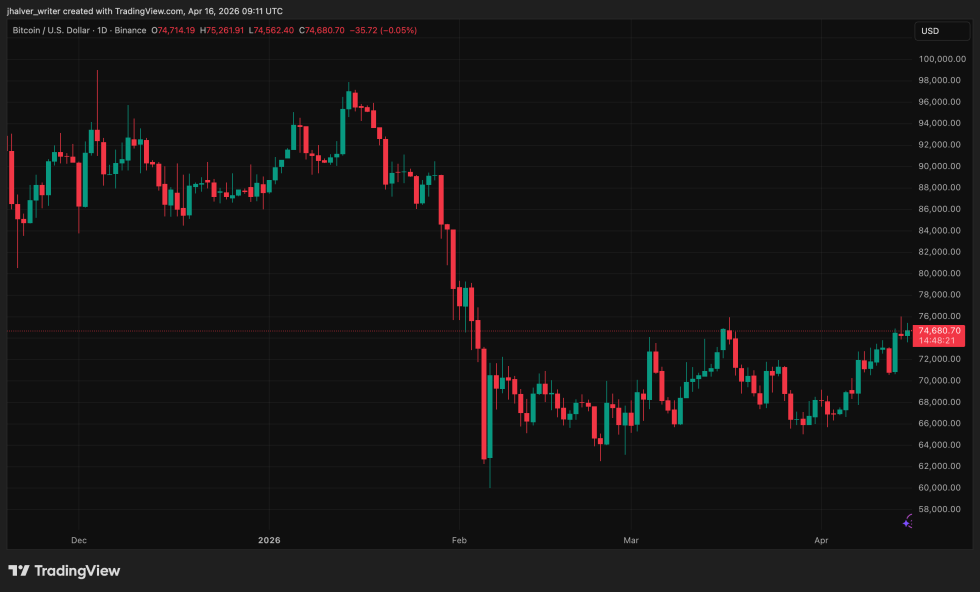
At the moment of writing, BTC trades for the highs $74ks on the daily chart. Source: BTCUSD on Tradingview.

Cover image from Perplexity. BTCUSD chart from Tradingview.

Perguntas relacionadas

QWhat is the South Korean government piloting to replace government expense credit cards?

AThe South Korean government is piloting the use of blockchain-based deposit tokens to replace government expense credit cards.

QHow do deposit tokens differ from Central Bank Digital Currencies (CBDCs)?

ADeposit tokens are digital claims on commercial bank deposits issued on permissioned blockchains, while CBDCs are digital versions of a country's official money created and managed directly by its central bank. Deposit tokens offer programmable settlement, transparent tracking, and real-time reporting.

QWhat are the expected benefits of using blockchain-based deposit tokens for government spending according to the press release?

AThe benefits include improved spending transparency by allowing preset management of spending time and permitted business categories, and the elimination of card-processing fees for small merchants by removing intermediaries.

QWhat is the potential trade-off mentioned for South Korean traders in adopting this system?

AThe trade-off is that traders gain efficiency and control but may lose some privacy and risk potential government overreach.

QWhat broader legislative framework is South Korea advancing alongside this pilot project?

ASouth Korea is advancing the Digital Asset Basic Act, a comprehensive crypto rulebook that will set standards for stablecoins, tokenized real-world assets, and crypto ETFs in the local market.

Leituras Relacionadas

Winter for Crypto IPOs: Consensys and Ledger Withdraw Applications

The crypto IPO window is tightening significantly in 2026, marked by prominent companies delaying or pausing their public listing plans. Following a successful 2025 "harvest year" that saw Circle, Bullish, and Gemini go public amidst a bull market, the tide has turned. Consensys, developer of MetaMask, recently postponed its IPO until at least fall 2026. Hardware wallet leader Ledger also suspended its planned US listing due to unfavorable market conditions, with Kraken having previously delayed its own plans. This shift is driven by a cooling market in 2026, characterized by a significant Bitcoin price correction, declining trading volumes, and reduced investor risk appetite for crypto stocks. The poor post-IPO performance of 2025 listings like Circle and Bullish, which saw major share price declines, has heightened investor caution. This contrasts sharply with the current AI sector, where companies like SpaceX, OpenAI, and Anthropic are commanding massive valuations and investor enthusiasm based on narratives of stable, exponential growth. Crypto companies now face pressure to transition from hype-driven models to demonstrating reliable cash flows and robust compliance. While the paused IPO plans may lead to valuation resets and affect ecosystem liquidity, they also accelerate industry consolidation toward stronger, more compliant infrastructure players. A potential recovery in Bitcoin's price and clearer regulations could reopen the IPO window in the latter half of 2026.

marsbitHá 3h

Winter for Crypto IPOs: Consensys and Ledger Withdraw Applications

marsbitHá 3h

ChatGPT Can Manage Your Money for You. Would You Trust It with Your Bank Account?

OpenAI has launched a personal finance tool for ChatGPT, currently in preview for US-based ChatGPT Pro users. This feature allows users to connect their bank and investment accounts (via Plaid, supporting over 12,000 institutions) directly to ChatGPT. It analyzes transactions, generates visual dashboards, and offers conversational financial advice—such as budgeting or planning for major purchases—based on the user's actual data. This move follows OpenAI's acquisitions of fintech startups Roi and Hiro Finance, signaling a strategic push into vertical "super assistant" applications, similar to its earlier health-focused feature. However, the launch has sparked significant privacy concerns. Critics question the safety of granting such sensitive financial access to an AI, especially amid ongoing lawsuits alleging OpenAI shared user chat data with third parties like Meta and Google. OpenAI emphasizes that ChatGPT only reads data (no transaction capabilities), deletes it within 30 days if disconnected, and offers opt-out options for model training. Yet, trust remains a major hurdle. The trend reflects a broader industry shift: AI companies like Anthropic and Perplexity are also targeting high-value, data-rich domains like finance and health. While technically promising, the tool operates in a regulatory gray area—it provides personalized guidance but disclaims formal financial advice or liability. Ultimately, OpenAI's challenge is convincing users to trust an AI with their most private financial information.

marsbitHá 3h

ChatGPT Can Manage Your Money for You. Would You Trust It with Your Bank Account?

marsbitHá 3h

Trading

Spot
Futuros
活动图片





