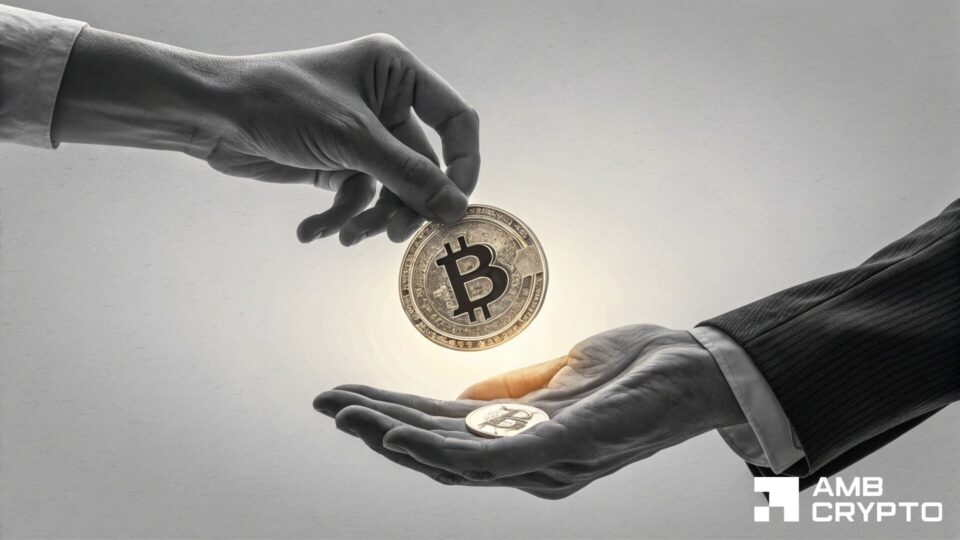
BlackRock moves 47K Ethereum in a day: But the real story isn’t a sell-off

ambcryptoPublicado em 2025-12-17Última atualização em 2025-12-17

Resumo

Even as Ethereum's price struggles around $3,000, institutional activity remains robust. On December 16, BlackRock moved 47,463 ETH (worth $140 million) to Coinbase Prime, not as a sell-off but as part of necessary rebalancing for its iShares Ethereum Trust (ETHA) amid significant market outflows. The same day, ETHA saw a net outflow of $221.3 million, accounting for nearly 99% of total outflows from U.S. Ethereum ETFs. Despite this, BlackRock's actions reflect institutional confidence and operational adaptation rather than exit. With ETHA holding 3.7 million ETH ($11 billion), it has been surpassed by BitMine Immersion's nearly 4 million ETH accumulation. BlackRock's recent $28.78 million ETH acquisition further underscores its commitment to Ethereum as critical financial infrastructure, not just speculative asset, for its BUIDL fund operations. Institutional moves, not retail sentiment, are currently steering Ethereum's market dynamics.

Even as Ethereum’s price hesitates around the $3,000 price level, the institutional engine behind the iShares Ethereum Trust (ETHA) is running at full speed.

On the 16th of December, on-chain data flagged a massive $140 million transfer as BlackRock deposited 47,463 ETH into Coinbase Prime.

Far from a simple “sell-off” signal, this move reflects the complex rebalancing needed to manage the leading spot Ethereum [ETH] ETF during heavy market liquidations.

What does this move tell us about BlackRock?

While retail traders hesitate, BlackRock’s major rebalancing shows strong institutional confidence, as ETF issuers must keep adjusting ETH holdings to match inflows.

This strategy helps stabilize the fund during volatility and reinforces Ethereum’s growing acceptance in traditional finance.

Though BlackRock remains the institutional “gold standard,” it is no longer the undisputed heavyweight in the Ethereum treasury race.

As of mid-December, BlackRock’s ETHA fund holds approximately 3.7 million ETH (approx. $11 billion).

However, this massive stash has officially been eclipsed by BitMine Immersion (BMNR).

Under the leadership of Tom Lee, BitMine has aggressively expanded its treasury to nearly 4 million ETH, signaling a “MicroStrategy-style” accumulation play that prioritizes protocol-level dominance over simple ETF fee collection.

Decoding the December liquidity drain

The timing of BlackRock’s 47,463 ETH deposit follows a turbulent period for US-based Ethereum ETFs.

On the 16th of December, Farside Investors’ data revealed a staggering net outflow of $221.3 million from BlackRock’s ETHA.

This single-day redemption accounted for nearly 99% of the total $224.2 million pulled from all US Ethereum ETFs combined.

All in all, this suggests that while the “institutional machinery” is moving funds on-chain, it is largely to facilitate heavy redemptions from investors who are rotating capital or de-risking amidst a lackluster Q4 performance for the asset.

Ethereum’s resistance at $3,000

That being said, this institutional reshuffling occurred against a backdrop of technical fragility.

At the time of reporting, Ethereum was trading at $2,935.44.

Despite a microscopic 0.77% gain in a 24-hour window, the broader trend remains bearish with ETH plummeting by 11.58% over the past seven days, according to CoinMarketCap

Hence, for BlackRock, the challenge is now two-fold: managing the logistics of massive ETF outflows while simultaneously defending a price floor that retail traders seem increasingly unwilling to support.

BlackRock’s another recent ETH acquisition

This coincided with BlackRock’s recent $28.78 million acquisition of Ethereum, which the broader market has largely misread as mere price speculation.

In reality, this move signalled BlackRock’s formal validation of Ethereum not as a “digital gold” alternative to Bitcoin, but as the essential financial infrastructure of the future.

By securing this bundle of ETH, the world’s largest asset manager is effectively stockpiling the “fuel” necessary to run its BUIDL fund, which operates exclusively on the Ethereum blockchain.

Ultimately, this acquisition shows BlackRock is no longer just participating in crypto, but actively building on Ethereum as mission-critical infrastructure for future global finance.


Final Thoughts

  • Institutional activity and not retail sentiment are steering Ethereum’s market, with BlackRock’s rapid moves reflecting ETF mechanics.
  • The $221 million ETF outflow highlights a liquidity crunch, but BlackRock’s rapid repositioning shows institutions are adapting, not exiting.


Leituras Relacionadas

The King of Blind Date Attire in Korea: How SK Hynix Made a Comeback Against Samsung?

In South Korea's dating scene, SK Hynix employees are now highly sought after, a status shift fueled by the company's astronomical profits and employee bonuses, projected to reach up to 6.1 million RMB per person by 2027. This marks a dramatic reversal for the long-time second-place player in memory semiconductors, which has now surpassed its rival Samsung in annual operating profit. The turnaround story began in 2008 when a struggling Hynix, emerging from bankruptcy restructuring, took a risky bet by agreeing to develop High Bandwidth Memory (HBM) with AMD. At the time, HBM had no clear market beyond high-end graphics cards and was a costly, complex technology. Major players like Samsung, pursuing its own HMC technology, declined. For Hynix, with only memory as its core business, it was a gamble born of necessity. The pivotal moment came in 2012 when SK Group Chairman Chey Tae-won acquired Hynix. Defying industry downturns, he invested heavily in R&D and fabrication, sustaining the HBM project through over a decade of commercial uncertainty and internal challenges. A key break occurred around 2016-2017 when Samsung faced production issues supplying HBM2 for Google's TPU, allowing SK Hynix to gain a crucial foothold in the data center market. The AI explosion post-ChatGPT in 2022 was the catalyst, turning HBM into a critical bottleneck for AI accelerators like NVIDIA's GPUs. By 2025, SK Hynix captured 62% of the global HBM market, leaving Samsung at 17%. For the first time, its annual operating profit exceeded Samsung's. Analysts point to the "innovator's dilemma" to explain Samsung's miss: its vast, successful business portfolio made it risk-averse, preventing an all-in bet on the initially niche HBM technology. In contrast, SK Hynix, as a challenger with its back against the wall, had no choice but to commit fully. The story highlights how Korea's chaebol system allows for ultra-long-term bets beyond quarterly pressures. However, SK Hynix's lead isn't guaranteed. Samsung is aggressively catching up on HBM4, and challenges like customer concentration (heavy reliance on NVIDIA) and technical hurdles in advanced packaging remain. The narrative underscores a market truth: the greatest alpha often comes from betting on uncertain, long-term directions others dismiss, much like HBM in 2008.

marsbitHá 5m

The King of Blind Date Attire in Korea: How SK Hynix Made a Comeback Against Samsung?

marsbitHá 5m

Understanding Hash in One Article: The "Browser Miner" on Ethereum

Hash is an Ethereum-based ERC-20 token described as a "browser-minable post-quantum token." Its key features include enabling browser-based GPU mining without specialized hardware, a fixed supply cap of 21 million tokens, immutable and permissionless smart contracts with no team allocation or pre-mining, and an emphasis on post-quantum security using Keccak256 hashing. The mining mechanism is a simplified on-chain proof-of-work where miners solve unique challenges tied to their wallet address. Key design elements prevent answer theft, with epochs resetting every 100 blocks (~20 minutes) and a per-block minting limit. Emission follows a Bitcoin-like halving schedule every 100,000 mints, starting at 100 tokens per mint. Projections suggest all tokens could be mined within approximately 294 days if a target rate of one mint per minute is sustained. Hash emphasizes "post-quantum" security by leveraging hash-based primitives like Keccak256, which are considered more resistant to quantum attacks compared to elliptic-curve cryptography. While not a fully post-quantum asset, it aligns with Ethereum's broader post-quantum research narrative. The project completed its Genesis sale at $0.03 and began trading on Uniswap, with its price reaching around $0.19. The initial circulating supply is small, with 5% sold in Genesis and 5% allocated to liquidity. The majority (47.6% of total supply) is allocated to early-stage mining, leading to a front-loaded emission schedule. This structure, combined with low initial liquidity, makes Hash a high-volatility, high-risk project dependent on sustained miner participation and market demand to absorb new supply.

marsbitHá 19m

Understanding Hash in One Article: The "Browser Miner" on Ethereum

marsbitHá 19m

OpenAI's Largest Internal Wealth Creation: 600 People Cash Out a Total of $6.6 Billion, 75 Take Home the Maximum $30 Million Each

A Wall Street Journal report reveals OpenAI's unprecedented pre-IPO wealth creation. In a single employee stock sale last October, over 600 current and former employees sold shares, collectively cashing out approximately $6.6 billion. Due to high investor demand, the company tripled the individual sale cap to $30 million, with about 75 employees selling the maximum amount. This event represents the largest such transaction in tech industry history for a private company. OpenAI's valuation was $500 billion for this tender offer. Employees with over two years of tenure were eligible, allowing many post-ChatGPT hires their first liquidity event. The company's stock has reportedly grown over 100-fold in seven years. Following a restructuring, employees collectively hold about 26% of OpenAI. The scale of executive wealth is also staggering. In court testimony related to Elon Musk's lawsuit, President and co-founder Greg Brockman confirmed his OpenAI stake is worth around $30 billion. Analysis indicates about 165 current and former employees hold a combined ~$164.9 billion in equity, averaging nearly $1 billion per person in paper wealth. OpenAI's per-employee stock-based compensation is estimated to be 34 times the average of major tech firms before their IPOs. OpenAI continues its rapid ascent, closing a $122 billion funding round at an $852 billion valuation in March. With monthly revenue hitting $2 billion, over 900 million weekly ChatGPT users, and plans for a potential trillion-dollar IPO in late 2026, this wealth-creation engine shows no signs of stopping.

链捕手Há 41m

OpenAI's Largest Internal Wealth Creation: 600 People Cash Out a Total of $6.6 Billion, 75 Take Home the Maximum $30 Million Each

链捕手Há 41m

Trading

Spot
Futuros

Artigos em Destaque

Como comprar CC

Bem-vindo à HTX.com!Tornámos a compra de CC(Canton) (CC) simples e conveniente.Segue o nosso guia passo a passo para iniciar a tua jornada no mundo das criptos.Passo 1: cria a tua conta HTXUtiliza o teu e-mail ou número de telefone para te inscreveres numa conta gratuita na HTX.Desfruta de um processo de inscrição sem complicações e desbloqueia todas as funcionalidades.Obter a minha contaPasso 2: vai para Comprar Cripto e escolhe o teu método de pagamentoCartão de crédito/débito: usa o teu visa ou mastercard para comprar CC(Canton) (CC) instantaneamente.Saldo: usa os fundos da tua conta HTX para transacionar sem problemas.Terceiros: adicionamos métodos de pagamento populares, como Google Pay e Apple Pay, para aumentar a conveniência.P2P: transaciona diretamente com outros utilizadores na HTX.Mercado de balcão (OTC): oferecemos serviços personalizados e taxas de câmbio competitivas para os traders.Passo 3: armazena teu CC(Canton) (CC)Depois de comprar o teu CC(Canton) (CC), armazena-o na tua conta HTX.Alternativamente, podes enviá-lo para outro lugar através de transferência blockchain ou usá-lo para transacionar outras criptomoedas.Passo 4: transaciona CC(Canton) (CC)Transaciona facilmente CC(Canton) (CC) no mercado à vista da HTX.Acede simplesmente à tua conta, seleciona o teu par de trading, executa as tuas transações e monitoriza em tempo real.Oferecemos uma experiência de fácil utilização tanto para principiantes como para traders experientes.

241 Visualizações TotaisPublicado em {updateTime}Atualizado em 2026.04.21

Como comprar CC

Como comprar BLEND

Bem-vindo à HTX.com!Tornámos a compra de Fluent (BLEND) simples e conveniente.Segue o nosso guia passo a passo para iniciar a tua jornada no mundo das criptos.Passo 1: cria a tua conta HTXUtiliza o teu e-mail ou número de telefone para te inscreveres numa conta gratuita na HTX.Desfruta de um processo de inscrição sem complicações e desbloqueia todas as funcionalidades.Obter a minha contaPasso 2: vai para Comprar Cripto e escolhe o teu método de pagamentoCartão de crédito/débito: usa o teu visa ou mastercard para comprar Fluent (BLEND) instantaneamente.Saldo: usa os fundos da tua conta HTX para transacionar sem problemas.Terceiros: adicionamos métodos de pagamento populares, como Google Pay e Apple Pay, para aumentar a conveniência.P2P: transaciona diretamente com outros utilizadores na HTX.Mercado de balcão (OTC): oferecemos serviços personalizados e taxas de câmbio competitivas para os traders.Passo 3: armazena teu Fluent (BLEND)Depois de comprar o teu Fluent (BLEND), armazena-o na tua conta HTX.Alternativamente, podes enviá-lo para outro lugar através de transferência blockchain ou usá-lo para transacionar outras criptomoedas.Passo 4: transaciona Fluent (BLEND)Transaciona facilmente Fluent (BLEND) no mercado à vista da HTX.Acede simplesmente à tua conta, seleciona o teu par de trading, executa as tuas transações e monitoriza em tempo real.Oferecemos uma experiência de fácil utilização tanto para principiantes como para traders experientes.

130 Visualizações TotaisPublicado em {updateTime}Atualizado em 2026.04.24

Como comprar BLEND

Como comprar ACN

Bem-vindo à HTX.com!Tornámos a compra de AITECH CLOUD NETWORK (ACN) simples e conveniente.Segue o nosso guia passo a passo para iniciar a tua jornada no mundo das criptos.Passo 1: cria a tua conta HTXUtiliza o teu e-mail ou número de telefone para te inscreveres numa conta gratuita na HTX.Desfruta de um processo de inscrição sem complicações e desbloqueia todas as funcionalidades.Obter a minha contaPasso 2: vai para Comprar Cripto e escolhe o teu método de pagamentoCartão de crédito/débito: usa o teu visa ou mastercard para comprar AITECH CLOUD NETWORK (ACN) instantaneamente.Saldo: usa os fundos da tua conta HTX para transacionar sem problemas.Terceiros: adicionamos métodos de pagamento populares, como Google Pay e Apple Pay, para aumentar a conveniência.P2P: transaciona diretamente com outros utilizadores na HTX.Mercado de balcão (OTC): oferecemos serviços personalizados e taxas de câmbio competitivas para os traders.Passo 3: armazena teu AITECH CLOUD NETWORK (ACN)Depois de comprar o teu AITECH CLOUD NETWORK (ACN), armazena-o na tua conta HTX.Alternativamente, podes enviá-lo para outro lugar através de transferência blockchain ou usá-lo para transacionar outras criptomoedas.Passo 4: transaciona AITECH CLOUD NETWORK (ACN)Transaciona facilmente AITECH CLOUD NETWORK (ACN) no mercado à vista da HTX.Acede simplesmente à tua conta, seleciona o teu par de trading, executa as tuas transações e monitoriza em tempo real.Oferecemos uma experiência de fácil utilização tanto para principiantes como para traders experientes.

79 Visualizações TotaisPublicado em {updateTime}Atualizado em 2026.04.28

Como comprar ACN

Discussões

Bem-vindo à Comunidade HTX. Aqui, pode manter-se informado sobre os mais recentes desenvolvimentos da plataforma e obter acesso a análises profissionais de mercado. As opiniões dos utilizadores sobre o preço de A (A) são apresentadas abaixo.

活动图片