Bitcoin Treasury Firm Strategy To Repurchase $1.5B Of Convertible Notes — Details

bitcoinistPublicado em 2026-05-17Última atualização em 2026-05-17

Resumo

Bitcoin treasury firm Strategy (formerly MicroStrategy) plans to repurchase approximately $1.5 billion of its convertible notes due in 2029 for an estimated $1.38 billion. According to a filing with the SEC, the company will fund the buyback using cash reserves, proceeds from securities sales, and/or potential sales of Bitcoin. This move, authorized by Chairman Michael Saylor, follows recent comments from CEO Phong Le about possible scenarios for selling Bitcoin to enhance shareholder value. The repurchase could positively impact equity holders by preventing future stock dilution. The news follows a record $1.53 billion trading volume for Strategy's preferred stock (STRC), a key instrument for its Bitcoin acquisitions. The firm remains the largest corporate Bitcoin holder with 818,869 BTC.

Bitcoin treasury company Strategy (formerly MicroStrategy) has disclosed its intention to repurchase $1.5 billion of its 2029 convertible debt notes. This move comes amid commentary on the shift in the Michael Saylor-led firm’s “Never Sell” perspective, intensifying focus on the company’s market actions in the coming weeks.

Will Strategy Sell Bitcoin To Repurchase Its Debt?

In a May 15th post on the social media platform X, Strategy’s chairman, Michael Saylor, confirmed that the firm has filed to repurchase $1.5 billion principal amount of its convertible senior notes due in 2029. This decision comes as part of the outcome of privately negotiated transactions with holders of this debt security.

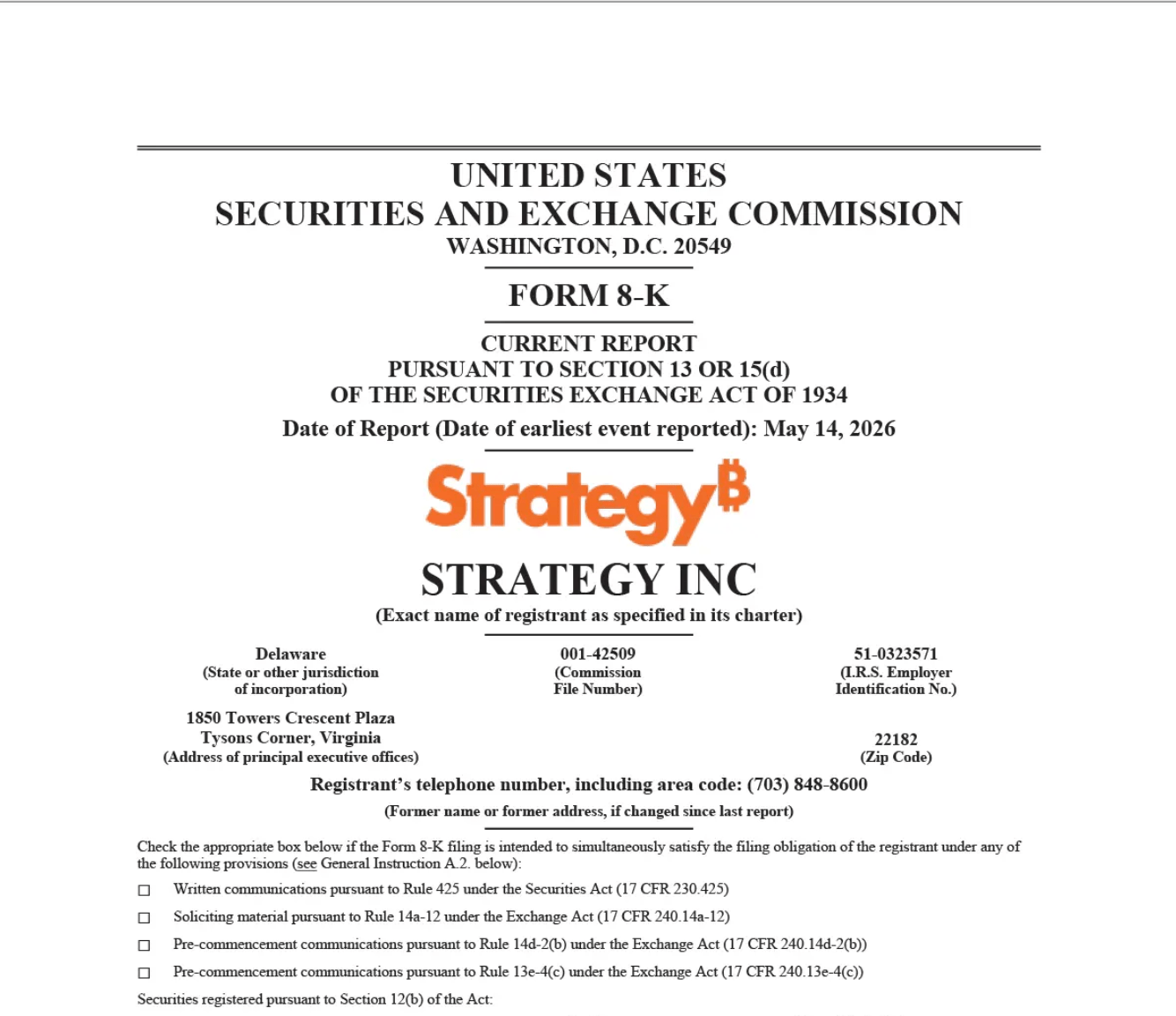
In the Form 8-K filed with the United States Securities and Exchange Commission (SEC) on May 14th, Strategy disclosed that it agreed to retire approximately $1.50 billion in aggregate principal amount of the 2029 Notes for an estimated aggregate cash repurchase price of approximately $1.38 billion.
Source: Strategy

The official filing read:

The final aggregate cash repurchase price for the Repurchased Notes is subject to adjustment, and will be based in part on the daily volume-weighted average price per share of Strategy’s class A common stock, par value $0.001 per share (the “Class A Common Stock”), during an agreed upon measurement period (the “Measurement Period”).

The Bitcoin treasury firm also revealed that these repurchase transactions will be funded with available cash reserves, proceeds from sales of securities under its at-the-market offering program, and/or proceeds from the sale of Bitcoin. Quite interestingly, this filing comes barely a week after the company’s CEO, Phong Le, highlighted scenarios in which the firm might shed some of its Bitcoin holdings.

According to the executive, this included situations that would increase shareholder value, such as dividend payments. It remains to be seen whether the firm debt repurchase falls into the category of activities that warrants the sale of a portion of its Bitcoin.

Merely looking at the action, retiring these convertible notes could be positive for equity investors, as it means that the hybrid debt instrument holders won’t be able to convert to common stock (and potentially dilute the shareholders). Instead, the repurchase gives Strategy a perfect opportunity to reorganize its balance sheet and capital structure.

Strategy’s STRC Registers Record High Daily Trading Volume

Interestingly, the news of this debt repurchase comes merely a day after STRC, Strategy’s Variable Rate Series A Perpetual Stretch Preferred Stock, posted its highest daily trading volume of $1.53 billion on Thursday, May 14th. This represents a significant jump from the previous record of $1.1 bill reached on April 13.

This trading explosion in STRC, which has been Strategy’s capital-raising instrument for purchasing Bitcoin, could help the firm raise about $735 million to buy BTC. As of this writing, the firm maintains its position as the largest corporate Bitcoin holder, with a stash of 818,869 Bitcoin, worth about $66 billion.

The price of BTC on the daily timeframe | Source: BTCUSDT chart on TradingView

Perguntas relacionadas

QWhat is the Bitcoin treasury firm formerly known as MicroStrategy planning to repurchase?

AThe Bitcoin treasury firm Strategy (formerly MicroStrategy) is planning to repurchase $1.5 billion principal amount of its convertible senior notes due in 2029.

QHow does Strategy plan to fund the repurchase of its convertible notes?

AStrategy plans to fund the repurchase transactions with available cash reserves, proceeds from sales of securities under its at-the-market offering program, and/or proceeds from the sale of Bitcoin.

QWhy could retiring the convertible notes be positive for Strategy's equity investors?

ARetiring the convertible notes could be positive for equity investors because it prevents holders of the debt instrument from converting to common stock, which would potentially dilute the shareholders. It also gives Strategy an opportunity to reorganize its balance sheet and capital structure.

QWhat recent record was set by Strategy's STRC preferred stock, and what could it enable the firm to do?

AStrategy's STRC (Variable Rate Series A Perpetual Stretch Preferred Stock) posted its highest daily trading volume of $1.53 billion on May 14th. This trading activity could help the firm raise about $735 million to buy Bitcoin.

QHow much Bitcoin does Strategy currently hold, and what is its approximate value?

AStrategy currently holds 818,869 Bitcoin, which is worth approximately $66 billion, maintaining its position as the largest corporate Bitcoin holder.

Leituras Relacionadas

Following US Ban on Fable 5, Zhipu AI's Stock Soars 47%

On June 15th, shares of Zhipu AI surged dramatically on the Hong Kong stock market, peaking at a 47.6% gain before closing 32.82% higher. This sharp increase was directly triggered by two recent industry events. On June 12th, Anthropic announced it was suspending global access to its latest flagship models, Claude Fable 5 and Claude Mythos 5, to comply with a U.S. government export control order. The next day, Zhipu AI announced it would open access to its latest open-source flagship model, GLM-5.2, under the permissive MIT license. The Anthropic incident highlighted a critical issue beyond raw model capability: the risk of sudden, unpredictable loss of access to advanced AI models, especially for developers and enterprises deeply integrated with them. This has shifted industry and market focus toward factors like stability, sustainable access, and controllability. Zhipu's move, promoting "frontier intelligence for all," positions its openly available model as a reliable and accessible alternative. The GLM-5.2 model emphasizes "Long Horizon Task" capabilities with a 1M context window, targeting complex, multi-step coding and engineering workflows where maintaining context is crucial. Analysts note this event exposes the risk of dependency on closed-source models subject to single jurisdictional controls, potentially accelerating a shift toward domestic base models and localized deployments. The market's reaction signals a new valuation dimension in AI: providers who can offer stable, long-term, and sustainably accessible AI capabilities are gaining strategic importance.

marsbitHá 16m

Following US Ban on Fable 5, Zhipu AI's Stock Soars 47%

marsbitHá 16m

Fully Entering the AI Era: Alipay Bets on Conversation, WeChat Holds Fast to Social

In May 2026, Alipay announced over 300 million AI payment transactions. Shortly after, WeChat opened its mini-programs for AI integration, sparking controversy by requiring developer source code access. This highlights their diverging approaches to AI integration. Alipay is testing "Project Treasure," an optional AI-native interface replacing traditional app grids with a conversational window. Users can command complex tasks (e.g., "book a ride and order coffee") handled end-to-end by AI. This shift follows an abandoned standalone AI app, focusing instead on enhancing its existing user base. For unmodified mini-programs, Alipay's AI uses "screen-reading" to simulate user interactions, bypassing the need for developer overhaul. It also introduced "Token Pay" for micro-transactions and "AI Wallets" for autonomous agent spending. WeChat, prioritizing its core social function, is taking an embedded approach. Its AI agent will operate within existing contexts like group chats and official accounts, assisting without a separate interface. To enable this, WeChat offers developers two paths: granting source code access for direct AI control ("Automatic Mode") or manually encapsulating services into standardized "Skills." Both place significant burden on developers. Key differences emerge in handling legacy services: WeChat demands developer cooperation (code or labor), while Alipay's screen-reading offers immediate, if potentially less stable, compatibility. Alipay's 3 billion AI transactions demonstrate user acceptance of AI-driven commercial actions. The divergent strategies may reshape mini-program ecosystems—Alipay passively "AI-fying" services, WeChat potentially favoring resource-rich developers—and set competing technical standards. Ultimately, the competition centers on where users entrust the command to "help me get things done."

marsbitHá 17m

Fully Entering the AI Era: Alipay Bets on Conversation, WeChat Holds Fast to Social

marsbitHá 17m

Trading

Spot
Futuros
活动图片