Before Musk Gave Him $1 Million, He Made $600,000 by Launching Coins

marsbitPublicado em 2026-02-12Última atualização em 2026-02-12

Resumo

On February 4th, X awarded user @beaverd $1 million for winning an article competition with a piece criticizing Deloitte. Beaver, a well-known meme coin trader, was later accused by Bubblemaps of being a "serial rugger" who allegedly made $600,000 by deploying and manipulating the price of a token called $SIAS on pump.fun, which rapidly rose to a $6 million market cap before crashing to zero. Bubblemaps claimed Beaver used multiple wallets to snipe and profit from the token. In response, Beaver gave a defiant reply, garnering significant support from parts of the crypto community. Supporters argued that since he did not promote the token on his social media, his actions weren’t fraudulent—just a high-risk bet that others lost. Some even criticized Bubblemaps’ own token $BMT as a worse offender. Beaver is also known for Somaliscan, a data site tracking U.S. government spending and exposing corruption, which earned him admiration, particularly among right-leaning audiences. The incident reignites the ongoing debate in crypto over whether launching and manipulating tokens without promotion constitutes unethical behavior or simply reflects the risky nature of meme coin trading.

On February 4th, X announced the winner of its million-dollar article competition. @beaverd, with his piece "Deloitte, a $74 billion cancer metastasized across America," became the ultimate winner, receiving a $1 million reward.
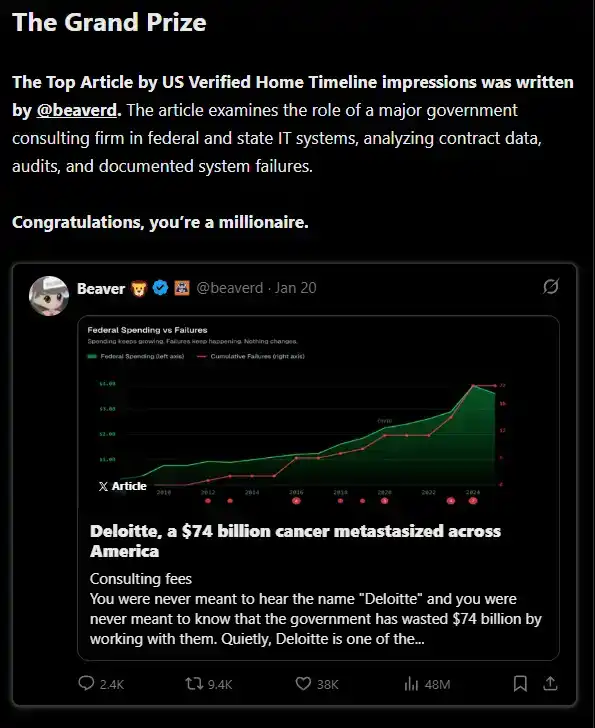
In the English-speaking crypto community, Beaver is a relatively well-known meme coin player, so his win excited the crypto circle. However, the day before yesterday, Bubblemaps posted a tweet accusing him of being a "serial rugger," alleging that he manipulated coin prices to profit $600,000.

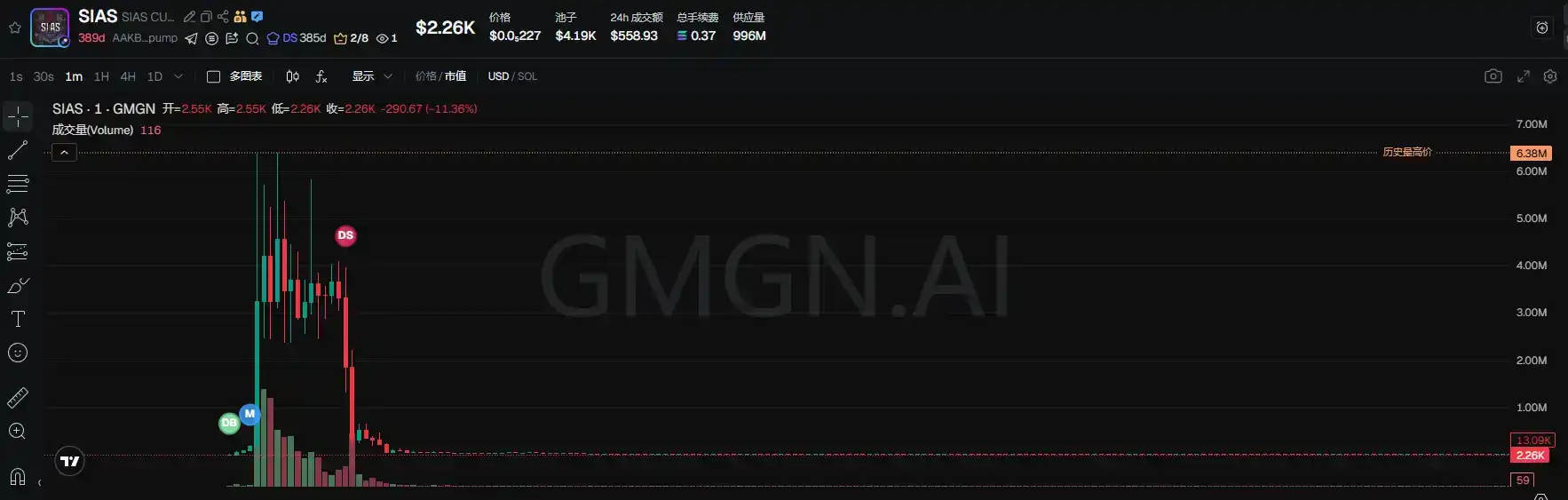
Bubblemaps stated that based on Beaver's public Solana address, they discovered an associated address "2mQB8o," which launched the token $SIAS on pump.fun. $SIAS quickly reached a market cap of $6 million within 7 minutes of deployment, but then rapidly plummeted to zero in the next 10 minutes due to large sell-offs by the dev.
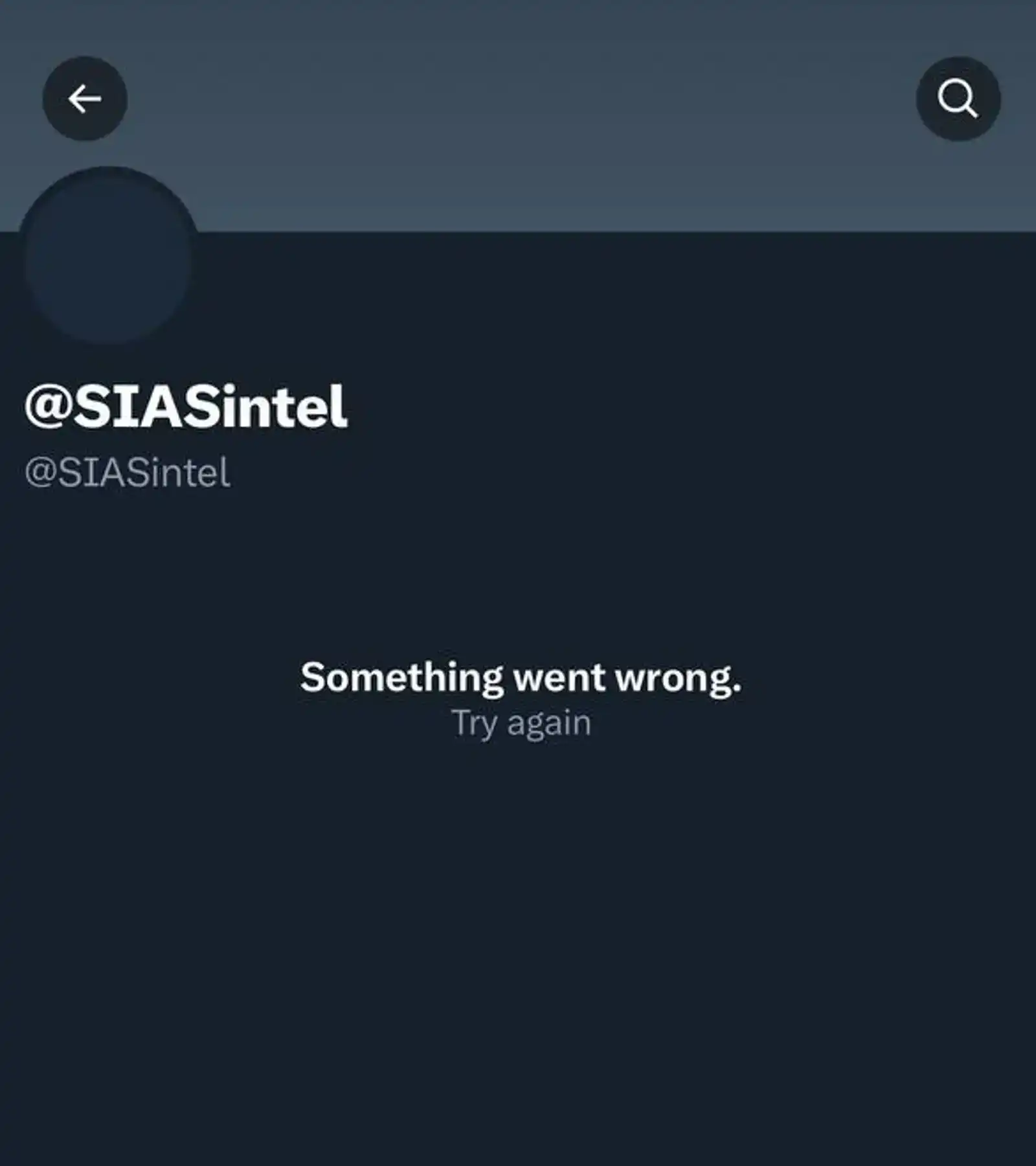
After the token crashed to zero, its X account was also deleted.
Through further on-chain analysis, Bubblemaps pointed out that Beaver was not only the dev but also used four other addresses to snipe the token, totaling a profit of $600,000.
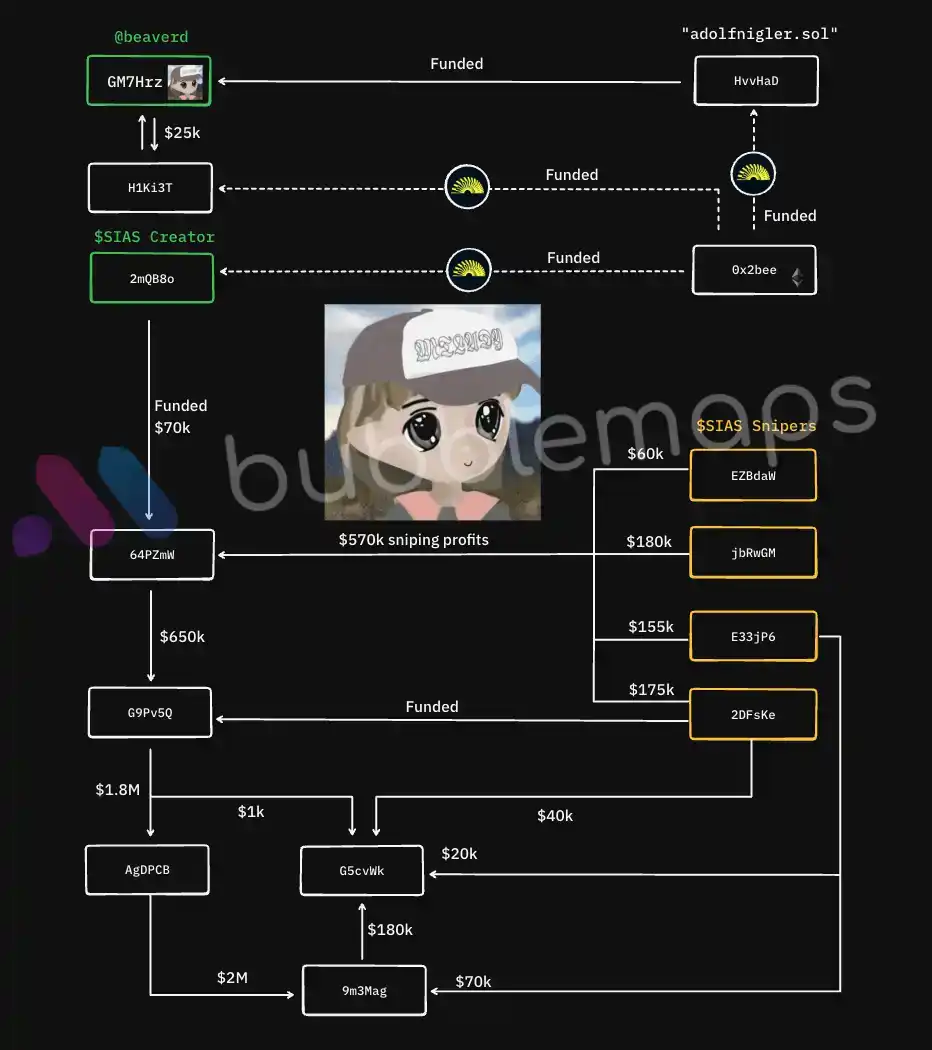
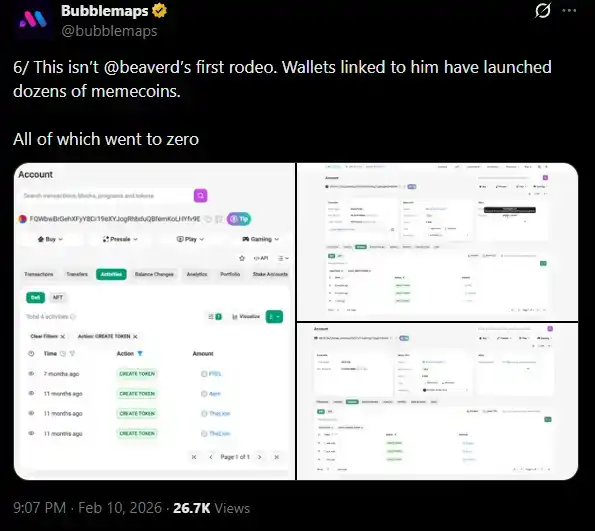
Finally, Bubblemaps also noted that all tracked addresses related to Beaver did not just launch this one token but many others, all of which crashed to zero.
In response to Bubblemaps' accusations, Beaver's reply was as wild as his Milady avatar:

Precisely because of Beaver's response, he gained considerable support. In the English-speaking community, Beaver is popular for being "fun," similar to figures like Bob Lax and mitch. To make an imperfect analogy, it's somewhat like Liang Xi in the Chinese circle.

This is an interesting manifestation of the crypto subculture. Whether in the Chinese or English-speaking circles, a significant portion of players hold the view of "you win some, you lose some"—meme coins are essentially a gamble, and if devs can make money through clever means, that's their skill. Since you gambled, you should take responsibility for yourself.
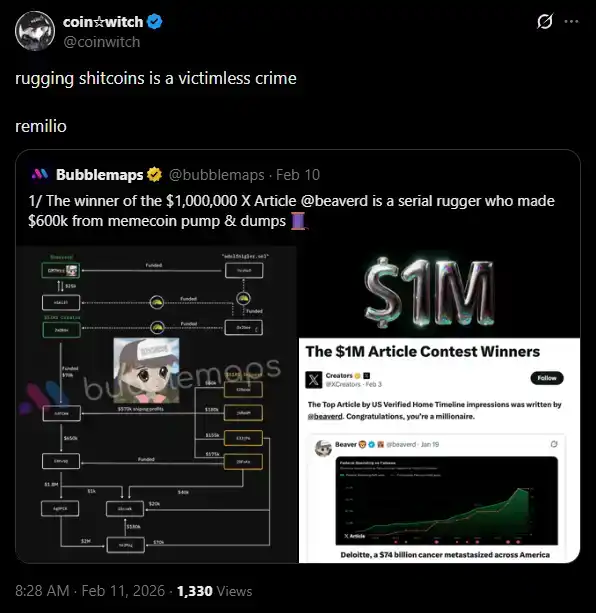
There is also the view that Beaver did not promote $SIAS through his X account (Bubblemaps' accusation also acknowledged this but pointed out that Beaver even profited from the token using his public address, which is an act of audacity). Therefore, Beaver is not guilty of "fraud"; rather, those who bet against him lost to him.

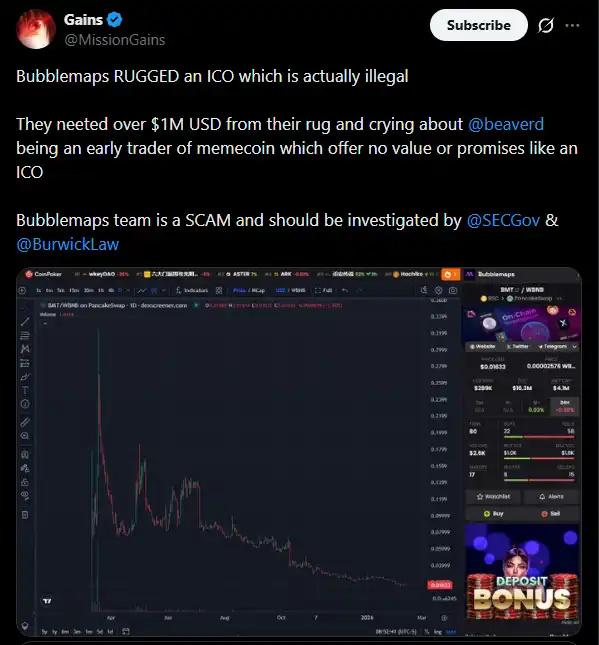
Players siding with Beaver even mocked the market performance of Bubblemaps' token $BMT, arguing that compared to Beaver, Bubblemaps—which conducted an ICO and made promises—is the illegal scam that should be held accountable:
Besides the有趣的 subculture of the crypto world, another reason for Beaver's popularity is his project Somaliscan. Somaliscan is an open-source data website that tracks over $55 trillion in U.S. government fiscal expenditures, exposing massive corruption in the U.S. government's refugee resettlement programs, particularly aid to Somalia. The data on this website covers U.S. government spending, political donations to officials, healthcare system fund allocations, federal loans, and summaries of individuals linked to the Epstein files. Beaver's million-dollar-winning article exposed the massive corruption of Deloitte, which received a $40 billion contract from the U.S. government but caused an estimated $34 billion in losses—a discovery he made while building the database for Somaliscan.

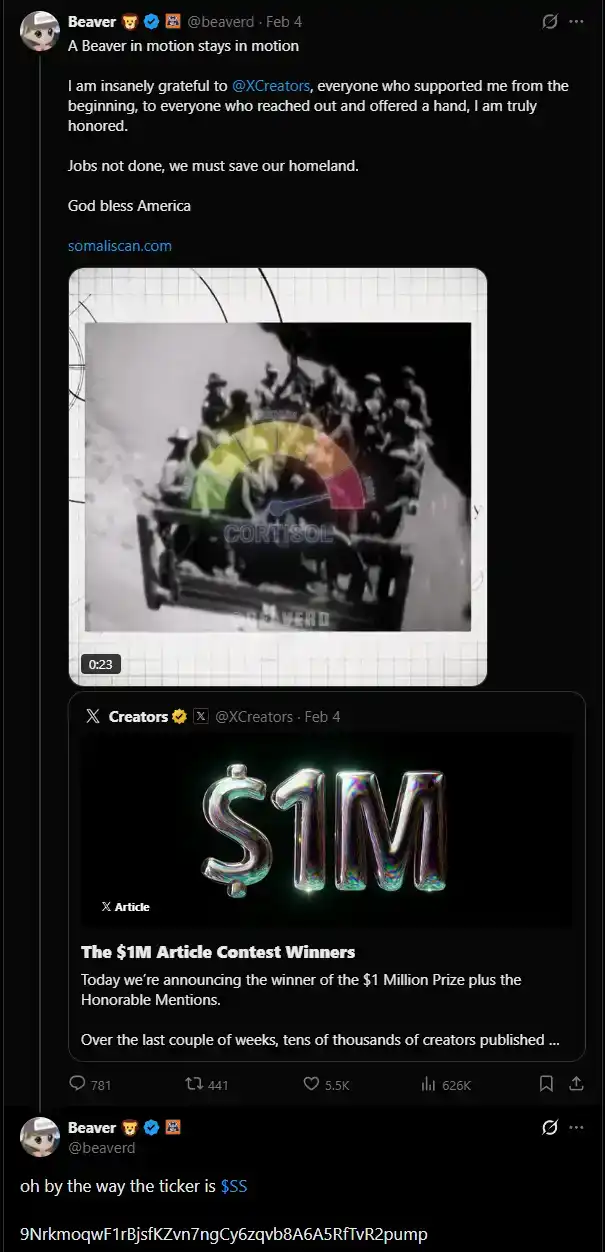
As a result, Beaver is seen as a hero by right-leaning players in the English-speaking community (especially in the U.S.). After X announced his million-dollar article prize, he immediately promoted Somaliscan and included the CA in the tweet's comments:
Setting aside emotional factors, this incident has indeed reignited a long-standing debate in the crypto community—if someone launches a token and manipulates its price but does not promote it, should they be criticized?

This debate will not cease unless the market ceases to be残酷.

Perguntas relacionadas

QWho won the $1 million article competition on X and what was the title of their winning article?

AThe winner was @beaverd with the article titled 'Deloitte, a $74 billion cancer metastasized across America'.

QWhat accusation did Bubblemaps make against Beaver regarding his activities in the crypto space?

ABubblemaps accused Beaver of being a 'serial rugger' who manipulated the price of a token called $SIAS on pump.fun, making a profit of $600,000 by quickly selling off his holdings and causing the token's value to plummet to zero.

QHow did Beaver respond to the allegations made by Bubblemaps?

ABeaver responded defiantly and with a wild attitude, which actually garnered him significant support from parts of the crypto community who view meme coin trading as a form of gambling where participants are responsible for their own risks.

QWhat is Somaliscan, and how is it related to Beaver's public image?

ASomaliscan is an open-source data website created by Beaver that tracks over $55 trillion in U.S. government spending, exposing corruption in programs like refugee安置 (especially aid to Somalia). It enhanced his reputation, particularly among right-leaning circles, who see him as a hero for uncovering government waste and corruption.

QWhat ongoing debate in the crypto community does the article highlight through Beaver's story?

AThe article highlights the debate over whether creating a token and manipulating its price without promoting it should be considered fraudulent or simply a risky bet that participants enter into willingly, reflecting the community's divided views on responsibility and ethics in meme coin trading.

Leituras Relacionadas

Following US Ban on Fable 5, Zhipu AI's Stock Soars 47%

On June 15th, shares of Zhipu AI surged dramatically on the Hong Kong stock market, peaking at a 47.6% gain before closing 32.82% higher. This sharp increase was directly triggered by two recent industry events. On June 12th, Anthropic announced it was suspending global access to its latest flagship models, Claude Fable 5 and Claude Mythos 5, to comply with a U.S. government export control order. The next day, Zhipu AI announced it would open access to its latest open-source flagship model, GLM-5.2, under the permissive MIT license. The Anthropic incident highlighted a critical issue beyond raw model capability: the risk of sudden, unpredictable loss of access to advanced AI models, especially for developers and enterprises deeply integrated with them. This has shifted industry and market focus toward factors like stability, sustainable access, and controllability. Zhipu's move, promoting "frontier intelligence for all," positions its openly available model as a reliable and accessible alternative. The GLM-5.2 model emphasizes "Long Horizon Task" capabilities with a 1M context window, targeting complex, multi-step coding and engineering workflows where maintaining context is crucial. Analysts note this event exposes the risk of dependency on closed-source models subject to single jurisdictional controls, potentially accelerating a shift toward domestic base models and localized deployments. The market's reaction signals a new valuation dimension in AI: providers who can offer stable, long-term, and sustainably accessible AI capabilities are gaining strategic importance.

marsbitHá 17m

Following US Ban on Fable 5, Zhipu AI's Stock Soars 47%

marsbitHá 17m

Fully Entering the AI Era: Alipay Bets on Conversation, WeChat Holds Fast to Social

In May 2026, Alipay announced over 300 million AI payment transactions. Shortly after, WeChat opened its mini-programs for AI integration, sparking controversy by requiring developer source code access. This highlights their diverging approaches to AI integration. Alipay is testing "Project Treasure," an optional AI-native interface replacing traditional app grids with a conversational window. Users can command complex tasks (e.g., "book a ride and order coffee") handled end-to-end by AI. This shift follows an abandoned standalone AI app, focusing instead on enhancing its existing user base. For unmodified mini-programs, Alipay's AI uses "screen-reading" to simulate user interactions, bypassing the need for developer overhaul. It also introduced "Token Pay" for micro-transactions and "AI Wallets" for autonomous agent spending. WeChat, prioritizing its core social function, is taking an embedded approach. Its AI agent will operate within existing contexts like group chats and official accounts, assisting without a separate interface. To enable this, WeChat offers developers two paths: granting source code access for direct AI control ("Automatic Mode") or manually encapsulating services into standardized "Skills." Both place significant burden on developers. Key differences emerge in handling legacy services: WeChat demands developer cooperation (code or labor), while Alipay's screen-reading offers immediate, if potentially less stable, compatibility. Alipay's 3 billion AI transactions demonstrate user acceptance of AI-driven commercial actions. The divergent strategies may reshape mini-program ecosystems—Alipay passively "AI-fying" services, WeChat potentially favoring resource-rich developers—and set competing technical standards. Ultimately, the competition centers on where users entrust the command to "help me get things done."

marsbitHá 18m

Fully Entering the AI Era: Alipay Bets on Conversation, WeChat Holds Fast to Social

marsbitHá 18m

Trading

Spot
Futuros
活动图片