As Channel Dividends Fade, What Can DeFi Protocols Rely On to Resist Giant Harvesting?

marsbitPublicado em 2026-06-22Última atualização em 2026-06-22

Resumo

The article discusses how major tech companies like Coinbase, Stripe, and Kraken are increasingly acquiring or building their own underlying infrastructure to capture profits, moving away from relying on external DeFi protocols. It uses the example of Coinbase's Base blockchain, which generates sequencing fees for Coinbase from protocols like Morpho that deploy on it. Similarly, Stripe acquired Bridge to capture stablecoin yield instead of paying it to Circle, and Kraken bought NinjaTrader for its derivatives licenses. The core argument is that when channel-based advantages (like user traffic) fade, control over the profit-generating infrastructure becomes critical. While this could lead to a future dominated by a few integrated giants, the article suggests a more balanced outcome is possible. Protocols that have already achieved deep, multi-chain integration and embedded themselves into corporate backends create high switching costs, making them difficult to replace. Examples include Morpho (despite reliance on Base, it's widely deployed) and Uniswap. The piece concludes that the race between institutional expansion and open-source protocol proliferation will ultimately shape the industry's structure.

Author: Thejaswini M A

Compiler: Saoirse, Foresight News

In Goodfellas, Ray Liotta has a line: "Forget about it. Pay me." This line shatters the romantic filter of mafia morality glorified in works like The Godfather, starkly revealing the cold, parasitic, and profit-driven essence of organized crime. Following this similar logic, let's discuss large tech companies.

You control value by controlling profits. To achieve this, you don't even need to build a public blockchain protocol or a project. This is a profit war with no rules. However, we cannot blame companies like Coinbase, Stripe, or Kraken for making such choices.

From the most fundamental business logic, their operations resemble a shrewd real estate play: securing traffic distribution channels first. Now holding the power of these channels, they look down and ask, "Who really holds the pricing power?"

Coinbase built its own blockchain; Stripe spent $11 billion acquiring infrastructure it could have leased; Kraken spent $15 billion acquiring a derivatives trading platform; Apple built the App Store. The logic of this playbook is: let others explore the market and bear the early-stage risks, then acquire the underlying infrastructure once the profitability of the sector becomes sufficiently attractive. The core question this article explores: when traffic distribution channels no longer hold core value, where will the industry head?

Coinbase has 110 million verified users. For years, its lending products offered to users were built on the open-source protocol Morpho, with all protocol fees going to Morpho. Later, Coinbase launched its own Layer 2 blockchain, Base. Morpho chose to deploy on Base solely because Coinbase's massive user base could bring transaction volume. Now, every transaction on Base generates sequencing fees that flow entirely into Coinbase's pockets, not Morpho's.

Base generated $76 million in net sequencing fee revenue in 2024, and $74 million in 2025. Before February 2026, according to a licensing agreement, Coinbase needed to share a portion of revenue with Optimism. But eventually, Coinbase severed the partnership, switched to self-developed underlying architecture, and now keeps the entire $64 million revenue stream. Meanwhile, Morpho remains firmly rooted on Base, developing well with a Total Value Locked (TVL) of $2.5 billion. However, every business processed by Morpho now shares a portion with Coinbase.
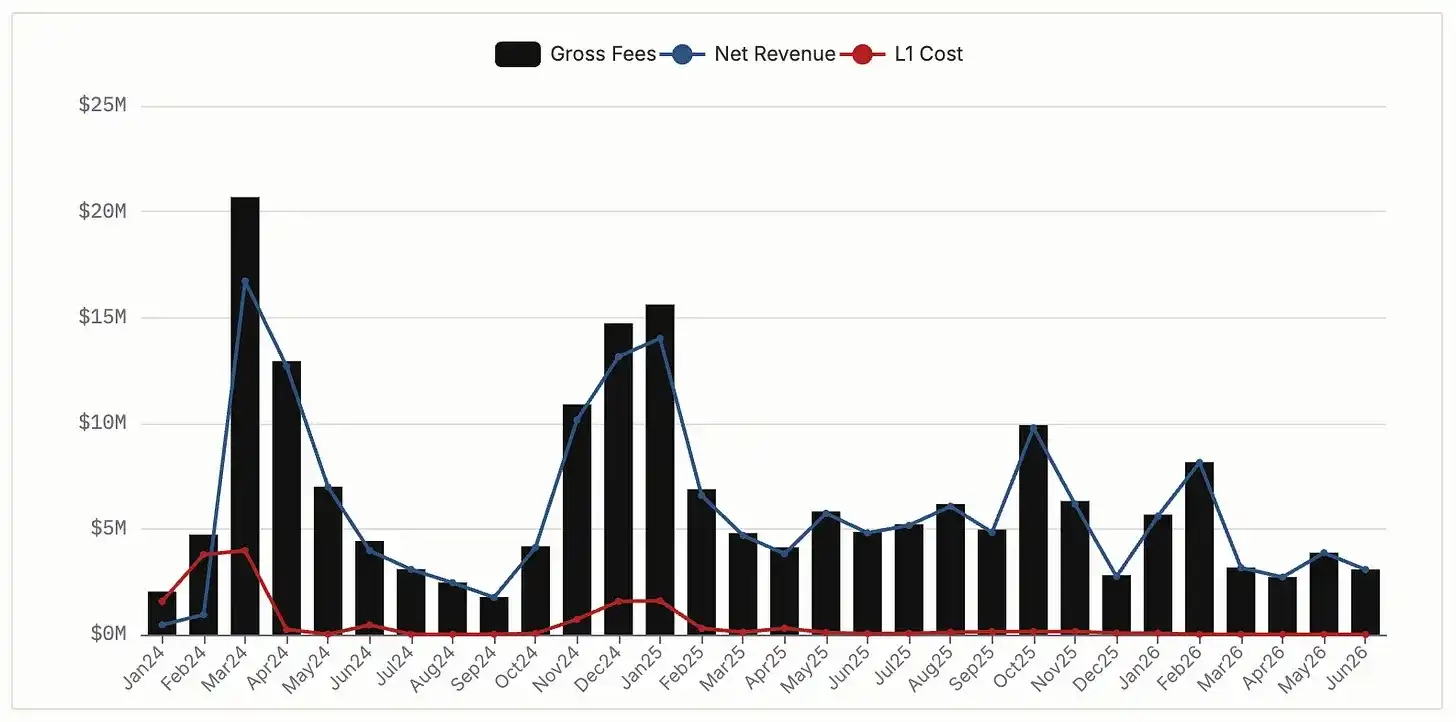
Base Monthly Sequencing Fee Revenue, Data Source: DeFiLlama

Coinbase, relying on Morpho's underlying architecture, launched a $300 million Bitcoin-backed lending product. Its issued wrapped Bitcoin, cbBTC, is the largest collateral asset within Morpho, accounting for 38% of the protocol's total TVL. This creates a mutual interdependence: Morpho holds the underlying core capability of Coinbase's credit products, while Coinbase can extract a revenue share from all of Morpho's business, making it difficult for either side to easily sever the cooperation.

Consider Stripe's case: in early 2025, it spent $11 billion acquiring Bridge. Before that, Stripe's stablecoin business relied on Circle's infrastructure. Circle held the stablecoin issuance rights and earned the floating interest generated by the reserve collateral assets. At that time, all revenue from Stripe's trillion-level stablecoin transactions flowed to Circle. The acquisition of Bridge completely reversed this situation. Bridge issues its own stablecoin, USDB, collateralized by BlackRock money market funds. After switching to USDB, the sizable interest from these reserves remained entirely within Stripe's ecosystem. Stripe's annual payment transaction volume reaches $1.4 trillion; long-term rental of a competitor's profit-generating foundation meant losing hundreds of millions in annual profit.

Patrick Collison once called stablecoins "the room-temperature superconductors of finance." Spending $11 billion to fully own this underlying tool is far more economical than continuously paying tolls to a competitor.

Pure spot exchanges have a natural growth ceiling, with users only able to trade hundreds of tokens. But Kraken wanted to attract institutional investors and sophisticated retail traders, groups that primarily trade via futures and clearing derivatives. Operating a derivatives business requires registration with the U.S. Commodity Futures Trading Commission (CFTC), membership with the National Futures Association (NFA), and broker-dealer licenses. Building this entire compliance system takes years; even building from scratch, regulators could deny approval for various uncontrollable reasons.

This is why Kraken targeted NinjaTrader. The $1.5 billion acquisition in January 2025 brought not only 1.7 million funded trading accounts but, more crucially, directly provided Kraken with the full set of broker-dealer licenses it would have struggled to quickly develop and obtain on its own.

By acquiring ready-made compliance qualifications, Kraken completely freed itself from dependence on external partners. It now fully owns the entire technological system and licenses, needing to rely on no one else nor spend years awaiting regulatory approval.

Some might say: large enterprises swallowing small protocols, isn't that industry norm? What's new here?

Morpho's total TVL is $6.4 billion, with $3.308 billion deployed on Ethereum and $2.488 billion deployed on Base. If Coinbase decided to delist Morpho and use a self-developed lending protocol instead, Morpho would immediately lose 39% of its TVL; but it would still retain 52% on Ethereum, while continuing to expand across multiple chains like Hyperliquid L1, Monad, and Arbitrum, allowing its overall business to operate stably.
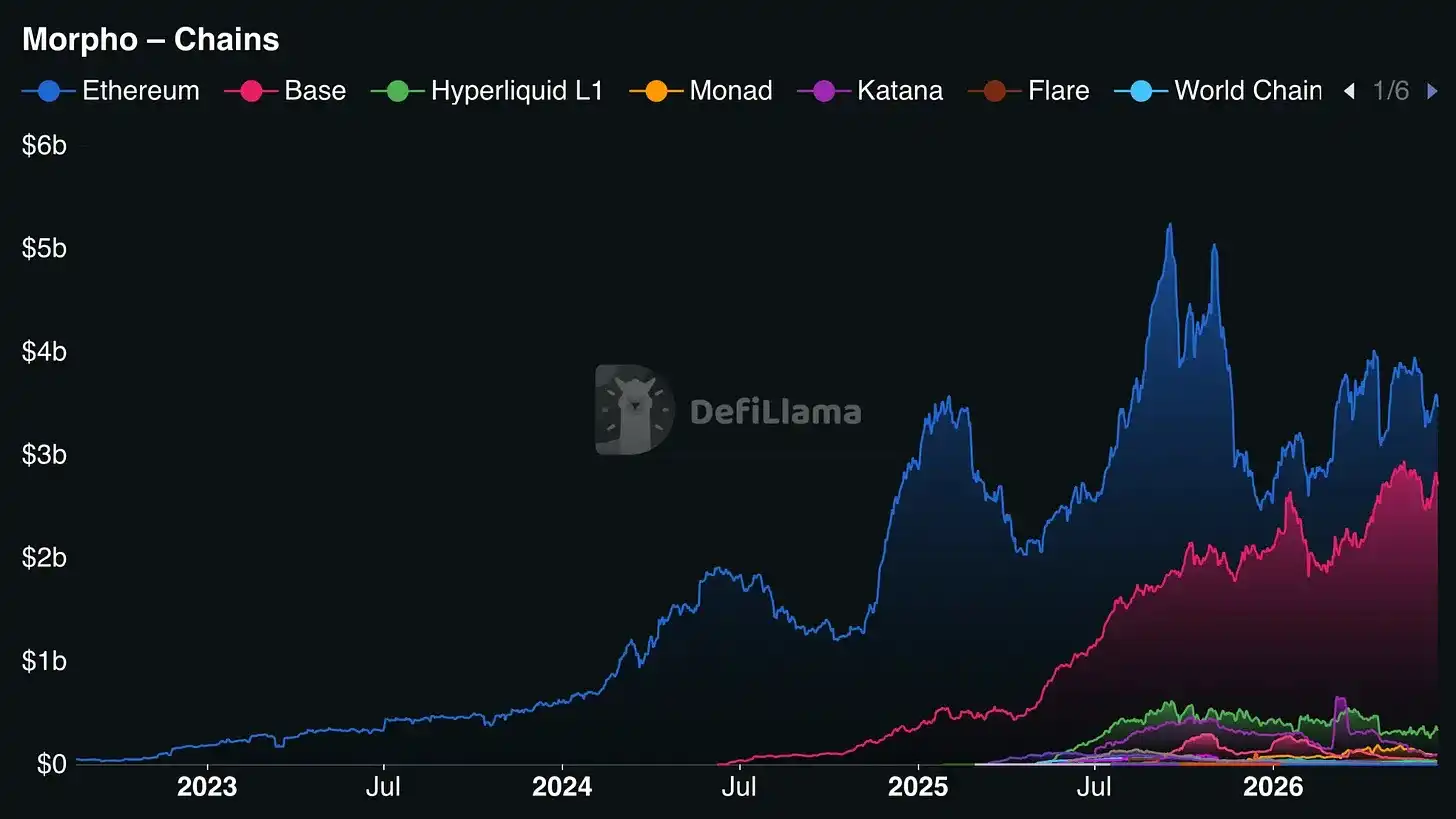
Morpho TVL Distribution Across Chains, Data Source: DeFiLlama

The case of Aerodrome on the Base chain vividly demonstrates the industry impact when a chain operator promotes its own competitor. Aerodrome is Base's native decentralized exchange (DEX), optimized for Base's architecture. Coinbase Ventures holds approximately $20 million worth of AERO tokens, its largest liquidity token investment; meanwhile, the project, through locked AERO token voting, guides liquidity towards Coinbase's products, including cbBTC pools. Aerodrome captures about 51% of Base's DEX trading volume, peaking at 77% in September 2024. Uniswap, deployed across 44 chains, is Base's second-largest DEX, holding 30% trading volume. Even after losing its top position on a single chain, Uniswap did not die: in 2025, it processed $212 billion in volume on Base, with estimated all-chain monthly trading volume around $73 billion.
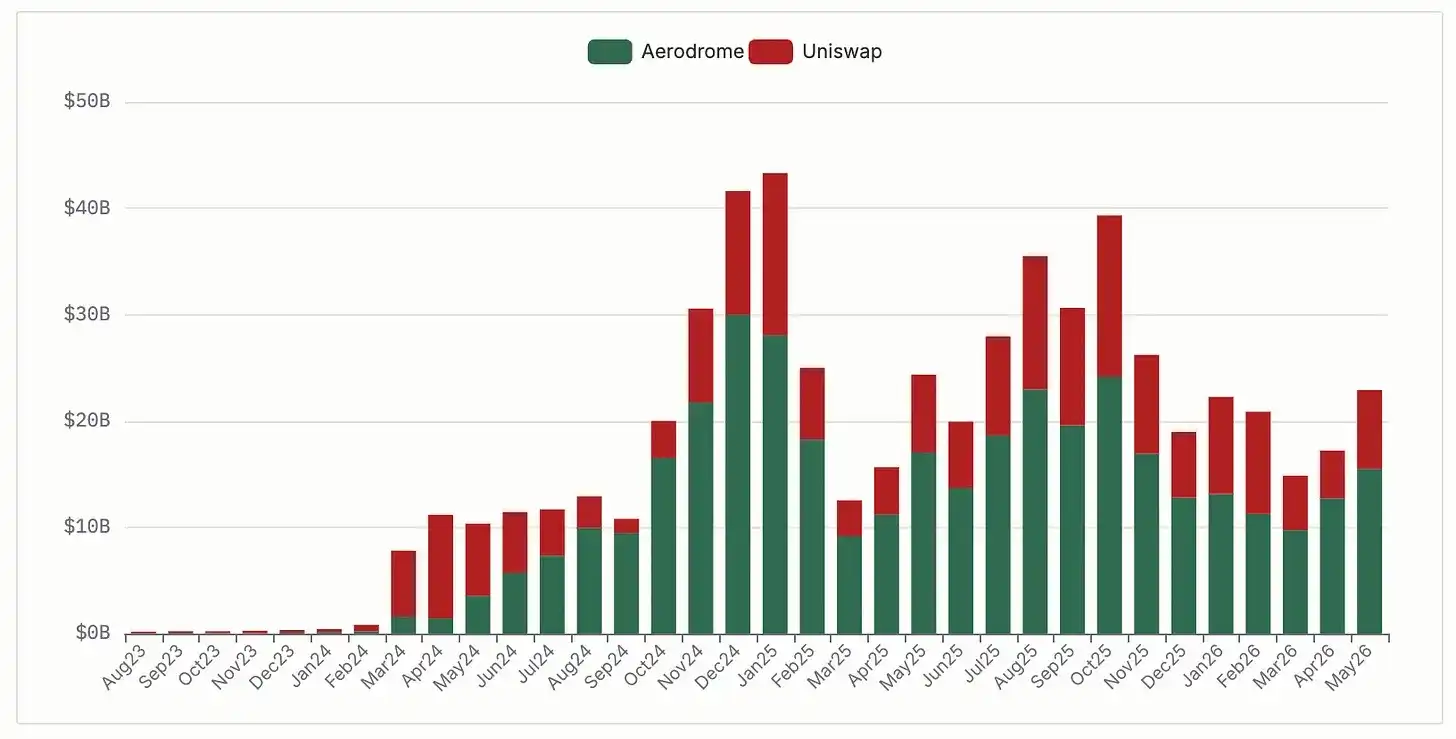
Base DEX Trading Volume Share, Data Source: DeFiLlama

This case confirms that multi-chain deployment is a protocol's natural moat. A project deployed only on a single chain is entirely at the mercy of the chain operator, who can at any time promote a competitor to squeeze its survival space. Conversely, a multi-chain deployed protocol can continue operating normally across other tracks even if it loses one chain's market. After witnessing Uniswap's traffic diversion on Base by Aerodrome, Morpho rapidly expanded its deployment across multiple chains. Large traffic platforms can vertically integrate downwards into the underlying layer, while open-source protocols can horizontally expand across multiple chains to diversify risk.

If you rely on underlying infrastructure you do not own, you do not truly control your business. The party controlling the underlying layer holds overwhelming pricing power over you, can define your product experience, and ultimately influence your operational stability. For companies of this scale, this dependency relation results in tangible profit loss daily. This business logic is not unique to crypto: Amazon built its moat on AWS; Apple, once constrained by Intel's chip roadmap, spent years developing custom chips to break free.

Everyone can check in real-time how much revenue Coinbase earns from Base sequencing fees and clearly view Morpho's TVL across various chains. This value extraction process is entirely transparent, unlike the internal infrastructure profits of traditional internet giants like Amazon.

One potential industry direction is a future market entirely controlled by giants like Coinbase, Stripe, Kraken, and a few banks. They would control the entire industry chain from underlying protocols to payment cards, with open-source protocols merely filling niche gaps the giants haven't yet addressed. This is a fully plausible development path for fintech. Open-source technology would no longer be a free, vast fertile ground for innovation but merely a patch of tape filling tiny crevices in giant enterprises not yet monetized. Like the joke goes: "Look at this high-quality small open-source protocol; let's just build a commercialization system on top of it to harvest the traffic."

However, I lean towards an optimistic view: considering several current acquisition cases, the probability of such complete monopolistic control is not as high as it seems. Underlying protocols are difficult to be exclusively monopolized by giants like traffic channels. Morpho can complete deployment on a new chain in mere weeks; replacing a battle-tested lending protocol deeply embedded in institutional operations incurs extremely high costs, not easily perceptible to outsiders. Coinbase's $300 million Bitcoin lending product still relies on Morpho because replicating Morpho's security system from scratch would take years and introduce security risks Coinbase is unwilling to bear.

Protocols that can survive this wave of giant consolidation share a core condition: completing full multi-chain deployment before traffic giants build their own ecosystems, deeply embedding themselves into major enterprises' backend systems, making the economic cost of replacement prohibitively high. Even Robinhood, a traffic giant with a massive user base, chose to integrate the third-party zero-knowledge proof perpetual contract exchange Lighter as its trading backend. Robinhood Ventures participated in Lighter's $68 million funding round, and founder Vlad Tenev maintains close communication with the project.

If only traffic channels could build moats, Robinhood could have self-developed the entire backend like Coinbase. But it didn't: combining centralized exchange trading speed with zero-knowledge verifiable matching logic is an extremely difficult niche technical challenge; the Lighter team spent over a year solving it. Robinhood calculated that purchasing the right to use mature technology is far more economical than developing from scratch.

Currently, Morpho occupies this favorable position of mutual deterrence, and Uniswap is the pioneer of this path. The speed of institutional expansion and the speed of open-source protocols' horizontal multi-chain expansion are in a game, the outcome of which will determine the direction of the industry landscape.

For now, the underlying operations of giants like Stripe and Coinbase still rely on open-source technology. In the short term, open-source protocols can still stand firm. In two years, we can re-examine the industry landscape.


Criptomoedas em alta

Perguntas relacionadas

QWhat is the core issue discussed in the article regarding DeFi protocols and large tech companies?

AThe core issue is how DeFi protocols can survive and compete when large tech companies and centralized platforms (like Coinbase, Stripe, Kraken) that control key distribution channels move to capture the underlying infrastructure and value, extracting fees and potentially replacing the protocols they once relied on.

QAccording to the article, what strategic move did Coinbase make to capture value from protocols like Morpho?

ACoinbase launched its own Layer 2 blockchain, Base. While Morpho deployed on Base to access its user base, all transaction sequencing fees generated on Base flow to Coinbase, not to Morpho, allowing Coinbase to capture value from Morpho's operations.

QHow does the article suggest DeFi protocols like Morpho can build a 'moat' against such centralization pressures?

AThe article suggests that multi-chain deployment is a key defensive moat. By spreading across multiple blockchains (like Ethereum, Arbitrum, Monad), a protocol is not reliant on any single chain operator. If it loses dominance on one chain, its operations on others can sustain it, making it harder for a centralized entity to control its fate.

QWhat example does the article use to illustrate the high cost of replacing a deeply integrated, battle-tested protocol?

AThe article uses Coinbase's own $300 million Bitcoin-backed lending product. Despite having the incentive to replace Morpho, Coinbase continues to use it because replicating Morpho's security and proven system from scratch would take years and introduce unacceptable risks that Coinbase is unwilling to bear.

QWhat contrasting example does the article provide to show that not all large platforms choose to build everything in-house?

AThe article cites Robinhood, which chose to integrate with the third-party ZK-powered perpetual exchange Lighter instead of building its own. Robinhood calculated that licensing the mature, specialized technology from Lighter was more economical than undertaking the difficult and time-consuming in-house development.

Leituras Relacionadas

Base Under Pressure

**Title: The Pressure Mounts for Base** Base, the Ethereum Layer 2 scaling solution backed by Coinbase, is facing significant pressure and public scrutiny from its leadership following the launch of Robinhood Chain. Base co-founder Jesse Pollak recently acknowledged strategic missteps, admitting that the chain's past focus on social and creator tokens (e.g., through Farcaster, Zora) failed to deliver sustainable adoption. He has refocused on core infrastructure, handing leadership of the Base App back to Coinbase's Cobie. While Base remains a top L2 contender alongside OP Mainnet and Arbitrum, and boasts the highest TVL (nearly $12B), its weaknesses are being highlighted by the new competitor. Key criticisms include its slow progress on decentralization. Base has faced issues with its single sequencer causing block production halts, and L2BEAT is reportedly considering downgrading its decentralization rating from Stage 1 to Stage 0. This contrasts sharply with the rapid initial success of Robinhood Chain, whose DEX quickly entered the top five by volume. The leadership styles of the parent companies are also being compared: Robinhood's CEO actively engages with new projects, while a recent incident where Coinbase's Brian Armstrong briefly changed his profile picture—sparking and then crashing a related meme token—drew community ire and mockery. Pollak stated Base is working with Coinbase on tokenized stocks backed 1:1 by real equity, differentiating it from Robinhood's derivatives model. However, the article argues that Base's most urgent task is to address its long-standing technical and trust issues. With more traditional finance players likely to emulate Robinhood's path, Base must use this competitive pressure to solidify its position as long-term financial infrastructure.

Foresight NewsHá 7m

Base Under Pressure

Foresight NewsHá 7m

White House Concession Removes Ethical Hurdle, Clarity Act Races Against Final Window Before Recess?

On July 21st, industry sources reported that the Trump administration has agreed to include an ethics provision in the "Clarity Act" (Digital Asset Market Clarity Act of 2025). This concession addresses the long-standing conflict-of-interest concerns regarding government officials and the crypto industry, potentially removing the final major obstacle to the bill's progress. Additionally, Patrick Witt, the executive director of the White House's Digital Asset Advisory Committee, confirmed he will remain in his role to help finalize the bill, alleviating previous concerns about his potential departure. The Clarity Act aims to establish a unified federal regulatory framework for the U.S. digital asset market. Its core objective is to resolve regulatory ambiguity by defining different types of digital assets (digital commodities, investment contract assets, and permitted payment stablecoins) and clarifying the respective oversight roles of the SEC and CFTC. This would end the long-running jurisdictional dispute between the two agencies and provide clearer compliance paths for the industry. With the ethics issue moving toward resolution, the most urgent challenge now is time. The U.S. Congress is set to begin its August recess in mid-August, leaving only a few working weeks to finalize the text and advance the bill through the Senate. Industry advocates, like the Blockchain Association's Kristin Smith, stress that this is a critical moment. If negotiations conclude successfully in the coming weeks, the Clarity Act could pass a key hurdle before the recess; otherwise, it may face significant delays. If enacted, the Clarity Act could mark a historic turning point in crypto regulation. By providing a clearer and more predictable legal framework, it aims to reduce uncertainty for businesses, developers, and traditional financial institutions looking to enter the digital asset space, potentially setting a global benchmark for market structure regulation.

Odaily星球日报Há 13m

White House Concession Removes Ethical Hurdle, Clarity Act Races Against Final Window Before Recess?

Odaily星球日报Há 13m

AI Era, Industrial Revolution, and Future Civilization Interview — Zhang Dingwen: The Future Does Not Belong to Chasers

"AI Era, Industrial Revolution and Future Civilization: An Interview with Zhang Dingwen – The Future Does Not Belong to Those Who Chase" In this interview, entrepreneur Zhang Dingwen reflects on his entrepreneurial journey and philosophy, moving beyond discussions of financing or success to emphasize understanding the "era" itself. He argues that true entrepreneurs should not chase short-term trends ("winds"), but position themselves in the direction of long-term technological and societal evolution. Zhang shares key lessons from his early days, including the realization that user value does not automatically translate to commercial value. For him, the core of entrepreneurship is not building a company but constantly upgrading one's own "cognition" – the ability to interpret information, ask the right questions, and understand the underlying "causes" behind business outcomes, not just the effects. His thinking has evolved from a focus on creating good products to a strategic focus on building "entrances" – platforms that naturally connect users to digital services. He sees smart wearables, like watches, not merely as hardware but as potential future gateways combining technological, financial, social, and even fashion attributes to create sustained user relationships and ecosystems. Ultimately, Zhang's vision transcends individual products or companies. He discusses business competition in three stages: product, platform, and finally, "civilization" – where the greatest companies influence how society operates by defining new rules and ways of life. He believes the mission of a truly great enterprise is to solve problems of its time, build enduring trust, and contribute lasting value, leaving behind not just wealth but a positive impact on how the world works. The future, he concludes, belongs not to the fastest, but to those with the correct long-term direction and a commitment to continuous learning and evolution.

marsbitHá 24m

AI Era, Industrial Revolution, and Future Civilization Interview — Zhang Dingwen: The Future Does Not Belong to Chasers

marsbitHá 24m

Cryptocurrency & Stock Market Barometer丨Strategy Cash Reserves Increase to $3.23 Billion, Halting BTC Purchases; Vanguard and Other Asset Managers Increase Holdings in Strategy Stock (July 21)

Market Overview & Warnings: The article warns of high volatility in South Korean stocks and continued dependence on U.S. stocks on geopolitics. Chinese A-shares remain under pressure. It advises against using leverage in current equity markets. For crypto-linked stocks, most have limited growth except Robinhood, with caution advised. U.S. Stock Market: Bearish bets on U.S. stocks, particularly targeting AI-related companies, have reached record highs since 2010, signaling deep skepticism about the sustainability of the AI-driven rally. Tech and chip stocks led a market decline, with the Philadelphia Semiconductor Index potentially entering a bear market. Increased expectations for Federal Reserve interest rate hikes and geopolitical tensions contributed to the negative sentiment. Bitcoin Treasury Company Updates: * Strategy: Increased its cash reserves to $3.23 billion and paused Bitcoin purchases. Several major asset managers, including Vanguard Group and Capital Group, increased their holdings of Strategy (MSTR) stock. * Global corporate Bitcoin buying slowed significantly to just $1.33 million last week. * Other notable activity: Strive purchased 21 BTC; ORANGE JUICE raised $40 million for Bitcoin acquisitions; Bitcoin Japan Corp. raised $60 million, allocating $4.08 million for its first BTC purchase. Other Crypto Treasury Holdings: * Ethereum: BitMine increased its ETH holdings to 5.78 million, nearing its 5% of supply goal. Its total crypto assets, cash, and securities are valued at $11.5 billion. * Solana: No significant corporate treasury activity reported. * Altcoins: HypeStrat made no adjustments to its treasury; its mNAV ratio fell to a long-term low. (Note: This summary is for informational purposes only and does not constitute investment advice.)

marsbitHá 25m

Cryptocurrency & Stock Market Barometer丨Strategy Cash Reserves Increase to $3.23 Billion, Halting BTC Purchases; Vanguard and Other Asset Managers Increase Holdings in Strategy Stock (July 21)

marsbitHá 25m

Trading

Spot

Artigos em Destaque

Como comprar RAY

Bem-vindo à HTX.com!Tornámos a compra de Raydium (RAY) simples e conveniente.Segue o nosso guia passo a passo para iniciar a tua jornada no mundo das criptos.Passo 1: cria a tua conta HTXUtiliza o teu e-mail ou número de telefone para te inscreveres numa conta gratuita na HTX.Desfruta de um processo de inscrição sem complicações e desbloqueia todas as funcionalidades.Obter a minha contaPasso 2: vai para Comprar Cripto e escolhe o teu método de pagamentoCartão de crédito/débito: usa o teu visa ou mastercard para comprar Raydium (RAY) instantaneamente.Saldo: usa os fundos da tua conta HTX para transacionar sem problemas.Terceiros: adicionamos métodos de pagamento populares, como Google Pay e Apple Pay, para aumentar a conveniência.P2P: transaciona diretamente com outros utilizadores na HTX.Mercado de balcão (OTC): oferecemos serviços personalizados e taxas de câmbio competitivas para os traders.Passo 3: armazena teu Raydium (RAY)Depois de comprar o teu Raydium (RAY), armazena-o na tua conta HTX.Alternativamente, podes enviá-lo para outro lugar através de transferência blockchain ou usá-lo para transacionar outras criptomoedas.Passo 4: transaciona Raydium (RAY)Transaciona facilmente Raydium (RAY) no mercado à vista da HTX.Acede simplesmente à tua conta, seleciona o teu par de trading, executa as tuas transações e monitoriza em tempo real.Oferecemos uma experiência de fácil utilização tanto para principiantes como para traders experientes.

310 Visualizações TotaisPublicado em {updateTime}Atualizado em 2026.06.02

Como comprar RAY

Discussões

Bem-vindo à Comunidade HTX. Aqui, pode manter-se informado sobre os mais recentes desenvolvimentos da plataforma e obter acesso a análises profissionais de mercado. As opiniões dos utilizadores sobre o preço de RAY (RAY) são apresentadas abaixo.

活动图片