Apple at 50: The Genius Exits, The Machine Lives Forever

marsbitPublicado em 2026-03-31Última atualização em 2026-03-31

Resumo

Apple's 50-year journey is a garage startup story that began with Ronald Wayne, the co-founder who sold his 10% stake for $800 to avoid personal financial risk. His departure set a pattern: Apple evolved from a company driven by visionary genius to a risk-averse system prioritizing certainty over innovation. Under Tim Cook, Apple shifted from product-driven growth to financial engineering, spending over $700 billion on stock buybacks to boost earnings per share and please Wall Street. Its supply chain strategy also changed, moving significant iPhone production to India to mitigate geopolitical risks and reduce dependency on any single region. Meanwhile, in the AI era, Apple leverages its App Store dominance, collecting billions in "Apple tax" from AI apps like ChatGPT without leading in AI innovation itself. As Cook’s potential successor, John Ternus—a pragmatic operator—rises, Apple solidifies its identity as a machine optimized for stability, control, and execution. The era of charismatic founders has ended; the system now reigns supreme.

In April 1976, three men signed the partnership agreement for Apple Inc. in a California garage. Twelve days later, one of them withdrew from the partnership. If he had not quit and endured the long half-century, his 10% stake would be worth $400 billion today. That sum would be enough for him to buy half of the oil empires in the Middle East, or to rub Elon Musk into the ground twice on the Forbes rich list.

This man's name is Ronald Wayne. When the public discusses the 50-year history of Apple, they tend to deify the persistence of Steve Jobs and Steve Wozniak, and then casually mock Wayne's cowardice and shortsightedness for selling his shares for a mere $800.

However, Wayne, then 41, was the only one among the three who had a proper job, assets, and even a family. Jobs, at the time, was willing to mortgage everything just to borrow money for parts. Looking at this long-haired young man with a dazed look in his eyes, Wayne felt nothing but unease. Because if this company went bankrupt, under the partnership laws of the time, creditors would let go of the two penniless young men and legally take every car, every house, and every cent of savings under Wayne's name.
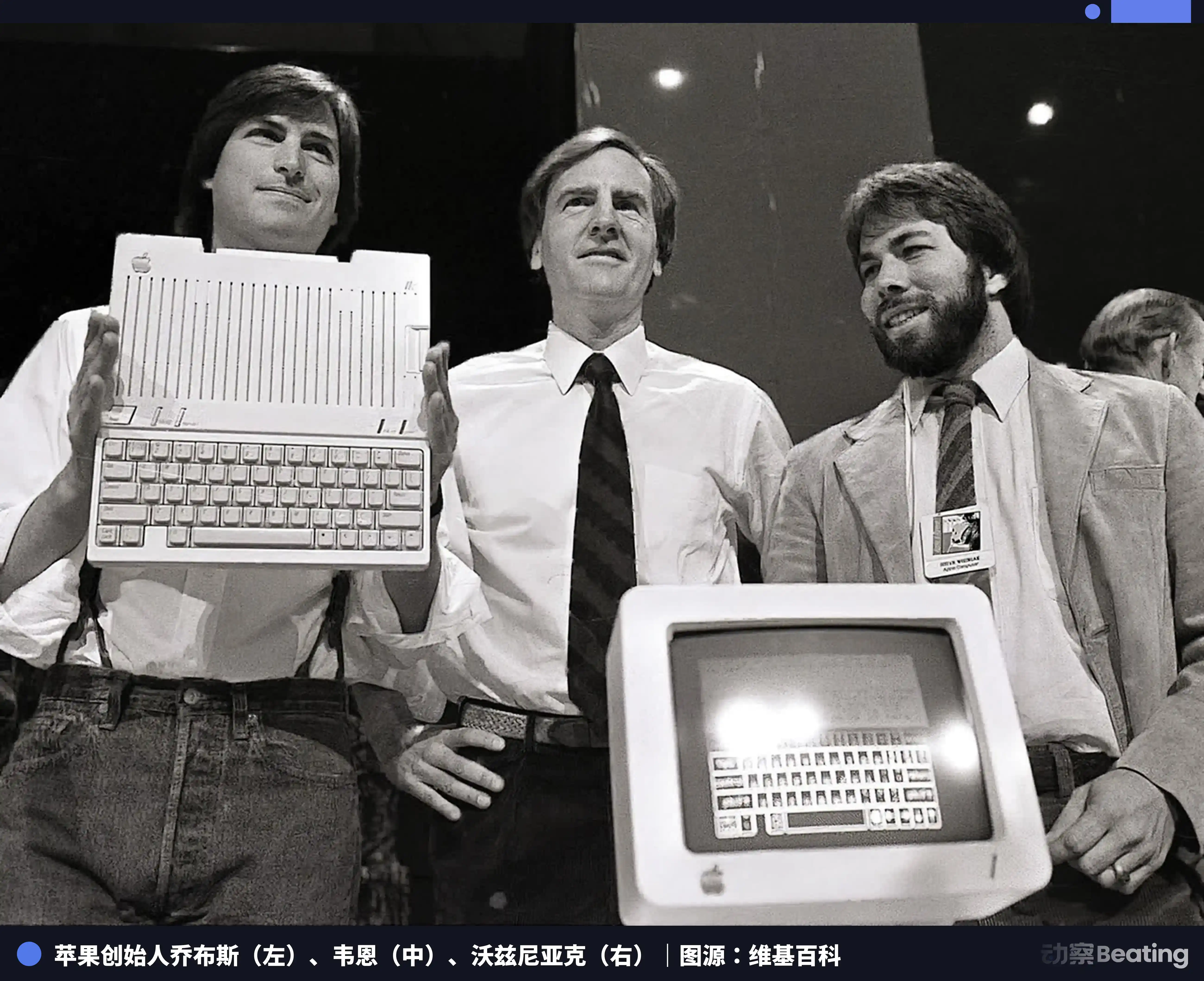
Wayne's exit was a rational calculation by an ordinary person facing "extreme uncertainty." He retreated to his safe life.

Wayne withdrew from Apple out of fear of risk, and the irony of history is that Apple, over the next 50 years, became another Wayne.

This company表面上 shouts "Think Different," but its bones are极其 averse to risk. Wayne left Apple because he disliked risk, and from then on, geniuses were responsible for creating myths, while the system was responsible for eliminating uncertainty. Apple's 50 years is not just a story about "genius changing the world," but also a victory of the system over the individual, of calculation replacing inspiration.

If the early Apple relied on Jobs's personal heroism to combat risk, then how did this behemoth, once truly grown, use hundreds of billions of real dollars to buy absolute security in the capital markets?

A "Hedge Fund" Disguised as a Tech Company

Jobs极度 hated dividends and stock buybacks. In his view, every penny Apple earned should be reinvested in R&D. Even in 2010, when Apple's cash reserves were already enormous, he stubbornly refused to budge under pressure from Wall Street.

But after Jobs's death, the new CEO, Tim Cook, succumbed to shareholder pressure and on March 19, 2012, announced Apple's first-ever dividend and a stock buyback plan worth tens of billions of dollars. From that day on, in the eyes of Wall Street, Apple gradually transformed from a world-changing tech company into a "hedge fund" disguised as a tech company.

According to statistics from Creative Planning and major financial institutions, from 2013 to the end of 2024, Apple's total stock buybacks reached $700.6 billion.
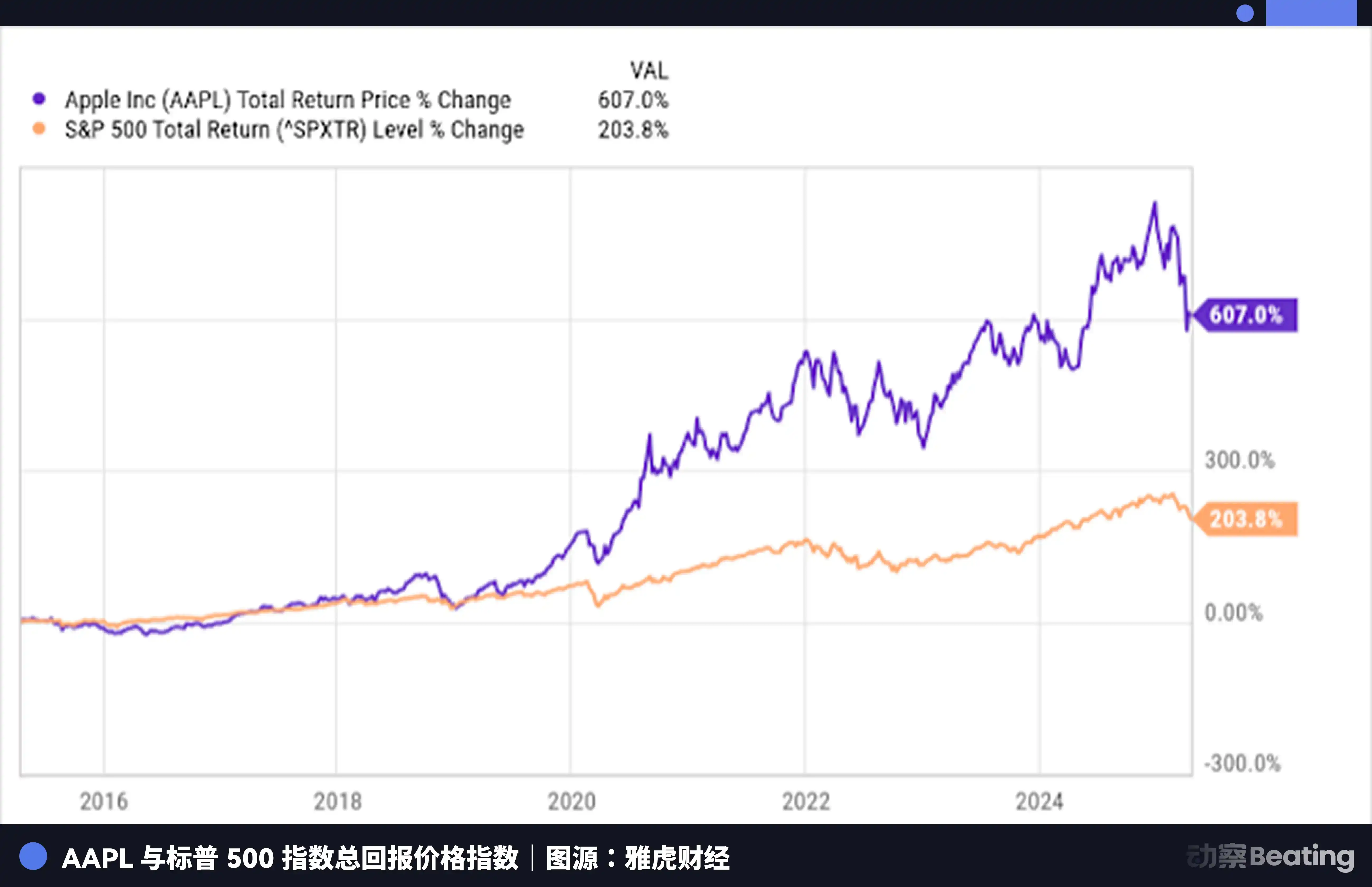
Among the constituents of the S&P 500 index, this figure exceeds the total market capitalization of 488 of them. In other words, the money Apple used to buy its own stock is enough to directly buy any listed company outside the top 13 in the global market cap rankings, such as Eli Lilly, Visa, or Netflix.

And when we look at the current AI frenzy, where Amazon, Google, and Meta are burning through nearly $700 billion疯狂 on AI large language models and computing power, trying to gamble on an uncertain future at a table where the cards are unclear, Apple is using a comparable amount of money to buy its own stock.

Technological innovation is risky; you might throw down a hundred billion and not even hear a sound. But reducing the number of shares outstanding and boosting earnings per share is 100% certain on the financial statements. Over the past decade, although Apple's net profit growth has slowed, its EPS has been artificially inflated by nearly 280% through疯狂 buybacks.

Warren Buffett heavily invested in Apple in recent years, even making it the absolute heavyweight in Berkshire Hathaway's portfolio, accounting for over 20% at one point. The old man wasn't buying the growth potential of a tech stock; he was buying the absolute certainty provided by this精密 machine during a period of technological平庸. In the mature stage of an industry cycle, financial engineering makes money much faster and more steadily than technological R&D.

It no longer needs a earth-shattering product to astonish the world; it just needs to act like a tireless pump, siphoning up profits and then precisely channeling them into Wall Street's reservoir.

On the financial statements, Apple bought absolute certainty with $700 billion. But the profits that support this massive numbers game—how are they squeezed out from the assembly lines in the physical world?

The Great Supply Chain Migration

In March, Tim Cook appeared in China once again, beaming. He drank Chinese afternoon tea and said to the camera with a smile: "China's supply chain is critical to Apple. We could not have achieved what we have today without Chinese suppliers."

But behind this warm and fuzzy PR rhetoric, Apple is quietly carrying out an epic supply chain migration.

In 2025, the number of iPhones assembled in India reached 55 million, a暴增 of 53% from the previous year. This means that now, one out of every four iPhones produced globally comes from India.
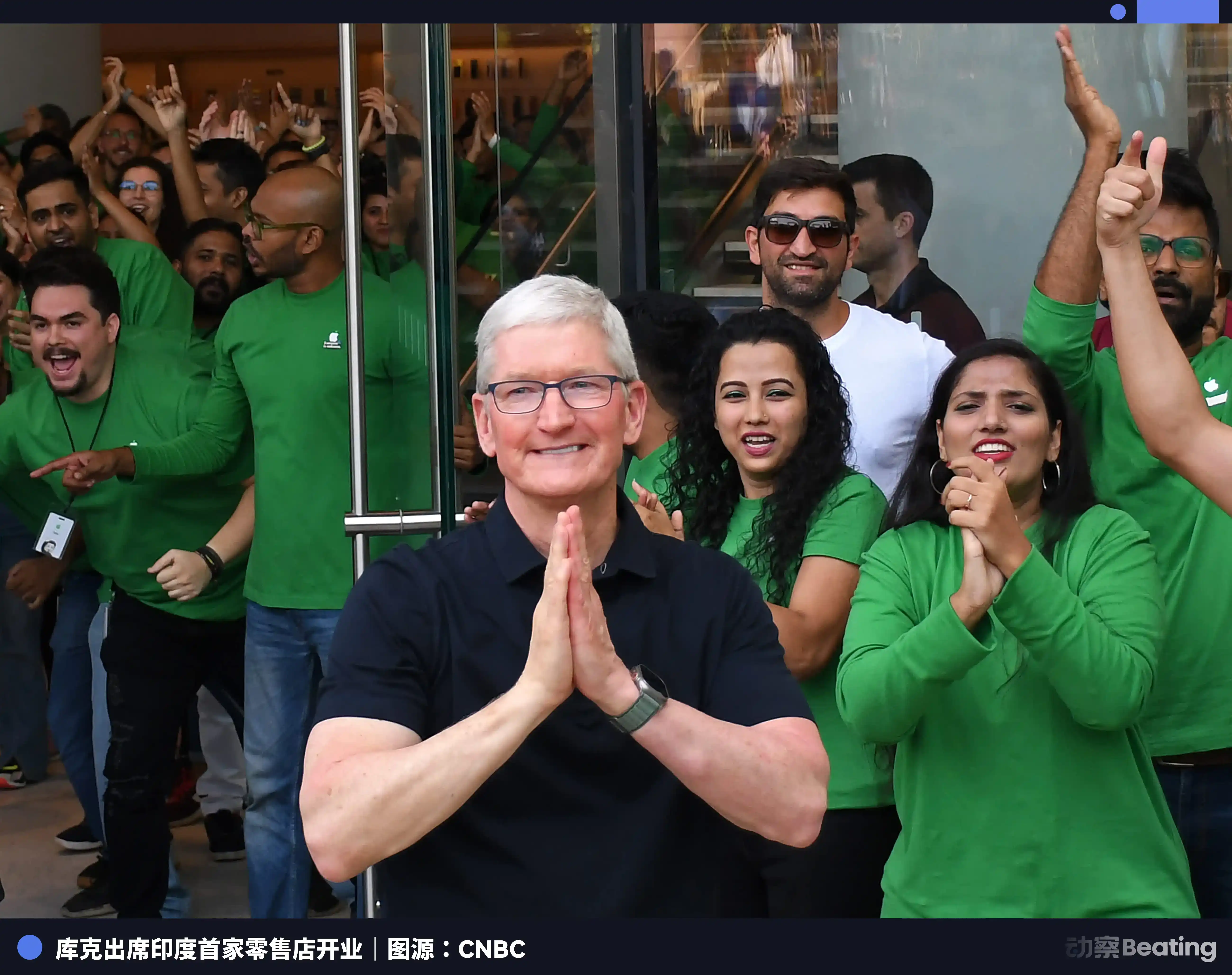
Tata Group just built a huge new factory in Hosur, Tamil Nadu, southern India, planning to double its workforce to 40,000 people; and Foxconn's factory in India exported $4.4 billion worth of iPhones to the US in just the first five months of 2025. The latest iPhone 17 series has even achieved the breakthrough of having all models assembled in India.

The reason behind the supply chain shift is not as simple as "searching for cheaper labor." It is surgery performed by the Apple system to eliminate geopolitical uncertainty and single-node risk. Apple treats the global supply chain like a motherboard design—wherever there is risk, it pulls out the capacitor from there and plugs it into a safer place.

In this process, whether it's the workers on the Foxconn assembly lines in China who once created "Zhengzhou speed," or the young labor force in the Hosur factory in India who have just put on anti-static clothing, there is essentially no difference within Apple's system. They are all just gears on this庞大 machine, replaced seasonally.

Apple cares about the stability and cost of the gears' operation. It死死 holds the product design rights in its spaceship headquarters in California, but perfectly outsources the dirty and hard work of production and management conflicts to Foxconn and Tata. In this impregnable supply chain system, all suppliers and workers are just consumables that can be replaced at any time.

After achieving this窒息 control in the physical world, how will this behemoth apply its old tricks to the most ferocious AI wave in the digital world?

The Toll Booth on the Road to the Gold Mine

In 2024, the generative AI wave swept across, and ChatGPT made the whole Silicon Valley exclaim that the "iPhone moment" had arrived again. Analysts were嘲笑 Apple: Siri is like an idiot, Apple is落后 in the AI era, Apple is finished.

But by 2026, when AI large language model companies were bleeding money on computing power and worrying themselves bald about commercial monetization, a piece of data from AppMagic surprised everyone.

In 2025, generative AI apps paid nearly $900 million in commissions to Apple just to be able to be listed on the App Store, the so-called "Apple Tax." Of this, nearly 75% of the money was paid by ChatGPT alone. Musk's Grok ranked second, contributing 5%.
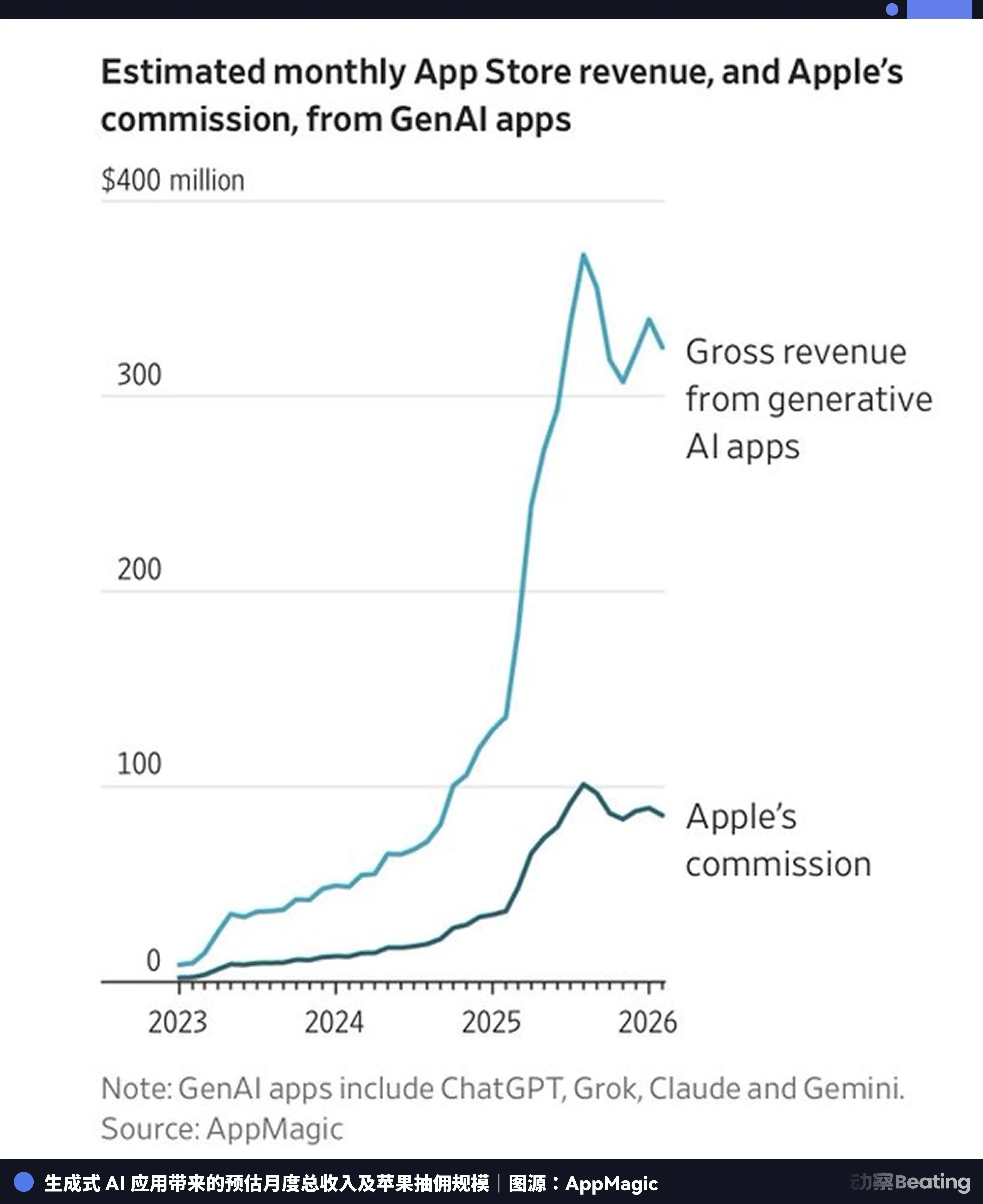
This is Apple's most terrifying aspect. It may not have built the shovels for the gold rush, but it directly controls the only road to the gold mine and built a toll booth.

Whether you are Claude or OpenAI, if you want to reach billions of high-net-worth iOS users globally, you must乖乖 listen to Apple and faithfully hand over 30% (or 15%) of your revenue to Cook. In the狂热 AI bubble, Apple used a近乎流氓 force of ecosystem monopoly to forcibly transform all AI innovation试图颠覆 it into steadily growing service revenue on its own financial reports.

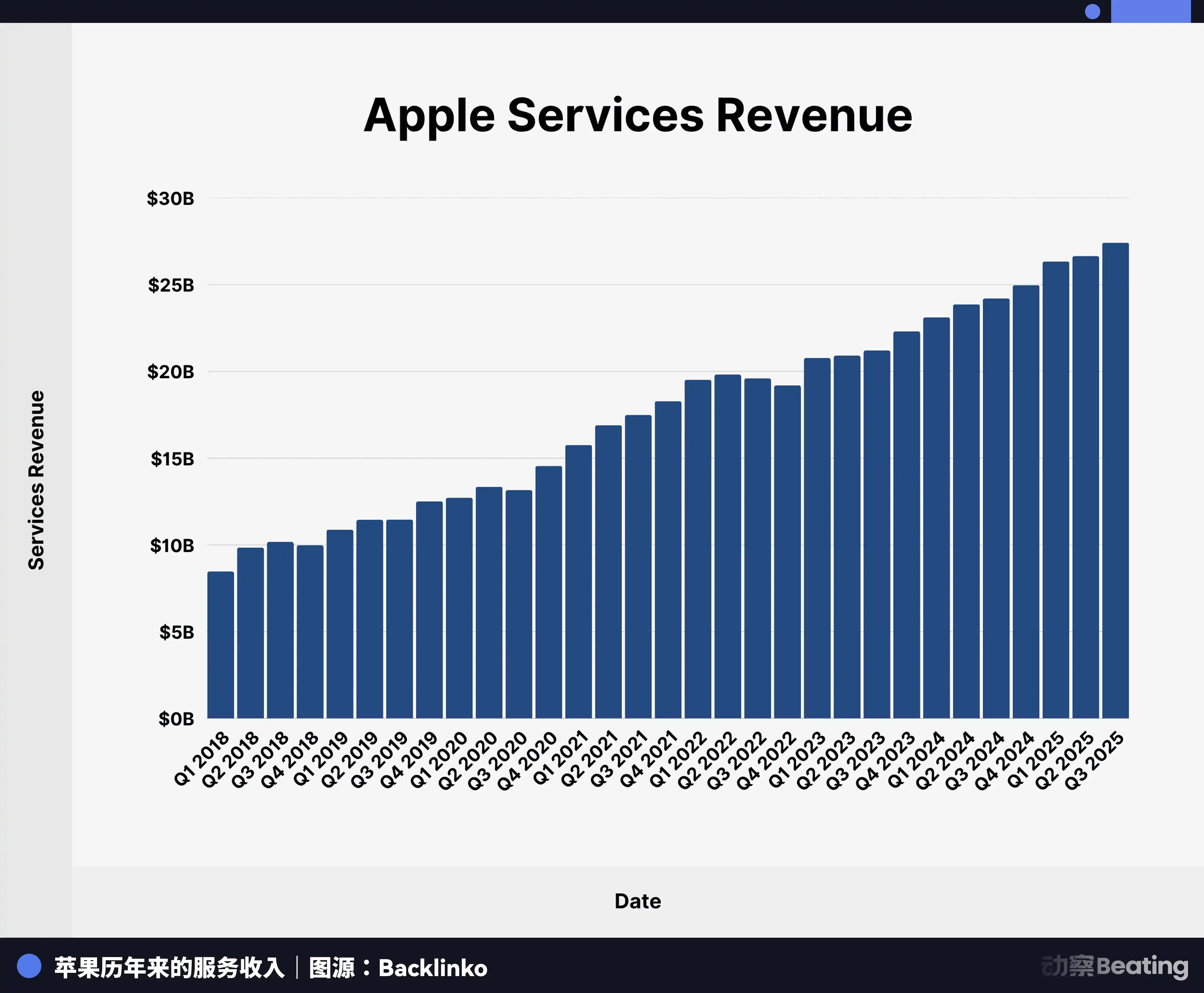
In the fourth quarter of fiscal year 2025, Apple's service revenue hit a historic high of $28.8 billion, a year-on-year increase of 15%. Among this, the AI apps seen as Apple's disruptors by the outside world contributed the most succulent piece of profit.
Of course, this kind of behavior has also attracted the hammer of antitrust. On March 15, 2026, facing huge regulatory pressure, Apple罕见 conceded in the Chinese market, reducing the standard App Store commission from 30% to 25%, and the commission for small developers from 15% to 12%. But this doesn't hurt its fundamentals at all.

From the supply chain in the physical world to the App Store in the digital world, Apple has mastered systemic control to the化境. When this machine becomes精密 to the extreme, does the person in the driver's seat still need to be a genius?

The Final Victory of the Cooks

At the 50th anniversary milestone of Apple, the biggest gossip in Silicon Valley isn't some revolutionary new product, but Cook's successor.

All clues point to one name: John Ternus.

This 50-year-old Senior Vice President of Hardware Engineering at Apple is practically a carbon copy of Tim Cook. He graduated from the University of Pennsylvania in 1997 with a degree in Mechanical Engineering, joined Apple in 2001, and has been there for 24 years. His resume is clean, devoid of Jobsian madness like going to India to find a spiritual guru, or those eccentric anecdotes.
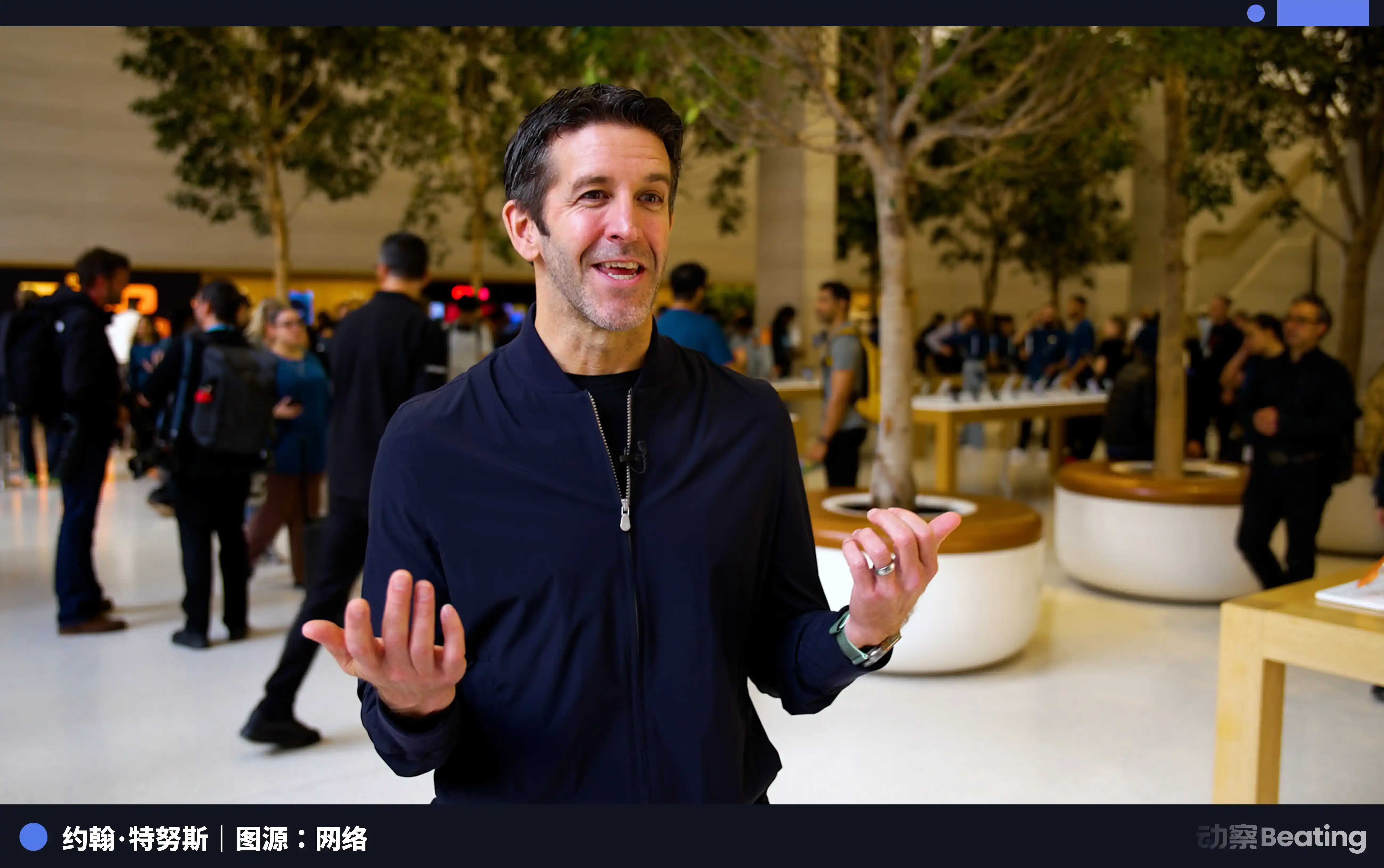
A deep dive by The New York Times wrote that when Ternus was promoted, the company arranged a private office with a door for him, but he refused. He chose to continue sitting in the open-plan workspace, mixing with his engineering team. He is pragmatic, low-key,极其注重 team collaboration, and even in key decisions like pushing for iPadOS and the LiDAR radar in the iPhone Pro, he has shown a商人's calculation of "finding absolute balance between product definition and commercial interest."

If Ternus successfully takes over, this will be the final physical severance of Apple from "personal heroism."

The market always迷恋 dreammakers like Jobs, who descend like gods,劈开 chaos with dazzling light, telling you what the future looks like. But what truly supports the seamless operation of a four-trillion-dollar empire are the Tim Cooks拿着算盘,抠到极致 every penny and every screw.

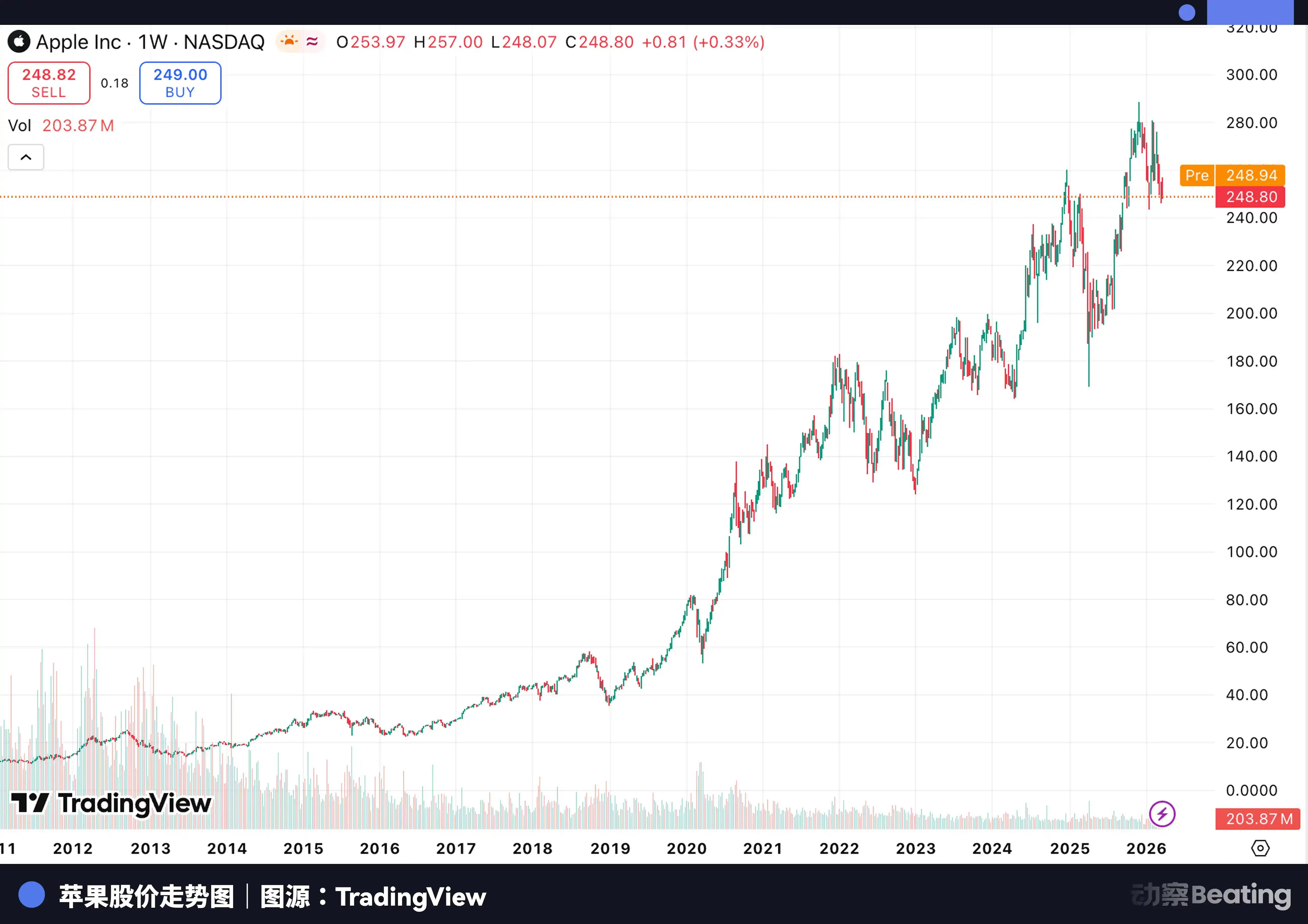
When Cook took over Apple, the company's market cap was $349 billion. Fifteen years later, amidst骂声 of "no innovation," he pushed Apple's market cap to a peak of nearly $4 trillion, an increase of more than tenfold. He didn't rely on flashes of inspiration, but on毫厘之间的 squeezing of the supply chain, the极致 use of financial buyback tools, and the近乎霸道 rent collection of the App Store ecosystem.
Ternus's ascension means Apple has completely given up the search for the next dreammaker. This company has fully embraced Cook's philosophy: in the mature stage of the tech industry,平庸 operational genius is more critical than brilliant product genius.

We miss Jobs because we miss the era when technology could still make hearts race; we can't do without Cook because we have become accustomed to technology being as stable, boring, but indispensable as tap water.

Apple's 50 years began with an ordinary man, Wayne, who was afraid to take risks, and ended with a超级 system that is极其精密,庞大, and厌恶一切 uncertainty. It used $700 billion in buybacks to eliminate capital risk, a global supply chain migration to eliminate manufacturing risk, App Store tolls to eliminate technological obsolescence risk, and finally, it used Ternus to replace Cook, eliminating the risk of "people."

Fifty-year-old Apple has finally become the冷酷,精密, and most profitable Big Brother in the screen it itself smashed with a hammer in 1984.

The genius exits, the machine lives forever.

Perguntas relacionadas

QWho was the third co-founder of Apple who left the company shortly after its founding, and why did he leave?

ARonald Wayne was the third co-founder who left Apple just 12 days after its founding. He left because, as a 41-year-old with assets and a family, he feared the financial risk under the partnership law, which would have made him personally liable for debts if the company failed, unlike the asset-poor Steve Jobs and Steve Wozniak.

QHow much has Apple spent on stock buybacks from 2013 to the end of 2024, and what does this strategy signify about the company's approach to risk?

AApple spent $700.6 billion on stock buybacks from 2013 to the end of 2024. This massive financial engineering strategy signifies a shift from high-risk technological innovation to a focus on creating absolute certainty for shareholders by artificially boosting earnings per share (EPS) and reducing financial risk, essentially acting like a 'hedge fund' disguised as a tech company.

QWhat major shift is occurring in Apple's supply chain, and what is the primary reason behind it beyond just cheaper labor?

AApple is undergoing a massive supply chain migration from China to countries like India, where it assembled 55 million iPhones in 2025. The primary reason is not just to find cheaper labor but to eliminate geopolitical uncertainty and single-node risk by redesigning its global supply chain like a motherboard, making it more resilient and replaceable to mitigate external risks.

QHow does Apple profit from the generative AI boom despite being perceived as a laggard in AI innovation?

AApple profits from the AI boom through its App Store 'tax.' In 2025, generative AI apps paid nearly $900 million in commissions to Apple just to be on the store, with ChatGPT alone contributing about 75% of that. Apple controls the gateway to its massive iOS user base, acting as a toll road to the AI gold rush, converting AI innovation into steady service revenue.

QWho is the likely successor to Tim Cook as CEO, and what does this choice indicate about Apple's future direction?

AJohn Ternus, the likely successor, is the Senior Vice President of Hardware Engineering. His profile as a pragmatic, low-key, and operationally focused executive, similar to Cook, indicates that Apple is fully embracing a philosophy where meticulous operational and financial management is prioritized over visionary product genius, effectively eliminating the 'risk' associated with relying on a singular, charismatic leader.

Leituras Relacionadas

Wall Street's Most Famous 'Cassandra' Now Has His Sights Set on Nvidia

Michael Burry, the famed "Big Short" investor, has once again captured Wall Street's attention with a series of short positions against major tech and semiconductor stocks, most notably Nvidia. In late June and July, through his "Cassandra Unchained" newsletter, Burry disclosed short bets against Nvidia, Tesla, Applied Materials, Caterpillar, the SOXX semiconductor ETF, and later, Micron Technology. His core thesis revolves around potential distortions in the AI infrastructure boom, specifically questioning whether extended depreciation schedules (e.g., 6 years vs. a realistic 2-3 years for AI chips) by cloud giants like Microsoft and Google artificially inflate profits. He also raises concerns about possible "off-balance-sheet circular financing," where chip demand might be propped up by vendor-backed funding to clients. Nvidia's stock experienced volatility following these disclosures, briefly dipping but largely holding near Burry's reported entry points, leaving his positions roughly flat or slightly underwater as of late July. This move is part of a pattern for Burry, whose track record since his legendary 2008 bet is mixed. He has faced notable losses, such as on Tesla in 2021, while scoring on broader market turns like the 2020 pandemic crash. His methodology focuses intensely on free cash flow and scrutinizing original financial documents to spot overvaluation and structural risks, but it often struggles with timing the market. The article contrasts Burry's stance with other prominent investors. Steve Eisman, another "Big Short" figure, is not shorting Nvidia, citing strong fundamentals but expressing nervousness about sustainability. Jim Chanos agrees with the broad "accounting mismatch" concern—comparing it to the dot-com bubble—but targets financial leverage in private equity firms rather than the chip stocks themselves. While Nvidia's short interest remains relatively low at 1.3-1.4% of float, the massive stock size means absolute short losses have been significant, exceeding $5 billion earlier this year. The piece concludes that for ordinary investors, the key takeaway is not replicating specific short bets but learning from the critical frameworks these investors use: questioning rosy accounting, identifying structural vulnerabilities, and maintaining skepticism during market euphoria, even if pinpointing the exact catalyst for a downturn remains elusive.

marsbitHá 24m

Wall Street's Most Famous 'Cassandra' Now Has His Sights Set on Nvidia

marsbitHá 24m

Weekly Selection丨Epic Stock Market Volatility, Changxin Tech's IPO Reshapes Storage Landscape, Saylor Aims to Re-Anchor STRC Around September 8th

PANews Weekly Digest: Market Turmoil, Tech Breakthroughs, and Crypto Developments. The week saw significant volatility across global markets. South Korea's KOSPI index experienced extreme turbulence, including multiple trading halts, largely driven by sharp declines in AI hardware stocks like SK Hynix. In contrast, China's Changxin Xinqiao (CXC) achieved a landmark IPO with a market cap surpassing 4 trillion yuan, marking a major success for the domestic DRAM industry after a decade of losses. In the crypto and Web3 space, several key narratives emerged. AI is driving demand for new infrastructure, with projects like AI agent wallets and programmable payments gaining traction, attracting interest from firms like Coinbase. The Bitcoin mining sector is pivoting, with companies like MARA focusing on energy management as electricity becomes a core AI-era asset. Meanwhile, the RWA (Real World Assets) sector faces a "utilization puzzle," with hundreds of billions in on-chain assets remaining dormant. Notable market movements included a historic single-day surge of over 17% for the KOSPI index and a significant migration of $16.5 billion in staked ETH within the Lido ecosystem. Michael Saylor announced a target to re-peg the STRC stablecoin around September 8th. Other highlights include discussions on Ethereum's ambitious 2030 roadmap for scaling and privacy, analysis showing high protocol revenues not always translating to token price gains, and warnings from Citi about potential extreme commodity price shocks by late 2026.

marsbitHá 29m

Weekly Selection丨Epic Stock Market Volatility, Changxin Tech's IPO Reshapes Storage Landscape, Saylor Aims to Re-Anchor STRC Around September 8th

marsbitHá 29m

When the Market Begins to Question AI Capex: A Full Analysis of Q2 Earnings Reports from Five Tech Giants

In late July 2026, five major US tech giants—Alphabet, Intel, Microsoft, Meta, and Apple—released their Q2 earnings reports. While all companies exceeded revenue and profit expectations, driven by strong AI-related business growth, investor reactions diverged sharply due to concerns over escalating AI capital expenditures (capex) and their impact on free cash flow. Alphabet reported strong revenue growth and a surging cloud business, but its stock fell after announcing a doubled year-on-year capex and negative quarterly free cash flow for the first time. Intel posted its strongest revenue growth in over 15 years, but its stock experienced volatile trading after significantly raising its full-year capex guidance. Microsoft saw its stock surge after beating estimates and, crucially, lowering its capex forecast while projecting positive free cash flow. Meta faced the most severe sell-off as its profits declined despite revenue beats, with free cash flow plunging over 90% and its capex guidance raised. Apple reported record June-quarter results, but its stock plummeted after providing Q4 revenue guidance that fell short of expectations, citing supply chain constraints and forex headwinds. The overall takeaway is that the market's focus has shifted from validating AI demand to scrutinizing the timeline for returns on massive AI investments. Companies demonstrating a clearer path to managing capex and preserving free cash flow, like Microsoft, were rewarded, while those signaling continued aggressive spending faced investor skepticism.

Odaily星球日报Há 38m

When the Market Begins to Question AI Capex: A Full Analysis of Q2 Earnings Reports from Five Tech Giants

Odaily星球日报Há 38m

a16z: From Companies to DAOs, DUNA May Become the Next Generation Organizational Form

This article, "From Companies to DAOs: How DUNA Could Become the Next Organizational Form," traces the 500-year evolution of business collaboration. It begins with medieval structures like the *commenda* and Florentine *compagnia*, which exposed partners to personal risk. The modern corporation, exemplified by the Dutch East India Company (VOC), was a revolutionary leap, enabling large-scale, capital-intensive ventures by offering limited liability and reducing coordination costs. However, corporations introduced new challenges like principal-agent problems and bureaucratic overhead. The piece argues that software and internet-native protocols are now reducing these traditional overheads. Decentralized Autonomous Organizations (DAOs) emerged as a new model for coordination without centralized management. Yet, DAOs face a significant legal vacuum: they lack legal recognition, leaving members exposed to unlimited personal liability, and their tokens are vulnerable to being classified as securities under unclear regulations (e.g., the Howey Test). This has forced projects into suboptimal workarounds like offshore foundations. The article identifies the Decentralized Unincorporated Nonprofit Association (DUNA) as a potential solution. Recently legalized in states like Wyoming, the DUNA provides a legal wrapper for decentralized networks. It grants key protections—legal personality, limited liability, and perpetual existence—to a group without imposing a traditional hierarchical management structure. This allows token-holder communities to govern, hold assets, and contract as a single legal entity, aligning with their decentralized nature. While DUNA doesn't solve all governance challenges or magically resolve securities law questions, it represents a crucial step. It fills the legal recognition gap, offering a native legal form for internet-scale, decentralized collaboration and extending the separation of personal risk from organizational venture into a new domain.

marsbitHá 1h

a16z: From Companies to DAOs, DUNA May Become the Next Generation Organizational Form

marsbitHá 1h

2026 Mid-Year Report On-Chain RWA: Tokenized Stock Market Cap Doubles in a Year, But 90% of Rights Are Hollow Shells

The 2026 Mid-Year Report on On-Chain RWA highlights a significant growth in tokenized stock market capitalization, which nearly doubled from $951 million in March to $1.89 billion by July. However, the report reveals a fundamental contradiction in this "layer 2.5" ecosystem: products with the strongest legal foundation (like regulated U.S. infrastructure) lack liquidity and distribution, while freely tradable offshored wrapper products often lack substantive ownership rights. The increase is driven largely by a few products (SECZ, FGRS, STRCx) and platforms (Ondo, xStocks, Securitize collectively hold over 85% share). While distributed value across networks like Ethereum, Solana, and BNB Chain has grown, the market remains fragmented. Products referencing the same underlying asset (e.g., Apple stock) are distinct legal liabilities with different intermediaries and jurisdictional rules, offering varying degrees of legal claim. The report cautions that headline numbers are misleading, as they reflect changes in distributed token value—driven by issuance, conversions, and price movements—not pure investor inflows. True "canonical shares" with legal ownership, wide wallet distribution, institutional liquidity, and independent on-chain price discovery do not yet exist at scale. Tokenized treasuries show stronger product-market fit, and ETFs may be easier to scale than single stocks. The core takeaway is a trade-off: legal certainty versus liquidity and composability.

marsbitHá 2h

2026 Mid-Year Report On-Chain RWA: Tokenized Stock Market Cap Doubles in a Year, But 90% of Rights Are Hollow Shells

marsbitHá 2h

Trading

Spot
活动图片