AI Inference Bills Soar, Shopify and Roblox Warn: Savings from Layoffs Not Enough to Cover Chip Costs

marsbitPublicado em 2026-05-11Última atualização em 2026-05-11

Resumo

The 2026 Q1 earnings season reveals a paradox: while AI helps companies freeze hiring and boost productivity, the soaring costs of AI inference—token consumption and GPU depreciation—are eroding savings from workforce reductions. Shopify reported that AI now writes over 50% of its code, enabling significant output with stable headcount. However, LLM costs, driven by heavy usage of its AI assistant Sidekick, are pressuring its subscription毛利率. Similarly, Roblox attributed a quarter of its full-year利润率下调 to increased AI investment. The article highlights a broader industry imbalance: combined AI capital expenditure for Amazon, Meta, Microsoft, and Google is projected to reach $725 billion in 2026, vastly outpacing potential savings from layoffs. For instance, Meta's planned裁员 would save about $2.4 billion annually, offsetting only ~12% of its incremental AI depreciation. While底层 model and chip suppliers like NVIDIA maintain high profitability, application-layer companies face a pricing squeeze. Their strategies now involve要么 tightly linking AI costs to user engagement (like Shopify) or introducing fees for advanced AI features (like Roblox), as covering AI bills with裁员 savings alone is financially unsustainable.

Author: Claude, Deep Chao TechFlow

Deep Chao Introduction: The Q1 2026 earnings season for tech giants reveals a new phenomenon: while AI helps companies freeze hiring and cut positions, its own token consumption and GPU depreciation are inversely eroding gross margins. Shopify's subscription business gross margin is being suppressed by LLM costs, with about a quarter of Roblox's full-year margin guidance downgrade directly attributed to incremental AI investments. The combined AI capital expenditures of Amazon, Meta, Microsoft, and Google will reach $725 billion in 2026, a 77% year-over-year increase. For the first time, the two ends of the AI dividend—labor savings and compute consumption—are being accounted for on the same balance sheet in the same quarter, with the latter clearly larger.

The first-quarter earnings season is applying a corrective patch to the simplistic narrative of 'AI replacing labor.'

While a group of tech companies report successes in hiring freezes and accelerated product iteration, they are forced to explain a more棘手 question to investors: soaring AI chip depreciation and unpredictable token consumption are inversely eating up the money saved from layoffs.

Shopify President Harley Finkelstein stated at the May 5, 2026 earnings call that AI now handles over 50% of the company's code writing and helped Shopify deliver over 300 products and features while keeping headcount flat. However, in the same call, management also acknowledged that the gross margin of subscription solutions is being partially offset by large language model (LLM) costs, and this dynamic will persist.

Shopify: The LLM Cost Black Hole Behind an 80% Gross Margin

Shopify's Q1 subscription solutions gross margin was 80%, flat year-over-year, but the cost of maintaining this figure is changing.

According to Shopify's 10-Q filing with the SEC, subscription solutions costs grew 20% year-over-year in Q1 2026, reaching $148 million, compared to $123 million in the same period last year. Cloud and infrastructure costs (including AI-related usage) increased by $22 million as a single line item, being the primary driver of cost expansion. Shopify CFO Jeff Hoffmeister said on the earnings call that scale effects and support efficiency improvements were "partially offset by increased LLM costs, primarily driven by merchant usage of Sidekick, and we expect this dynamic to continue."

Sidekick is Shopify's AI assistant embedded in the platform. Its weekly active shops grew 385% year-over-year this quarter. Merchants used Sidekick to create over 12,000 custom apps this quarter, up more than 200% sequentially, with nearly half of Shopify Flows being AI-generated. AI-driven store traffic grew 8x year-over-year, and orders from AI search grew nearly 13x year-over-year.

But this explosion in usage means exponential growth in AI inference calls. Every interaction a merchant has with Sidekick, every proactive suggestion generated by the Pulse feature, corresponds to a token bill paid to upstream model providers.

Shopify explained the books for "internal AI" and "external AI" separately to investors: using AI internally for coding and controlling personnel expenses is a victory in the "cost game," while providing AI products externally to merchants is a strategic choice to "deeply tie infrastructure costs to merchant usage." Finkelstein summarized this logic on the earnings call as "AI is a structural advantage, not just a cost."

Roblox: One-Quarter of Margin Downgrade Directly from AI

Roblox CFO Naveen Chopra explicitly disclosed at the Q1 2026 earnings call on April 30 that about one-quarter of the full-year margin downgrade relative to prior guidance stems from incremental AI investment and adjustments to DevEx (Developer Exchange) for U.S. users aged 18 and above.

Roblox currently runs over 400 AI models on its own and cloud GPUs, processing 1.5 million inference calls per second, covering scenarios like discovery recommendations, communication safety, marketplace recommendations, and 3D generation.

Management is attempting to slice through inference costs via business model adjustments. Roblox Co-founder and CEO David Baszucki said on the earnings call that the company's upcoming "Roblox Reality" project, a technology capable of running 2K real-time photorealistic video models at 60Hz, will not be offered for free. "This will use cloud compute resources. We will have some form of subscription or payment mechanism, so we believe we can offset the costs on the real-time inference side," Baszucki explained.

Chopra added that the company's 2026 capital expenditure guidance remains unchanged, relying primarily on deploying GPUs in its own data centers to meet inference demand for the year, while some training tasks will still use the cloud. Roblox previously disclosed that by migrating some AI inference workloads from third-party clouds to its own data centers by the end of 2025, it had already achieved a 10x efficiency improvement in specific workloads like safety review and content discovery.

However, Roblox's quarterly full-year guidance includes multiple pressures: the aforementioned incremental AI investment, deleveraging of fixed costs due to lower-than-expected bookings scale, and the DevEx rate increase for 18+ adult content creators to 37.8%, ultimately triggering a market repricing of its full-year margin.

Industry Ledger: $725 Billion Capex vs. $2.7 Billion Salary Savings

The micro cases of Shopify and Roblox sit within a larger macro structural imbalance.

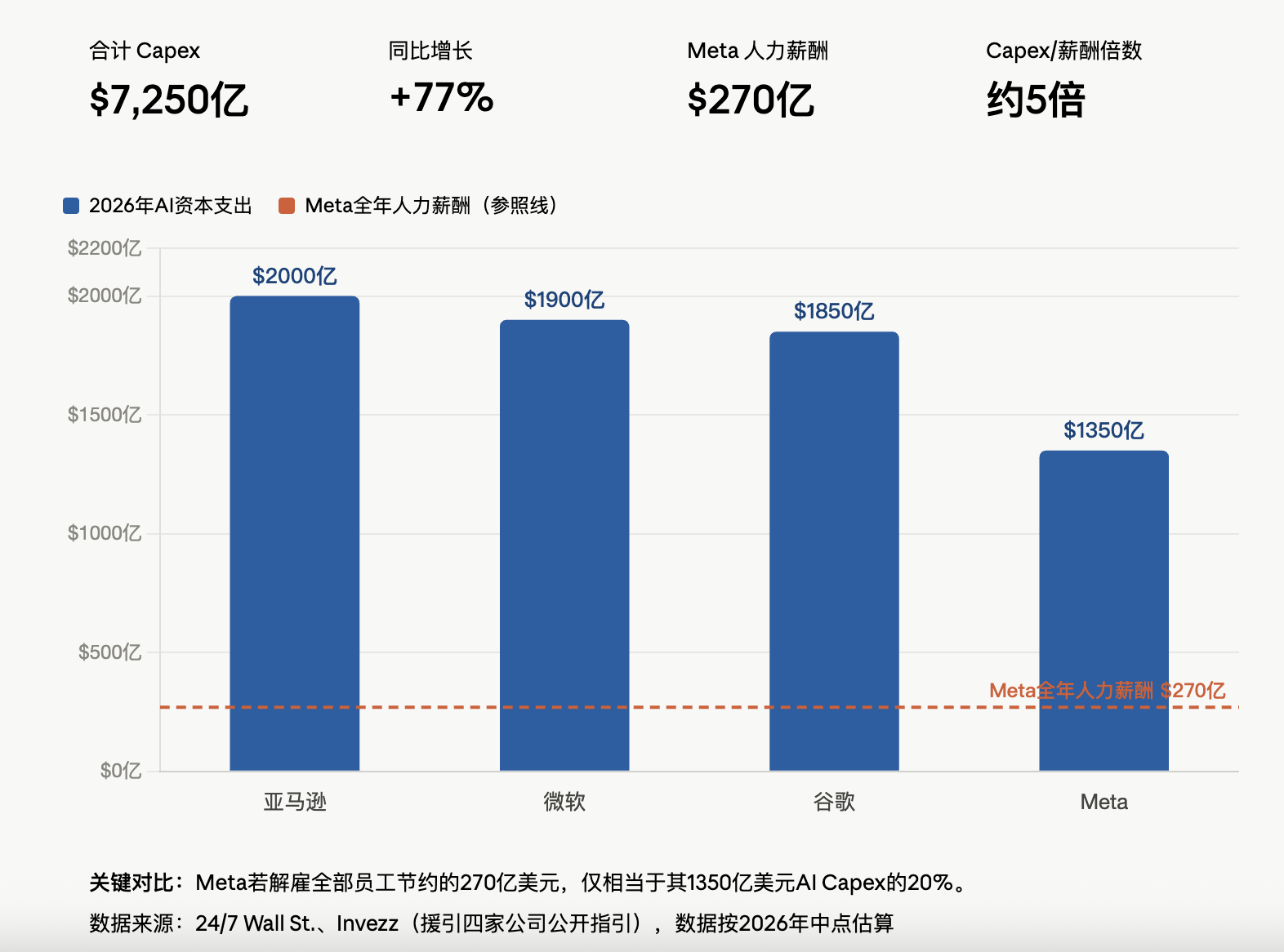
According to data cited by 24/7 Wall St., the combined AI capital expenditures of Amazon, Meta, Microsoft, and Google will reach $725 billion in 2026, a 77% year-over-year increase. Among them, Meta's full-year capex guidance is between $125 billion and $145 billion, meaning a daily expenditure of $370 million on data center construction; Microsoft's 2026 calendar year capex is $190 billion, with Amazon committing $200 billion.

This calculation is quite disproportionate compared to personnel expenses. Meta's total human compensation—all wages, benefits, stock-based compensation—amounts to approximately $27 billion. Even if Meta fired all its employees tomorrow, the savings would be less than one-fifth of its 2026 infrastructure expenditure.

Wedbush Securities analyst Dan Ives estimated in an April 25 research note that Meta's upcoming layoff of 8,000 people could free up about $2.4 billion in annual operating expenses, only offsetting about 12% of the incremental depreciation drag expected in 2026. In other words, for every dollar of financial pressure from AI compute expenditure, nearly ten dollars of human cost savings would be needed to fully offset it.

Meta CFO Susan Li positioned Meta's headcount reduction on the Q4 2025 earnings call as "building a leaner operating model to help offset the massive investments we are making." This statement clearly characterizes layoffs as a financial tool for AI capital expenditure, not a byproduct of productivity gains.
Victory for Model Providers, Dilemma for the Application Layer

The biggest beneficiaries of this ledger博弈 are the underlying model and compute suppliers. Microsoft Cloud gross margin held at 69% under the pressure of AI infrastructure expansion; OpenAI's gross margin is externally estimated at around 50%, Anthropic's at around 60%. Nvidia continued to report a gross margin level of about 70% in fiscal year 2026.

Application-layer companies, especially SaaS players that both consume AI and package AI capabilities into subscription products for sale, are facing a new financial structure: revenue is highly correlated with AI usage intensity, but the cost curve is dictated by upstream model provider pricing, and every model upgrade can bring new token consumption.

In his analysis of AI gross margins, Tanay Jaipuria points out that although the inference cost for a single model is declining at 80%-90% annually, the price of frontier models remains stable or even rises. If application-layer companies insist on calling the strongest model for every request, their Cost of Goods Sold (COGS) is effectively being led by the model providers' price cards.

Shopify's response is to position AI products as a strategic gateway deeply binding traffic and merchants, making the growth in inference costs a proxy indicator for "platform embed depth." Roblox's solution is to strip high-end AI experiences out of the free tier, forcing users to pay for inference costs. Behind both paths lies the same consensus: purely covering AI compute bills with savings from layoffs simply doesn't add up mathematically.


Criptomoedas em alta

Perguntas relacionadas

QAccording to the article, what is the main financial challenge that companies like Shopify and Roblox are facing despite using AI to reduce labor costs?

ACompanies are facing the challenge that the soaring costs of AI chip depreciation and unpredictable token consumption for AI inference are eating up the money saved from layoffs and headcount reductions, creating a negative impact on their profit margins.

QHow much of Shopify's subscription solution cost increase in Q1 2026 was driven by AI-related usage?

AIn Shopify's Q1 2026 subscription solution costs, the 'cloud and infrastructure costs (including AI-related usage)' line item increased by $22 million, which was the primary driver of the total cost expansion compared to the previous year.

QWhat proportion of Roblox's downward revision to its full-year profit margin guidance is directly attributed to AI investments?

AApproximately one-quarter of Roblox's downward revision to its full-year profit margin guidance is directly attributed to incremental AI investments.

QWhat is the estimated total AI capital expenditure for Amazon, Meta, Microsoft, and Google in 2026 according to the data cited?

AThe combined AI capital expenditure for Amazon, Meta, Microsoft, and Google is estimated to reach $725 billion in 2026.

QAccording to the Wedbush Securities analyst's estimate mentioned, how does the cost savings from Meta's potential 8,000-person layoff compare to its incremental AI depreciation cost?

AThe estimated annual operating expense savings from Meta's potential 8,000-person layoff is about $2.4 billion, which would only offset approximately 12% of the incremental depreciation drag expected in 2026 from its AI investments.

Leituras Relacionadas

Annual Salary of Millions Competing for Electricians, Meta Rushes to Open Its Own Technical School

The AI boom is facing an unexpected bottleneck: a severe shortage of skilled construction workers and electricians. As tech giants like Meta, OpenAI, and Alphabet race to build massive data centers—such as OpenAI's $16 billion "Stargate" project—they are hitting a critical labor wall. The U.S. needs an estimated 130,000 more electricians, 240,000 construction workers, and 150,000 supervisors by 2030 for AI infrastructure alone, but tens of thousands of electrician jobs go unfilled each year. While AI companies offer high premiums, with electricians earning up to $280,000 annually, worker scarcity still causes massive losses—delays on a single project can cost $14.2 million per month. The complexity of building AI data centers, which require immense power (equivalent to powering hundreds of thousands of homes), sophisticated electrical systems, and advanced liquid cooling solutions, demands highly skilled technicians who are in short supply. To combat this, companies are investing heavily in training. Meta has committed $115 million to a free training school offering tuition, housing, and stipends, targeting 5,000 new workers. OpenAI is partnering with unions to secure skilled labor. These efforts are paying off, with a significant rise in Gen Z interest in trade schools over college. However, the power demands are staggering. AI data centers are driving a rapid surge in electricity consumption, projected to account for up to 12% of U.S. power use by 2028 and raising costs for consumers. Furthermore, the construction boom is project-based, leading to a potential future glut of trained workers once building peaks, which could depress wages industry-wide. The race for AI supremacy now depends as much on skilled hands as on advanced chips.

marsbitHá 55m

Annual Salary of Millions Competing for Electricians, Meta Rushes to Open Its Own Technical School

marsbitHá 55m

OpenAI No Longer Sells Its Most Expensive Model for Profit

OpenAI is shifting its business strategy away from promoting its most expensive, flagship models for every task. Recent price cuts—80% for GPT-5.6 Luna and 20% for Terra—signal a deeper change: the company now actively advises users that many tasks don't require the most powerful model. Instead, OpenAI recommends a tiered approach: use the high-end GPT-5.6 Sol for complex planning and analysis, then delegate execution to cheaper models like Luna. This mirrors moves by Anthropic, which recently launched Claude Opus 5 at half the price of its top model, Fable 5. Both companies are de-emphasizing flagship models as primary revenue drivers, using them instead for brand prestige and technological showcases. The industry is entering a "mass-market" phase, similar to automotive, where high-volume, cost-effective models handle daily operations and drive scale. OpenAI's price reductions are partly enabled by AI models themselves optimizing underlying code and infrastructure, creating a self-reinforcing cycle of efficiency gains and cost reduction. Competition is shifting from "who is smartest" to "who offers the best value." The goal is no longer selling individual models but fostering widespread API adoption and ecosystem lock-in. By making AI calls cheap and ubiquitous, companies like OpenAI aim to become the indispensable, utility-like infrastructure powering automated workflows—the "water and electricity" of software, quietly embedded everywhere.

marsbitHá 55m

OpenAI No Longer Sells Its Most Expensive Model for Profit

marsbitHá 55m

Will the Fed Definitely Raise Interest Rates in September? How Will Crypto and U.S. Stocks Withstand the Pressure?

The market's expectation for a September Fed rate hike surged dramatically in early August, jumping from under 50% to over 80% within a week. This shift followed a contentious July FOMC meeting, where a 9-3 vote to hold rates revealed growing dissent from hawkish members advocating for an immediate hike to combat persistent inflation. The primary catalyst for this repricing is rising oil prices, driven by renewed geopolitical tensions around the Strait of Hormuz, which threaten global supply. Energy costs directly influence inflation metrics, making the upcoming July CPI report (due August 12th) a critical data point. If it shows inflation reaccelerating, the probability of a September hike will solidify. For Bitcoin and crypto assets, this is typically bearish news. Bitcoin continues to behave as a high-beta, liquidity-sensitive risk asset. A rate hike raises the opportunity cost of holding non-yielding assets and could drive capital toward money markets, pressuring crypto prices in the short term. However, historical patterns suggest that if a hike is perceived as the end of a tightening cycle rather than the start, any negative price impact may be brief. U.S. stocks, particularly crypto-linked equities like Coinbase and growth-oriented tech stocks, are also vulnerable. Higher rates increase discount rates in valuation models, putting pressure on high-multiple companies. This coincides with a pivotal tech earnings season where investor focus has shifted from massive AI capital expenditure to tangible revenue and cash flow generation. Companies with negative cash flow and weak growth narratives could face heightened volatility if borrowing costs rise in September. In summary, a September Fed hike has evolved into a mainstream market scenario. Key factors to watch are oil prices, the July CPI report, and Fed communications, which will determine the final decision and its impact on volatile crypto and equity markets.

marsbitHá 1h

Will the Fed Definitely Raise Interest Rates in September? How Will Crypto and U.S. Stocks Withstand the Pressure?

marsbitHá 1h

Trading

Spot

Artigos em Destaque

Como comprar CHIP

Bem-vindo à HTX.com!Tornámos a compra de USD.AI (CHIP) simples e conveniente.Segue o nosso guia passo a passo para iniciar a tua jornada no mundo das criptos.Passo 1: cria a tua conta HTXUtiliza o teu e-mail ou número de telefone para te inscreveres numa conta gratuita na HTX.Desfruta de um processo de inscrição sem complicações e desbloqueia todas as funcionalidades.Obter a minha contaPasso 2: vai para Comprar Cripto e escolhe o teu método de pagamentoCartão de crédito/débito: usa o teu visa ou mastercard para comprar USD.AI (CHIP) instantaneamente.Saldo: usa os fundos da tua conta HTX para transacionar sem problemas.Terceiros: adicionamos métodos de pagamento populares, como Google Pay e Apple Pay, para aumentar a conveniência.P2P: transaciona diretamente com outros utilizadores na HTX.Mercado de balcão (OTC): oferecemos serviços personalizados e taxas de câmbio competitivas para os traders.Passo 3: armazena teu USD.AI (CHIP)Depois de comprar o teu USD.AI (CHIP), armazena-o na tua conta HTX.Alternativamente, podes enviá-lo para outro lugar através de transferência blockchain ou usá-lo para transacionar outras criptomoedas.Passo 4: transaciona USD.AI (CHIP)Transaciona facilmente USD.AI (CHIP) no mercado à vista da HTX.Acede simplesmente à tua conta, seleciona o teu par de trading, executa as tuas transações e monitoriza em tempo real.Oferecemos uma experiência de fácil utilização tanto para principiantes como para traders experientes.

482 Visualizações TotaisPublicado em {updateTime}Atualizado em 2026.06.02

Como comprar CHIP

Discussões

Bem-vindo à Comunidade HTX. Aqui, pode manter-se informado sobre os mais recentes desenvolvimentos da plataforma e obter acesso a análises profissionais de mercado. As opiniões dos utilizadores sobre o preço de CHIP (CHIP) são apresentadas abaixo.

活动图片












