Author|jk
In the short span of the past week, market bets on a September interest rate hike have jumped from less than 50% to over 80%.
Such a rapid pace of repricing is uncommon in the history of Fed-watching over the past year, and Bitcoin and various crypto-related stocks have already begun to pay the price for this possibility.
Last week, the Federal Reserve's July 29th FOMC meeting voted 9 to 3 to maintain the target range for the federal funds rate at 3.50% to 3.75%, marking the fifth consecutive meeting of holding rates steady. However, unlike previous decisions that were almost a foregone conclusion, this vote showed a clear divergence. Cleveland Fed President Hamarc, Minneapolis Fed President Kashkari, and Dallas Fed President Logan cast dissenting votes, advocating for an immediate 25 basis point hike, citing inflation having run above the 2% target for over five consecutive years. Fed Chair Walsh used a rather vivid phrase in the post-meeting press conference, saying he "asked for a proper family squabble, and indeed got one."
This division directly fueled market expectations for a September hike. According to data from the CME FedWatch tool, just one week before this meeting, market pricing for a September hike was less than 53%. But within a short week, as rising oil prices fueled inflation concerns, this probability surged to 82% at one point, currently reported at 73%. The 9-to-3 vote result represents the expansion of hawkish forces favoring a hike within the committee, which the market widely interprets as a significant increase in the likelihood of a September hike.
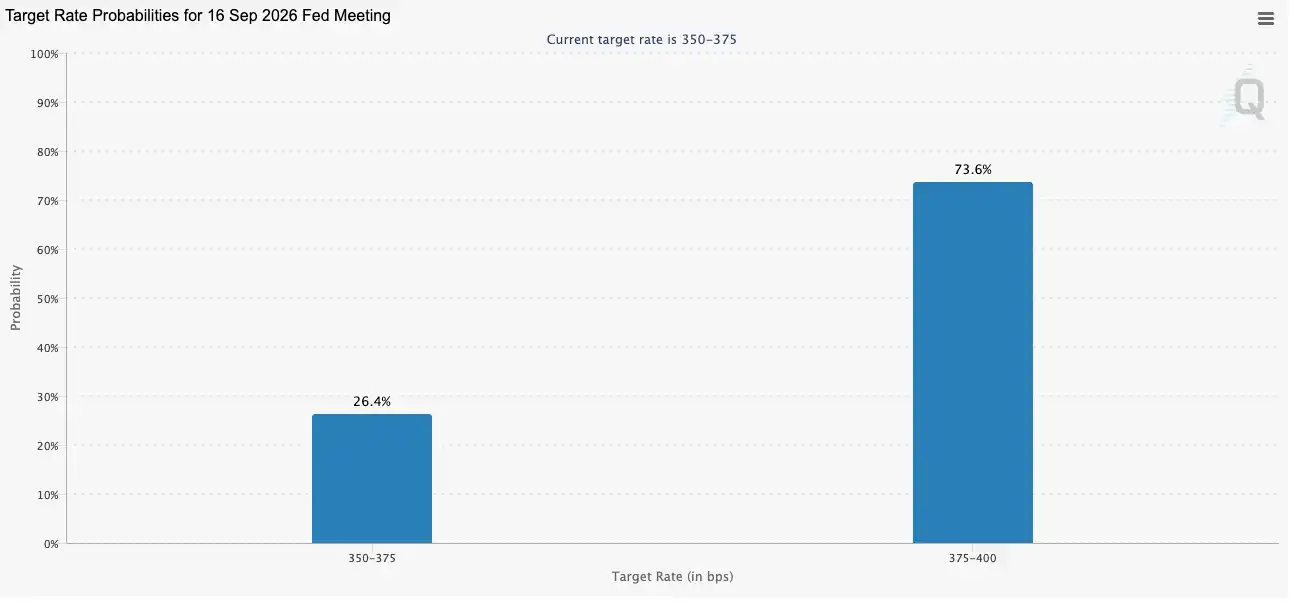
Current probability of a rate hike. Source: CME
It should be noted, however, that a clear gap remains between market pricing and the overall consensus among economists. A FactSet survey of economists shows that the majority still believe that interest rate cuts will resume in 2027, with a cumulative reduction of around 50 basis points. In other words, short-term interest rate futures pricing more reflects a sensitive reaction to recent oil price and inflation data.
From a broader perspective, the resurgence of these hike expectations follows a fairly clear transmission chain, with the core starting point being geopolitical conflicts near the Strait of Hormuz. Since July, escalating tensions between Iran and related parties have repeatedly threatened this key waterway, approximately 30 miles wide, which handles about 20% of the world's daily seaborne oil trade. WTI crude oil futures rose by roughly 20% cumulatively in July. Note, this is not the first conflict, but a second flare-up between Iran and the U.S. post-agreement. Energy prices are one of the most direct components feeding into the Fed's favored PCE inflation gauge, and rising oil prices quickly show up in the next inflation reading. This is the direct reason behind the market's swift repricing of hike probabilities over the past week.
Looking at specific data points, the June CPI report released on July 14th showed a year-on-year increase of 3.5%, the most encouraging reading since the Iran conflict erupted, primarily due to temporary relief from a 5.7% month-on-month drop in energy prices during the ceasefire period. However, this relief appears quite fragile, and July's renewed rise in oil prices is likely to be reflected in the next set of data. The next key node widely recognized by the market is the July CPI report to be released on August 12th. If the data shows the June moderation was real and sustainable, the probability of a September hike will likely retreat towards the economist consensus. But if the data shows energy-driven inflation re-accelerating, especially with the Iran ceasefire still incomplete and oil prices remaining above $80 per barrel, the probability of a September hike will rise further.
The Fed's own signals are also reinforcing this expectation. The dot plot from the June FOMC meeting shows that 9 out of 18 participants now project at least one rate hike this year, up from the median expectation in the March meeting, which still pointed to rate cuts. The core PCE inflation forecast was raised to 3.3% for 2026. Chair Walsh has simplified policy statements and de-emphasized forward guidance since taking office. He notably did not submit his own economic projections at the June meeting, but his press conference remarks were interpreted as hawkish by the market, directly fueling rate hike bets at the time. Some officials have held dissenting views; for instance, former Governor Milan earlier this year publicly questioned the logic of hiking when core CPI monthly readings had once turned negative. Overall, apart from the evolution of the geopolitical situation itself in the coming month, the July CPI data, the August non-farm payrolls report, and Fed officials' remarks at the Jackson Hole Economic Symposium will all be crucial windows for judging whether a September hike will truly materialize, which will also amplify volatility in crypto assets and related U.S. stocks around these data releases.
What's the Impact on Crypto Assets?
For crypto assets, rising rate hike expectations are traditionally not good news. Bitcoin is currently oscillating between $64,000 and $65,000, and remains highly sensitive to Fed signals. Bitcoin has repeatedly exhibited characteristics of a high-beta risk asset over the past year, with its price movements showing an increasingly strong correlation with the U.S. dollar liquidity cycle. Since the beginning of the year, impacted by a series of macro shocks including tariff policies and geopolitical risks, Bitcoin once fell below $64,000. Meanwhile, traditional safe-haven assets like gold and silver posted double-digit gains. This divergence itself indicates that the market does not treat Bitcoin as a true safe haven but rather as a liquidity-sensitive risk asset. If the Fed does pivot to a hike in September, the opportunity cost of holding non-yielding assets like Bitcoin will rise further, and the incentive for capital to flow back from risk assets to money market funds and short-duration bonds will correspondingly increase, posing direct pressure on short-term sentiment in the crypto market.
However, the impact of rate hikes on Bitcoin is not linear. Entering 2023, despite the Fed raising rates twice more consecutively, Bitcoin rose 21% against the trend. The actual price impact of the last two hikes was quite limited, indicating that when the rate hike path is fully digested by the market and inflation data shows marginal improvement signs, the hike itself may not necessarily suppress prices continuously. What truly determines the market reaction is often the change in expectations regarding a policy pivot, not a single rate hike action. This historical experience also provides a reference for observing this potential September hike. If a September hike materializes but is interpreted by the market as the tail end of the tightening cycle rather than the beginning, the decline in Bitcoin will likely be short-lived and shallow, with the market moving faster into expectations for a rate-cutting cycle.
How Will U.S. Stocks Be Affected?
In the U.S. stock market, crypto concept stocks and crypto-linked assets tend to amplify Bitcoin's own volatility. The share prices of companies like Coinbase (COIN), Circle (CRCL), and Strategy (MSTR) typically react more sharply to interest rate expectations than spot Bitcoin: Rising hike expectations mean higher risk-free rates, which directly increases the discount rate in stock valuation models, putting particular pressure on growth-oriented and high-valuation tech stocks. An important pillar supporting the U.S. stock rally in recent years has been the valuation expansion driven by rate cut expectations. Once this expectation is reversed, the market needs to reprice for higher funding costs, and an increase in index volatility is almost inevitable. It's worth noting that several high-weight tech stocks within the S&P 500 and Nasdaq indices have already experienced significant corrections. If September hike expectations further solidify, valuation pressure on such core, heavily weighted stocks could transmit to the entire index level.
Simultaneously, this resurgence of hike expectations coincides with one of the most capital-intensive earnings seasons for tech giants. From late July to early August, Google, Microsoft, Meta, Amazon, and Apple reported Q2 earnings, with market reactions showing clear divergence. The core point of contention lies in whether capital expenditures can translate into actual revenue. Google Cloud revenue soared 82% year-over-year, hitting a record growth rate, but its full-year capital expenditure guidance was raised to a range of $195-205 billion, and its stock price dropped 7% accordingly. Meta's revenue grew 28% year-over-year, slightly exceeding expectations, but its capital expenditure guidance was raised to a range of $130-145 billion, causing its stock to plunge nearly 9%. Apple fell sharply due to weaker-than-expected revenue guidance for its fiscal fourth quarter and renewed supply chain constraint concerns. Only Microsoft delivered a report that satisfied the market, with annual cloud revenue exceeding $100 billion for the first time and its FY27 capital expenditure guidance lowered from $190 billion to $175 billion. Its stock soared over 15% in a single day, marking its largest gain in nearly 18 years. The combined capital expenditure plans of these four companies approach $750 billion, and the market's judgment criteria have shifted from "how much they're willing to spend on AI" to "whether this money can be converted into visible revenue and cash flow."
This divergence implies heightened sensitivity for September. These giants primarily rely on debt and equity financing to fill their cash flow gaps for capital expenditure. If a September hike materializes, rising corporate financing costs would directly compress the marginal return space for their capital expenditure. At that point, market tolerance for the narrative of "burning cash on AI for growth" may narrow further, and stock price volatility for those companies with already negative cash flow and lacking compelling growth stories could be even more severe than in this July round.
Regarding the September FOMC meeting, a more accurate statement at present is that a rate hike has evolved from a low-probability event almost ruled out at the start of the year to the mainstream scenario priced in by the market at over 50%. For crypto asset and related U.S. stock investors, oil price movements, monthly CPI data, and Fed officials' remarks at venues like the Jackson Hole Economic Symposium will all be key windows over the next month to observe whether the probability of a hike further solidifies.







