a16z Releases Top 100 AI Apps List: ChatGPT's Dominance Shakes, Global Market Divides into Three

marsbitPublicado em 2026-03-10Última atualização em 2026-03-10

Resumo

a16z's sixth annual Generative AI Consumer Apps Top 100 reveals a shifting landscape. While it remains the dominant leader with 900M weekly active users, ChatGPT's supremacy is being challenged. Competitors like Gemini and Claude are growing paid subscriptions faster, signaling a battle for the "default AI assistant." The report expands its scope to include established products where AI is now core to the experience, such as Canva, Notion, and CapCut. Key findings include: the market is splitting into three distinct geographic ecosystems (Western, Chinese, and Russian); creative tools are undergoing a major reshuffle as video, music, and voice generation rise while image tools get bundled into larger platforms; agentic AI, capable of taking actions, is emerging with tools like OpenClaw; and AI is increasingly moving beyond browsers and apps into desktops, browsers themselves, and deep integrations into existing software. The competition is evolving from a simple feature war to a strategic battle over building entire ecosystems and operating systems.

Author: ethn, a16z

Compiled by: Deep Tide TechFlow

Deep Tide Guide: a16z has released the sixth edition of its generative AI consumer applications list. ChatGPT has 900 million weekly active users, but Gemini and Claude are growing their paid subscriptions faster. The battle for the "default AI assistant" has officially begun.

The biggest change in this edition is the inclusion of established products like CapCut, Canva, and Notion, where "AI features have become core," alongside the first-time coverage of Agents, AI browsers, and desktop tools.

Author Olivia Moore is a partner on a16z's consumer team. This report is one of the most systematic public datasets currently tracking the landscape of AI consumer applications.

Full text below:

Three years ago, we released the first edition of this list with a simple goal: to figure out which generative AI products were actually being used by mainstream consumers. Back then, the line between "AI-native" companies and others was clear. ChatGPT, Midjourney, and Character.AI were products built from the ground up around foundational models, while the rest of the software world was still figuring out how to use the technology.
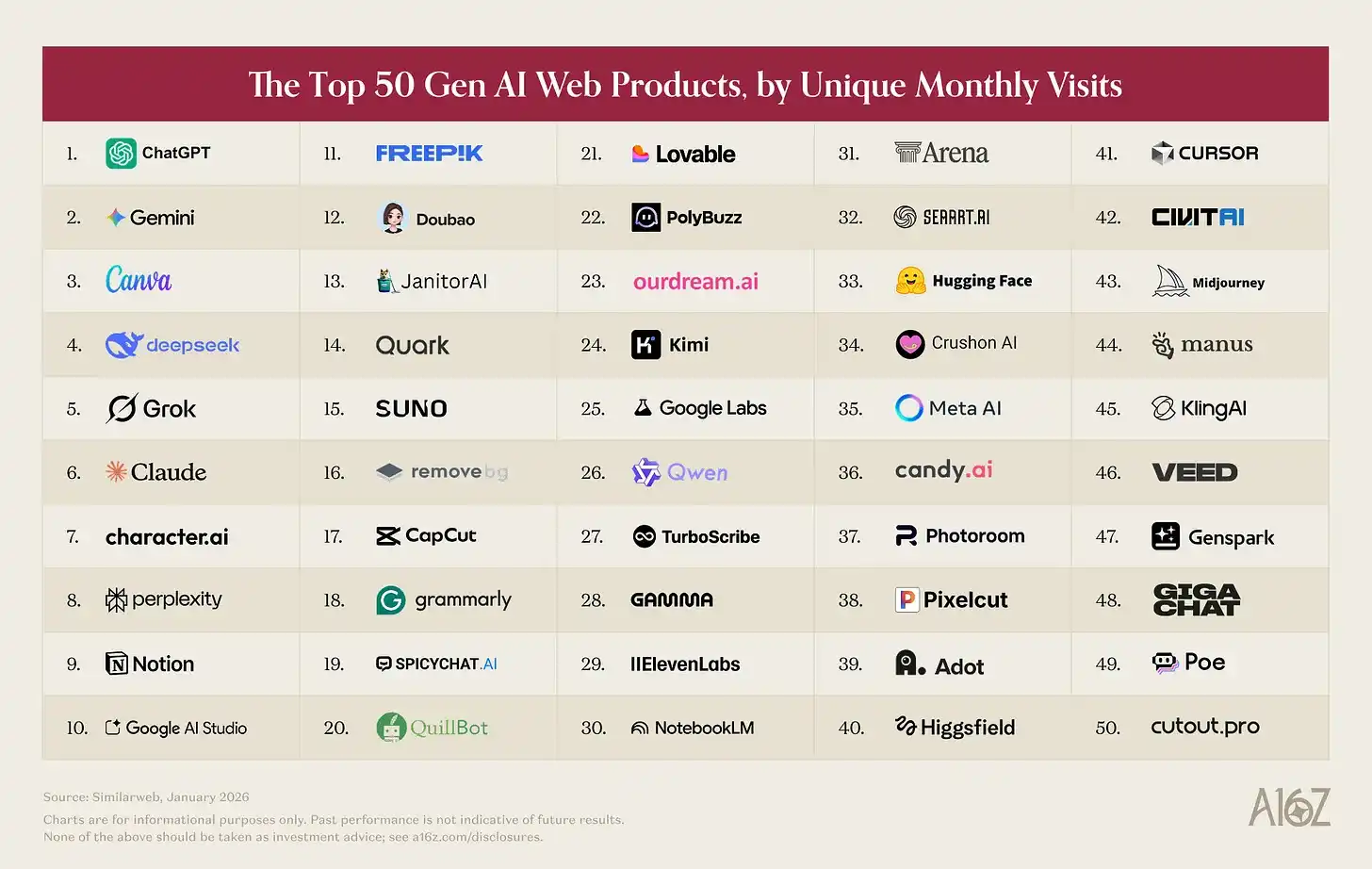
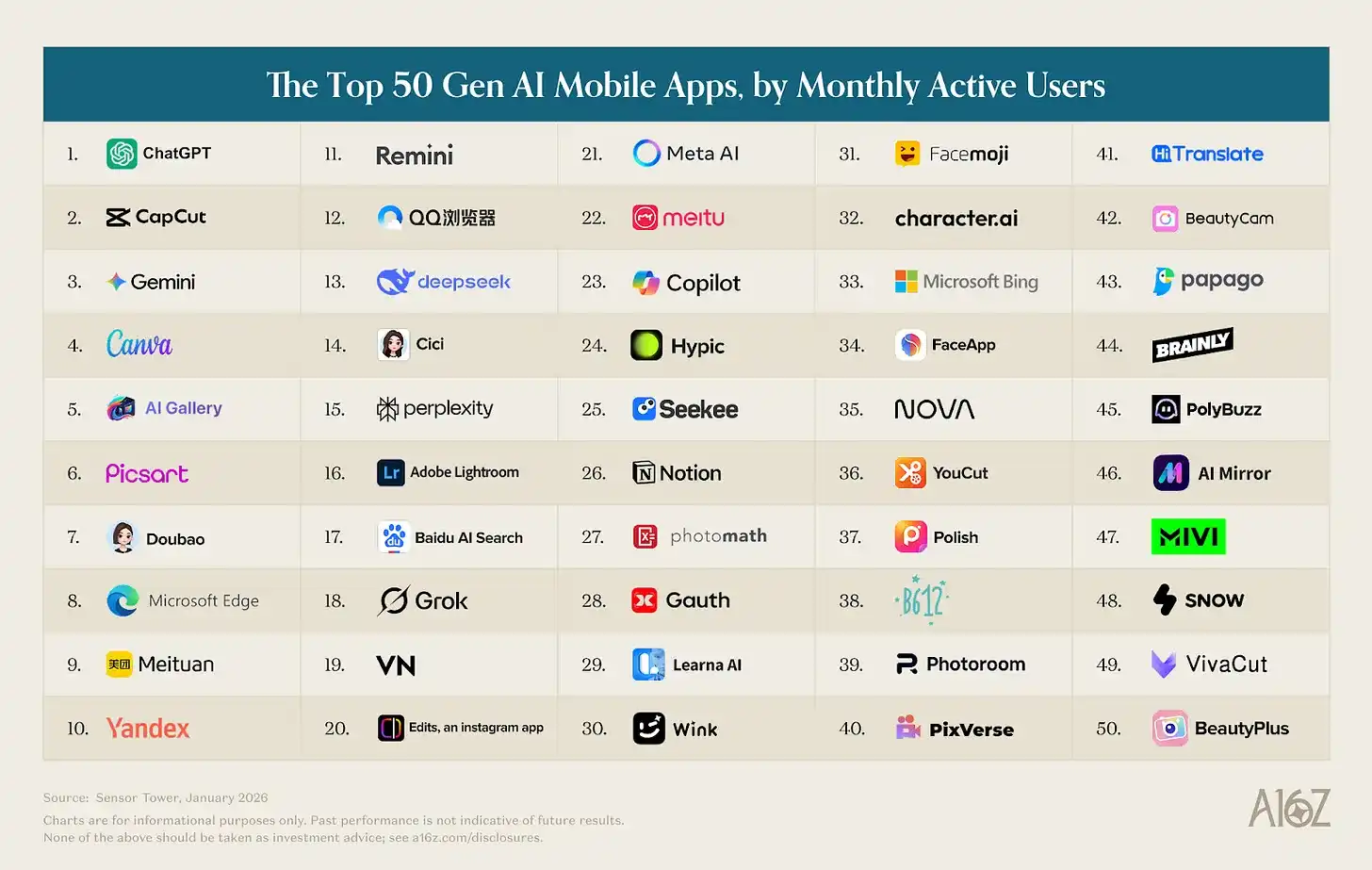
That line no longer holds. CapCut, a video editor with 736 million monthly active mobile users, has its most popular features entirely powered by AI—background removal, AI effects, auto-captions, and text-to-video. Canva's growth engine is completely built on its Magic Suite AI tools. Notion's paid attachment rate for AI soared from 20% to over 50% in a year, with AI features now contributing to about half of the company's ARR.

Starting with this edition, we've expanded our scope to include all consumer products where generative AI has become a core part of the experience, including CapCut, Canva, Notion, Picsart, Freepik, and Grammarly. We believe this gives a more accurate picture of how people actually use AI, though the top-ranked products are still mostly AI-native.
Caption: Full Top 100 Generative AI Consumer Applications List, March 2026 Edition

As before, web rankings are based on monthly unique visitors (data source: SimilarWeb, as of January 2026), and mobile rankings are based on monthly active users (data source: Sensor Tower, as of January 2026). Here are our key findings:

1. ChatGPT Leads, But the Battle for the "Default AI" Has Begun

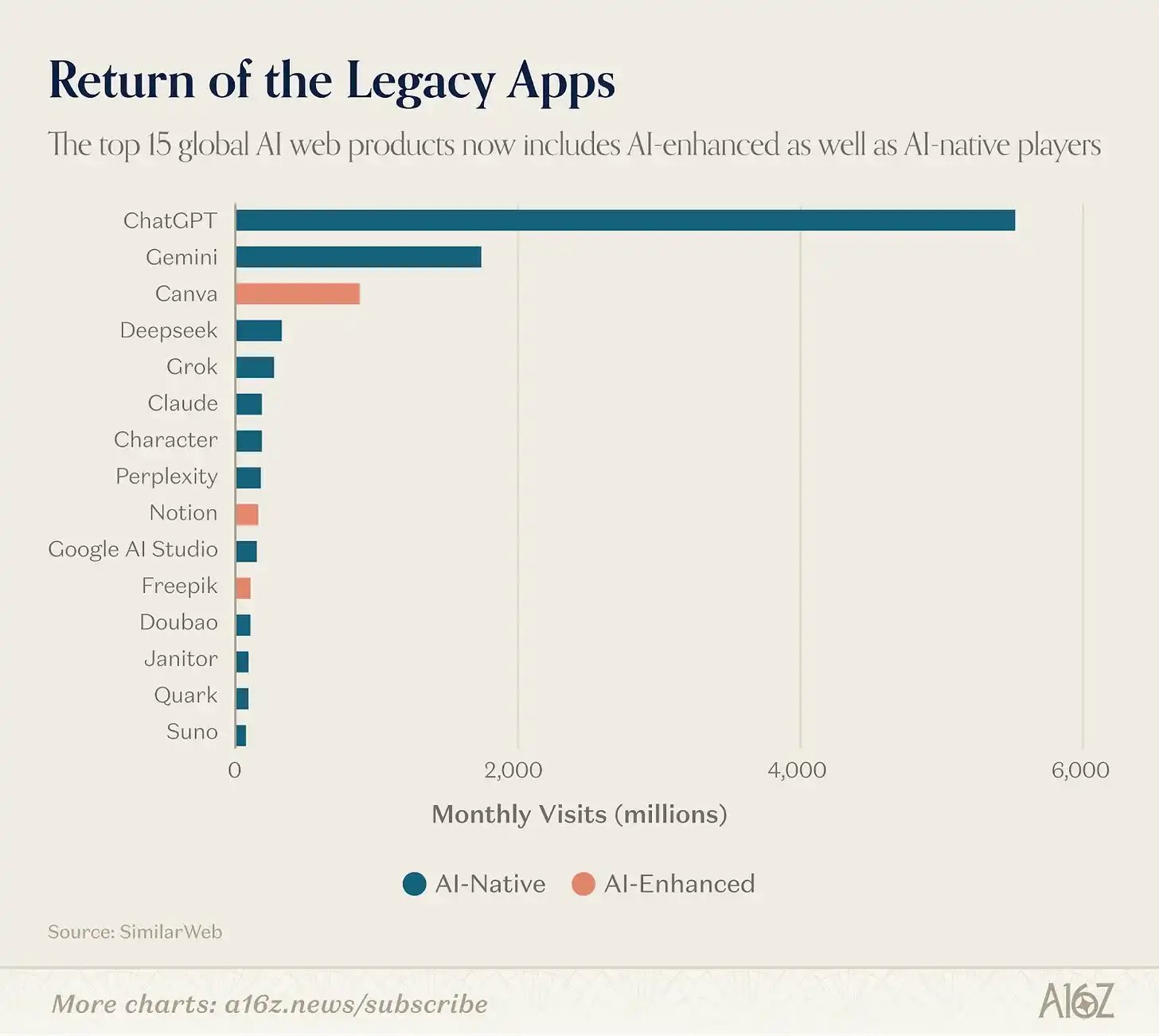
ChatGPT remains the largest consumer AI product by a significant margin. Its web traffic is 2.7 times that of the second-place Gemini, and its mobile MAU is 2.5 times Gemini's. ChatGPT's weekly active users grew by 500 million in the past year, now reaching 900 million. This is staggering given the difficulty of growth at scale—over 10% of the global population uses ChatGPT weekly.
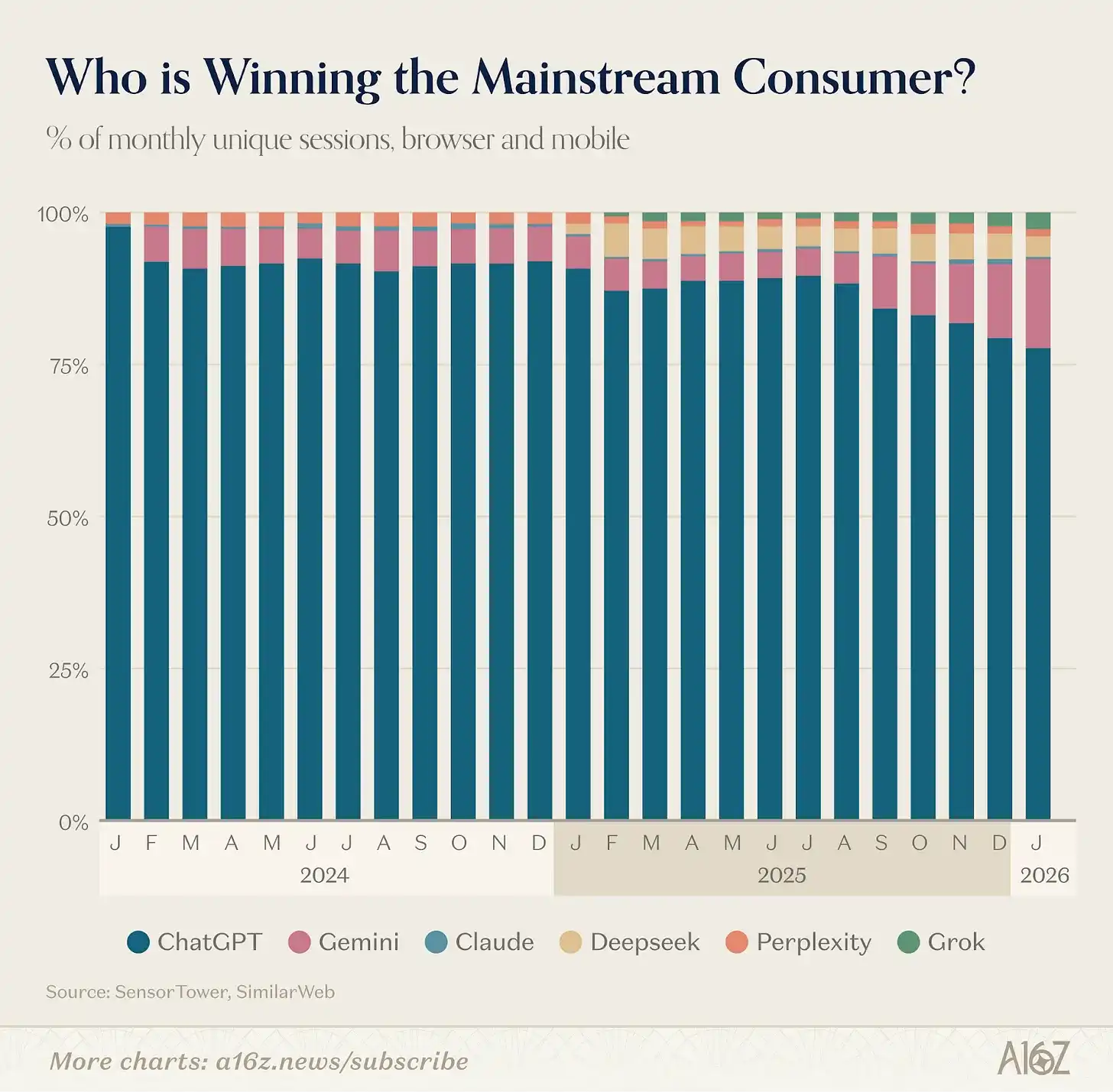
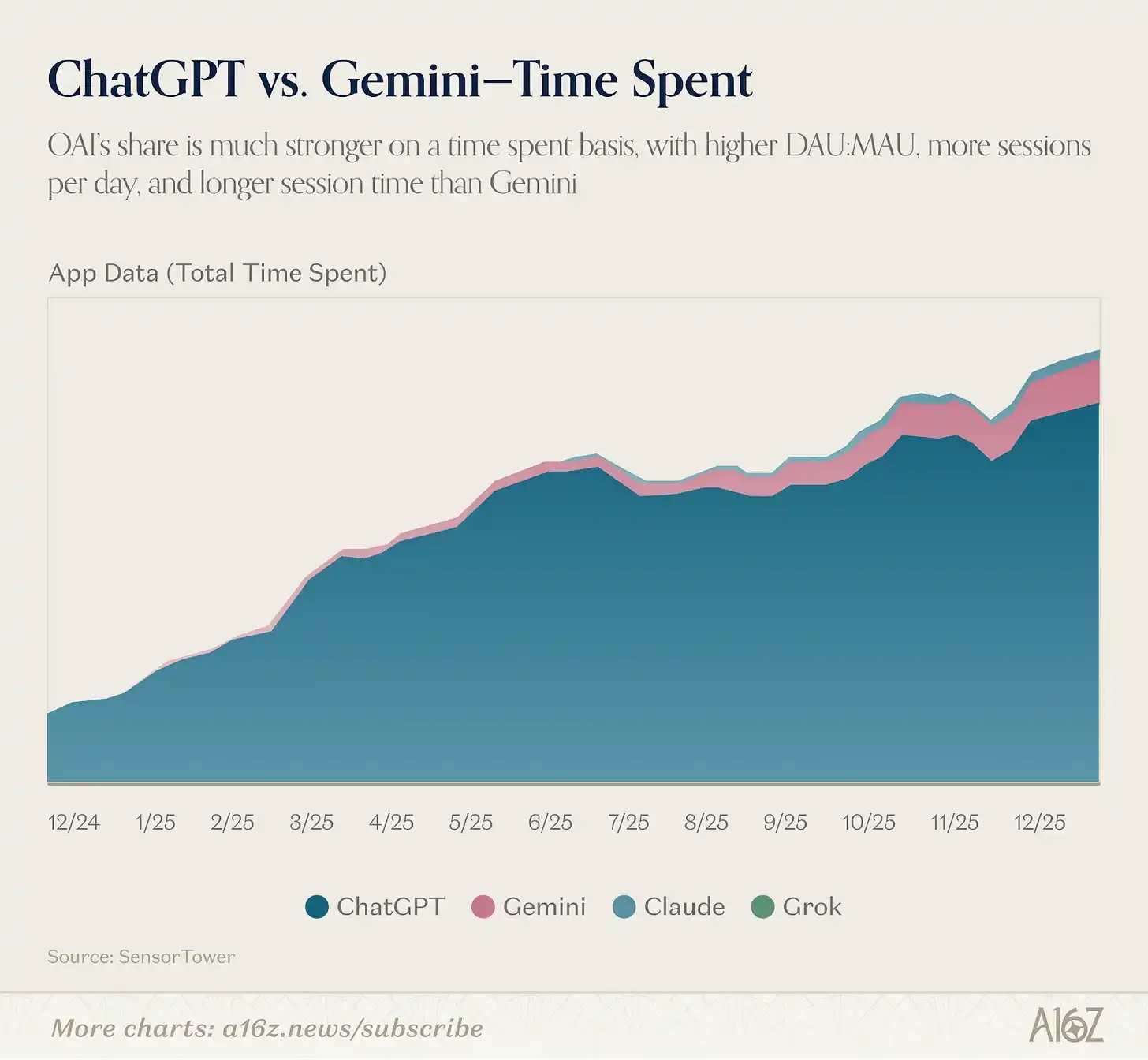
But we're starting to see the field widen, with other general-purpose platforms focusing on specific scenarios. Gemini and Claude's paid subscription growth in the US accelerated over the past year (though they are still far behind ChatGPT in absolute terms—ChatGPT has 8x the paid users of Claude and 4x those of Gemini). According to Yipit Data, as of January 2026, Claude's paid users grew over 200% year-over-year, while Gemini's grew 258%. We also see increasing "multi-platform" behavior—about 20% of ChatGPT's weekly web users also used Gemini in the same week.
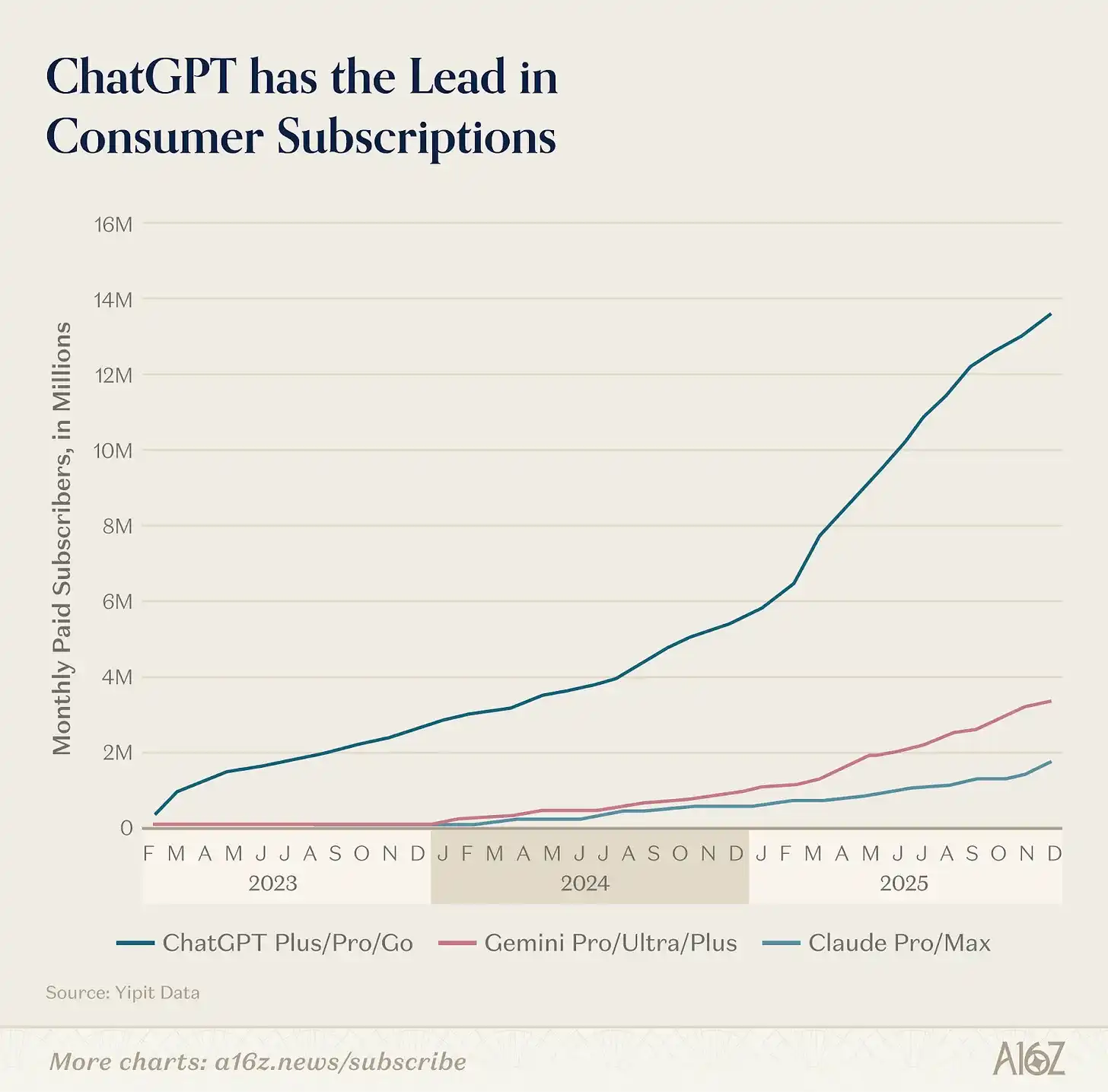
What's happening? Competitors are pushing hard. Google scored a big win with creative models—Nano Banana generated 200 million images in its first week, bringing 10 million new users to Gemini; Veo 3 is widely recognized as a breakthrough moment for AI video. Anthropic is targeting professional users, launching Cowork, Claude in Chrome, Excel and PowerPoint plugins, and most crucially, Claude Code.

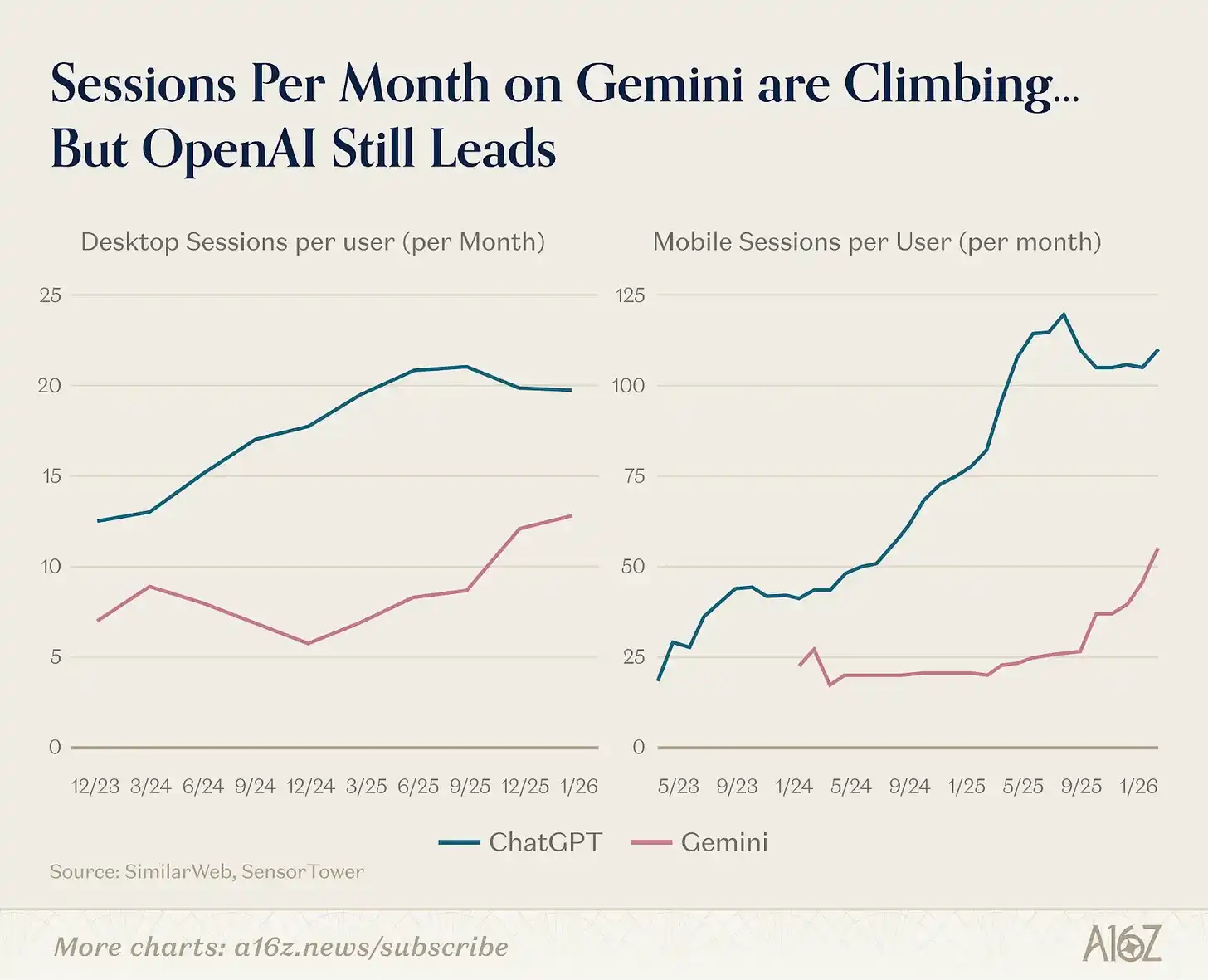
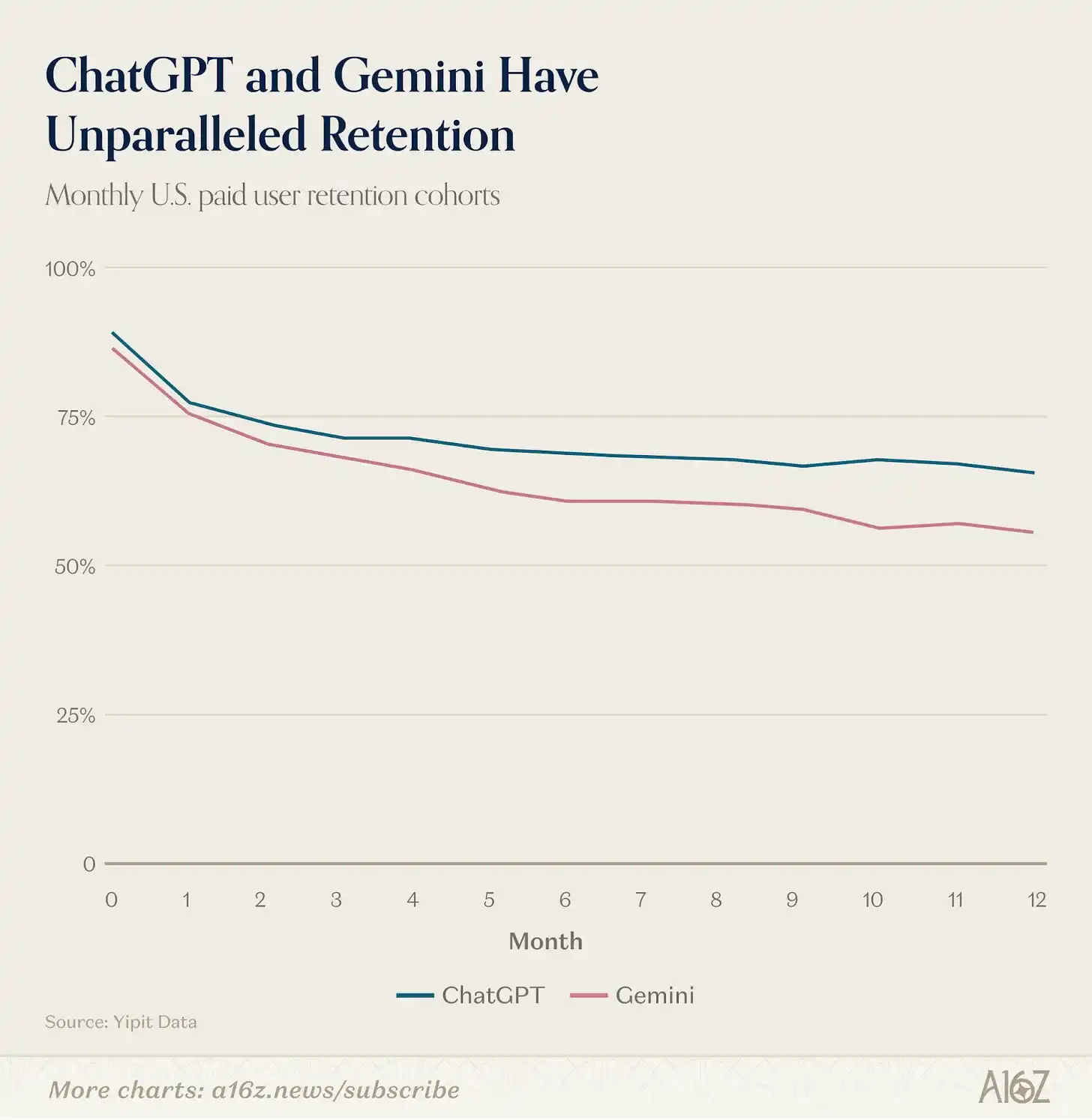
This competition isn't just about who leads today, but who can build structural moats. Context accumulates: the more an LLM knows about you, the better its results, and the more locked-in you become. Early data shows Gemini's average monthly sessions per user on the web are rising, though ChatGPT still leads by 1.3x. On mobile, ChatGPT's advantage is greater, with 2.2x the average monthly sessions per user compared to Gemini. According to Yipit Data, both have top-tier consumer paid user retention rates in the US.
The next layer of lock-in comes from app stores. Both ChatGPT and Claude have launched connector ecosystems—ChatGPT has GPTs and Apps, Claude has MCP integrations and Connectors, allowing users to build workflows on top of the assistants. Once users configure their AI to connect to their calendar, email, and CRM, switching costs rise dramatically. Developers are likely to focus their efforts on the platform with the most users, creating a flywheel effect similar to early platform wars.

We can already see the platforms diverging. Sam Altman previously stated that OpenAI wants to "bring AI to the billions who can't afford a subscription," which is why they started showing ads. He also indicated OpenAI would launch a "Sign in with ChatGPT" identity layer, positioning the AI assistant as the default interface between consumers and the internet. The ambition is to make ChatGPT the starting point for everything: shopping, booking hotels, browsing the web, health management, daily life.

The app directories reflect this divergence. As of late February, ChatGPT's app store covers 13 categories with 220 apps. Claude has about 160 curated connectors plus about 50 community MCP servers. But only 41 apps overlap between the two—roughly 11% of their combined directories—and these 41 are almost all universal productivity tools everyone needs: Slack, Notion, Figma, Gmail, Google Calendar, HubSpot, Stripe.

Beyond core tools, the two platforms are heading in almost completely different directions. ChatGPT has over 85 exclusive apps in categories like travel, shopping, food, health, lifestyle, and entertainment, where Claude has almost none. These are consumer transaction scenarios: booking flights on Expedia, grocery shopping via Instacart, browsing homes on Zillow, tracking nutrition on MyFitnessPal. This is the most aggressive super-app play among all AI companies. Claude's exclusive integrations lean professional: financial data terminals (PitchBook, FactSet, Moody's, MSCI), developer infrastructure (Sentry, Supabase, Snowflake, Databricks), science and medical tools (PubMed, Clinical Trials, Benchling), and an open-source MCP community which has no equivalent on ChatGPT.
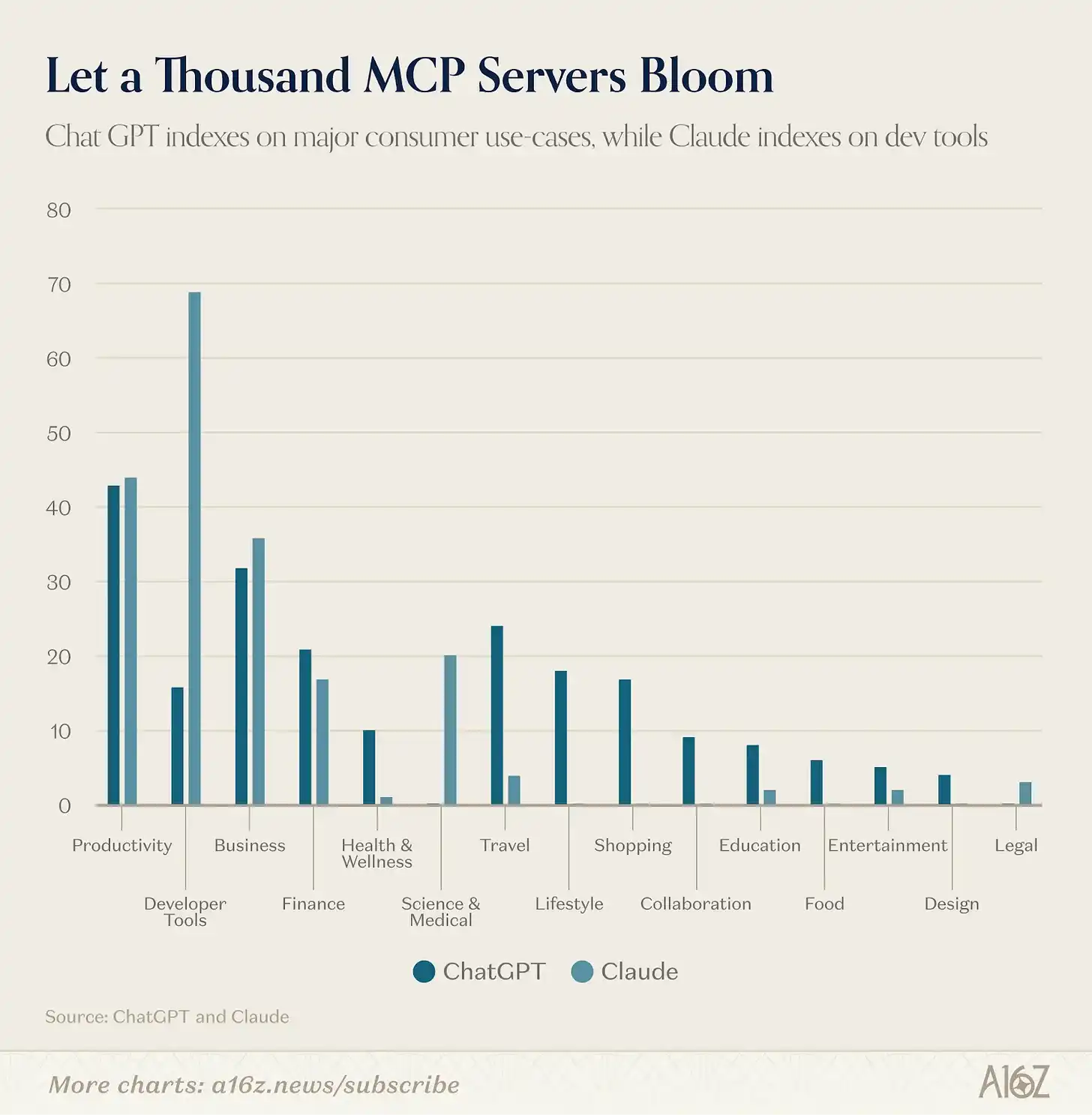
Anthropic seems focused on power AI users (developers, knowledge workers, etc.). These users are more willing and able to pay for expensive direct subscriptions. While ChatGPT also has products for similar audiences (e.g., Codex, Frontier), they are simultaneously aiming to be a platform for truly mass-market users—which could open more monetization paths as the user base grows. They are already testing ads, and transaction fees are a logical extension.

If AI assistants are not just chat windows but OS-level environments, this competition might ultimately resemble the mobile OS wars more than the search wars—two platforms with starkly different philosophies, each building trillion-dollar ecosystems.

2. Global Usage is Splitting Along Product Lines

Geographically, the AI market is splitting into three distinct ecosystems, with the gaps between them widening.
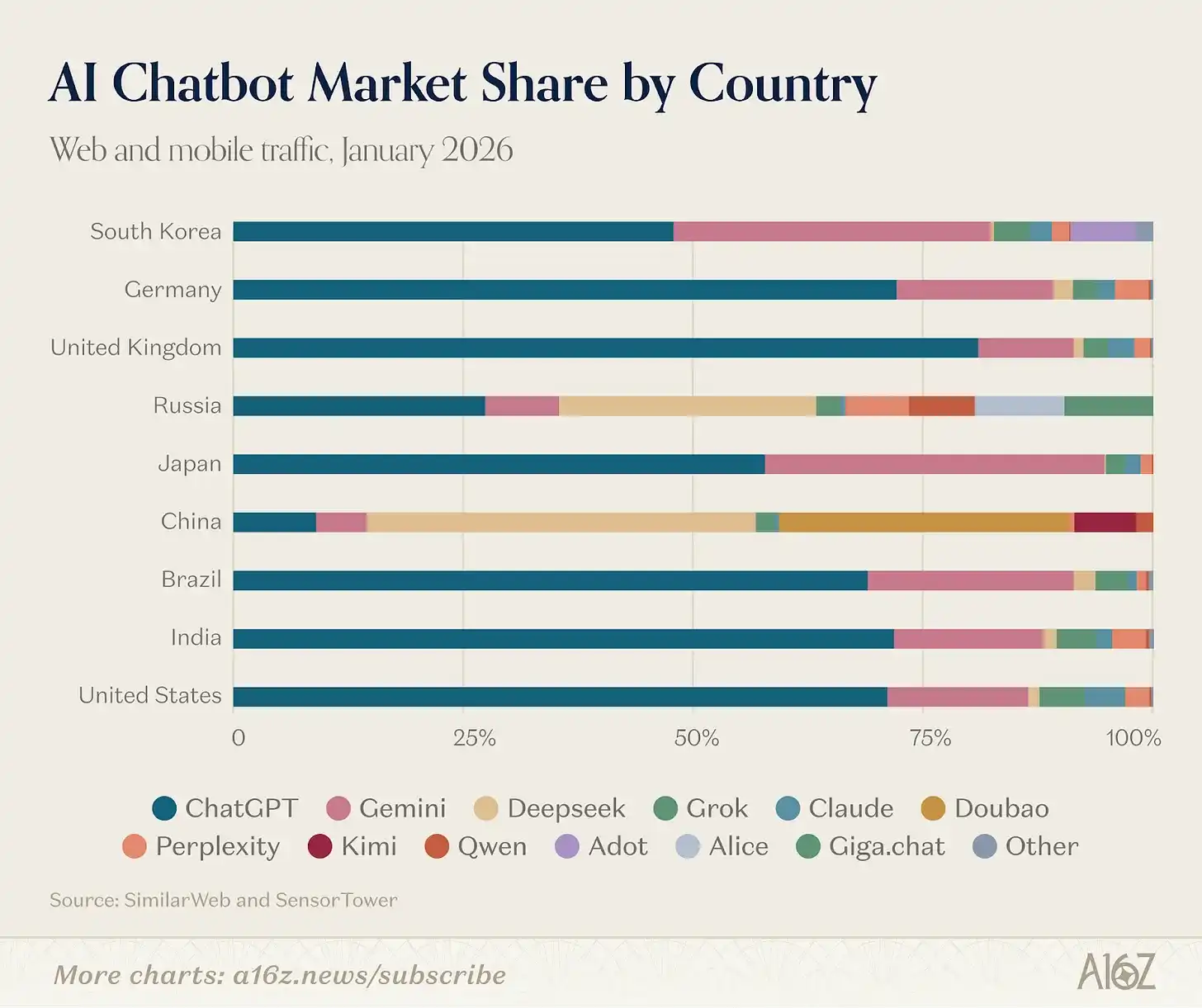
Western AI tools share highly similar user bases. The core markets for ChatGPT, Claude, Gemini, and Perplexity all come from the same pool: the US, India, Brazil, the UK, and Indonesia, just in different orders. None have significant usage in China or Russia. The reason is policy: since 2022, Western tech sanctions have restricted Russian access to US AI tools; China requires AI providers to register, store data locally, and comply with censorship rules.

DeepSeek is the only product that spans multiple camps. Its web traffic is distributed across China (33.5%), Russia (7.1%), and the US (6.6%), with a similar pattern on mobile. Chinese users also heavily use ByteDance's Doubao and local product Kimi.

Russia, which barely registered as a separate market in our early editions, has now become a third pole, with DeepSeek ranking second in penetration. The Yandex browser, integrated with the Alice AI assistant, has 71 million MAU, placing it in the global top 10 mobile AI products. Sber's GigaChat also appears on our web list for the first time. This pattern mirrors China's, just compressed: sanctions created a vacuum, and local products filled it within two years.

To measure AI adoption on a per capita basis, we built a simple index combining web visits per capita and mobile MAU per capita, scored from 0 to 100. The results redefine the geographic landscape. Singapore ranks first, followed by the UAE, Hong Kong, and South Korea. The US—the origin of most AI products—ranks 20th.
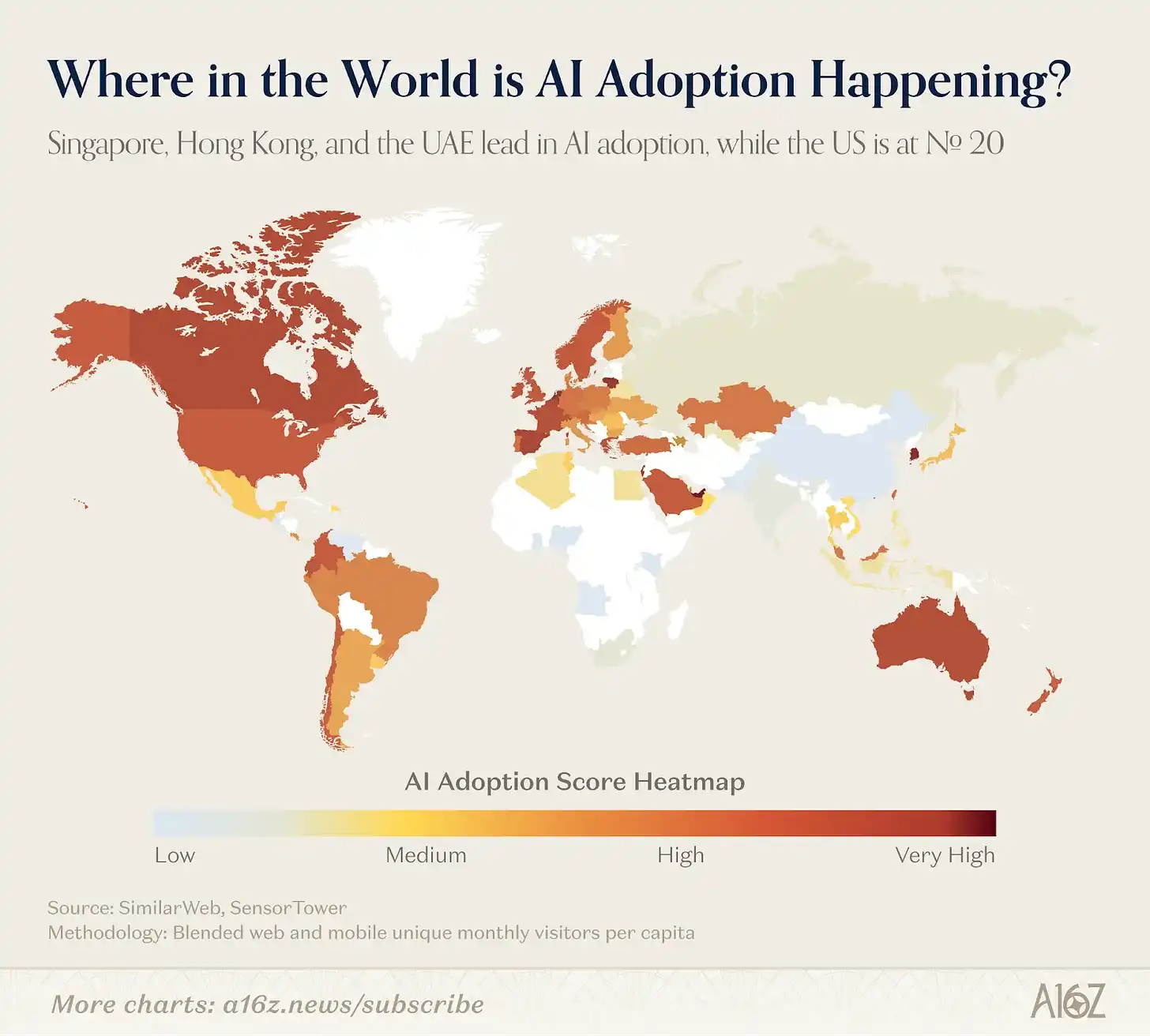
Caption: Generative AI Per Capita Adoption Index (0-100), Singapore leads, US ranks 20th

3. Creative Tools See Major Reshuffle

Midjourney, DALL-E, and Stable Diffusion were the products that brought most early users into the world of generative AI—all three launched before ChatGPT. Image generators not only dominated the creative category (video and audio generation came later) but also held steady positions in the upper tiers of our first three lists. This category has since changed dramatically.

In the first list from September 2023, 7 out of 9 creative tools on the web were image generators. Three years later, only 3 image generators remain on the list, but there are still 7 creative tools. The difference lies in what filled the vacancies: video, music, and voice products have claimed the spots vacated by image generation.
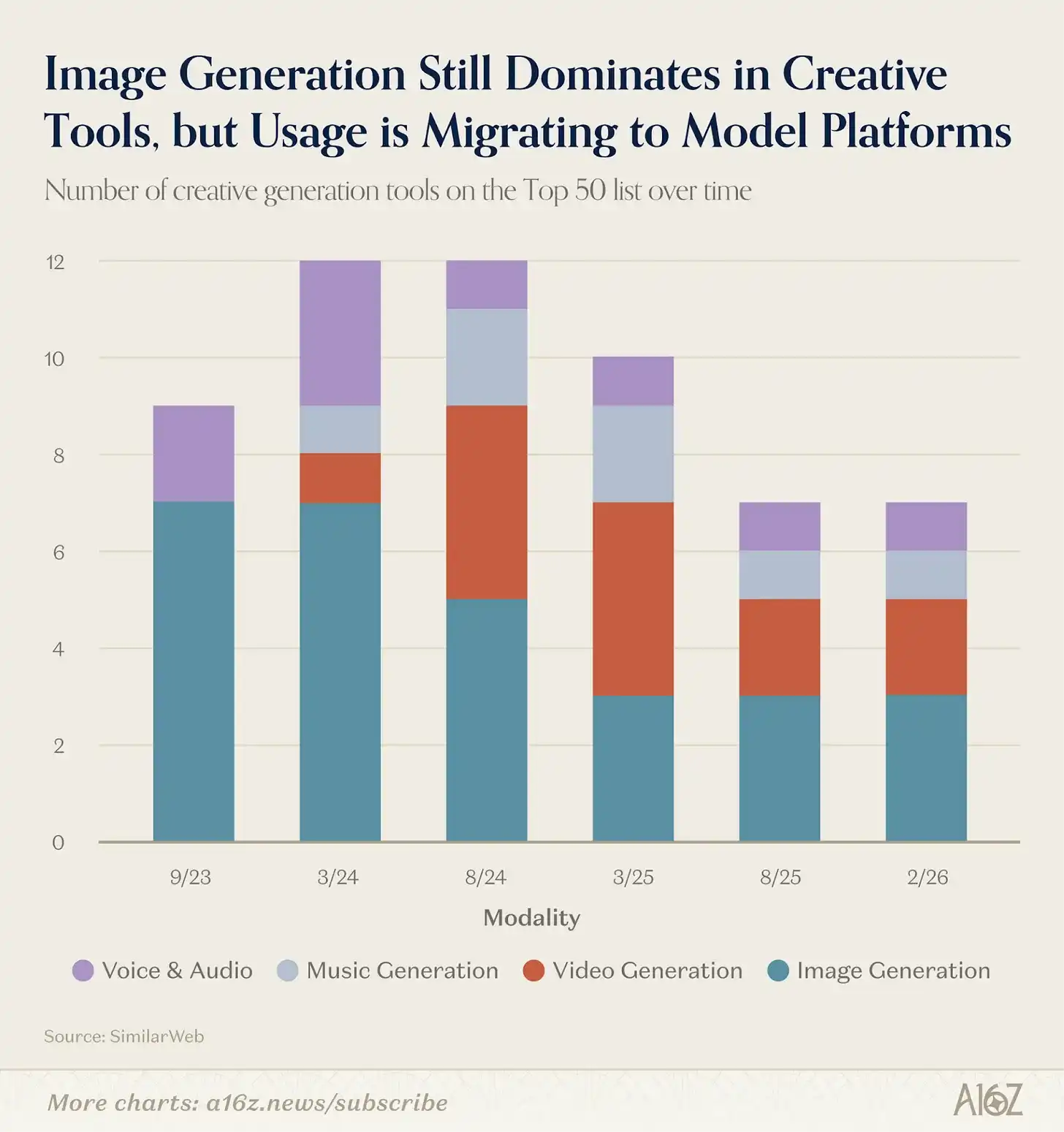
The story of image generation is one of being consumed by bundling. As the quality of built-in image models in ChatGPT (GPT Image 1.5) and Gemini (Nano Banana) improved, the bar for standalone image products rose sharply. Midjourney, which ranked in the top 10 in our first list, has now fallen to 46th place. The products that remain—Leonardo, Ideogram, CivitAI—tend to serve specific creative communities, differentiating with opinionated features rather than competing head-on with general-purpose generators.

Video generation is the area with the most change in this edition. Kling AI, Hailuo, and Pixverse have all built substantial user bases, with Chinese-developed models continuing to lead in output quality. It wouldn't surprise us to see apps based on Seedance 2.0 appear in the next list. Veo 3 was the first US model to close the gap, driving traffic to Google Labs (which rose from rank 36 to 25).

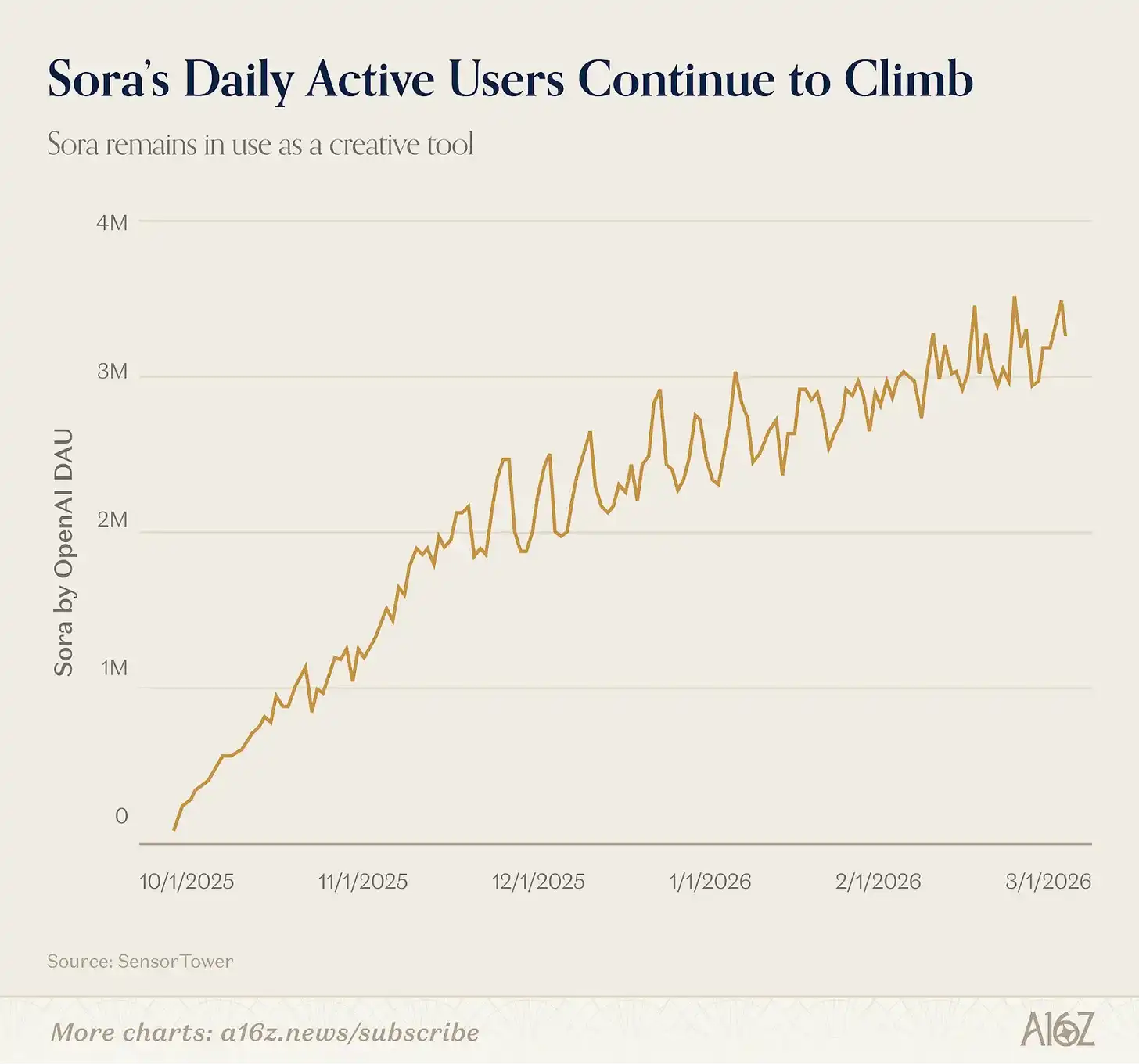
Who's missing? Sora. OpenAI launched Sora 2.0 as a standalone app in September 2025, allowing users to upload their own digital avatars as Cameos to generate videos featuring real people. Sora topped the US App Store charts for 20 consecutive days, reaching 1 million downloads faster than ChatGPT. Downloads subsequently fell back, because Sora failed to sustain viral growth as a social app (no one has cracked the AI × social formula yet), so it didn't make the mobile list this time. But SensorTower data shows Sora still has over 3 million mobile DAU, and AI video creators continue to use the model, even if they publish their work on other platforms.
Music and voice have been more defensible. Suno maintained its ranking from the previous edition (15th). ElevenLabs has been on every list since September 2023; its core capabilities—voice cloning, dubbing, audio production—are specialized enough that they haven't yet been turned into a checkbox feature in a giant's product.

The pattern to summarize: in creative directions where model giants and big players like Google and OpenAI focus (images, and increasingly video), traffic for independent products gets compressed—though there's still room for products targeting niches beyond the mainstream, potentially with higher price points. In directions the giants haven't focused on (music, voice), independent products have more room.

4. Agents Have Arrived

The shift towards agentic AI didn't start with this edition—it began last time, in the form of vibe coding. When Lovable, Cursor, and Bolt appeared on our March 2025 list, they represented something new: AI products that don't just answer questions or generate media, but build things for the user. This is agent behavior, just confined to a vertical.

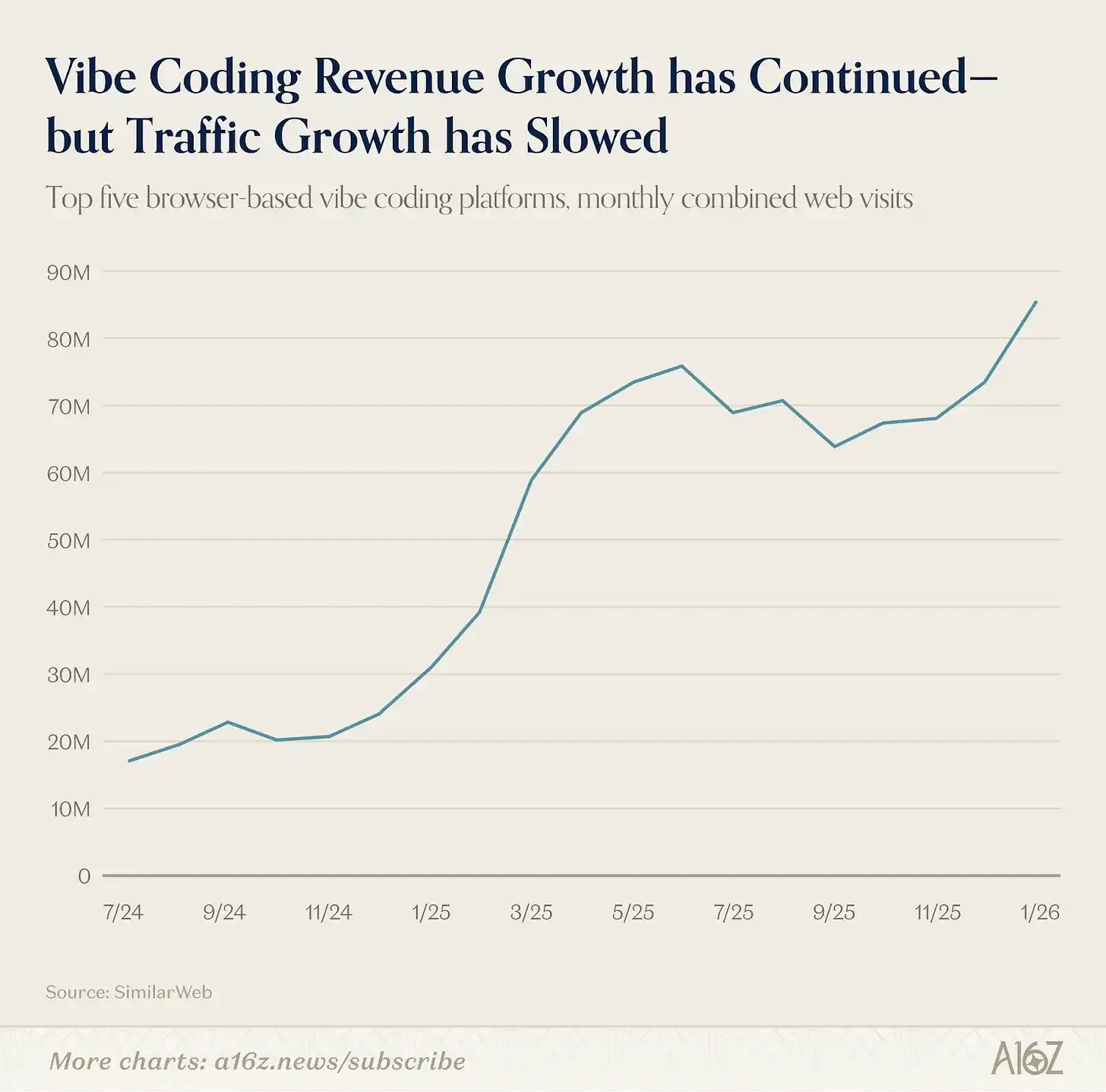
Vibe coding proved its retention capability among technical (and semi-technical) users. Both Replit and Lovable are on this list, as is Claude Code (via Claude). There's more room for growth, as this trend hasn't truly hit the mass market. Traffic for the top five vibe coding platforms is still growing, albeit slower than the initial explosion, but revenue for many products is rising as developers and teams deepen their usage.
More recently, general-purpose agents have begun to emerge. In January 2026, an open-source project called OpenClaw went from a side project by an independent developer to 68,000 GitHub stars and mainstream media coverage in just weeks. Created by Austrian developer Peter Steinberger, OpenClaw is an AI agent that runs locally, connects to your messaging apps, and performs multi-step tasks on your behalf.

If ChatGPT was the moment consumers discovered AI could converse, OpenClaw might be the moment they discover AI can act. The product exploded in the developer community—if we extended our analysis window to February instead of January, OpenClaw would rank in the web top 30.

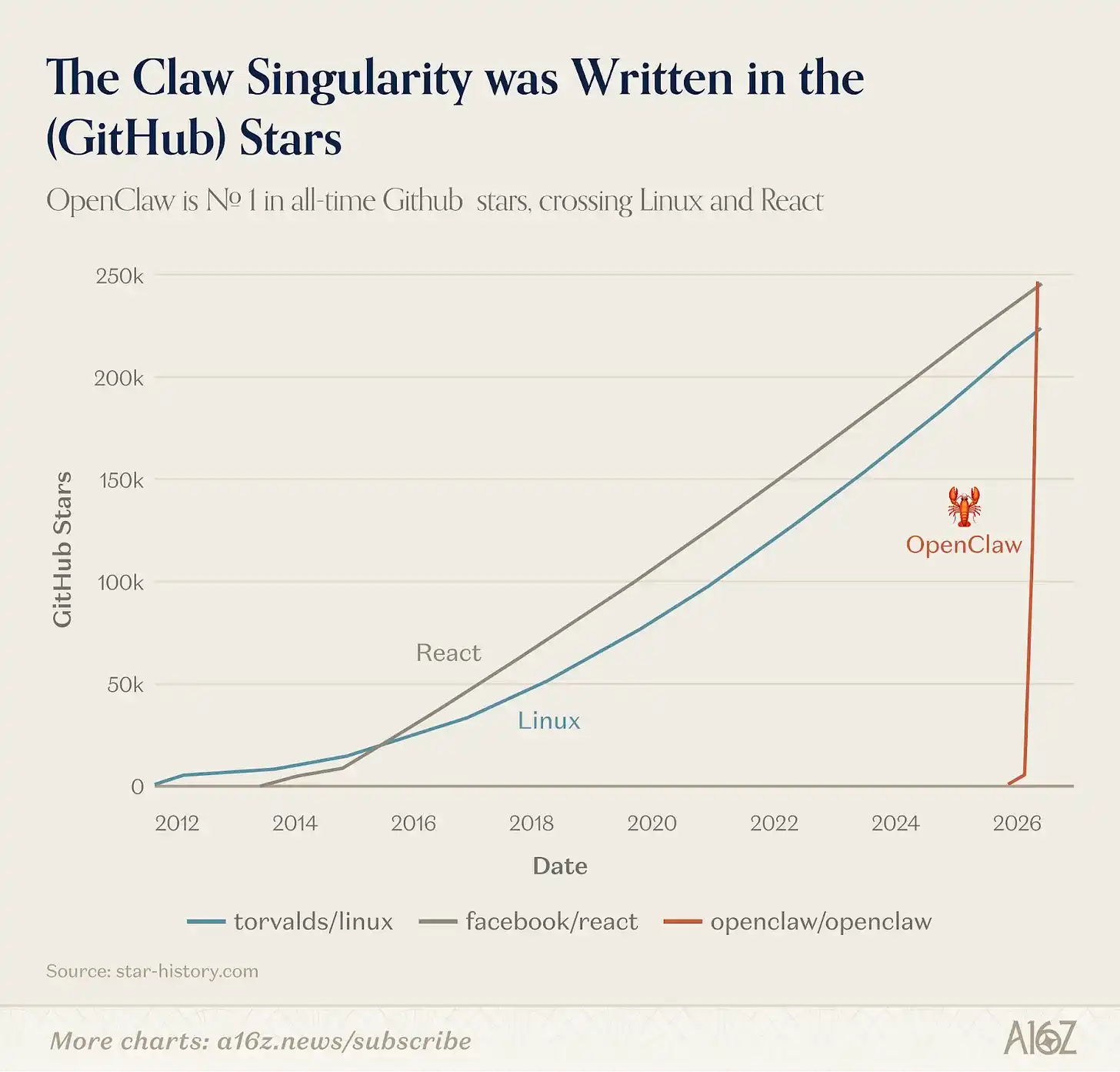
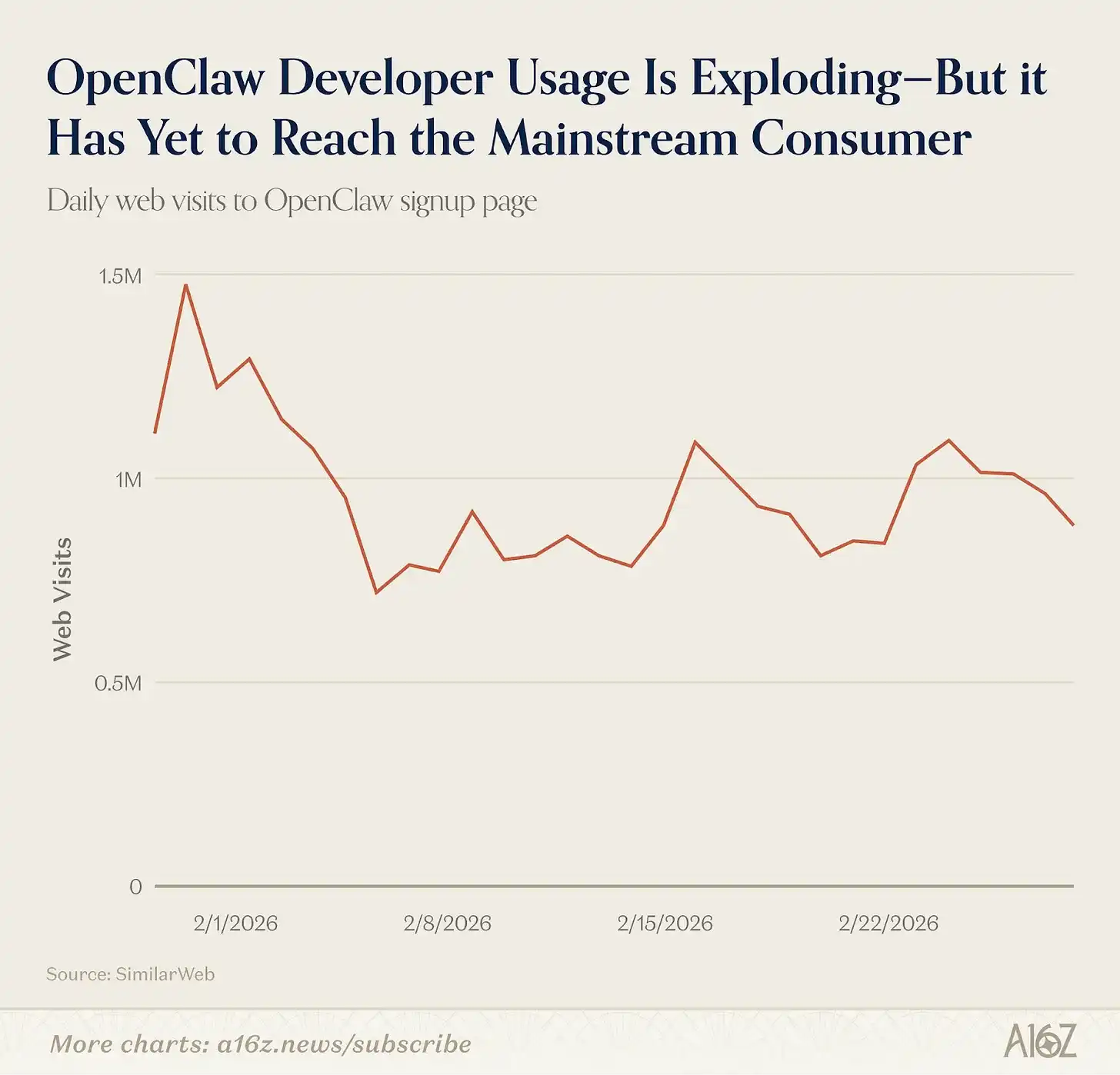
But OpenClaw isn't yet a consumer product—installation and maintenance require terminal skills. OpenClaw continues to gain momentum among technical users, becoming the most starred project on GitHub in early March, surpassing React and Linux. But the product hasn't "graduated" to truly mainstream users yet—at least judging by the new visitor data for the OpenClaw installation page, growth has been fairly flat. The project was acquired by OpenAI in February 2026, which might signal a more user-friendly version of OpenClaw is coming.
OpenClaw isn't the only general-purpose agent on the list. Manus and Genspark also made it—both platforms allow consumers to hand off open-ended tasks (research, spreadsheet analysis, slide deck creation) to AI, which completes the entire workflow end-to-end. Manus is on the list for the second time; after its last appearance, it was acquired by Meta for approximately $2 billion in December 2025. Genspark is new to this edition—the company closed a $300 million Series B earlier this year and announced it reached $100 million in annualized revenue.

On mobile, consumers often interact with agents via text, not through a mobile app. Upon installation, users connect OpenClaw to platforms like WhatsApp, Telegram, and Signal, sending it instructions as if messaging a friend, and it executes tasks in the background. Other products like Poke offer similar agent experiences via SMS.

These products will compete directly with the agent capabilities of the general-purpose LLM assistants consumers use every day—ChatGPT, Claude, and Gemini. As these giants build out their own connector and app ecosystems, will consumers choose one as their primary agent? The next six months will give us the answer.

5. AI Moves Beyond the Browser and App

Every previous edition of this list ranked AI products using two metrics: web visits and mobile MAU. But a new class of AI products is emerging that neither metric captures. Some of the most important consumer AI growth over the past year has occurred in products that are completely invisible in these two dimensions.

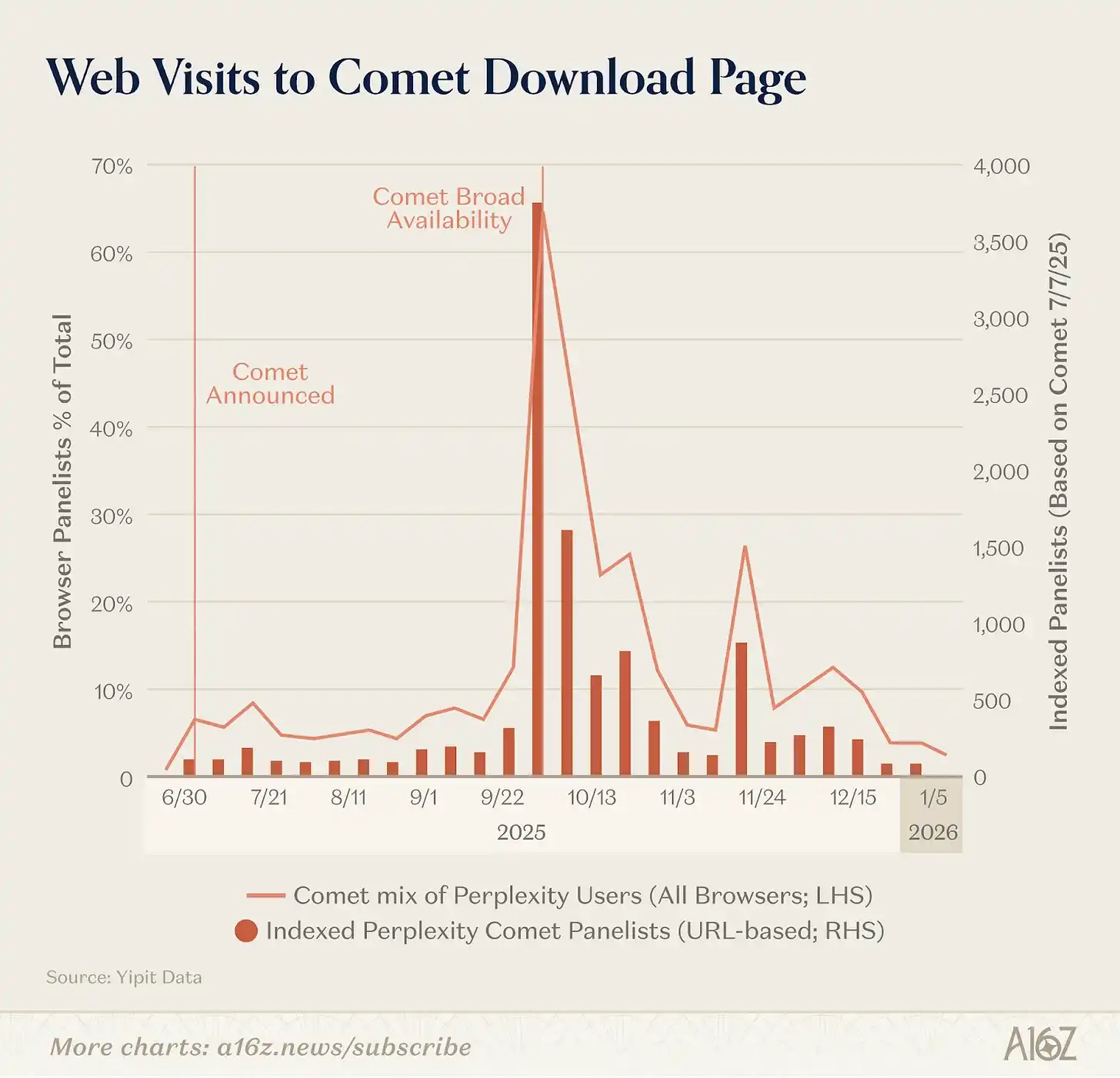
The most obvious change is that the browser itself is becoming an AI product. Over the past nine months, OpenAI released Atlas (a browser with ChatGPT built into every page), Perplexity launched Comet, and Browser Company (later acquired by Atlassian) launched Dia. Yipit data shows Perplexity's Comet has had the biggest impact in the market (measured by download page visits), but no AI browser has yet seen accelerating growth.

Other AI giants have chosen the path of adding AI to existing browsers rather than launching a separate AI browser. Google integrated Gemini into Chrome and released a beta of Disco, which can dynamically generate web apps based on a user's browser tabs. Anthropic released Claude in Chrome, which can connect to a user's Claude or Claude Code session to drive actions on the web.
Growth in native desktop AI tools is even more explosive, especially developer tools. Claude Code—a command-line developer agent—reached $1 billion in annualized revenue in just six months. OpenAI launched a standalone Mac app for Codex, and the company stated Codex had 2 million weekly active users by early March, growing 25% week-over-week. Cursor held its position in the web top 50.

For pure consumers, the most common standalone desktop AI applications are voice-related. Note-taking tools like Fireflies, Fathom, Otter, TL;DV, and Granola reach users through PLG models, gradually penetrating enterprises—the top five players combined have over 20 million visitors. Workspace apps like Notion (on the list for the first time) are also increasingly integrating AI through notetakers, research agents, and even task automation.

Finally, AI is embedding itself more deeply into the tools people already use. Anthropic launched Claude in Excel and Claude in PowerPoint. OpenAI launched ChatGPT for Excel. Google deepened Gemini's integration across the entire Workspace suite—Docs, Sheets, Gmail, and Meet all have native AI features. In January 2026, Google also launched Personal Intelligence, connecting Gemini to Gmail, Google Photos, YouTube, and Search, allowing the assistant to reference your hotel bookings, purchase history, photo library, and watch history without you having to tell it.

The implication for this list: our rankings increasingly underestimate the AI products people use the most. A developer who spends eight hours a day in Claude Code, or a knowledge worker who dictates every email through Wispr, are heavy AI users, but are almost invisible in web traffic data. As AI shifts from a destination to a feature, our methodology needs to evolve too.


Perguntas relacionadas

QWhat are the main findings of a16z's sixth edition of the Top 100 Generative AI Consumer Applications list?

AThe main findings include: 1) ChatGPT remains the dominant AI product but faces growing competition from Gemini and Claude, especially in paid subscriptions; 2) The global AI market is splitting into three distinct ecosystems (Western, Chinese, and Russian); 3) Creative tools are undergoing a major reshuffle, with video, music, and voice generation gaining ground over image generation; 4) AI agents are emerging as a new category, with tools like OpenClaw and Manus gaining traction; 5) AI is increasingly moving beyond browsers and apps into desktop tools, browsers themselves, and embedded integrations.

QHow has the competitive landscape for general AI assistants like ChatGPT, Gemini, and Claude evolved?

AWhile ChatGPT still leads with 900 million weekly active users (2.7x more web traffic than Gemini and 2.5x more mobile MAUs), Gemini and Claude are growing faster paid subscription rates in the U.S. (258% and 200% YoY growth, respectively). About 20% of ChatGPT's weekly web users also use Gemini in the same week. The competition is intensifying around building structural moats through context accumulation, app stores, and differentiated strategies—OpenAI aims for a super-app approach targeting mass consumers, while Anthropic focuses on high-end professional users.

QWhat geographic trends does the report highlight in AI adoption?

AThe global AI market is splitting into three ecosystems: 1) Western tools (ChatGPT, Gemini, Claude, Perplexity) dominate in the U.S., India, Brazil, the U.K., and Indonesia but have negligible usage in China or Russia due to policies; 2) China has its own ecosystem with products like DeepSeek, Doubao, and Kimi; 3) Russia has rapidly developed a local AI market with DeepSeek, Yandex Browser (with Alice AI), and GigaChat. Singapore leads in per capita AI adoption, while the U.S. ranks 20th.

QHow has the creative AI tools category changed since the first edition of the list?

AIn the first list (2023), 7 out of 9 creative tools were image generators. Now, only 3 image generators remain in the top 100, but creative tools still hold 7 spots—with video, music, and voice generation replacing image generation. Image tools like Midjourney declined as giants like ChatGPT and Gemini integrated high-quality image models. Video generation (e.g., Kling AI, Veo 3) saw significant momentum, while music (Suno) and voice (ElevenLabs) tools remain resilient due to their specialized, less-bundled nature.

QWhat are AI agents, and which examples are mentioned in the report?

AAI agents are products that go beyond generating content to taking actions or completing multi-step tasks for users. Examples include: 1) Vibe coding tools like Lovable, Cursor, and Claude Code for developers; 2) General-purpose agents like OpenClaw (an open-source agent for messaging apps), Manus (acquired by Meta), and Genspark (for research and presentations); 3) Mobile agents operating via text (e.g., Poke). These agents compete with the expanding capabilities of major LLM assistants like ChatGPT, Claude, and Gemini.

Leituras Relacionadas

Trading

Spot
Futuros

Artigos em Destaque

O que é $S$

Compreender o SPERO: Uma Visão Abrangente Introdução ao SPERO À medida que o panorama da inovação continua a evoluir, o surgimento de tecnologias web3 e projetos de criptomoeda desempenha um papel fundamental na formação do futuro digital. Um projeto que tem atraído atenção neste campo dinâmico é o SPERO, denotado como SPERO,$$s$. Este artigo tem como objetivo reunir e apresentar informações detalhadas sobre o SPERO, para ajudar entusiastas e investidores a compreender as suas bases, objetivos e inovações nos domínios web3 e cripto. O que é o SPERO,$$s$? O SPERO,$$s$ é um projeto único dentro do espaço cripto que procura aproveitar os princípios da descentralização e da tecnologia blockchain para criar um ecossistema que promove o envolvimento, a utilidade e a inclusão financeira. O projeto é concebido para facilitar interações peer-to-peer de novas maneiras, proporcionando aos utilizadores soluções e serviços financeiros inovadores. No seu núcleo, o SPERO,$$s$ visa capacitar indivíduos ao fornecer ferramentas e plataformas que melhoram a experiência do utilizador no espaço das criptomoedas. Isso inclui a possibilidade de métodos de transação mais flexíveis, a promoção de iniciativas impulsionadas pela comunidade e a criação de caminhos para oportunidades financeiras através de aplicações descentralizadas (dApps). A visão subjacente do SPERO,$$s$ gira em torno da inclusão, visando fechar lacunas dentro das finanças tradicionais enquanto aproveita os benefícios da tecnologia blockchain. Quem é o Criador do SPERO,$$s$? A identidade do criador do SPERO,$$s$ permanece algo obscura, uma vez que existem recursos publicamente disponíveis limitados que fornecem informações detalhadas sobre o(s) seu(s) fundador(es). Esta falta de transparência pode resultar do compromisso do projeto com a descentralização—uma ética que muitos projetos web3 partilham, priorizando contribuições coletivas em vez de reconhecimento individual. Ao centrar as discussões em torno da comunidade e dos seus objetivos coletivos, o SPERO,$$s$ incorpora a essência do empoderamento sem destacar indivíduos específicos. Assim, compreender a ética e a missão do SPERO é mais importante do que identificar um criador singular. Quem são os Investidores do SPERO,$$s$? O SPERO,$$s$ é apoiado por uma diversidade de investidores que vão desde capitalistas de risco a investidores-anjo dedicados a promover a inovação no setor cripto. O foco desses investidores geralmente alinha-se com a missão do SPERO—priorizando projetos que prometem avanço tecnológico social, inclusão financeira e governança descentralizada. Essas fundações de investidores estão tipicamente interessadas em projetos que não apenas oferecem produtos inovadores, mas que também contribuem positivamente para a comunidade blockchain e os seus ecossistemas. O apoio desses investidores reforça o SPERO,$$s$ como um concorrente notável no domínio em rápida evolução dos projetos cripto. Como Funciona o SPERO,$$s$? O SPERO,$$s$ emprega uma estrutura multifacetada que o distingue de projetos de criptomoeda convencionais. Aqui estão algumas das características-chave que sublinham a sua singularidade e inovação: Governança Descentralizada: O SPERO,$$s$ integra modelos de governança descentralizada, capacitando os utilizadores a participar ativamente nos processos de tomada de decisão sobre o futuro do projeto. Esta abordagem promove um sentido de propriedade e responsabilidade entre os membros da comunidade. Utilidade do Token: O SPERO,$$s$ utiliza o seu próprio token de criptomoeda, concebido para servir várias funções dentro do ecossistema. Esses tokens permitem transações, recompensas e a facilitação de serviços oferecidos na plataforma, melhorando o envolvimento e a utilidade gerais. Arquitetura em Camadas: A arquitetura técnica do SPERO,$$s$ suporta modularidade e escalabilidade, permitindo a integração contínua de funcionalidades e aplicações adicionais à medida que o projeto evolui. Esta adaptabilidade é fundamental para manter a relevância no panorama cripto em constante mudança. Envolvimento da Comunidade: O projeto enfatiza iniciativas impulsionadas pela comunidade, empregando mecanismos que incentivam a colaboração e o feedback. Ao nutrir uma comunidade forte, o SPERO,$$s$ pode melhor atender às necessidades dos utilizadores e adaptar-se às tendências do mercado. Foco na Inclusão: Ao oferecer taxas de transação baixas e interfaces amigáveis, o SPERO,$$s$ visa atrair uma base de utilizadores diversificada, incluindo indivíduos que anteriormente podem não ter participado no espaço cripto. Este compromisso com a inclusão alinha-se com a sua missão abrangente de empoderamento através da acessibilidade. Cronologia do SPERO,$$s$ Compreender a história de um projeto fornece insights cruciais sobre a sua trajetória de desenvolvimento e marcos. Abaixo está uma cronologia sugerida que mapeia eventos significativos na evolução do SPERO,$$s$: Fase de Conceituação e Ideação: As ideias iniciais que formam a base do SPERO,$$s$ foram concebidas, alinhando-se de perto com os princípios de descentralização e foco na comunidade dentro da indústria blockchain. Lançamento do Whitepaper do Projeto: Após a fase conceitual, um whitepaper abrangente detalhando a visão, os objetivos e a infraestrutura tecnológica do SPERO,$$s$ foi lançado para atrair o interesse e o feedback da comunidade. Construção da Comunidade e Primeiros Envolvimentos: Esforços ativos de divulgação foram feitos para construir uma comunidade de primeiros adotantes e investidores potenciais, facilitando discussões em torno dos objetivos do projeto e angariando apoio. Evento de Geração de Tokens: O SPERO,$$s$ realizou um evento de geração de tokens (TGE) para distribuir os seus tokens nativos a apoiantes iniciais e estabelecer liquidez inicial dentro do ecossistema. Lançamento da dApp Inicial: A primeira aplicação descentralizada (dApp) associada ao SPERO,$$s$ foi lançada, permitindo que os utilizadores interagissem com as funcionalidades principais da plataforma. Desenvolvimento Contínuo e Parcerias: Atualizações e melhorias contínuas nas ofertas do projeto, incluindo parcerias estratégicas com outros players no espaço blockchain, moldaram o SPERO,$$s$ em um jogador competitivo e em evolução no mercado cripto. Conclusão O SPERO,$$s$ é um testemunho do potencial do web3 e das criptomoedas para revolucionar os sistemas financeiros e capacitar indivíduos. Com um compromisso com a governança descentralizada, o envolvimento da comunidade e funcionalidades inovadoras, abre caminho para um panorama financeiro mais inclusivo. Como em qualquer investimento no espaço cripto em rápida evolução, potenciais investidores e utilizadores são incentivados a pesquisar minuciosamente e a envolver-se de forma ponderada com os desenvolvimentos em curso dentro do SPERO,$$s$. O projeto demonstra o espírito inovador da indústria cripto, convidando a uma exploração mais aprofundada das suas inúmeras possibilidades. Embora a jornada do SPERO,$$s$ ainda esteja a desenrolar-se, os seus princípios fundamentais podem, de facto, influenciar o futuro de como interagimos com a tecnologia, as finanças e uns com os outros em ecossistemas digitais interconectados.

69 Visualizações TotaisPublicado em {updateTime}Atualizado em 2024.12.17

O que é $S$

O que é AGENT S

Agent S: O Futuro da Interação Autónoma no Web3 Introdução No panorama em constante evolução do Web3 e das criptomoedas, as inovações estão constantemente a redefinir a forma como os indivíduos interagem com plataformas digitais. Um projeto pioneiro, o Agent S, promete revolucionar a interação humano-computador através do seu framework aberto e agente. Ao abrir caminho para interações autónomas, o Agent S visa simplificar tarefas complexas, oferecendo aplicações transformadoras em inteligência artificial (IA). Esta exploração detalhada irá aprofundar-se nas complexidades do projeto, nas suas características únicas e nas implicações para o domínio das criptomoedas. O que é o Agent S? O Agent S é um framework aberto e agente, especificamente concebido para abordar três desafios fundamentais na automação de tarefas computacionais: Aquisição de Conhecimento Específico de Domínio: O framework aprende inteligentemente a partir de várias fontes de conhecimento externas e experiências internas. Esta abordagem dupla capacita-o a construir um rico repositório de conhecimento específico de domínio, melhorando o seu desempenho na execução de tarefas. Planeamento ao Longo de Longos Horizontes de Tarefas: O Agent S emprega planeamento hierárquico aumentado por experiência, uma abordagem estratégica que facilita a decomposição e execução eficientes de tarefas intrincadas. Esta característica melhora significativamente a sua capacidade de gerir múltiplas subtarefas de forma eficiente e eficaz. Gestão de Interfaces Dinâmicas e Não Uniformes: O projeto introduz a Interface Agente-Computador (ACI), uma solução inovadora que melhora a interação entre agentes e utilizadores. Utilizando Modelos de Linguagem Multimodais de Grande Escala (MLLMs), o Agent S pode navegar e manipular diversas interfaces gráficas de utilizador de forma fluida. Através destas características pioneiras, o Agent S fornece um framework robusto que aborda as complexidades envolvidas na automação da interação humana com máquinas, preparando o terreno para uma infinidade de aplicações em IA e além. Quem é o Criador do Agent S? Embora o conceito de Agent S seja fundamentalmente inovador, informações específicas sobre o seu criador permanecem elusivas. O criador é atualmente desconhecido, o que destaca ou o estágio nascente do projeto ou a escolha estratégica de manter os membros fundadores em anonimato. Independentemente da anonimidade, o foco permanece nas capacidades e no potencial do framework. Quem são os Investidores do Agent S? Como o Agent S é relativamente novo no ecossistema criptográfico, informações detalhadas sobre os seus investidores e financiadores não estão explicitamente documentadas. A falta de informações disponíveis publicamente sobre as fundações de investimento ou organizações que apoiam o projeto levanta questões sobre a sua estrutura de financiamento e roteiro de desenvolvimento. Compreender o apoio é crucial para avaliar a sustentabilidade do projeto e o seu impacto potencial no mercado. Como Funciona o Agent S? No núcleo do Agent S reside uma tecnologia de ponta que lhe permite funcionar eficazmente em diversos ambientes. O seu modelo operacional é construído em torno de várias características-chave: Interação Humano-Computador Semelhante: O framework oferece planeamento avançado em IA, esforçando-se para tornar as interações com computadores mais intuitivas. Ao imitar o comportamento humano na execução de tarefas, promete elevar as experiências dos utilizadores. Memória Narrativa: Utilizada para aproveitar experiências de alto nível, o Agent S utiliza memória narrativa para acompanhar os históricos de tarefas, melhorando assim os seus processos de tomada de decisão. Memória Episódica: Esta característica fornece aos utilizadores orientações passo a passo, permitindo que o framework ofereça suporte contextual à medida que as tarefas se desenrolam. Suporte para OpenACI: Com a capacidade de funcionar localmente, o Agent S permite que os utilizadores mantenham o controlo sobre as suas interações e fluxos de trabalho, alinhando-se com a ética descentralizada do Web3. Fácil Integração com APIs Externas: A sua versatilidade e compatibilidade com várias plataformas de IA garantem que o Agent S possa integrar-se perfeitamente em ecossistemas tecnológicos existentes, tornando-o uma escolha apelativa para desenvolvedores e organizações. Estas funcionalidades contribuem coletivamente para a posição única do Agent S no espaço cripto, à medida que automatiza tarefas complexas e em múltiplos passos com mínima intervenção humana. À medida que o projeto evolui, as suas potenciais aplicações no Web3 podem redefinir a forma como as interações digitais se desenrolam. Cronologia do Agent S O desenvolvimento e os marcos do Agent S podem ser encapsulados numa cronologia que destaca os seus eventos significativos: 27 de Setembro de 2024: O conceito de Agent S foi lançado num artigo de pesquisa abrangente intitulado “Um Framework Agente Aberto que Usa Computadores como um Humano”, mostrando a base para o projeto. 10 de Outubro de 2024: O artigo de pesquisa foi disponibilizado publicamente no arXiv, oferecendo uma exploração aprofundada do framework e da sua avaliação de desempenho com base no benchmark OSWorld. 12 de Outubro de 2024: Uma apresentação em vídeo foi lançada, proporcionando uma visão visual das capacidades e características do Agent S, envolvendo ainda mais potenciais utilizadores e investidores. Estes marcos na cronologia não apenas ilustram o progresso do Agent S, mas também indicam o seu compromisso com a transparência e o envolvimento da comunidade. Pontos-Chave Sobre o Agent S À medida que o framework Agent S continua a evoluir, várias características-chave destacam-se, sublinhando a sua natureza inovadora e potencial: Framework Inovador: Concebido para proporcionar um uso intuitivo de computadores semelhante à interação humana, o Agent S traz uma abordagem nova à automação de tarefas. Interação Autónoma: A capacidade de interagir autonomamente com computadores através de GUI significa um avanço em direção a soluções computacionais mais inteligentes e eficientes. Automação de Tarefas Complexas: Com a sua metodologia robusta, pode automatizar tarefas complexas e em múltiplos passos, tornando os processos mais rápidos e menos propensos a erros. Melhoria Contínua: Os mecanismos de aprendizagem permitem que o Agent S melhore a partir de experiências passadas, aprimorando continuamente o seu desempenho e eficácia. Versatilidade: A sua adaptabilidade em diferentes ambientes operacionais, como OSWorld e WindowsAgentArena, garante que pode servir uma ampla gama de aplicações. À medida que o Agent S se posiciona no panorama do Web3 e das criptomoedas, o seu potencial para melhorar as capacidades de interação e automatizar processos significa um avanço significativo nas tecnologias de IA. Através do seu framework inovador, o Agent S exemplifica o futuro das interações digitais, prometendo uma experiência mais fluida e eficiente para os utilizadores em diversas indústrias. Conclusão O Agent S representa um ousado avanço na união da IA e do Web3, com a capacidade de redefinir a forma como interagimos com a tecnologia. Embora ainda esteja nas suas fases iniciais, as possibilidades para a sua aplicação são vastas e cativantes. Através do seu framework abrangente que aborda desafios críticos, o Agent S visa trazer interações autónomas para o primeiro plano da experiência digital. À medida que avançamos mais profundamente nos domínios das criptomoedas e da descentralização, projetos como o Agent S desempenharão, sem dúvida, um papel crucial na formação do futuro da tecnologia e da colaboração humano-computador.

538 Visualizações TotaisPublicado em {updateTime}Atualizado em 2025.01.14

O que é AGENT S

Como comprar S

Bem-vindo à HTX.com!Tornámos a compra de Sonic (S) simples e conveniente.Segue o nosso guia passo a passo para iniciar a tua jornada no mundo das criptos.Passo 1: cria a tua conta HTXUtiliza o teu e-mail ou número de telefone para te inscreveres numa conta gratuita na HTX.Desfruta de um processo de inscrição sem complicações e desbloqueia todas as funcionalidades.Obter a minha contaPasso 2: vai para Comprar Cripto e escolhe o teu método de pagamentoCartão de crédito/débito: usa o teu visa ou mastercard para comprar Sonic (S) instantaneamente.Saldo: usa os fundos da tua conta HTX para transacionar sem problemas.Terceiros: adicionamos métodos de pagamento populares, como Google Pay e Apple Pay, para aumentar a conveniência.P2P: transaciona diretamente com outros utilizadores na HTX.Mercado de balcão (OTC): oferecemos serviços personalizados e taxas de câmbio competitivas para os traders.Passo 3: armazena teu Sonic (S)Depois de comprar o teu Sonic (S), armazena-o na tua conta HTX.Alternativamente, podes enviá-lo para outro lugar através de transferência blockchain ou usá-lo para transacionar outras criptomoedas.Passo 4: transaciona Sonic (S)Transaciona facilmente Sonic (S) no mercado à vista da HTX.Acede simplesmente à tua conta, seleciona o teu par de trading, executa as tuas transações e monitoriza em tempo real.Oferecemos uma experiência de fácil utilização tanto para principiantes como para traders experientes.

1.0k Visualizações TotaisPublicado em {updateTime}Atualizado em 2025.03.21

Como comprar S

Discussões

Bem-vindo à Comunidade HTX. Aqui, pode manter-se informado sobre os mais recentes desenvolvimentos da plataforma e obter acesso a análises profissionais de mercado. As opiniões dos utilizadores sobre o preço de S (S) são apresentadas abaixo.

活动图片













