In response to the growing adoption of crypto in real estate, four Japanese regulatory authorities have issued joint guidance outlining compliance requirements to mitigate money laundering risks in property transactions.
Authorities Issue Crypto Guidance For Real Estate Industry
On Tuesday, Japan’s Financial Services Agency (FSA), in collaboration with the Ministry of Land, Infrastructure, Transport and Tourism, the National Police Agency, and the Ministry of Finance, published a joint guidance request that major industry bodies must follow when utilizing crypto assets in real estate transactions.
The request, addressed to key associations from the two industries, warned about the potential risks posed by real estate deals using digital assets, affirming that “given the nature of crypto assets, which can be transferred across borders instantaneously, there is a high risk that they will be used as a settlement method in real estate transactions for money laundering and other illicit activities.”
Therefore, Japanese regulators advised real estate firms conducting crypto transactions to strictly enforce Know Your Customer (KYC) procedures and source-of-funds verifications under the Act on Prevention of Transfer of Criminal Proceeds.
They also requested firms notify regulators and law enforcement upon discovering unlicensed transactions or unusual fund flows. In addition, it explained that cross-border crypto asset receipts and payments exceeding 30 million yen are subject to reporting obligations:
Furthermore, from the perspective of understanding these actual conditions, the Foreign Exchange and Foreign Trade Act (Act No. 228 of 1949) stipulates that: (1) any person who receives cryptocurrency or similar assets from overseas in an amount exceeding the equivalent of 30 million yen must submit a “Report on Payment or Receipt of Payment”; and (2) in cases where a non-resident acquires real estate or similar assets located in Japan, a “Report on the Acquisition of Real Estate or Rights Thereof Located in Japan.
Notably, the guidance request explicitly stated that activities involving the exchange of crypto assets for fiat currency or brokerage services on behalf of clients may constitute crypto asset exchange operations, adding that conducting such operations without proper registration carries the risk of legal violations.
Japan’s Digital Asset Landscape
This month, Japan amended its Financial Instruments and Exchange Act (FIEA) to classify crypto assets as financial instruments. As reported by Bitcoinist, digital assets in Japan have been regulated by the Payment Services Act, which focuses on digital money and transactions rather than investment activities.
If passed, the amended law would move crypto out of the payments category and bring it into the same framework as stocks and other securities. The reclassification will require issuers to file annual disclosures, bringing them closer in line with publicly listed companies.
Additionally, the legislation will impose substantial penalties on individuals engaged in illicit activities. For instance, unlicensed crypto operators would face prison sentences ranging from three to ten years.
Fines would be increased from ¥3 million, around $18,800, to ¥10 million, roughly $62,600. Meanwhile, insider trading would also be explicitly banned under the new framework, a prohibition that did not exist under the Payment Services Act.
Notably, Japanese authorities have been working to restructure how crypto assets are treated in the country, with the government also backing a tax reform plan to introduce a separate system for different transactions.
The outline of the 2026 Tax Reform, released last December, proposed changing the current progressive tax system, in which digital asset gains can be taxed at up to 55%, to a system like the one used for stocks, with a flat 20% tax on crypto income.
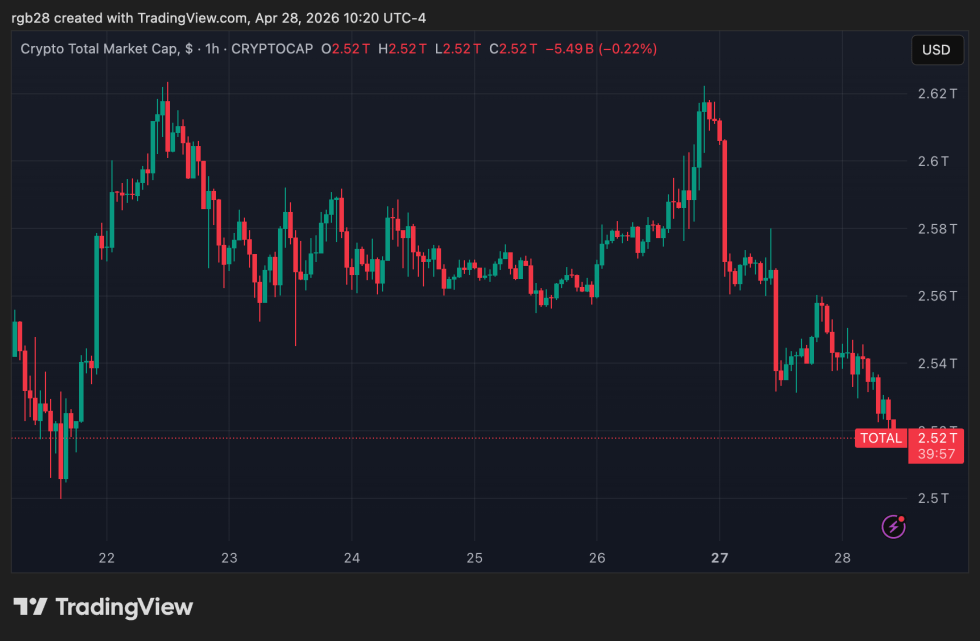
The total crypto market capitalization is at $2.52 trillion in the one-week chart. Source: TOTAL on TradingView