The Networking Game in Silicon Valley's Elite Circles: Those with Connections Get $50 Million, While the Truly Talented Can't Raise Money?

marsbitPublicado em 2026-07-10Última atualização em 2026-07-10

Resumo

"Silicon Valley's Meritocracy to Relationship Game: How Networks Now Trump Talent." The article argues that Silicon Valley has shifted from a meritocracy to a "kingmaker" system where connections and background outweigh true ability. Key factors driving this change include: 1. **AI-Distorted Expectations:** Unprecedented growth curves (e.g., Anthropic) have led VCs to seek only "sure things" or pattern-match against past successes. 2. **Capital Concentration:** LP funds are concentrated in a few large, multi-stage funds, pushing VCs to overpay for hot deals to secure capital. 3. **VC Professionalization:** The industry has become a standardized career path, attracting conformist "NPCs" rather than independent thinkers. The long IPO timeline incentivizes safe, consensus bets for career advancement over risky, fund-returning outliers. This consensus capital fuels consensus founders. Startups are now a standard career option, with accelerators pressuring uniform ideas (e.g., 81% AI). Founders from elite schools (Stanford, OpenAI) easily raise millions based on pedigree, not proof. Large funds preemptively back "centrally cast" teams with $10-50M war chests to dominate categories, sidelining outsiders. The "kingmaker" strategy has downstream effects: it encourages aggressive, sometimes fraudulent, revenue reporting and allows founders to sell significant secondary shares early, attracting grifters. The author predicts a mean reversion. History shows the hottest trends rare...

Author: Shower Thoughts

Compilation: Deep Chao TechFlow

Deep Chao Guide: Silicon Valley is shifting from meritocracy to connections-based favoritism. Founders with Stanford backgrounds raise funds effortlessly, VCs preemptively invest $50 million in 'centrally cast' teams to create hype, while truly capable outsiders struggle to raise capital. This approach may work short-term, but ultimately, it will lose to the underestimated outliers—those who follow the herd are waiting to be slaughtered.

Peter Thiel often asks variations of this question: "In a given environment, what is it that you cannot say?" In the evangelical-dominated South, it's dangerous to be gay or liberal. On university campuses, it's dangerous to be conservative.

In Silicon Valley, the unassailable dogma is meritocracy.

Silicon Valley has long prided itself on meritocracy. Outsiders with no background or connections could emerge, build generational companies, and be rewarded for it. The industry has always been proud of being 2,851 miles away from Washington D.C.—a place notorious for getting things done through lobbying and insider connections.

Today, success in Silicon Valley depends on who you know and how willing they are to prop you up.

This is no different from how any other old-money industry operates. In East Coast high finance, you need the right elite school. In British politics, you need the right family surname.

How did Silicon Valley go from meritocracy to king-making?

Consensus Groupthink

It's no secret that Silicon Valley thinking has become extremely consensus-driven in recent years. This is mainly due to 1) AI distorting growth expectations, 2) LP capital concentration, and 3) the professionalization of the venture capital industry.

First, AI has completely distorted expectations for revenue growth. For the first time in history, we're seeing startups go from $0 to $100 million ARR in one to two years. Compared to the SaaS era, sustained three-year growth would get your company to an IPO. Even more extreme is growth on the scale of Anthropic—from $9 billion ARR in December 2025 to $47 billion ARR by May 2026 (adding up the annual revenues of Palantir, Snowflake, and CoreWeave along the way), which is unprecedented.

Well-known VCs now say never invest in diamonds in the rough. Either wait for an inflection point and try to get into the hottest companies, or try to pattern-match past successes and back a new company early. The former is the right strategy for growth-stage investing; the latter is a mistake. I'll explain why later and how this affects founders.

Second, LP capital has concentrated into the hands of a few established multi-stage franchise funds. In the first half of last year, 12 VCs took 50% of all LP capital. This is largely a reaction to over-allocation to the venture asset class in 2021-2022 and a flight to "quality" brand names that institutional allocators don't have to risk their careers defending in IC meetings. Family office LPs, in particular, are especially keen on getting into hot Silicon Valley companies, regardless of valuation. If a VC fund must pay a high price for a tiny stake in a hot company to secure LP capital, then so be it.

Third, the culture of the VC industry has shifted from a boutique craft to a mature career path. Over a decade ago, venture capital was a craft. Like a medieval guild, VCs followed an apprenticeship model, where seasoned GPs trained young junior VCs to develop the taste for judging founder quality and the feel for market timing.

Over time, the VC industry has professionalized into another standard career path. Previously, it was 2 years of investment banking → 2 years of business school → private equity. Now it's 2 years at a big tech company → 2 years at a high-growth startup → venture capital. Once there's a standard career path, it attracts excellent sheep NPCs who follow the herd, rather than the intensely independent thinkers the industry relies on to make contrarian bets.

Given that IPO timelines are longer than ever, thus extending feedback cycles, getting into hot companies (not necessarily the best companies!) is a better strategy for promotion within a VC firm. Mid-level VCs would rather quickly and easily get markups from safe consensus bets than risk betting on a potential fund returner. Large VC firms also have higher turnover than ever, so they might not even be at the firm in a few years to get carry on that fund-returning deal.

Consensus Money Attracts Consensus Founders

One would think the typical startup founder is an intensely non-conformist rebel, carving their own path in the world, who doesn't care at all what the establishment thinks. These founders are often polarizing to their peers, ignore their boss's instructions, and would be fired from structured corporate jobs. But that's less the case now.

Starting a company is becoming a more standard career option, no different from big tech or consulting. A contributing factor is the high unemployment rate for new college graduates looking for entry-level white-collar jobs, which are shrinking due to AI. Instead of struggling in the job search, apply to a startup accelerator, treat it like an internship program, burn through $500k, have fun, and figure out adult life.

The Stanford Review once wrote that YC is for cowards. With YC increasing from 2 batches a year to 4 (about 800 startups per year!), plus the explosion in the number of other accelerator programs, it's no surprise that the typical startup founder has become more uniform and less an unorthodox outlier.

Accelerators pressure startups to be legible to VCs by demo day, so startups naturally wandering through the idea maze trying to find product-market fit tend to build in the most obvious, crowded categories that already work. 81% of the current YC batch are doing AI for XYZ. Crypto startups are building new banks for stablecoins in XYZ region or prediction markets for XYZ niche. Consensus VCs fund these consensus ideas because they feel safe and familiar, easily pattern-matching to what already works. But the truth is the best companies define new categories and start years before that category is obvious or even has a name.

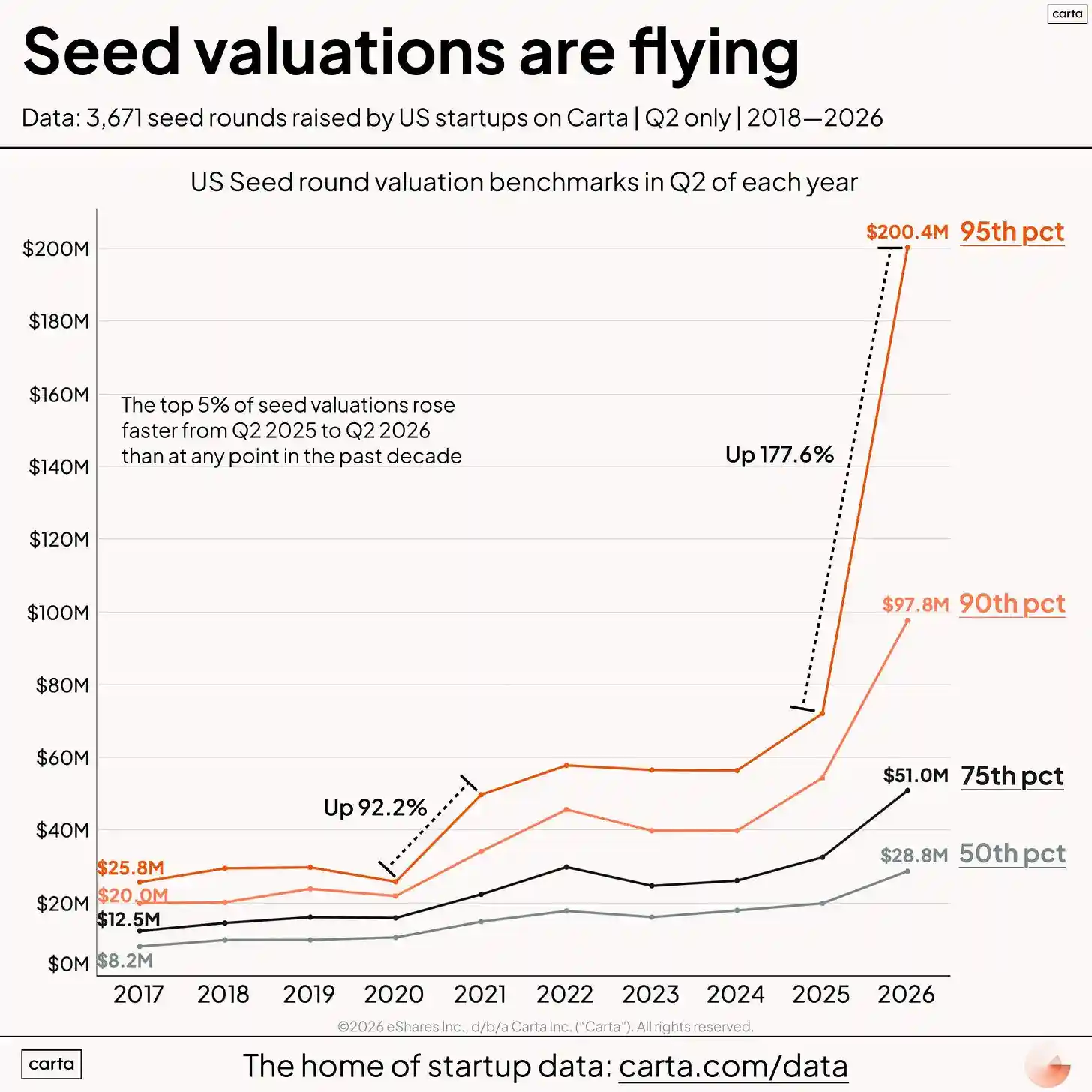
For founders not going through accelerators, a good background is more important than ever. Anyone who went to Stanford can raise money. Anyone spinning out of OpenAI can raise money. Check size and valuation are a function of how good the pedigree is and how well-connected the founder is within VC circles.

Beyond that, large multi-stage funds are giving a set of centrally cast characters (i.e., those with the best pedigrees) war chests of $10 million to $50 million to crown a category before their company has traction, making it hard for others who aren't centrally cast to win those markets.

So now it's not "Can you build a great business?" but "Can you fit the mold that large VC firms want to fund?"

An insular inner circle of soul-less individuals—those with background and connections getting preferential treatment—goes against the meritocratic idea that any skilled, hardworking entrepreneur can win. Meritocracy historically gave Silicon Valley its halo, the only place in America where the American Dream still exists and works. Today, Silicon Valley is becoming more like Wall Street or K Street.

Founders outside the network now feel they have to play "the game" to become one of the centrally cast. This means schmoozing with VC associates at happy hours and dinners, acting slightly autistic to create FOMO and fundraising momentum. Normally, founders networking with VCs is a waste of time; they should be focused on building the company and talking to customers. Now it's all part of the game, an extra skill founders must cultivate.

Downstream Effects of King-Making

To be fair, king-making does work to some extent. Raising massive capital gives you a huge war chest to acquire customers at a loss (i.e., unprofitably until your competitors go bankrupt or pivot). It scares other teams away from entering your market.

However, king-making also creates moral hazard for bad behavior. Companies get ~creative~ in reporting revenue, and founders sell secondary shares early.

King-making pressures companies to show revenue growth at all costs to be legible to VCs. This leads some companies to outright fabricate revenue (securities fraud) or get creative with methodologies. One example is taking a one-off contract and annualizing it into ARR. These contracts are often just pilot pricing with exit clauses, so they are ironically neither "annual," "recurring," nor even "revenue." Another example is rebranding ARR from "annual recurring revenue" to "annual run rate" and calculating ARR as last week's revenue × 52 or even last day's revenue × 365. This isn't exactly securities fraud, but it doesn't look good to anyone doing diligence.

VCs trying to king-make a competitive round often allow founders to sell secondary shares to win the deal. Apparently, 10% of a hot company's round going to founder secondary shares is now common practice. The downstream effect of founder secondary shares is that it attracts scammers. Those who can play the "game" described earlier well to create VC FOMO for a Series A and use it to sell millions in founder secondary shares (often more than the company's lifetime revenue) and then slowly rug.

Mean Reversion

The pendulum has swung too far toward consensus today, and I bet there will be a mean reversion toward contrarian thinking.

History repeatedly shows that the hottest theme in any given year is not the category of the most valuable company founded that year. I have no reason to believe this time will be different.

I'd rather back outsiders with chips on their shoulders 24/7 than insiders prematurely crowned by VCs. I believe there's a huge blind spot outside the Silicon Valley groupthink bubble—great founders without backgrounds, outside the distribution, illegible to most VCs.

I'm optimistic that meritocracy will ultimately win, and those chasing momentum playing the king-making game will be left licking their wounds.

Those who follow the herd are waiting to be slaughtered.
Criptomoedas em alta

Perguntas relacionadas

QAccording to the article, how has Silicon Valley's principle of meritocracy transformed in recent years?

AThe article argues that Silicon Valley has transformed from a meritocracy, where success was based on talent and hard work, into a 'kingmaking game' where results depend heavily on who you know and your background, such as attending elite schools like Stanford or having connections to firms like OpenAI. It compares this new dynamic to the relationship-driven cultures of Wall Street and Washington D.C.

QWhat are the three main factors the author cites for the shift towards consensus thinking in Silicon Valley venture capital?

AThe author cites three main factors: 1) AI has distorted growth expectations, making VCs chase only proven 'inflection points' or pattern-match to past successes. 2) LP capital has concentrated into a few large, established multi-stage franchise funds, which drives investments into high-profile 'safe' deals. 3) The VC industry has professionalized into a standard career path, attracting conformist 'NPCs' rather than independent thinkers, and internal promotion incentives favor safe consensus bets over risky, potentially high-return outliers.

QWhat negative downstream effects does the 'kingmaking' approach to funding have on startup behavior, as described in the article?

AThe 'kingmaking' approach creates moral hazard and encourages bad behavior. It pressures companies to show explosive growth at all costs, leading to creative or fraudulent revenue reporting (e.g., annualizing one-time pilot contracts, redefining ARR as 'annual run rate' based on a single day's revenue). It also attracts founders who are good at the 'game' of creating VC FOMO, allowing them to sell large secondary shares early and potentially 'rug' or abandon the project slowly after cashing out.

QHow has the profile of a typical startup founder changed, according to the author's analysis?

AThe author argues the typical founder is no longer a rebellious, non-conformist outlier. Startups have become a standard career option, akin to big tech or consulting, especially for graduates facing high unemployment. The proliferation of accelerators (like YC expanding batches) pressures founders to work on easily understood, consensus ideas (e.g., 'AI for XYZ'), creating more uniform founders. Success now often depends on fitting the mold of what large VC firms want to fund—having a prestigious background and networking skills—rather than purely on building a great business.

QWhat is the author's final prediction regarding the current trend of consensus and kingmaking in Silicon Valley investment?

AThe author predicts a mean reversion towards contrarian thinking. They argue that history shows the hottest trends in a given year do not produce its most valuable companies. They express a belief that meritocracy will ultimately win, and that great founders exist as 'outliers' outside the Silicon Valley groupthink bubble. The final line is a warning: 'Those who chase momentum, get ready to be slaughtered.'

Leituras Relacionadas

Top 8 DEXs of July 2026

This article presents the top 8 decentralized exchanges (DEXs) for July 2026, highlighting their key features and evolution within the DeFi space. DEXs, which enable peer-to-peer cryptocurrency trading via smart contracts without intermediaries, are praised for offering users greater control, privacy, transparency, and global access compared to centralized platforms. The listed DEXs are: 1. **Shadow Exchange**: A Sonic-native DEX specializing in concentrated liquidity for efficient trading and reduced slippage. 2. **Uniswap**: A leading protocol using an Automated Market Maker (AMM) model across multiple blockchains. 3. **SushiSwap**: An evolved platform offering token swaps, yield farming, and governance via its SUSHI token across 40+ networks. 4. **Orca**: A user-friendly AMM on Solana featuring capital-efficient "Whirlpools" for concentrated liquidity. 5. **Meteora**: A Solana-based DEX focusing on dynamic liquidity infrastructure and vaults for advanced strategies. 6. **Raydium**: A hybrid exchange on Solana combining AMM pools with a central limit order book for deep liquidity. 7. **Hyperliquid**: A Layer 1 blockchain hosting a non-custodial perpetual futures exchange using an on-chain order book. 8. **PancakeSwap**: A multi-chain AMM hub originating on BNB Chain, now supporting thousands of trading pairs across several networks. The article concludes by noting the significant role of DEXs in crypto, their expansion beyond simple swaps into areas like derivatives and cross-chain interoperability, and advises users to conduct their own research before engaging with any platform.

ambcryptoHá 1m

Top 8 DEXs of July 2026

ambcryptoHá 1m

USDT Market Cap Approaches Ethereum's: What Signal Does This Convey?

The market capitalization of USDT has nearly reached that of Ethereum, making it the second-largest cryptocurrency after Bitcoin. This prompts an examination of what this signifies and what it does not. Firstly, this does not relate to economic security. Unlike some Web3 systems where a governance token's value must underpin the security of its applications (e.g., oracles), USDT's stability is not backed by the value of the underlying blockchains it operates on. Tether, the issuer, controls the assets, and can freeze, reissue, or abandon tokens on a compromised chain. While stablecoins require functional blockchains, a chain's native token market cap does not provide direct security for the stablecoin. Secondly, USDT's growth does not inherently reflect poorly on Ethereum. USDT is a dollar-pegged store of value, while ETH represents a claim on future Ethereum network revenue. Their valuations are driven by different factors. USDT's rising market cap simply indicates strong demand for stablecoin utility, independent of Ethereum's technological merits or competitive position. The core insight is the overwhelming market demand for permissionless dollar transfers. This is the most established and essential use case in crypto. It requires minimal technological sophistication—essentially just a trusted issuer's promise of redemption on a functional chain. This explains why stablecoin supply has grown exponentially while the combined market cap of major non-stablecoin cryptocurrencies like Bitcoin, Ethereum, and others has stagnated for years. Users primarily seek accessible dollar-denominated assets. They largely disregard the issuer's credibility (as seen with Tether's dominance over more credible alternatives like USDC or BlackRock's BUIDL) and are indifferent to the governance or decentralization of the underlying blockchain. As long as a stablecoin is widely accepted and easy to transfer, users will adopt it across any chain. The trend suggests that the market for permissionless stablecoins could continue to expand far beyond the total value of the smart contract platforms that host them, driven by this singular, powerful use case.

Foresight NewsHá 18m

USDT Market Cap Approaches Ethereum's: What Signal Does This Convey?

Foresight NewsHá 18m

Crypto 美股观察:CRCL、HOOD、COIN 与 MSTR,最近在交易什么?

Recent weeks have seen significant developments for four key US-listed crypto-related stocks—Circle (CRCL), Robinhood (HOOD), Coinbase (COIN), and MicroStrategy (MSTR)—with their core investment theses diverging. For **Circle (CRCL)**, its stock price is increasingly realigning with the fundamental driver of **USDC circulation**. After IPO exuberance faded, CRCL's performance now correlates closely with changes in USDC supply, which is heavily influenced by DeFi activity and risk appetite. The recent contraction in USDC, linked to events like the KelpDAO incident, has pressured the stock. A sustainable recovery signal for CRCL would require a confluence of recovering DeFi TVL, stablecoin demand, and consecutive weeks of USDC net issuance. **Robinhood (HOOD)** gained market attention with the launch of its **Robinhood Chain**, an Ethereum L2. While not an immediate threat to Coinbase's dominant Base network in terms of scale or developer ecosystem, it represents a strategic encroachment. Robinhood's path—leveraging its traditional retail brokerage user base and assets to build a chain-based financial system—challenges Coinbase's narrative as the sole listed company integrating crypto-native infrastructure with traditional finance. This could dilute COIN's long-term scarcity premium. **MicroStrategy (MSTR)** made a notable shift by **selling Bitcoin** for the first time in a meaningful way (3,588 BTC), breaking its long-standing "buy-only" posture. The sales, used to fund dividends and replenish USD reserves, signal a move towards active capital management. While not indicative of a bearish turn on Bitcoin, it introduces new complexity for MSTR investors. The stock must now be evaluated not just as a leveraged Bitcoin proxy, but also considering fixed cash obligations from preferred dividends and debt, alongside its capital allocation strategy between holding BTC and maintaining liquidity. In summary, the investment narratives for these stocks are evolving beyond simple crypto market beta. Key variables now include stablecoin fundamentals, competition in chain-based financial ecosystems, and the balance between asset accumulation and corporate capital structure management.

marsbitHá 30m

Crypto 美股观察:CRCL、HOOD、COIN 与 MSTR,最近在交易什么?

marsbitHá 30m

Trading

Spot

Artigos em Destaque

O que é $S$

Compreender o SPERO: Uma Visão Abrangente Introdução ao SPERO À medida que o panorama da inovação continua a evoluir, o surgimento de tecnologias web3 e projetos de criptomoeda desempenha um papel fundamental na formação do futuro digital. Um projeto que tem atraído atenção neste campo dinâmico é o SPERO, denotado como SPERO,$$s$. Este artigo tem como objetivo reunir e apresentar informações detalhadas sobre o SPERO, para ajudar entusiastas e investidores a compreender as suas bases, objetivos e inovações nos domínios web3 e cripto. O que é o SPERO,$$s$? O SPERO,$$s$ é um projeto único dentro do espaço cripto que procura aproveitar os princípios da descentralização e da tecnologia blockchain para criar um ecossistema que promove o envolvimento, a utilidade e a inclusão financeira. O projeto é concebido para facilitar interações peer-to-peer de novas maneiras, proporcionando aos utilizadores soluções e serviços financeiros inovadores. No seu núcleo, o SPERO,$$s$ visa capacitar indivíduos ao fornecer ferramentas e plataformas que melhoram a experiência do utilizador no espaço das criptomoedas. Isso inclui a possibilidade de métodos de transação mais flexíveis, a promoção de iniciativas impulsionadas pela comunidade e a criação de caminhos para oportunidades financeiras através de aplicações descentralizadas (dApps). A visão subjacente do SPERO,$$s$ gira em torno da inclusão, visando fechar lacunas dentro das finanças tradicionais enquanto aproveita os benefícios da tecnologia blockchain. Quem é o Criador do SPERO,$$s$? A identidade do criador do SPERO,$$s$ permanece algo obscura, uma vez que existem recursos publicamente disponíveis limitados que fornecem informações detalhadas sobre o(s) seu(s) fundador(es). Esta falta de transparência pode resultar do compromisso do projeto com a descentralização—uma ética que muitos projetos web3 partilham, priorizando contribuições coletivas em vez de reconhecimento individual. Ao centrar as discussões em torno da comunidade e dos seus objetivos coletivos, o SPERO,$$s$ incorpora a essência do empoderamento sem destacar indivíduos específicos. Assim, compreender a ética e a missão do SPERO é mais importante do que identificar um criador singular. Quem são os Investidores do SPERO,$$s$? O SPERO,$$s$ é apoiado por uma diversidade de investidores que vão desde capitalistas de risco a investidores-anjo dedicados a promover a inovação no setor cripto. O foco desses investidores geralmente alinha-se com a missão do SPERO—priorizando projetos que prometem avanço tecnológico social, inclusão financeira e governança descentralizada. Essas fundações de investidores estão tipicamente interessadas em projetos que não apenas oferecem produtos inovadores, mas que também contribuem positivamente para a comunidade blockchain e os seus ecossistemas. O apoio desses investidores reforça o SPERO,$$s$ como um concorrente notável no domínio em rápida evolução dos projetos cripto. Como Funciona o SPERO,$$s$? O SPERO,$$s$ emprega uma estrutura multifacetada que o distingue de projetos de criptomoeda convencionais. Aqui estão algumas das características-chave que sublinham a sua singularidade e inovação: Governança Descentralizada: O SPERO,$$s$ integra modelos de governança descentralizada, capacitando os utilizadores a participar ativamente nos processos de tomada de decisão sobre o futuro do projeto. Esta abordagem promove um sentido de propriedade e responsabilidade entre os membros da comunidade. Utilidade do Token: O SPERO,$$s$ utiliza o seu próprio token de criptomoeda, concebido para servir várias funções dentro do ecossistema. Esses tokens permitem transações, recompensas e a facilitação de serviços oferecidos na plataforma, melhorando o envolvimento e a utilidade gerais. Arquitetura em Camadas: A arquitetura técnica do SPERO,$$s$ suporta modularidade e escalabilidade, permitindo a integração contínua de funcionalidades e aplicações adicionais à medida que o projeto evolui. Esta adaptabilidade é fundamental para manter a relevância no panorama cripto em constante mudança. Envolvimento da Comunidade: O projeto enfatiza iniciativas impulsionadas pela comunidade, empregando mecanismos que incentivam a colaboração e o feedback. Ao nutrir uma comunidade forte, o SPERO,$$s$ pode melhor atender às necessidades dos utilizadores e adaptar-se às tendências do mercado. Foco na Inclusão: Ao oferecer taxas de transação baixas e interfaces amigáveis, o SPERO,$$s$ visa atrair uma base de utilizadores diversificada, incluindo indivíduos que anteriormente podem não ter participado no espaço cripto. Este compromisso com a inclusão alinha-se com a sua missão abrangente de empoderamento através da acessibilidade. Cronologia do SPERO,$$s$ Compreender a história de um projeto fornece insights cruciais sobre a sua trajetória de desenvolvimento e marcos. Abaixo está uma cronologia sugerida que mapeia eventos significativos na evolução do SPERO,$$s$: Fase de Conceituação e Ideação: As ideias iniciais que formam a base do SPERO,$$s$ foram concebidas, alinhando-se de perto com os princípios de descentralização e foco na comunidade dentro da indústria blockchain. Lançamento do Whitepaper do Projeto: Após a fase conceitual, um whitepaper abrangente detalhando a visão, os objetivos e a infraestrutura tecnológica do SPERO,$$s$ foi lançado para atrair o interesse e o feedback da comunidade. Construção da Comunidade e Primeiros Envolvimentos: Esforços ativos de divulgação foram feitos para construir uma comunidade de primeiros adotantes e investidores potenciais, facilitando discussões em torno dos objetivos do projeto e angariando apoio. Evento de Geração de Tokens: O SPERO,$$s$ realizou um evento de geração de tokens (TGE) para distribuir os seus tokens nativos a apoiantes iniciais e estabelecer liquidez inicial dentro do ecossistema. Lançamento da dApp Inicial: A primeira aplicação descentralizada (dApp) associada ao SPERO,$$s$ foi lançada, permitindo que os utilizadores interagissem com as funcionalidades principais da plataforma. Desenvolvimento Contínuo e Parcerias: Atualizações e melhorias contínuas nas ofertas do projeto, incluindo parcerias estratégicas com outros players no espaço blockchain, moldaram o SPERO,$$s$ em um jogador competitivo e em evolução no mercado cripto. Conclusão O SPERO,$$s$ é um testemunho do potencial do web3 e das criptomoedas para revolucionar os sistemas financeiros e capacitar indivíduos. Com um compromisso com a governança descentralizada, o envolvimento da comunidade e funcionalidades inovadoras, abre caminho para um panorama financeiro mais inclusivo. Como em qualquer investimento no espaço cripto em rápida evolução, potenciais investidores e utilizadores são incentivados a pesquisar minuciosamente e a envolver-se de forma ponderada com os desenvolvimentos em curso dentro do SPERO,$$s$. O projeto demonstra o espírito inovador da indústria cripto, convidando a uma exploração mais aprofundada das suas inúmeras possibilidades. Embora a jornada do SPERO,$$s$ ainda esteja a desenrolar-se, os seus princípios fundamentais podem, de facto, influenciar o futuro de como interagimos com a tecnologia, as finanças e uns com os outros em ecossistemas digitais interconectados.

86 Visualizações TotaisPublicado em {updateTime}Atualizado em 2024.12.17

O que é $S$

O que é AGENT S

Agent S: O Futuro da Interação Autónoma no Web3 Introdução No panorama em constante evolução do Web3 e das criptomoedas, as inovações estão constantemente a redefinir a forma como os indivíduos interagem com plataformas digitais. Um projeto pioneiro, o Agent S, promete revolucionar a interação humano-computador através do seu framework aberto e agente. Ao abrir caminho para interações autónomas, o Agent S visa simplificar tarefas complexas, oferecendo aplicações transformadoras em inteligência artificial (IA). Esta exploração detalhada irá aprofundar-se nas complexidades do projeto, nas suas características únicas e nas implicações para o domínio das criptomoedas. O que é o Agent S? O Agent S é um framework aberto e agente, especificamente concebido para abordar três desafios fundamentais na automação de tarefas computacionais: Aquisição de Conhecimento Específico de Domínio: O framework aprende inteligentemente a partir de várias fontes de conhecimento externas e experiências internas. Esta abordagem dupla capacita-o a construir um rico repositório de conhecimento específico de domínio, melhorando o seu desempenho na execução de tarefas. Planeamento ao Longo de Longos Horizontes de Tarefas: O Agent S emprega planeamento hierárquico aumentado por experiência, uma abordagem estratégica que facilita a decomposição e execução eficientes de tarefas intrincadas. Esta característica melhora significativamente a sua capacidade de gerir múltiplas subtarefas de forma eficiente e eficaz. Gestão de Interfaces Dinâmicas e Não Uniformes: O projeto introduz a Interface Agente-Computador (ACI), uma solução inovadora que melhora a interação entre agentes e utilizadores. Utilizando Modelos de Linguagem Multimodais de Grande Escala (MLLMs), o Agent S pode navegar e manipular diversas interfaces gráficas de utilizador de forma fluida. Através destas características pioneiras, o Agent S fornece um framework robusto que aborda as complexidades envolvidas na automação da interação humana com máquinas, preparando o terreno para uma infinidade de aplicações em IA e além. Quem é o Criador do Agent S? Embora o conceito de Agent S seja fundamentalmente inovador, informações específicas sobre o seu criador permanecem elusivas. O criador é atualmente desconhecido, o que destaca ou o estágio nascente do projeto ou a escolha estratégica de manter os membros fundadores em anonimato. Independentemente da anonimidade, o foco permanece nas capacidades e no potencial do framework. Quem são os Investidores do Agent S? Como o Agent S é relativamente novo no ecossistema criptográfico, informações detalhadas sobre os seus investidores e financiadores não estão explicitamente documentadas. A falta de informações disponíveis publicamente sobre as fundações de investimento ou organizações que apoiam o projeto levanta questões sobre a sua estrutura de financiamento e roteiro de desenvolvimento. Compreender o apoio é crucial para avaliar a sustentabilidade do projeto e o seu impacto potencial no mercado. Como Funciona o Agent S? No núcleo do Agent S reside uma tecnologia de ponta que lhe permite funcionar eficazmente em diversos ambientes. O seu modelo operacional é construído em torno de várias características-chave: Interação Humano-Computador Semelhante: O framework oferece planeamento avançado em IA, esforçando-se para tornar as interações com computadores mais intuitivas. Ao imitar o comportamento humano na execução de tarefas, promete elevar as experiências dos utilizadores. Memória Narrativa: Utilizada para aproveitar experiências de alto nível, o Agent S utiliza memória narrativa para acompanhar os históricos de tarefas, melhorando assim os seus processos de tomada de decisão. Memória Episódica: Esta característica fornece aos utilizadores orientações passo a passo, permitindo que o framework ofereça suporte contextual à medida que as tarefas se desenrolam. Suporte para OpenACI: Com a capacidade de funcionar localmente, o Agent S permite que os utilizadores mantenham o controlo sobre as suas interações e fluxos de trabalho, alinhando-se com a ética descentralizada do Web3. Fácil Integração com APIs Externas: A sua versatilidade e compatibilidade com várias plataformas de IA garantem que o Agent S possa integrar-se perfeitamente em ecossistemas tecnológicos existentes, tornando-o uma escolha apelativa para desenvolvedores e organizações. Estas funcionalidades contribuem coletivamente para a posição única do Agent S no espaço cripto, à medida que automatiza tarefas complexas e em múltiplos passos com mínima intervenção humana. À medida que o projeto evolui, as suas potenciais aplicações no Web3 podem redefinir a forma como as interações digitais se desenrolam. Cronologia do Agent S O desenvolvimento e os marcos do Agent S podem ser encapsulados numa cronologia que destaca os seus eventos significativos: 27 de Setembro de 2024: O conceito de Agent S foi lançado num artigo de pesquisa abrangente intitulado “Um Framework Agente Aberto que Usa Computadores como um Humano”, mostrando a base para o projeto. 10 de Outubro de 2024: O artigo de pesquisa foi disponibilizado publicamente no arXiv, oferecendo uma exploração aprofundada do framework e da sua avaliação de desempenho com base no benchmark OSWorld. 12 de Outubro de 2024: Uma apresentação em vídeo foi lançada, proporcionando uma visão visual das capacidades e características do Agent S, envolvendo ainda mais potenciais utilizadores e investidores. Estes marcos na cronologia não apenas ilustram o progresso do Agent S, mas também indicam o seu compromisso com a transparência e o envolvimento da comunidade. Pontos-Chave Sobre o Agent S À medida que o framework Agent S continua a evoluir, várias características-chave destacam-se, sublinhando a sua natureza inovadora e potencial: Framework Inovador: Concebido para proporcionar um uso intuitivo de computadores semelhante à interação humana, o Agent S traz uma abordagem nova à automação de tarefas. Interação Autónoma: A capacidade de interagir autonomamente com computadores através de GUI significa um avanço em direção a soluções computacionais mais inteligentes e eficientes. Automação de Tarefas Complexas: Com a sua metodologia robusta, pode automatizar tarefas complexas e em múltiplos passos, tornando os processos mais rápidos e menos propensos a erros. Melhoria Contínua: Os mecanismos de aprendizagem permitem que o Agent S melhore a partir de experiências passadas, aprimorando continuamente o seu desempenho e eficácia. Versatilidade: A sua adaptabilidade em diferentes ambientes operacionais, como OSWorld e WindowsAgentArena, garante que pode servir uma ampla gama de aplicações. À medida que o Agent S se posiciona no panorama do Web3 e das criptomoedas, o seu potencial para melhorar as capacidades de interação e automatizar processos significa um avanço significativo nas tecnologias de IA. Através do seu framework inovador, o Agent S exemplifica o futuro das interações digitais, prometendo uma experiência mais fluida e eficiente para os utilizadores em diversas indústrias. Conclusão O Agent S representa um ousado avanço na união da IA e do Web3, com a capacidade de redefinir a forma como interagimos com a tecnologia. Embora ainda esteja nas suas fases iniciais, as possibilidades para a sua aplicação são vastas e cativantes. Através do seu framework abrangente que aborda desafios críticos, o Agent S visa trazer interações autónomas para o primeiro plano da experiência digital. À medida que avançamos mais profundamente nos domínios das criptomoedas e da descentralização, projetos como o Agent S desempenharão, sem dúvida, um papel crucial na formação do futuro da tecnologia e da colaboração humano-computador.

700 Visualizações TotaisPublicado em {updateTime}Atualizado em 2025.01.14

O que é AGENT S

Como comprar S

Bem-vindo à HTX.com!Tornámos a compra de Sonic (S) simples e conveniente.Segue o nosso guia passo a passo para iniciar a tua jornada no mundo das criptos.Passo 1: cria a tua conta HTXUtiliza o teu e-mail ou número de telefone para te inscreveres numa conta gratuita na HTX.Desfruta de um processo de inscrição sem complicações e desbloqueia todas as funcionalidades.Obter a minha contaPasso 2: vai para Comprar Cripto e escolhe o teu método de pagamentoCartão de crédito/débito: usa o teu visa ou mastercard para comprar Sonic (S) instantaneamente.Saldo: usa os fundos da tua conta HTX para transacionar sem problemas.Terceiros: adicionamos métodos de pagamento populares, como Google Pay e Apple Pay, para aumentar a conveniência.P2P: transaciona diretamente com outros utilizadores na HTX.Mercado de balcão (OTC): oferecemos serviços personalizados e taxas de câmbio competitivas para os traders.Passo 3: armazena teu Sonic (S)Depois de comprar o teu Sonic (S), armazena-o na tua conta HTX.Alternativamente, podes enviá-lo para outro lugar através de transferência blockchain ou usá-lo para transacionar outras criptomoedas.Passo 4: transaciona Sonic (S)Transaciona facilmente Sonic (S) no mercado à vista da HTX.Acede simplesmente à tua conta, seleciona o teu par de trading, executa as tuas transações e monitoriza em tempo real.Oferecemos uma experiência de fácil utilização tanto para principiantes como para traders experientes.

1.3k Visualizações TotaisPublicado em {updateTime}Atualizado em 2026.06.02

Como comprar S

Discussões

Bem-vindo à Comunidade HTX. Aqui, pode manter-se informado sobre os mais recentes desenvolvimentos da plataforma e obter acesso a análises profissionais de mercado. As opiniões dos utilizadores sobre o preço de S (S) são apresentadas abaixo.

活动图片