Senator Elizabeth Warren slams CLARITY Act as a ‘ticket to sanctions evasion’

ambcryptoPublicado em 2026-07-10Última atualização em 2026-07-10

Resumo

Democratic Senator Elizabeth Warren strongly opposes the CLARITY Act, a broad crypto market bill, calling it a "ticket to sanctions evasion." She echoes concerns from former U.S. National Security Council official Richard Nephew, who warns the bill's exemptions for decentralized finance (DeFi) and weaker anti-money laundering rules could enable terrorists, sanctions evaders, and other illicit actors. The banking lobby also opposes the bill, citing illicit finance risks. White House Crypto Advisor Patrick Witt dismissed Warren's concerns, referencing a political setback in Maine. The bill faces a challenging path in the Senate, needing 60 votes to pass. While some Democrats support provisions protecting software developers, others vow to withhold support unless ethics concerns are addressed. With a shrinking legislative calendar, the bill's odds of passage have dropped to 45%. The crypto industry fears failure to pass it before the August recess could delay major regulatory clarity until the 2030s.

Democratic Senator Elizabeth Warren has maintained her strong opposition to the broader crypto market bill, the CLARITY Act. Amid increasing uncertainty about the bill’s path and the industry’s push for a Senate floor vote, Sen. Warren said,

As currently drafted, the CLARITY Act is a ticket to sanctions evasion.

She was echoing concerns raised by Richard Nephew, a former special envoy for Iran and director for Iran at the U.S National Security Council (NSC). Nephew called out the Senate for pushing the CLARITY Act with broader exemption for DeFi and weak anti-money laundering (AML) requirements.

For him, the recent freezing of over $1B of Iranian crypto by the U.S Treasury would be impossible with DeFi legal exemptions proposed in the bill. He added,

The bill would leave parts of the crypto ecosystem vulnerable to exploitation by terrorists, sanctions evaders, fraudsters, and other illicit actors under the guise of technological neutrality.

Here, it’s worth pointing out that the banking lobby is also against the bill. Initially, the lobby pushed against the legislation because of stablecoin yield. However, its recent opposition has increasingly been framed using the ‘illicit finance’ narrative.

White House downplays Sen. Warren’s concerns

In response to Sen. Warren, White House’s Chief Crypto Advisor Patrick Witt directed a jab at the lawmaker. He commented,

I wonder how heavily your colleagues will weigh your advice on crypto legislation after the train wreck you just orchestrated in Maine.

His jab was aimed at discrediting Sen. Warren’s judgment and endorsing Graham Platner for the Maine Senate race. Platner recently stepped down from the race after an alleged sexual scandal.

However, deflective politics won’t wish away some of the key issues that have been raised over the bill, like ethics. Especially after President Donald Trump’s massive $1.4B crypto profits.

Besides, if all 53 Republicans support the bill on the floor vote, they will still need seven Democrats to hit the 60-vote threshold to pass it.

Interestingly, a section of pro-crypto Democrats have vowed to withhold support if the ethics aren’t addressed.

Surprisingly, Section 604 (so-called DeFi exemptions) has seen support from some Democrats like Sen. Ron Wyden. For Wyden, who co-sponsored the Section 604 alongside Sen. Cynthia Lummis, the provision will allow the DoJ to pursue illicit actors while protecting developers of non-custodial software. In fact, some law enforcement groups are now supporting the provision after recent talks.

That said, with a shrinking Senate Calendar, the odds of the bill’s passage have dropped to 45%.

Overall, the industry is concerned that failure to pass the bill before the August recess could push another window to the 2030s.
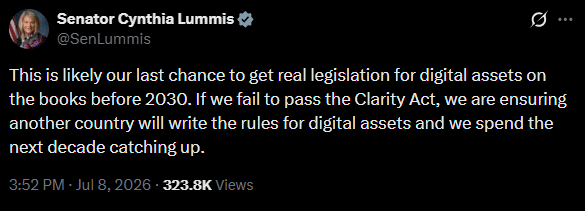
Source: X

Final Summary

  • Sen. Warren believes the crypto market structure bill, as drafted, would facilitate ‘sanctions evasion’
  • The industry fears that another chance for creating bipartisan crypto rules could be postponed to the 2030s.


Perguntas relacionadas

QWhat is the CLARITY Act according to Senator Elizabeth Warren, and what is her main criticism of it?

AAccording to Senator Elizabeth Warren, the CLARITY Act, as currently drafted, is a 'ticket to sanctions evasion.' Her main criticism is that the bill, with its broader exemptions for DeFi and weak anti-money laundering (AML) requirements, would leave parts of the crypto ecosystem vulnerable to exploitation by terrorists, sanctions evaders, and other illicit actors.

QWho echoed Senator Warren's concerns regarding the CLARITY Act, and what specific example did they provide?

ARichard Nephew, a former special envoy for Iran and director for Iran at the U.S National Security Council (NSC), echoed Senator Warren's concerns. He provided the example that the recent freezing of over $1 billion of Iranian crypto by the U.S. Treasury would be impossible with the DeFi legal exemptions proposed in the bill.

QWhat was the White House Chief Crypto Advisor Patrick Witt's response to Senator Warren's opposition, and what was it aimed at?

AWhite House Chief Crypto Advisor Patrick Witt commented, 'I wonder how heavily your colleagues will weigh your advice on crypto legislation after the train wreck you just orchestrated in Maine.' His jab was aimed at discrediting Senator Warren's judgment, referencing her endorsement of Graham Platner, who stepped down from the Maine Senate race after an alleged sexual scandal.

QWhat is the current estimated probability of the CLARITY Act passing in the Senate, and what are the main obstacles?

AThe current estimated probability of the CLARITY Act passing in the Senate has dropped to 45%. The main obstacles include needing 60 votes (requiring 7 Democrats if all 53 Republicans support it), concerns from some pro-crypto Democrats about unaddressed ethics issues, and a shrinking Senate calendar.

QWhich section of the bill has seen support from some Democrats like Sen. Ron Wyden, and what is their reasoning?

ASection 604, the so-called DeFi exemptions, has seen support from some Democrats like Sen. Ron Wyden. Wyden, who co-sponsored this section, argues that the provision will allow the Department of Justice (DoJ) to pursue illicit actors while protecting developers of non-custodial software.

Leituras Relacionadas

Top 8 DEXs of July 2026

This article presents the top 8 decentralized exchanges (DEXs) for July 2026, highlighting their key features and evolution within the DeFi space. DEXs, which enable peer-to-peer cryptocurrency trading via smart contracts without intermediaries, are praised for offering users greater control, privacy, transparency, and global access compared to centralized platforms. The listed DEXs are: 1. **Shadow Exchange**: A Sonic-native DEX specializing in concentrated liquidity for efficient trading and reduced slippage. 2. **Uniswap**: A leading protocol using an Automated Market Maker (AMM) model across multiple blockchains. 3. **SushiSwap**: An evolved platform offering token swaps, yield farming, and governance via its SUSHI token across 40+ networks. 4. **Orca**: A user-friendly AMM on Solana featuring capital-efficient "Whirlpools" for concentrated liquidity. 5. **Meteora**: A Solana-based DEX focusing on dynamic liquidity infrastructure and vaults for advanced strategies. 6. **Raydium**: A hybrid exchange on Solana combining AMM pools with a central limit order book for deep liquidity. 7. **Hyperliquid**: A Layer 1 blockchain hosting a non-custodial perpetual futures exchange using an on-chain order book. 8. **PancakeSwap**: A multi-chain AMM hub originating on BNB Chain, now supporting thousands of trading pairs across several networks. The article concludes by noting the significant role of DEXs in crypto, their expansion beyond simple swaps into areas like derivatives and cross-chain interoperability, and advises users to conduct their own research before engaging with any platform.

ambcryptoHá 51m

Top 8 DEXs of July 2026

ambcryptoHá 51m

USDT Market Cap Approaches Ethereum's: What Signal Does This Convey?

The market capitalization of USDT has nearly reached that of Ethereum, making it the second-largest cryptocurrency after Bitcoin. This prompts an examination of what this signifies and what it does not. Firstly, this does not relate to economic security. Unlike some Web3 systems where a governance token's value must underpin the security of its applications (e.g., oracles), USDT's stability is not backed by the value of the underlying blockchains it operates on. Tether, the issuer, controls the assets, and can freeze, reissue, or abandon tokens on a compromised chain. While stablecoins require functional blockchains, a chain's native token market cap does not provide direct security for the stablecoin. Secondly, USDT's growth does not inherently reflect poorly on Ethereum. USDT is a dollar-pegged store of value, while ETH represents a claim on future Ethereum network revenue. Their valuations are driven by different factors. USDT's rising market cap simply indicates strong demand for stablecoin utility, independent of Ethereum's technological merits or competitive position. The core insight is the overwhelming market demand for permissionless dollar transfers. This is the most established and essential use case in crypto. It requires minimal technological sophistication—essentially just a trusted issuer's promise of redemption on a functional chain. This explains why stablecoin supply has grown exponentially while the combined market cap of major non-stablecoin cryptocurrencies like Bitcoin, Ethereum, and others has stagnated for years. Users primarily seek accessible dollar-denominated assets. They largely disregard the issuer's credibility (as seen with Tether's dominance over more credible alternatives like USDC or BlackRock's BUIDL) and are indifferent to the governance or decentralization of the underlying blockchain. As long as a stablecoin is widely accepted and easy to transfer, users will adopt it across any chain. The trend suggests that the market for permissionless stablecoins could continue to expand far beyond the total value of the smart contract platforms that host them, driven by this singular, powerful use case.

Foresight NewsHá 1h

USDT Market Cap Approaches Ethereum's: What Signal Does This Convey?

Foresight NewsHá 1h

Trading

Spot
活动图片