Blockchain Capital Partner: Most People Have a Narrow Understanding of the On-Chain Economy

链捕手Publicado em 2026-05-18Última atualização em 2026-05-18

Resumo

Author Spencer Bogart, a partner at Blockchain Capital, argues that most people have a narrow view of the on-chain economy, seeing it primarily as a faster, cheaper version of existing financial systems. While this represents a significant opportunity, he believes it's only a small part of the story. Bogart compares the current state of crypto to the early internet, where email was the obvious "faster mail" application. The truly transformative categories—like search, social media, and cloud computing—were entirely new and unimaginable beforehand. Similarly, the most profound innovations in crypto will not be incremental improvements but entirely new categories enabled by the core properties of public blockchains: atomic execution, shared global state, programmable custody, and composability. He cites the "flash loan" as a prime example of a "new verb"—a financial action structurally impossible before programmable assets and atomic settlement. It allows for uncollateralized, trustless borrowing of any size, provided repayment occurs within the same transaction, enabling novel strategies like arbitrage and collateral swaps. Bogart admits the difficulty in precisely predicting these future innovations, as human imagination tends to extrapolate from the past. He posits that the most exciting applications in ten years will be things that don't exist today and have no precedent—products only possible in a global, composable, always-on environment with programmable assets. While...

Author: Spencer Bogart, General Partner at Blockchain Capital

Compiled by: Hu Tao, ChainCatcher

Most people look at on-chain technology and see faster, more efficient versions of existing technology: faster payments, lower settlement costs, more efficient capital markets. They are not wrong. This alone holds enormous opportunity and will produce many venture-scale outcomes over the next decade.

But I believe this is the smaller part of the story.

When I look at this technology, at the range of possibilities enabled by programmable assets in a global, composable, always-on environment, I think we've only scratched the surface. The most amazing things haven't been built yet. And the reason they haven't been built isn't because the technology isn't ready, but because we haven't conceived of them yet.

The Email Trap

In the early days of the internet, the most obvious use case was communication. Email was faster and cheaper than mail. Email was significant, but it wasn't created to speed up the postal service. It was its own thing, and it spread quickly. So, if you were evaluating the internet in 1995 and saw email widely adopted, you could reasonably conclude that the thesis was already proven.

But most of the opportunity wasn't even a bud yet. Search, social networking, e-commerce, cloud computing, software as a service (SaaS), streaming—these weren't "faster versions of existing things"; they were new categories that were impossible before the internet created the conditions. Google wasn't a faster library, Facebook wasn't a faster phone book, AWS wasn't a faster server room. They only made sense once you had a globally connected, programmable network.

Collectively, these additional categories were orders of magnitude larger than the "faster communication" use case.

I think crypto is in a booming phase right now. Most attention is focused on making existing financial products run better on-chain, like faster settlement, cheaper cross-border payments, tokenized treasuries and stocks, and more efficient lending markets. And it's working: stablecoins will settle $33 trillion by 2025, and the market cap of tokenized treasuries recently surpassed $15 billion. The world's largest asset managers and banks are building on public chains.

That's great. I'm excited about all of it. I'm working on it every day. But this is the most obvious application; it fits perfectly with our existing mental models, and it's so large it's easy to mistake for the entire opportunity.

I'm more interested in the question: What becomes possible *only* when you have programmable resources in a global, composable, always-on, permissionless environment? What are the new verbs, the unnamed categories?

What a New Verb Looks Like

We have at least one clear example, worth studying because it illustrates what I think we'll often see.

What if you could borrow a billion dollars with no collateral, and the lender had mathematically guaranteed repayment?

That's a flash loan: borrow any amount with no collateral, provided you repay it within the same transaction. If you don't repay, the entire transaction reverts as if it never happened. The lender has zero risk. No credit check. No relationship needed. No collateral. Just the system's own logic providing the guarantee.

Before flash loans existed, no one needed them. Why? The concept was incompatible with the traditional financial system. It was useless before programmable assets existed, so there was no existing category to improve. Unc collateralized, unlimited, guaranteed-repayment lending is impossible in any system where trades take time. It only becomes possible when execution is atomic, assets are programmable, and the entire sequence either completes entirely or doesn't happen at all.

Once atomicity made it feasible, flash loans became a standard tool in the on-chain economy for arbitrage, liquidations, collateral swaps, and capital efficiency strategies that aren't possible in traditional payment systems. Of course, any powerful new technology will be abused, which only highlights the novelty of the underlying mechanism.

Flash loans didn't make lending faster or cheaper. They created a way to lend that was structurally impossible before programmable assets and atomic execution. That's what I mean by a "new verb" or a "new action." The system can now do something it couldn't before, not because someone optimized a process, but because the fundamentals changed.

The Limits of Imagination

But I have to be honest about the limits of my own imagination.

I can describe the design space in abstract terms. Public blockchains introduce a set of primitives that didn't exist before: atomic execution, shared global state, programmable custody, deterministic settlement, composability across independent participants, and software assets. We've never had a financial system where settlement, custody, clearing, and execution are all integrated into the same programmable environment. When previously separate layers collapse into one, new things become possible.

But I can't tell you exactly what those things are. And I think that's precisely the point.

Human imagination works backward. We're very good at improving on what already exists, but not very good at conceiving of what was impossible just yesterday. We look at on-chain technology and instinctively ask: What existing products can it make faster and cheaper? The harder, more valuable question is: What can it create that didn't exist before?

I have some hunches. Programmable custody systems that enforce complex agreements without intermediaries. Capital entrusted to software agents operating within bounded constraints. Financial structures that form and dissolve in real-time based on on-chain verified conditions. These directions feel right. But the most important applications might be things I can't describe yet because they're unlike anything I've seen before.

Not being able to list them is perhaps the strongest point of the argument: If I could easily list all the new things, they wouldn't be truly new. The design space is vast, mostly unexplored, and impossible to map by intuition alone. That's the key point.

So, most attempts in this space will fail. A large design space doesn't mean outcomes are easy. But the opportunities embedded in the things that do work are enormous, and we've spent the last thirteen years building pattern recognition to spot them before they're obvious. And that's the opportunity that makes me so excited for the next decade.

Most of the opportunity lies ahead.

If the internet analogy holds, the on-chain equivalents of search, social, cloud, and SaaS haven't been built yet. Email was a trillion-dollar industry; what came after it was orders of magnitude larger.

I think in ten years we'll look back and what will excite us most are things that don't exist today. Things that aren't just more efficient banks, exchanges, or asset managers, but things that are only possible when you have programmable assets in a composable, global, 24/7 environment. Things that seem obvious in hindsight but that we can't see now because there's no precedent for them.

Flash loans give us a glimpse, but that's just the tip of the iceberg. The design space is immense, and we've only just begun exploring.


Perguntas relacionadas

QAccording to the author, why do most people have a narrow understanding of the on-chain economy?

ABecause most people view blockchain technology merely as a faster, cheaper, and more efficient version of existing systems (like payments, settlements, and capital markets). They focus on incremental improvements to known financial products rather than imagining the fundamentally new categories and actions that become possible in a globally composable, always-on environment with programmable assets.

QWhat is the 'email trap' analogy used to illustrate?

AThe 'email trap' analogy illustrates that during the internet's early days, email was seen as a faster, cheaper version of mail. While significant, it represented only the most obvious application. The truly massive opportunities (like search, social networks, e-commerce, and cloud computing) were new categories that didn't exist before the internet enabled them. Similarly, today's focus on making existing finance more efficient on-chain is like email, potentially missing the larger, yet-unimagined transformative applications.

QWhat is a 'flash loan' and why is it cited as an example of a 'new verb'?

AA flash loan is an uncollateralized loan of any size that must be borrowed and repaid within the same blockchain transaction. If repayment fails, the entire transaction is atomically reverted. It's a 'new verb' because this form of borrowing was structurally impossible in traditional finance, which requires time, collateral, and credit checks. It only became feasible with atomic execution and programmable assets, enabling entirely new actions like arbitrage and collateral swaps that were not previously possible.

QWhat fundamental concepts do public blockchains introduce that create new design possibilities?

APublic blockchains introduce concepts like atomic execution, shared global state, programmable custody, deterministic settlement, composability across independent actors, and software-native assets. They create a single, programmable environment that integrates settlement, custody, clearing, and execution—layers that were previously separate in traditional finance. The fusion of these layers enables new possibilities.

QWhat is the author's main expectation for the on-chain economy in the next decade?

AThe author expects that the most exciting developments in the next decade will be things that don't exist today—fundamentally new categories and applications that are only possible in a global, composable, always-on environment with programmable assets. These will be analogous to the search, social, and cloud computing equivalents of the internet era, far surpassing the value of simply making existing financial systems more efficient, just as those internet services surpassed the value of email.

Leituras Relacionadas

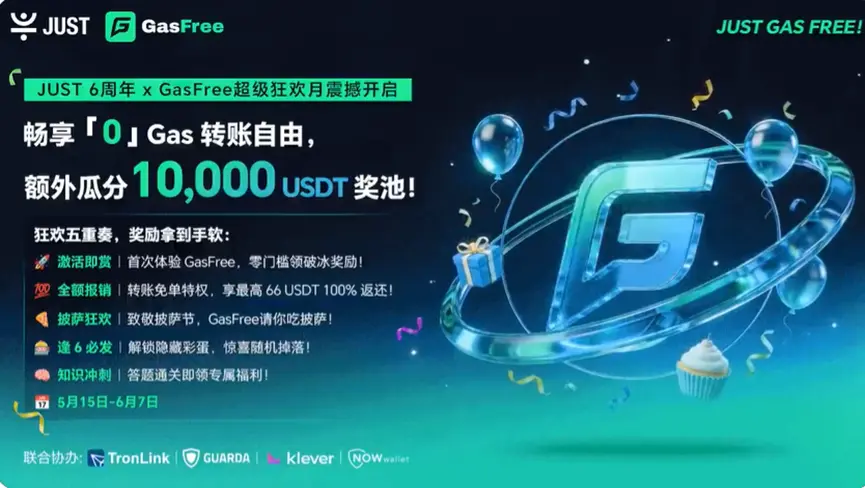
"JUST 6th Anniversary x GasFree Super Carnival Month" Grandly Arrives: Enjoy "0" Gas Transfer Freedom & Share the 10,000 USDT Bonus Pool

The "JUST 6th Anniversary x GasFree Super Carnival Month" event has launched, celebrating the JUST ecosystem's six-year milestone within the TRON network. Running from May 18th to June 7th, the event features a 10,000 USDT prize pool and is designed to promote the GasFree smart wallet. GasFree, a key product of the JustLend DAO protocol, allows users to pay transaction fees directly with the token being transferred (e.g., USDT), eliminating the need to hold the network's native token (TRX) for gas. This innovation aims to simplify on-chain transactions and lower the entry barrier for new users. The carnival offers five main activities: 1. **GasFree Activation Challenge:** New users can earn random rewards (5.2-522 USDT) for activating GasFree and completing their first transfer. 2. **Transfer Rebate:** 200 users daily are randomly selected to receive a 100% rebate on their activation and transaction fees. 3. **Bitcoin Pizza Day Special:** A dedicated event with custom rewards to celebrate crypto culture. 4. **JUST 6th Anniversary Lucky Draw:** Special anniversary reward packages for lucky participants. 5. **Knowledge Quiz:** A trivia contest where users can win prizes by answering questions about JUST and GasFree. To participate, users need a compatible wallet like TronLink (recommended), Klever, Guarda, or NOW Wallet. They must then find the GasFree feature, fund it with USDT, and complete at least one USDT transfer to qualify for the rewards. The article highlights GasFree's significant adoption, reporting over 872 billion USD in cumulative transaction volume and more than 612 million USD in saved user fees since its launch. The event underscores JUST's commitment to enhancing the DeFi user experience by making on-chain interactions more accessible and cost-effective.

链捕手Há 2h

"JUST 6th Anniversary x GasFree Super Carnival Month" Grandly Arrives: Enjoy "0" Gas Transfer Freedom & Share the 10,000 USDT Bonus Pool

链捕手Há 2h

Trading

Spot
Futuros

Artigos em Destaque

Como comprar PEOPLE

Bem-vindo à HTX.com!Tornámos a compra de ConstitutionDAO (PEOPLE) simples e conveniente.Segue o nosso guia passo a passo para iniciar a tua jornada no mundo das criptos.Passo 1: cria a tua conta HTXUtiliza o teu e-mail ou número de telefone para te inscreveres numa conta gratuita na HTX.Desfruta de um processo de inscrição sem complicações e desbloqueia todas as funcionalidades.Obter a minha contaPasso 2: vai para Comprar Cripto e escolhe o teu método de pagamentoCartão de crédito/débito: usa o teu visa ou mastercard para comprar ConstitutionDAO (PEOPLE) instantaneamente.Saldo: usa os fundos da tua conta HTX para transacionar sem problemas.Terceiros: adicionamos métodos de pagamento populares, como Google Pay e Apple Pay, para aumentar a conveniência.P2P: transaciona diretamente com outros utilizadores na HTX.Mercado de balcão (OTC): oferecemos serviços personalizados e taxas de câmbio competitivas para os traders.Passo 3: armazena teu ConstitutionDAO (PEOPLE)Depois de comprar o teu ConstitutionDAO (PEOPLE), armazena-o na tua conta HTX.Alternativamente, podes enviá-lo para outro lugar através de transferência blockchain ou usá-lo para transacionar outras criptomoedas.Passo 4: transaciona ConstitutionDAO (PEOPLE)Transaciona facilmente ConstitutionDAO (PEOPLE) no mercado à vista da HTX.Acede simplesmente à tua conta, seleciona o teu par de trading, executa as tuas transações e monitoriza em tempo real.Oferecemos uma experiência de fácil utilização tanto para principiantes como para traders experientes.

482 Visualizações TotaisPublicado em {updateTime}Atualizado em 2025.03.21

Como comprar PEOPLE

Discussões

Bem-vindo à Comunidade HTX. Aqui, pode manter-se informado sobre os mais recentes desenvolvimentos da plataforma e obter acesso a análises profissionais de mercado. As opiniões dos utilizadores sobre o preço de PEOPLE (PEOPLE) são apresentadas abaixo.

活动图片