Hong Kong Stock Market in July: Super IPOs Coexist with Wave of Breakings, Hard Tech Still the Main Theme

marsbitPublicado em 2026-08-04Última atualização em 2026-08-04

Resumo

The Hong Kong IPO market in July presented a "two-tiered" scenario characterized by both a mega-IPO and a significant wave of new stock listings falling below their issue price ("breaking issue"). The highlight was Zhongji Innolight's (stock code: 03308.HK) listing on July 30, which raised approximately HK$53.41 billion. This marked the largest IPO on the Hong Kong exchange in nearly seven years since Alibaba's secondary listing. A prominent trend was the continued dominance of A+H listings, with companies like Luxshare (02475.HK) and others contributing significantly to the total monthly fundraising of around HK$116 billion. In stark contrast, the market saw a sharp rise in "broken issues." Out of 17 new listings for the month, 7 broke issue on their debut, with the rate climbing to 47% by month-end. Factors contributing to this included an intense concentration of listings (15 in one week), profit-taking by investors, and a market reassessment of valuations, particularly for companies with unclear commercial prospects. Despite the sell-off, hard tech remained the core theme, accounting for over 70% of July's listings. Key sectors were semiconductors and AI/autonomous driving. However, market enthusiasm became highly selective, with extreme over-subscription for certain niche players while others were heavily sold off. This signals a shift from speculative fervor towards a more value-driven assessment. Looking ahead, recent listing reforms by the Hong Kong Exchanges are ...

By | Caihua She

July has just passed, and the Hong Kong IPO market continued the hot momentum from the first half of the year, but the characteristic of 'ice and fire coexisting' became more pronounced: 'Super IPOs' coexisted with 'mini IPOs', and while hard tech remained the main theme of the market, the rate of breakings (falling below issue price) surged significantly for the entire month.

Wind data shows that 17 new stocks were listed on the Hong Kong stock market in July (compared to 24 in June), with 14 new stocks 'gushing' onto the market in just three days from July 8th to 10th. July 9th even witnessed the spectacle of seven new stocks listing on the same day, with a combined net fundraising exceeding HKD 38 billion.

On one side, the largest IPO in nearly seven years made a high-profile debut; on the other side, nearly half of the new stocks broke on their listing day. What market logic lies behind this round of divergent performance? Let's review from three dimensions.

The Debut of Super IPOs, A+H Shares Supporting Half of Fundraising

The number one event in July's IPO market was undoubtedly InnoLight Technology (03308.HK).

On July 30th, the global leader in optical interconnect, InnoLight Technology, officially listed on the Hong Kong Stock Exchange. With a total fundraising of HKD 53.41 billion, it topped the list for Hong Kong IPO fundraising scale in 2026, simultaneously setting a new high for Hong Kong IPO fundraising in nearly seven years since Alibaba's (09988.HK) secondary listing in Hong Kong in 2019. If the 15% over-allotment option is fully exercised, the total fundraising could reach up to approximately HKD 61.4 billion. The issue price was set at HKD 980 per share, a slight 3% discount to the upper limit of the price range of HKD 1010.

This InnoLight Technology IPO attracted numerous renowned cornerstone investors, including Hillhouse, BlackRock, Temasek, Abu Dhabi Investment Authority, Alibaba, Tencent, etc., collectively subscribing to nearly HKD 27 billion.

Prior to InnoLight Technology, Luxshare Precision (02475.HK) had already set the year-to-date record at that time with a HKD 24.266 billion fundraising on July 9th. Additionally, San Huan Group (06951.HK) raised HKD 7.158 billion, Nexchip Semiconductor (02249.HK) raised HKD 6.982 billion, and Momenta-W (06880.HK) raised approximately HKD 5.894 billion. The total fundraising for companies listed in July was about HKD 116 billion, with InnoLight Technology alone contributing nearly half.
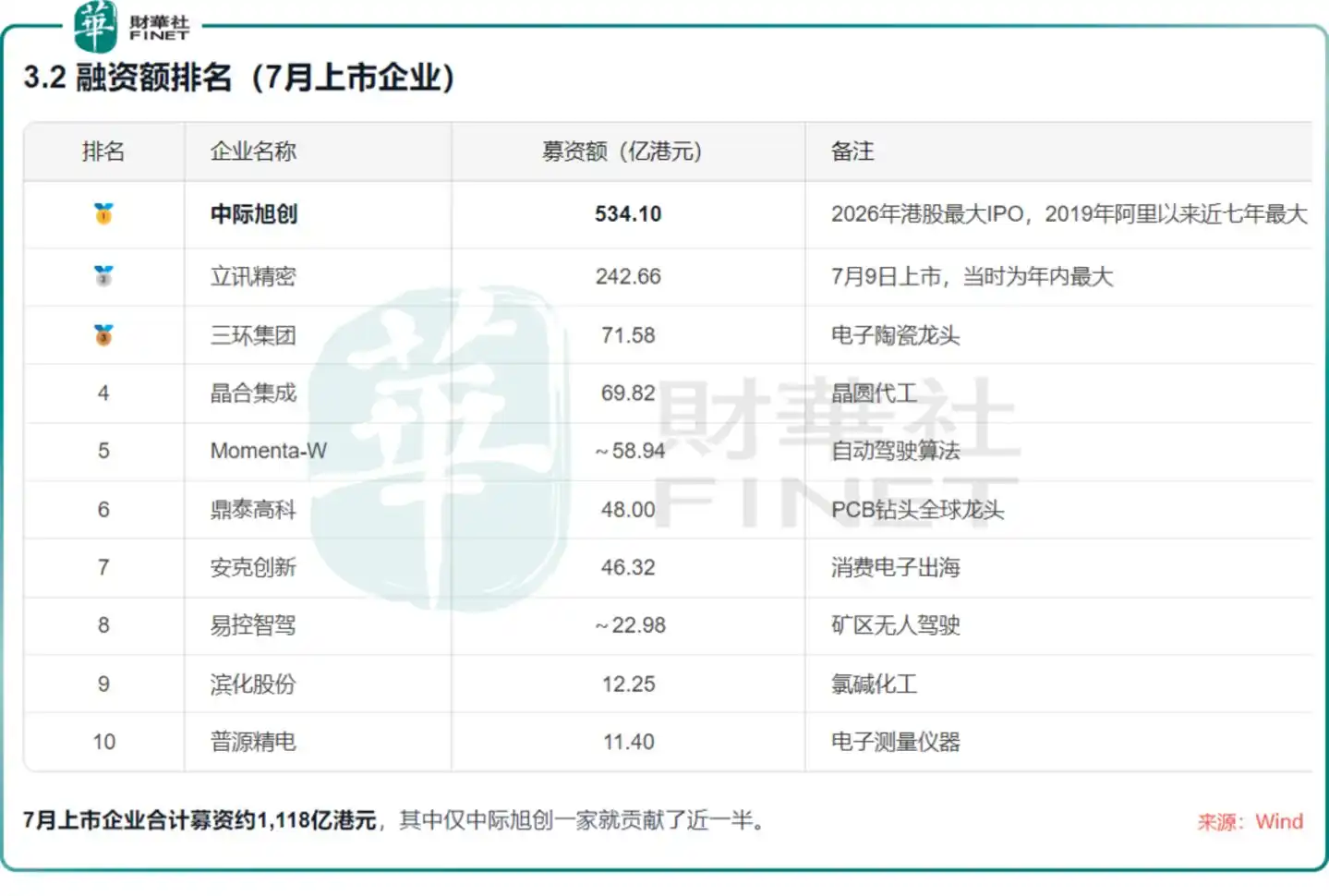
It is worth noting that among the 17 companies listed in July, 8 were A+H listed companies—Anker Innovations (00668.HK), Luxshare Precision, San Huan Group, DIT Technology (01377.HK), Rigol Technologies (00537.HK), Nexchip Semiconductor, Binhu Chemical (06745.HK), and InnoLight Technology, accounting for about 47% in number, and also contributing an extremely high proportion of the total fundraising.

According to Wind data, looking back at the first half of the year, A-share leaders such as Shenghong Technology (02476.HK), Muyuan Foods (02714.HK), and Montage Technology (06809.HK) had already taken the lead in listing on the Hong Kong Stock Exchange. Among the companies that filed applications in July, there were concentrated filings from A-share companies including Sunline, Dinolite, CVTE, Powtech, Giantec, Deye, Hand Enterprise, and Xingyu Automotive Lighting.

Overall, A-share leaders forming groups to go to Hong Kong has shifted from a 'trend' to a 'norm', constituting the most core supply source for Hong Kong IPOs.

Wave of Breakings Arrives, the Era of 'Guaranteed Profits from New Listings' Ends

In sharp contrast to the clamor of super IPOs is the sharply rising rate of breakings.

Among the 17 new stocks in July, 7 companies broke on their first day of trading, with a first-day breaking rate of about 41%, significantly higher than the levels in the first half of the year. If statistics are counted until the end of July, the number of breaking companies expanded to 8, and the breaking rate rose to 47%, with nearly half of the companies suffering from breakings.
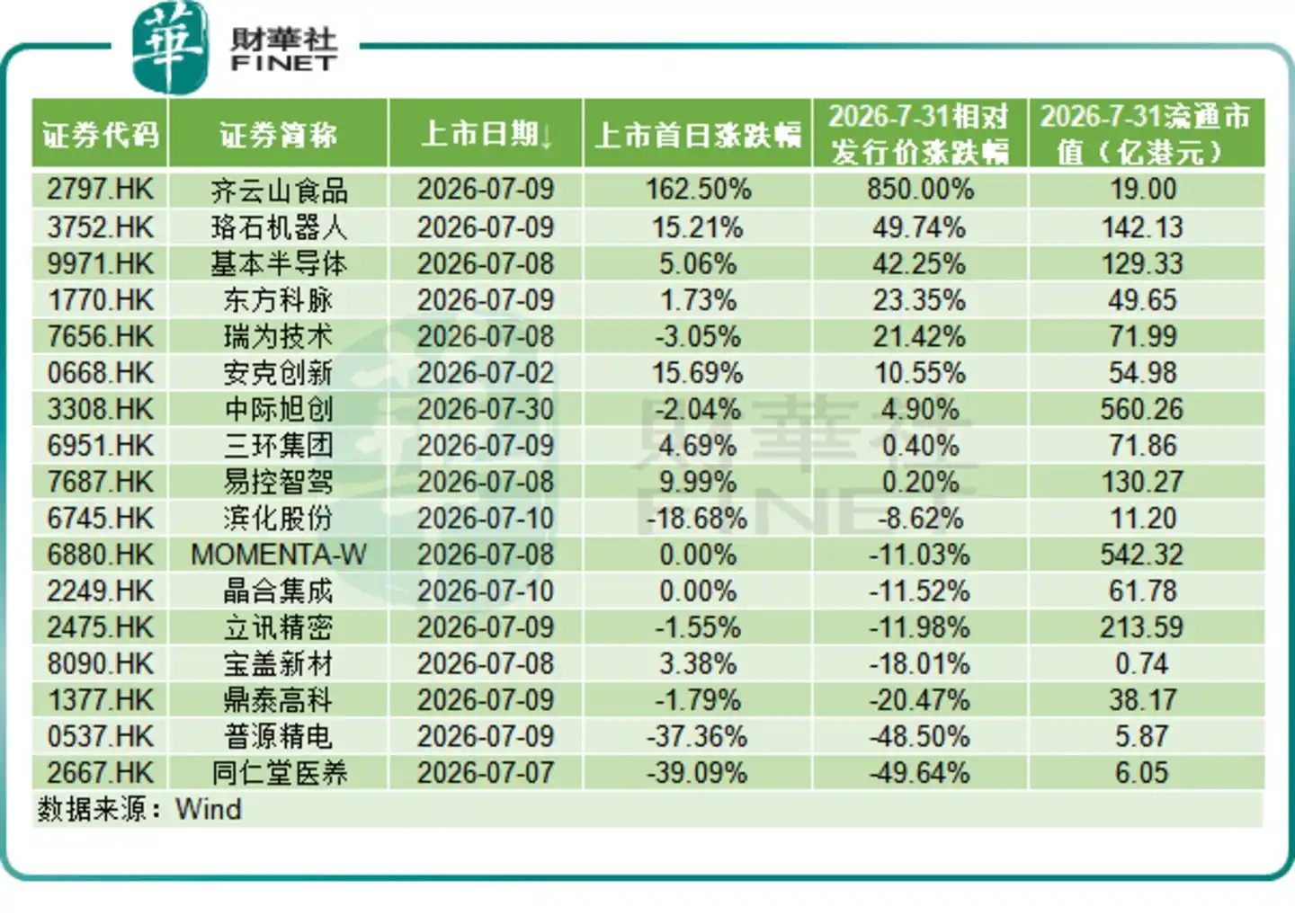
On July 7th, Tong Ren Tang Healthcare (02667.HK) plunged 39.09% on its listing day, marking the largest decline of the month; on July 9th, Rigol Technologies closed down 37.36%; on July 10th, Binhu Chemical fell 18.68%; even the much-anticipated Luxshare Precision broke at the open, with its stock price once falling over 9% during the session, ultimately closing down 1.55%.

Even more surprising was InnoLight Technology—this near seven-year largest IPO broke on its first day, closing at HKD 960 per share, down about 2.04% from the issue price. Regarding this, Lu Suiqi, retired associate professor at Peking University's School of Economics, analyzed that this breaking was not due to a deterioration in the company's fundamentals, but rather a 'negative feedback from good news realization' formed by the resonance of multiple factors, including valuation system restructuring, AH share price gap and safety margin contraction, and concentrated profit-taking by high-position holders.

It is worth noting that intensive supply was the direct driver of the rising breaking rate. In the week from July 6th to 10th, 15 new stocks were listed intensively, severely diverting funds for new subscriptions. Coupled with the market sentiment suppression brought by the peak of cornerstone investor lock-up expiries in July, the market's capacity to absorb new stocks clearly declined. During the new subscription frenzy in the first half of the year, many investors had already accumulated substantial floating profits. Faced with the intensive listing of new stocks, profit-taking became the preferred choice.

The deeper reasons lie in valuation shifts and liquidity games. In the first half of the year, the stock prices of hard tech new listings like Zhipu AI (02513.HK) and Tianshu Zhixin (09903.HK) kept climbing, pushing market expectations for tech stocks to extremely high levels. However, among the companies listed in July, the profitability models and commercialization prospects of some targets were not clearer than those in the first half, yet they carried equal or even higher valuation expectations. When the overall liquidity of the Hong Kong stock market did not show significant incremental improvement, these new stocks naturally faced stricter pricing scrutiny. The good old days in the first half of the year where one could 'close their eyes and subscribe to new listings' to make money were put on pause in July.

Hard Tech Still the Main Theme, But Capital Begins 'Voting with Feet'

Despite the wave of breakings, hard tech was still the absolute protagonist of July IPOs.

Wind data shows that among the 17 listed companies, at least 12 can be classified as hard-core technology enterprises, accounting for over 70%. The semiconductor industry chain occupied half of the stage: Basic Semiconductor (SiC power device IDM), Nexchip Semiconductor (foundry), San Huan Group (electronic ceramics), and DIT Technology (PCB drill bits) collectively made their appearance. Additionally, there were several companies in the AI and autonomous driving tracks, including autonomous driving software supplier Momenta-W, the world's first listed mining area autonomous driving company Yikong Zhijia (07687.HK), and Hong Kong's first visual embodied intelligence company Revo Technology (07656.HK), though Momenta-W and Yikong Zhijia have now broken.

Among them, Basic Semiconductor can be called the 'most popular stock' of July: its public offering was oversubscribed by 4812.72 times, receiving approximately 207,700 valid applications, with a lottery win rate for one board lot of only 0.17%. This is already one of several 'thousand-fold oversubscription' cases appearing consecutively in Hong Kong since 2026. After Yifei Technology (06871.HK) set a historical record with 14,855.4 times oversubscription in the first half of the year, the market's frenzy for new stock subscriptions has not subsided, but capital has become more discerning: only companies in high-growth sectors, possessing scarcity, and with reasonable pricing can receive such extreme追捧.

An even more noteworthy signal is that the market has shifted from 'subscribing with eyes closed' to carefully selecting, even 'voting with feet'. Companies with clear commercialization paths and scarcity are favored by capital (e.g., Loxo Robotics rose 49.74% cumulatively in July, Qiyunshan Food rose 850% cumulatively in July), while targets with unclear profitability models or overstretched valuations are ruthlessly abandoned (e.g., Baogai New Materials, Rigol Technologies both broke significantly). This divergence is not a bad thing;恰恰相反, it precisely indicates that the Hong Kong IPO market is returning from sentiment-driven to value-driven.

From a more macro perspective, on July 24th, the Hong Kong Stock Exchange officially implemented listing mechanism reforms: extending confidential filing to all IPO new applicants, lowering the market capitalization threshold for weighted voting rights to HKD 20 billion, and optimizing the overseas issuer system. These reforms will further lower the barriers and uncertainty for tech companies to list in Hong Kong, paving the way for more hard tech companies in the future.

Regarding the pipeline of new listings, according to Wind statistics, as of August 2nd, there were 352 companies in the Hong Kong IPO queue, with A-share listed companies accounting for nearly 30%. SHEIN had already passed its hearing on July 26th and is expected to list as early as the end of August, potentially becoming the largest cross-border e-commerce IPO in Hong Kong in 2026. Shenwan Hongyuan expects the total number of Hong Kong IPOs in 2026 to reach 175-195, with total fundraising amounting to HKD 450-520 billion.

However, as new stock supply remains high and the pressure from cornerstone lock-up expiries gradually releases, only companies truly possessing hard-core competitiveness and clear commercialization paths can continuously attract the favor of global capital. The wave of breakings in July is not a signal of market cooling, but a healthy valuation correction—for investors, this means the need to more prudently screen targets; for high-quality enterprises, this means true value will ultimately be seen by the market.


Criptomoedas em alta

Perguntas relacionadas

QWhich company executed the largest IPO on the Hong Kong stock market in July, and what were its key fundraising details?

AZhongji Xuchuang (Stock Code: 03308.HK) executed the largest IPO in July, raising HKD 53.41 billion. This is the largest IPO on the Hong Kong stock market since Alibaba's secondary listing in 2019. If the 15% over-allotment option is fully exercised, the total fundraising could reach approximately HKD 61.4 billion. The offering price was set at HKD 980 per share, a 3% discount to the upper limit of the price range.

QWhat was the trend in IPO first-day price performance in July compared to the first half of the year, and what were the primary reasons cited for the increase in 'breaking issue' (price falling below offering price) rates?

AIn July, the first-day 'breaking issue' rate for IPOs was approximately 41%, a significant increase compared to the rate in the first half of the year. By the end of July, this rate rose to 47%. The primary reasons cited for this increase include: a concentrated supply of 15 new listings in a single week leading to severe diversion of subscription funds; a peak period for lock-up expirations of cornerstone investors dampening market sentiment; a shift in market focus from broad-based enthusiasm to selective valuation scrutiny; and insufficient overall market liquidity growth to support the high valuation expectations for some new listings.

QWhat was the dominant theme or sector for companies going public on the Hong Kong stock market in July?

AThe dominant theme for IPOs in July was hard technology (hard-tech). Among the 17 companies that went public, at least 12 could be classified as hard-tech firms, accounting for over 70% of the total. The semiconductor industry chain was particularly prominent, featuring companies like Basic Semiconductor, Nexchip, Sanhuan Group, and Dingtai High-tech. Other hard-tech sectors represented included AI and autonomous driving, with companies like Momenta-W, Yikong Zhijia, and Ruive Technology.

QWhat significant reform did the Hong Kong Stock Exchange implement in late July regarding its listing rules, and what are its expected impacts?

AOn July 24, the Hong Kong Stock Exchange officially implemented a listing mechanism reform. The key changes include extending the confidential filing option to all IPO applicants, lowering the market capitalization threshold for Weighted Voting Rights (WVR) structures to HKD 20 billion, and optimizing the listing regime for overseas issuers. This reform is expected to lower the barriers and reduce uncertainties for technology companies seeking to list in Hong Kong, paving the way for more hard-tech companies to go public in the future.

QAccording to the article, what major IPO is expected to list soon, and what is its projected significance?

AAccording to the article, Shein (SHEIN) passed its hearing on July 26 and is expected to list as early as the end of August. It is projected to become the largest cross-border e-commerce IPO on the Hong Kong stock market in 2026.

Leituras Relacionadas

Wall Street Morning Report: AI + Cloud Computing Takes Over the Market Again, Amazon Knocks on the Door of $3 Trillion

Wall Street's August began with a strong rally, driven by easing Middle East tensions as President Trump signaled progress on U.S.-Iran talks, prompting a sharp drop in oil prices. Major indices hit record or near-record highs, with the Dow Jones Industrial Average up 1.32%, the Nasdaq Composite surging 2.13%, and the S&P 500 rising 1.48%. The energy sector was the sole decliner. The AI and cloud computing narrative dominated the tech rally. The "Magnificent Seven" index jumped 3.6%. Amazon's market cap surpassed $3 trillion for the first time following robust AWS results, while Nvidia regained a $5 trillion valuation. Meta, Google, and Microsoft also posted significant gains. Other AI-related stocks like Palantir, CoreWeave, and various semiconductor and infrastructure companies saw strong advances. In other markets, gold held above $4,000, supported by central bank buying. Treasury yields fell as oil prices dropped. The U.S. dollar remained stable despite strong manufacturing data. Japan's substantial currency intervention raised concerns, but U.S. officials reassured markets about the mechanism used. Key events ahead include major industry conferences (Ai4 2026, FMS Summit) and earnings reports from companies like SpaceX, AMD, and Pfizer. The White House is also set to host a meeting with leading AI firms to discuss regulatory frameworks.

marsbitHá 6m

Wall Street Morning Report: AI + Cloud Computing Takes Over the Market Again, Amazon Knocks on the Door of $3 Trillion

marsbitHá 6m

The July Tech Stock Pullback: Which Funds Are Paying the Price for Buying High?

In July, China's technology stocks experienced a sharp correction, causing significant pain for actively managed mutual funds that aggressively increased their holdings in the sector during the second quarter. The sell-off saw major indices like the ChiNext and STAR 50 fall over 25% and 28% for the month, respectively. Funds that piled into tech at its June peak faced steep losses. Notably, several veteran "value investor" fund managers, known for long-term holdings in consumer staples, made dramatic shifts. Star managers like Zhang Kun (E Fund Blue Chip Selected) and Liu Yanchun (Invesco Great Wall Dingyi) drastically reduced positions in liquor stocks like Kweichow Moutai, switching instead to semiconductor and AI hardware companies like SMIC and Ingenic International. Data shows active equity funds' allocation to the electronics sector reached a historical high of 42.64% by end-Q2. Around 67 funds saw their TMT (Technology, Media, Telecom) weighting surge from an average of 6.75% to 54.99%. The consequences were severe in July: these high-TMT funds fell an average of over 20%, with 12 plunging more than 40%. Examples include Jinhua High-Quality Growth and Guoshou Anbao Wenhui, which fell 26.34% and nearly 40% respectively after raising TMT weights above 70%. The article also highlights issues of "style drift," where funds with names like "high-dividend" held high-P/E tech stocks instead, confusing investors. Newly launched funds suffered even more. For instance, Guotai Haitong New Energy RuiXuan Hybrid, launched in mid-June, saw its net asset value plummet to 0.5509 yuan by July 30, a loss of nearly 45%. Analysts note the extreme sector concentration mirrored past bubbles (e.g., 2021 new energy). The intense, crowded trade itself became a major risk. While tech stocks rebounded sharply on July 31, the funds that chased the high face a longer-term market test.

marsbitHá 22m

The July Tech Stock Pullback: Which Funds Are Paying the Price for Buying High?

marsbitHá 22m

Dalio's Warning: AI Bubble Is Here, Gold Is the Hard Asset

Ray Dalio, founder of Bridgewater Associates, warns that the AI sector is currently in a bubble, drawing parallels to historical examples like the 1929 crash and the dot-com bubble. He explains that revolutionary new technologies lead to excessive excitement and investment, often with investors ignoring price fundamentals and taking on debt, which ultimately creates unsustainable asset valuations. Dalio outlines three key signs that a bubble is about to burst: 1) Rising interest rates, which force asset sales for liquidity. 2) A significant increase in stock supply as companies issue more shares. 3) A shift in ownership from steadfast institutional investors to less knowledgeable, often leveraged, retail investors. To navigate the potential downturn, he strongly advocates for a diversified investment portfolio, criticizing cash as a poor long-term store of value due to inflation. He specifically recommends allocating 5-15% of a portfolio to gold, which he views as a unique "hard asset" and an effective hedge because it is no one else's liability. In contrast, he is skeptical of Bitcoin as "digital gold," citing potential vulnerabilities to future technologies like quantum computing and government intervention. Regarding the AI revolution, Dalio believes the primary beneficiaries will be capitalists who own the automating technology, potentially exacerbating wealth inequality as machines replace both physical and increasingly complex cognitive labor. However, he concludes that humans with exceptional intelligence and strong collaborative skills will continue to thrive by leveraging uniquely human traits like emotion and intuition that AI cannot replicate. Finally, touching on his theory of long-term cycles, Dalio suggests the world is currently approaching a significant inflection point in an approximate 80-year cycle of changing world orders.

marsbitHá 51m

Dalio's Warning: AI Bubble Is Here, Gold Is the Hard Asset

marsbitHá 51m

On the Eve of Circle's Earnings Report, Wall Street Shows Major Divergence in CRCL Valuation

On the eve of Circle (CRCL) releasing its quarterly earnings report, Wall Street analysts are deeply divided over the company's valuation. Morgan Stanley downgraded Circle from "Equal Weight" to "Underweight," slashing its price target from $106 to $38. Analyst James Faucette argues the market overestimates the growth potential of Circle's core USDC stablecoin, noting its circulation hasn't increased since Q3 2025 and new use cases beyond remittances and card spending are limited. He warns that slowing USDC growth could pressure the crucial "reserve income" and shift revenue toward lower-margin transaction fees. In stark contrast, TD Cowen initiated coverage with a "Buy" rating and an $82 price target. Analyst Bryan Bergin believes the market underestimates Circle's potential to evolve from a stablecoin issuer into a broader digital financial infrastructure platform. He forecasts a ~31% annual growth rate for USDC through 2030 and expects faster growth in fee-based revenue from services like payments, RWA tokenization, and its Arc network. A key external factor adding uncertainty is the stalled progress of the CLARITY Act in the US Senate, whose delay could dampen institutional adoption expectations for stablecoins. The core disagreement lies in whether Circle's future hinges on USDC circulation growth or a successful platform-based transformation. The upcoming earnings report is keenly awaited for insights into reserve income trends and the progress of newer business verticals.

marsbitHá 2h

On the Eve of Circle's Earnings Report, Wall Street Shows Major Divergence in CRCL Valuation

marsbitHá 2h

Trading

Spot

Artigos em Destaque

Como comprar T

Bem-vindo à HTX.com!Tornámos a compra de Threshold Network Token (T) simples e conveniente.Segue o nosso guia passo a passo para iniciar a tua jornada no mundo das criptos.Passo 1: cria a tua conta HTXUtiliza o teu e-mail ou número de telefone para te inscreveres numa conta gratuita na HTX.Desfruta de um processo de inscrição sem complicações e desbloqueia todas as funcionalidades.Obter a minha contaPasso 2: vai para Comprar Cripto e escolhe o teu método de pagamentoCartão de crédito/débito: usa o teu visa ou mastercard para comprar Threshold Network Token (T) instantaneamente.Saldo: usa os fundos da tua conta HTX para transacionar sem problemas.Terceiros: adicionamos métodos de pagamento populares, como Google Pay e Apple Pay, para aumentar a conveniência.P2P: transaciona diretamente com outros utilizadores na HTX.Mercado de balcão (OTC): oferecemos serviços personalizados e taxas de câmbio competitivas para os traders.Passo 3: armazena teu Threshold Network Token (T)Depois de comprar o teu Threshold Network Token (T), armazena-o na tua conta HTX.Alternativamente, podes enviá-lo para outro lugar através de transferência blockchain ou usá-lo para transacionar outras criptomoedas.Passo 4: transaciona Threshold Network Token (T)Transaciona facilmente Threshold Network Token (T) no mercado à vista da HTX.Acede simplesmente à tua conta, seleciona o teu par de trading, executa as tuas transações e monitoriza em tempo real.Oferecemos uma experiência de fácil utilização tanto para principiantes como para traders experientes.

551 Visualizações TotaisPublicado em {updateTime}Atualizado em 2026.06.02

Como comprar T

Discussões

Bem-vindo à Comunidade HTX. Aqui, pode manter-se informado sobre os mais recentes desenvolvimentos da plataforma e obter acesso a análises profissionais de mercado. As opiniões dos utilizadores sobre o preço de T (T) são apresentadas abaixo.

活动图片